All Souls, All Saints, All of Us

(Translation into most languages at tab to the right.)

This year, the All-Souls’ Procession in Tucson, where I live, is today. The traditional date for celebrating All Souls’ Day (the Day of the Dead) is November 2nd. It was delayed this year because Halloween was on the same weekend. Tucson has one of the largest processions in the country with several hundred thousand people participating. Preceding this is All Saints Day on November 1st.

All Saints Day had its beginnings in Roman Church tradition dating back to the early centuries when Christians were martyred for their faith or who had publicly confessed and somehow survived the Roman persecution. The belief was that they were saints and immediately taken up into heaven. By the mid 800’s, Pope Gregory IV assigned Nov. 1st as the holy feast of All Saints.

All Souls’ Day evolved sometime around 1000 as a time to pray for the souls of all who had died. This is tied in directly with the Catholic Church belief in purgatory and those who are awaiting the joys of heaven. In pleading for them, we are reminded of our own offenses and so inspired to lead purer lives.

My husband, John, and I have walked many times in the procession here in Tucson although we are not Catholics and we believe that all those who have faith in and follow Jesus are saints, as the New Testament teaches.(1) Many Evangelical Christians think it is wrong to participate in All Souls’ events because it is not biblical to pray for the dead and they reject the concept of purgatory because nothing we do can alter ones destination in the afterlife. (2)

While we hold to basic New Testament beliefs, we do not find it contradictory to be part of the All-Souls’ procession in remembrance of our son, John Leif. The procession is a public ceremony to honor the dead and celebrate their lives, allowing participants to release and integrate their grief. Our son’s death from a heroin overdose – a reason many others are there – continues to be a source of sadness and regret. To remember and celebrate him as a person worthy of love is important for us. We do not want to shame him and do not want him to be forgotten. 

What is sad to us is the way in which this holiday is treated with similar vitriol that partisan politics infiltrates so many areas of American life these days. There are “Christians” who stand along the procession route shouting out ugly and sinful – yes, sinful – rebukes to those walking in remembrance of their loved ones. Sadly, many people feel it necessary to take a side on almost every issue – and supposed Christians are some of the leading voices. The unholy mixture of politics and “faith” in our country is deeply disturbing to us and absolutely un-Biblical. 

While we hold that our beliefs are true and worthy of sharing with others, we also feel it imperative that we respect others’ beliefs and faith traditions without mocking or denigrating them as all New Testament writing demonstrates. This is especially important when it comes to how people choose to remember and honor their loved ones who have died. 

In the past several decades, opioid addiction has taken the lives of hundreds of thousands of beautiful young people. We believe they are worthy of being remembered without shame and with love in whatever way their loved ones choose. And in so doing, we hope their lives stand as a warning for other young people tempted into experimenting with increasingly deadly drugs.

  1. I Corinthians 1:2, Romans 1:7, Philippians 1:1, Ephesians 2:19
  2. Hebrews 9:27
  3. History behind All Saints and All Souls:
Advocacy or Cheerleading?

(Translation into most languages at tab to the right.)

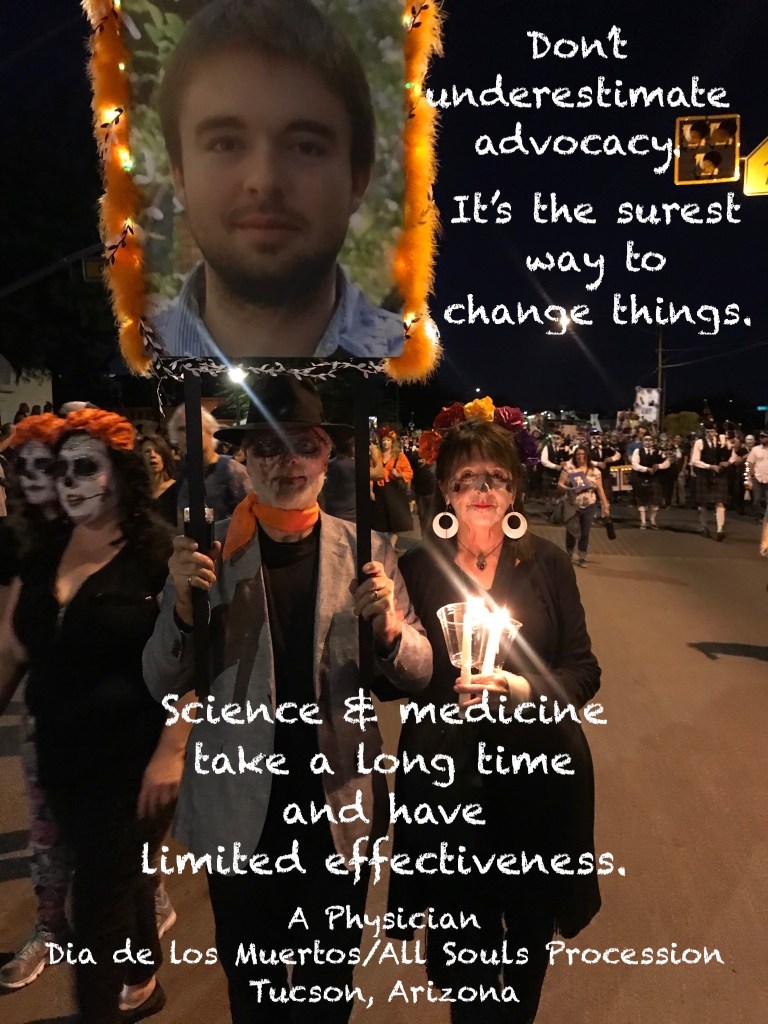
A few months ago, John was on a phone call with a physician who was asking his input about a new drug to help with opioid addiction. John shared about our son’s addiction and death and how we hoped that by speaking openly about his life and writing our book and blog we could help in some small way. His response was something I did not expect and will never forget. He said, “Don’t underestimate advocacy because it is the surest way to change things. Science and medicine take a long time and have limited effectiveness.”

An advocate is someone who works by speaking, acting, or writing truthfully on behalf of a person or group in order to promote, protect, and defend their welfare and to seek justice for their rights. To speak out for those who have no voice. But advocacy is not cheerleading. A cheerleader is someone who only supports their team or player – since they are in competition against another team. They are indiscriminate about what their team does or doesn’t do. They don’t necessarily look at the big picture or causes and effects. Their role is to simply cheer on their team or player and boost support from their fans with slogans that may or may not be true.

Serious problems that affect the wellbeing of individuals, communities, and entire societies, such as the Covid-19 pandemic, addictions, and racial prejudice and inequality, are not helped by cheerleading. People in danger and suffering need advocates who have compassion, who are truth-tellers, and who will vigorously and untiringly work for a solution.

When I see a young person on the streets, homeless and struggling, enslaved to a substance that is stealing their life – or anyone living with addiction of any sort – I long to be helpful in a meaningful way and become discouraged at my inability to do so. And if I feel discouraged, how must they feel? What will help bring real, substantive change and hope to these lives and in these circumstances?

As parents of a son with a deadly addiction, we were sometimes cheerleaders when we needed to be advocates. Cheering him on and telling him he could do it without any medical help was not being realistic or being the advocates he needed. I think it is difficult to be an effective advocate for those we love because we are too close to have a clear perspective. Which is why a supportive recovery community – for both the family and the one struggling – is vital. We must try and use whatever resources we have: our voice for those who are not being heard, our writing to bring clarity to public thinking, our physical presence to stand or march with others, and our time, energy, and finances to step in where we can or offer help to find those resources.

There are as many ways to be an advocate as there are needs in this world. I have friends involved in racial justice, in refugee struggles, in stopping sexual exploitation and abuse, homelessness and poverty – the list is endless. The question is: How can each one of us be an advocate for the people and needs we are aware of and that we have a passion for?

Malcolm Guite

Blog for poet and singer-songwriter Malcolm Guite

The Gift of Need

How Need Can Strengthen Individuals and Communities

Memoirs and Musings

David Bradley Such

Dave Barnhart

Church planter, pastor, author, coach

RecoveryLife101

Just another WordPress.com site

Abbie In Wondrland

life...on Gods' terms.

Living In Graceland

"..learn the unforced rhythms of grace" matt 11:28

Janaburson's Blog

All about opioid addiction and its treatment with medication

Breaking In News Network

Seeking the truth and bypassing the MSM

Junkbox Diaries

Trauma, PTSD, Mental Health, Addiction, and Recovery

Ohio Society of Addiction Medicine

The Ohio Society of Addiction Medicine is a chapter of ASAM - A professional society actively seeking to define and expand the field of addiction medicine.

traceyh415

Addiction, Recovery, Loss, Grief

WordPress.com News

The latest news on WordPress.com and the WordPress community.