(Translation into most languages at tab to the right.)
It’s a new year around the world. Most developed and industrialized nations have similar hopes and concerns. Yet when one travels outside of the USA, we find some striking differences in how other leading countries in the world govern themselves. This is obvious in one particular area – when it comes to what substances are legal, allowed, or illegal.
Kratom is a good example. It is a Thai traditional medicine. The plant is in the coffee family and when used traditionally – i.e., chewed or dried for tea – it can produce mild stimulant or sedative-like effects. (1) But in the last decade, people driven by greed and profit (it is a billion-dollar industry), have once again figured out how to chemically super-charge the derivatives in Kratom in order to create a market with a highly addictive substance in the guise of a “natural” product sold at convenience stores and gas stations in all but six states in the USA. These concentrated derivatives contain 7-hydroxymitragynine (7-OH), a powerful psychoactive compound that occurs naturally in tiny amounts in kratom. 7-OH affects the same receptors in the brain as morphine and heroin – thus, the same effects that people seek in those drugs. And in these new potencies, kratom has the same strong potential for addiction.
A recent FDA report states that “7-OH is a naturally occurring substance in the kratom plant (Mitragyna speciosa), but only a minor constituent that comprises less than 2% of the total alkaloid content in natural kratom leaves. However, 7-OH demonstrates substantially greater mu-opioid receptor potency than kratom’s primary alkaloid constituent mitragynine, as well as other classical opioids such as morphine.” (2) There are too many articles documenting its opioid-like properties and side effects that I cannot cite them here, but the facts are easy to find, including its addictive qualities and associated deaths. I’ve given links to a few articles that are easy to read at the end of the blog.
Australia criminalized possession, supply, manufacture, production, growth or importation in 2005 and classified it as a Schedule 9 prohibited substance in all states and territories. It cannot be legally sold in health food stores or online in Australia. The only exceptions are for approved medical or scientific research, analytical, teaching, or training purposes, which require specific government authorization and licenses. (3)
What is interesting and frustrating is to see how one country can quicklky and efficiently act in agreement about a public health threat and create legislation that protects its citizens while it also leaves room for ongoing scientific investigation. Think about how many decades it has taken for the USA to come up with a similar approach for cannabis. It is currently illegal under federal law as a Schedule 1 controlled substance, but 40 of our 50 states have legalized it for medical use and 24 for recreational use. Schedule 1 classification places it alongside drugs like heroin and LSD. It can be scientifically studied legally, but there are complex federal regulations that require approval from the DEA (Drug Enforcement Agency) and the FDA. We just can’t seem to get our congress to simply function like other countries in a timely manner.
Kratom is a perfect example. In 2016 the DEA intended to put 7-OH into the Schedule 1 category, which would have banned it. But there was pushback from the public and congress who argued that it had potential for chronic pain relief or even opioid withdrawal. So why couldn’t we make it illegal or at least regulate it while also allowing for scientific research? Why?
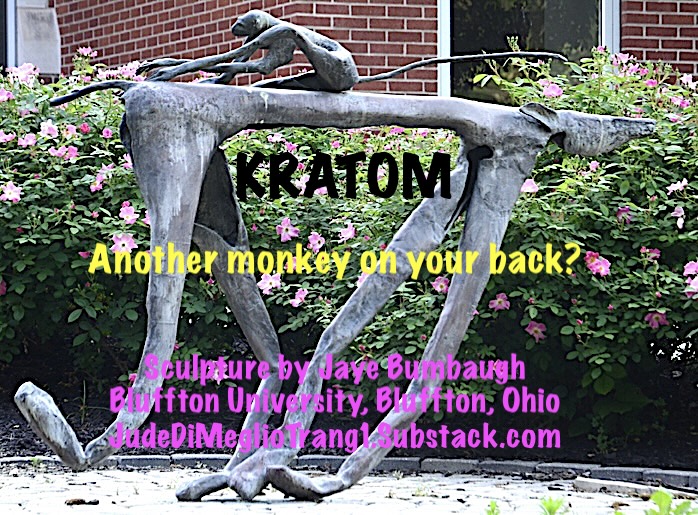
In the meantime, young people and adults who listen to friends or influencers are being lured once again into experimenting with something that will sooner or later prove to be a monkey on their back. If there are young people in your life who are curious about any substance, take the time to do the homework and discuss the facts with them. And if you see “Natural” or “Organic” Kratom being sold at your local gas station or convenience store, let the owners know you will not be shopping there until they remove these addictive products from their shelves.
NOTE: Thank you to Dr. Bayo Curry-Winchell for her very informative article (5)
- 1. Not all kratom is equal: The important distinction between native leaf and extract products (2023)
https://onlinelibrary.wiley.com/doi/10.1111/add.16366 - 2. https://www.fda.gov/media/187899/download#:~:text=In%20vitro%20studies%20reveal%207,fentanyl%2C%20oxycodone%2C%20and%20hydrocodone.
- 3. Australian drug laws
https://www.lexology.com/library/detail.aspx?g=db6f3ba8-a2c5-4fb2-89b8-ab93d1b09b23 - 4. Following “the Roots” of Kratom (Mitragyna speciosa): The Evolution of an Enhancer from a Traditional Use to Increase Work and Productivity in Southeast Asia to a Recreational Psychoactive Drug in Western Countries (2015)
https://onlinelibrary.wiley.com/doi/10.1155/2015/968786 - 5. The Legal Drug That Could Fuel the Next Addiction Epidemic
A dangerous substance masked as “natural” is lurking on convenience store shelves. (2025)
https://katiecouric.com/health/wellness/is-kratom-dangerous-addiction-overdose/