(Translation into most languages at tab to the right.)
It’s a new year around the world. Most developed and industrialized nations have similar hopes and concerns. Yet when one travels outside of the USA, we find some striking differences in how other leading countries in the world govern themselves. This is obvious in one particular area – when it comes to what substances are legal, allowed, or illegal.
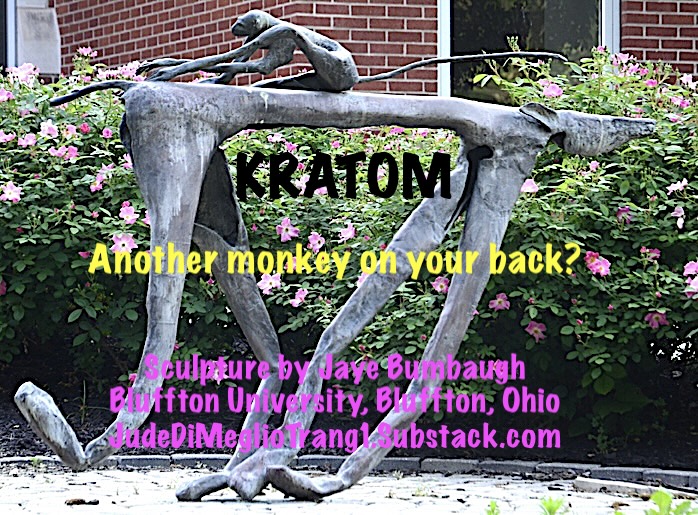
Kratom is a good example. It is a Thai traditional medicine. The plant is in the coffee family and when used traditionally – i.e., chewed or dried for tea – it can produce mild stimulant or sedative-like effects. (1) But in the last decade, people driven by greed and profit (it is a billion-dollar industry), have once again figured out how to chemically super-charge the derivatives in Kratom in order to create a market with a highly addictive substance in the guise of a “natural” product sold at convenience stores and gas stations in all but six states in the USA. These concentrated derivatives contain 7-hydroxymitragynine (7-OH), a powerful psychoactive compound that occurs naturally in tiny amounts in kratom. 7-OH affects the same receptors in the brain as morphine and heroin – thus, the same effects that people seek in those drugs. And in these new potencies, kratom has the same strong potential for addiction.
If access to health care is considered a human right, who is considered human enough to have that right?
I critique market-based medicine not because I haven’t seen its heights but because I’ve seen its depths.
~Paul Farmer, M.D., Ph.D. (1)
In sorting through bins of old notes and letters, I knew one bin in particular would bring up painful memories. It was our son, JL’s. It was difficult, as I had imagined. And one of the – no, THE – most painful reminder related to his death from an overdose. It was the fact that we played a role in his preventable death. And so does the American capitalistic healthcare debacle.
The previous New Year’s eve, he was with two of his friends who overdosed and one died. It shook him to his core and he came to us and asked for help. We went together to his addiction doctor and after separate sessions, we then talked together. His doctor said: “This young man cannot start using again because if he does, he will die.” This came from his years of experience working with young people who had been inadverntently caught up in the opioid epidemic of the 2000’s. He felt JL would need to be on Suboxone for a long period of time and maybe for the rest of his life.
JL was hesitant because he had been on Suboxone years ago when it was very expensive and being prescribed at 32 mg a day – a huge amount that left patients feeling like they were drugged. And the worse part was trying to get off it. Tapering off was extremely difficult and took forever – like extended withdrawals.
Aside from the physical hurdles was the cost. It was very expensive and, guess what? It was, of course, not covered by our private health insurance (which cost us almost $1000/mo as self-employed workers) because addiction was not considered a healthcare issue. As a matter of fact, if a person said they had an illegal drug addiction, they would likely be dropped from health insurance coverage and be reported to the police.
What is so painful for us now is that we made the decision that January to drop JL from our costly policy and to not cover his getting Suboxone due to the expenses (it would have been hundreds of dollars a month for the Rx). And in the mistaken belief that he just needed to try harder. We thought this would force him to stay clean – good old fashioned will power and hard work. He did go into a detox program for a month and then into a great sober living program where he did so well we thought we had turned the corner in his 10-year struggle with opioid addiction (which had started when he was 14 and experimenting with Oxy’s).
What we didn’t understand at that time was that opioid addiction is not overcome by willpower. The result was after 6 months, he finally had impacted wisdom teeth surgery and weeks of opioid pain meds – because we thought there was no other option and we thought he could handle it. Within 3 weeks he began using heroin again and after a few days, overdosed and died. August 2, 2014.
What our family did not have as an option was what was finally put into law in 2014: The Affordable Care Act (ACA). This law mandates that all new individual and small-group plans cover substance use disorder (SUD) treatment as one of the ten essential health benefits. It also prevents insurers from denying coverage or charging more because of a pre-existing condition, including addiction.
Sadly, there are politicians who want to revoke the ACA or limit much of its coverage. As the supposed leading nation in the developed world, we are the only one without universal health care for every person from cradle to grave. All of our peer nations have it. Some systems work better than others. Regardless, health care is not seen as an option or a privilege for those who can afford it. It is considered part of a healthy and egalitarian society.
But in order for our government to save money (since our elected officials don’t want to tax millionaires and billionaires equitably), there have been significant cuts to Medicaid and SNAP and changes to the Affordable Care Act (ACA), that are projected to increase costs and reduce coverage for millions. There are too many details to go into here, but the bottom line to me is this:
Why are we even debating how much coverage these programs and health insurance companies offer when we should be pressing for complete health care coverage for all Americans – especially for the least of us who can barely afford food?
If we consider ourselves a nation built on Judeo-Christian principles, how can we not believe that as a society it is our responsibility to care for the sick – as people of faith have always done?
If how we viewed health care changed – as a basic need instead of a privilege – then the necessary changes to our taxing structure and health insurance would change. Where there is a will, there is a way.
(Translation into most languages at tab to the right.)
Wastewater monitoring is an effective tool in detecting emerging opioid threats, predicting overdoses, and tailoring treatments, according to new research from Biobot Analytics, Mathematica, and the Washington/Baltimore High Intensity Drug Trafficking Area (W/B HIDTA) program. (1)
My husband and I live in Melbourne, Australia part of the year so we can be close to our daughter and family. We love Australians and their friendly and balanced way of approaching life and politics. It is a federal parliamentary democracy similar to England.
One area where they are ahead of the USA is in their approach to illicit drugs. As a nation with comprehensive health care for all from cradle to grave, they have a more communal attitude than our American individualistic posture. They view caring for each other as part of being a healthy and functioning society.
This necessarily affects how they treat people who use illicit drugs. They aggressively pursue educational and preventative measures while also working to keep those who use drugs as safe as possible until they are ready to seek recovery. While they don’t have a fluid border with a drug-producing country like we do with Mexico, they still have a problem with illicit drugs arriving from China and Asia.
One area that they use as a public health strategy is wastewater surveillance such as was used during the Covid-19 pandemic. Samples are collected from wastewater treatment plants, sewer systems, or targeted populations such as college dorms or prisons. When pooled together, they provide a community view of drugs circulating in the population. The samples are analyzed and the data is calculated through very sophisticated methods. The data then give objective, community-wide information on drug use trends. This is of great benefit in tracking changes and identifying new drug use and outbreaks and as an early warning tool. In the US, Biobot Analytics and Mathematica are leading the way with the “Drug-Surge” algorithm. (1) In a study involving five counties across four states, the algorithm correctly flagged between 71% and 100% of drug overdoses.
The US Drug Enforcement Agency (DEA) uses this wastewater testing to detect trends in illicit substances well in advance of reported overdoses. Xylazine was detectable a month before suspected overdoses from it were reported. Geographic and socioeconomic trends can be tracked also. If put to use, a national alert system would give early warning of at least a week in order to alert the public to a new or more potent drug threat.
In the US, the National Wastewater Surveillance System (NWSS) that is run by the CDC began in response to the Covid-19 pandemic. The CDC coordinates a national system primarily for infectious disease monitoring. While drug consumption can also be targeted, a national program does not yet exist. (3,4) Meanwhile, the National Institute on Drug Abuse (NIDA) is working with Biobot and Mathematica and has regional programs focusing on illicit drug use as a response to the opioid crisis.
With the CDC in the midst of worrisome changes, let’s be vocal proponents for increased national coordinated surveillance of illicit drugs in our wastewater and the use of that information to help prevent overdoses and deaths.
Wastewater Data Offers Powerful Tool in Confronting Opioid Epidemic
(Translation into most languages at tab to the right.)
Eleven years ago today my husband John and I woke up thinking it would be just another normal, hot August Saturday morning. But when the sheriff knocked on the door, the day – and our lives – were no longer normal. It is surprising how quickly our lives can go from normal to abnormal.
I was sorting through some files and found a drawing that our son, John Leif (JL) had done when he was around nine. It was obviously of Van Gogh’s “Starry Night” but it was also obviously done by a normal nine-year-old – not an artistic prodigy. And it made me think about how JL was just like any other normal kid growing up in middle-class America in the 1990’s-2000’s. He learned to ride a 2-wheel bike at around five, he played with Lego’s, he took swimming lessons, he loved monster trucks and lasagna and macaroni & cheese with ketchup. But something so abnormal for normal young teenagers ended up ruining some of what should have been the best years of his life and ultimately taking his life – and the lives of many of his friends and hundreds of thousand other normal kids.
What was abnormal was the criminal promotion and availability of highly addictive medicine to young kids by Purdue Pharmaceuticals and the Sackler family. Never before had American kids been exposed to legal drugs (that were promoted as “non-addictive”) that they experimented with as if they were simply trying a joint. And the results were the devastation of the Opioid Epidemic. Which is not over, especially for the once normal kids who are still alive and living with the cancer of addictions. We see many of them on the street corners and under bridges, living from hand to mouth, barely surviving, living anything but a normal life.
Sadly, seeing these shells of once normal kids has become a “new normal” as our society doesn’t seem to agree on how to best provide lasting recovery options with a continuum of care – or whether we even should. In my last Substack podcast and article with special guest Sam Quinones we discuss some ideas from his book “The Least of Us” for how to help get these once normal kids from normal families the help they need to try to return to something like a normal life. (1) Let’s not forget that those addicted people were once normal kids.
(Translation into most language at tab to the right)
Sam Quinones is a quintessential storyteller in an investigative journalists’ body. And he uses his skill to weave in stories from families and communities along with the “true tales” from recent history of greed, corruption, deceit, and the politics surrounding the drug epidemic we are living with today. It is his reason for hope that I want to focus on now. Heaven knows we need some hope for The Least of Us… In the Time of Fentanyl and Meth. (1)
Part of the hope he feels comes from positive changes beginning in how drugs and addiction are viewed now compared to previous decades. ‘…greatly expanded drug treatment is part of what America needs…recovering addicts face scary odds as long as the drugs that torment them are widely available, potent, and almost free. The now-cliché is “We can’t arrest our way out of this.” We can’t treat our way out of it, either, as long as supply is so potent and cheap.’ (2) He discusses the mistake of drug criminalization, the possibilities and problems associated with drug legalization and drug decriminalization – all very well thought through and discussed. He traveled across America and interviewed professionals in every field to gain insights into this nightmare that is swallowing lives from every socio-economic group. (For those unclear about what opiates or meth do to our brains, there are detailed explanations woven in throughout the book.)
But his biggest reason for hope came from when Quinones traveled and also extensively interviewed another segment of American society: the addicted, their families, and those working in the many fields who are trying to restore the lives of those taken captive by these powerful substances. I have to say, many of the stories were hard to read, but it is from these people in the trenches and their stories that Quinones began to have hope.
Drug courts are one reason to hope. Because synthetic dope today does not allow users to hit rock bottom before seeking treatment – because ‘Today, rock bottom is death. We can use arrests – but not as a reason to send someone to prison. Instead, criminal charges are leverage we can use to pry users from the dope that will consume them otherwise.’ (3) It helps to put some space between their brain and dope so they can embrace sobriety where life repair can begin. Drug courts are not a luxury – they are a necessity.
Yet Quinones found that ‘…our best defense, perhaps our only defense, lies in bolstering community. America is strongest when we understand that we cannot succeed alone, and weakest when it’s every man for himself…That’s why the lesson we must learn is that we’re only as strong as the most vulnerable, as people who are in pain.’ (4)
As he traveled and listened, Quinones saw that it was people who loved those who are ‘the least of us’ who were making the sacrifices on a daily basis to help in ways they could. But they need help and support – from others and from the policies that are in place in our country.
Recently, I was sharing with a woman the contrast we experienced while we lived in Australia with our daughter and family for two years from the beginning of the Covid pandemic. I said that we were struck by the self-centered mentality – in private life and politics – we encountered when we returned to America and how different it is from the sense of being part of a community and responsibility to others that pervades Australian society. She responded: ‘I’d rather be selfish and self-centered than have my rights and freedoms taken away.’ I was literally speechless. What have we become?
Bolstering community will take a change from our self-centered culture where we who have plenty think we don’t have enough. Where we at the top of the food chain, instead of helping to maintain our communities, have corroded them in isolating and insulating ourselves by abandoning the places where we used to come together like neighborhood parks and community gatherings. ‘We need to again make policy of the belief that we can’t go it alone. The spirit of community needs to be built out, collectively, not just a shift of heart, which is necessary, but in taxation, in health care, in improved infrastructure – in other words, a shift in where the resources go…much of what neuroscience has learned about our brain confirms religion’s truths:humans need love, purpose, compassion, patience, forgiveness, and engagement with others. We’re built for simple things – for empathy and community. That is our defense.’ (5)
He ends his book, his plea to all of us, with this:
‘Community reconstruction doesn’t have to always be complex. It comes down to the unnoticed “constant habit of kindness” that French observer Alexis de Tocqueville, in the mid-1800’s, saw strengthened us locally and kept Americans from destructive isolation and the worst of individualism…The lessons are that we are strongest in community, as weak as our most vulnerable, and the least of us lie within us all.’ (6)
Thank you, Sam.
The Least of Us: True Tales of America and Hope in the Time of Fentanyl and Meth by Sam Quinones
(Translation into most languages at tab to right.)
In the Greek and Roman worlds, a stigma was a tattoo or brand, especially for a slave, identifying the person as “inferior.” As stigma moved into English, it referred to a mark you couldn’t actually see but which was nonetheless powerful. Social stigmas are based on perceivable characteristics, associated with certain behaviors that distinguish a person from other members of society. They convey disapproval and disgrace. Dis-approval. Non-approval. Dis-grace. Non-grace.
In an article on The Stigma of Addiction from Hazelden Recovery we learn: “The stigma of addiction stems from behavioral symptoms of substance use disorder…which can result in negative consequences including legal, occupational and relationship problems. Understandably, these consequences cause embarrassment and shame among those affected. They also create stigmatized attitudes and perceptions among the wider public, a response that perpetuates and exacerbates the private shame associated with drug addiction. For generations, this combination of personal shame and public stigma has produced tremendous obstacles to addressing the problem of alcoholism and addiction. Today, the stigma of addiction is seen as a primary barrier to effective addiction prevention, treatment and recovery efforts at the individual, family, societal levels. Addiction stigma prevents too many people from getting the help they need.” Yes, only one in 10 people struggling with addiction receive treatment. The article goes on to discuss the irony that many of these stigmatizing behaviors diminish and/or disappear when a person is appropriately treated in recovery.
When talking recently with some of our son’s friends, they have been unwilling to let their past drug use become public knowledge because of the potential negative repercussions they justifiably fear in their careers and relationships. How much worse would it be if they were still living with addiction? What does this say about us as individuals, communities, employers, and society in general? When an individual is seen as having a moral failure instead of a chronic health condition, stigma is the logical result. But no one makes the decision about how their brain will react to a substance and whether they will become addicted after minimal use or hate how it makes them feel and never use it again.
Negative labels stick like glue to our hearts and soul and, for those struggling with addiction and alcoholism, the personal shame becomes how they define themselves. The public stigma that follows is the tattoo they never asked to have. If we can reject stigmatizing and instead provide a safe and listening ear to those struggling with addiction, inviting them to share their stories and encourage them to consider recovery options, they may be willing to join the many people who do learn to manage their disease and successfully recover. Let’s remember that they are just as valuable and able and worthy of love – and as human – as you and me.
Translation into most languages at tab to the right.
One of the things I have come to appreciate about the Australian way is their straightforward approach to life. They are easy-going yet they say what they mean and you know where you stand. A lack of pretense – with a large dose of slightly off-color humor added in.
I think that is why they are more advanced in their drug policies and treatments than America – they are more honest and have less taboos. They benefit from having had comprehensive public health for decades which has facilitated progressive drug policies such as clean needle exchanges, safe-injecting sites, and medication assisted treatment.
John and I had an interesting conversation a few weeks ago here in Australia with Jack Nagel. Jack does the “Real Drug Talk” podcast from Melbourne and also runs the Connection Based Living Recovery Programs. We were preparing to record a podcast with Jack – see links below – and were asking about his experiences and what the current trends are here with drugs of abuse.
In discussing opioids, I wondered why methamphetamines seems to be the main drug of choice and why heroin is not as common here as it is in the States. Jack said that in the 1990’s there was a big problem with heroin coming in from the Golden Triangle of SE Asia and lots of overdose deaths. And the heroin use was IV, not smoking. So, there is a collective memory of street people using heroin and dying which created a lot of stigma and fear associated with IV use.
After that trend slowed, people began using meth – young people like Jack –because smoking or snorting meth seems more innocuous and a less intrusive way to take a powerful drug than IV. Jack said that there is a huge cohort of people who don’t live on the streets and who smoke meth for years. Sadly, they don’t seek help because the public messaging that portrays meth addicts as homeless people with sores and missing teeth doesn’t apply to them. But meth addiction will eventually burst that bubble and ruin their lives too.
There is also a growing problem with cocaine. While once considered the drug of the wealthy city dweller with some high-flying users in Australia spending $10-$20K per week, statistics reveal cocaine usage has now spread much further. Consumption has grown in other areas and demographics where prosperity has increased such as middle-class teachers, tradesmen, etc. Australia is now the highest per capita user of the drug in the world. And the rise in use is being driven by men aged in their 20’s, with Sydney leading the country in use. The most recent stats reveal that there are nearly 1 million weekly cocaine users in Australia out of a population of 26 million. (1,2,3)
We also talked with Jack about what the entry drugs are for kids here in Australia. After alcohol and pot, they usually begin with hard “party” drugs used at house parties and concerts like ecstasy/MDMA, benzodiazepines, GHB/GBL. All mood-altering drugs that create different types of euphoria, but which are dangerous because many times they are mixed with alcohol and other drugs, sometimes without the user’s knowledge.
Even though heroin is in the background in Australia, it is still available and becoming more dangerous due to fentanyl being mixed in to the supply of much of the heroin, and all opioids, along with other drugs of abuse. (4)
When our son, JL, began using Oxy’s he never thought he would even try heroin. Then, as Oxy’s became more expensive and heroin was cheaper, he started smoking heroin. He then swore he would never stick a needle in his vein – the danger and stigma to him was clear. Eventually, just like 95% of heroin users, he did just that. He was living under the delusion that smoking opioids – or any drug – would never lead him to become a “junkie”, an IV drug user.
My concern for the young people and families of Australia is that, as The Age reported in 2020, pain management with opioids has increased here too, although not to the degree it had in the States. Opioid-related deaths have increased in the past decade and today at least three people die from opioid harm each day and 150 are hospitalized. (5) Fentanyl is showing up in wastewater testing and drug overdoses of cocaine and meth, drugs where the users are not expecting a potent narcotic. Because it is synthetic and cheaper to produce in China and India, it brings its criminal networks a greater profit margin.
As I’ve said before and will continue to say: We will not treat our way out of the opioid/drug epidemic. Prevention is key. Let’s continue to stay aware and educated about what we all can do to keep our children and their future safe and healthy.
(Twenty-ninth in a series of topical blogs based on chapter by chapter excerpts from Opiate Nation. Translation into most languages is available to the right.)
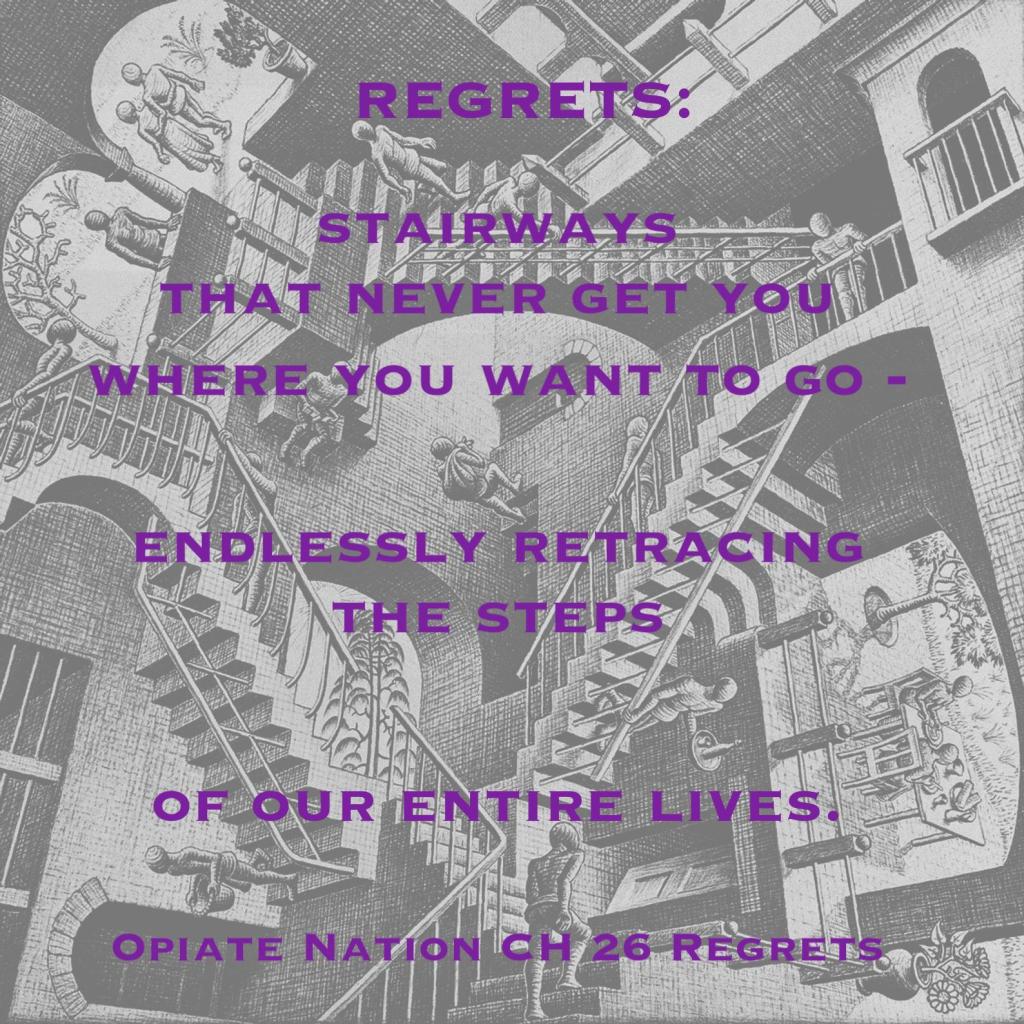
Our family loves the art of Dutch mathematician and artist M. C. Escher: the buildings that open into themselves, the school of fish that become a flock of birds, the circuitous stairways that go up and down throughout multiple buildings without an end point. Yes, stairways that never get you where you want to go, but keep you endlessly retracing your steps. They are no longer interesting art to wonder at. They now mirror how John and I have felt many times since August 2nd—regrets—retracing the steps of our entire lives.
(Sixteenth in a series of topical blogs based on chapter by chapter excerpts from Opiate Nation. Translation into most languages is available to the right.)
(I am re-posting this blog due to a glitch on some platforms in January)
In 2020, overdose deaths have increased worldwide, and by as much as 25% in the US. Deaths from acute intoxication have also increased dramatically. People are isolated and anxious, their treatment and recovery programs have been disrupted, and the illicit drug supply has become dangerous. Health officials believe that the majority of these deaths have occurred because hospitals are full and emergency services are overwhelmed with Covid-19 patients, thus removing the urgent, lifesaving care of overdose reversal that has been established in the past few years. Funding for all mental health services has also been diverted to pandemic care, which has complicated access to basic resources. Suicides are rising at an alarming rate.
A conversation that I believe is relevant to the current times came to mind this week. A lawyer asked Jesus “Who is my neighbor?” as he was trying to wriggle out of the command to “Love your neighbor as yourself.” Jesus told him about a man beaten and robbed while on a journey. As the man lay almost dead on the road, he was passed by several religious leaders who refused to help him. Then a man, who was not the same nationality or religion, came and bandaged and rescued him and paid for his care until he was well. Jesus asked the lawyer, “Which of these men proved to be a neighbor?” The lawyer replied, “The one who showed compassion.” Jesus responded, “Go and do the same.” *
The Ohio Society of Addiction Medicine is a chapter of ASAM - A professional society actively seeking to define and expand the field of addiction medicine.





 Opiate Nation