TEMPTATION: Fight it or Heed the warning signs?

(Translation into most languages at tab to the right)

I have been thinking about temptation recently and how differently we each respond when we face something that is hard for us to resist. How do we resist something that is alluring and that we have repeatedly succumbed to in the past? Something that we are addicted to like lying or shoplifting, alcohol or drugs, gossip or gambling, social media or overeating? The list of behaviors that can derail our lives in one way or the other is endless. It’s not just how an addiction can cause us harm, but also how it can debilitate or destroy our relationships, that makes learning how to beat temptation important.

So, when we are tempted to indulge in our pet addiction, what do we do? 

I read an article on Medium about temptation and willpower that supports the thoughts I’ve held throughout my life. Riikka Iivanainen (1) confesses that she has high self-control and discusses her research into why some people succeed at resisting temptation while others don’t. 

She says, High self-control does predict many positive life outcomes: People who’re good at self-control do better in school, have fewer mental health problems, have better relationships with friends and family, and generally exhibit fewer impulsive behaviors like binge eating and alcohol abuseThey’re even happier.

From the many scientific studies she researched, she goes on to say, Having good self-control doesn’t mean a constant battle against temptations. The kind of self-control that gets you all those good outcomes is more effortless than what’s commonly suggested by the term’s “willpower” and “self-discipline.”

Psychologists tell us that constantly resisting temptation is exhausting and will soon leave us with ego-depletion. Relying on self-control in the face of temptation is destined to fail. So what kind of self-control is “more effortless”? Riikka says, The people who reported fewer problematic desires and less conflict related to those desires were good at avoiding temptation, not resisting it.

Isn’t this insight what the basis of what most recovery programs are built upon? The acronym HALT is a tool to remind us to take a moment and avoid temptation by being aware of the primary things that can lead us to it: Hungry, Angry, Lonely, Tired. We are susceptible to self-destructive behaviors, temptations, and relapse when these basic human needs are unmet. HALT is a reminder, an early warning system. Being self-aware helps us recognize our needs and address them in a positive way before turning to harmful habits or destructive people.

Hungry – being hungry can be physical or emotional hunger

Angry – being angry at someone else or at yourself

Lonely – being lonely can be while in a crowd or from self-isolation

Tired – being tired affects our body, mind, and spirit

Some ways to deal with these needs is the subject of my Opiate Nation blog post April 14, 2018, H.A.L.T. https://opiatenation.com/2018/04/14/h-a-l-t/

We need to know ourselves and be honest about what our problematic desires are and avoid them rather than flirt with them. Desires are matters of the heart and we need to do all we can to support the healthy, life-affirming desires we have. I’ll end with pertinent insights from some of my favorite sources: 

There are several good protections against temptation, but the surest is cowardice.(2)

Strength comes prior to temptation, not during it. Overcoming is a prior act. It involves making a decision to remain pure before the temptation comes. (3)

Rather than waiting for temptation to raise its inevitable head and struggling to resist it, researchers at the University of Wyoming say it’s more effective to plan in advance to manage those temptations with well-thought-out self-control strategies. (4)

It is easier to prevent bad habits than to break them. (5)

Paul repeatedly told the early Christians in their very pagan cultures to “flee” temptation. (6)

Learning takes us through many states of life, but it fails utterly in the hour of danger and temptation. Then faith alone saves. (7)

But for persons needlessly to expose themselves to temptation, and to do those things that tend to sin, is unwarrantable, and contrary to that excellent example set before us. (8)

Jesus showed us by example when we are confronted with unavoidable temptation to speak the truth in order to help us resist until we are able to escape. (9)

Temptations, of course, cannot be avoided, but because we cannot prevent the birds from flying over our heads, there is no need that we should let them nest in our hair. (10)

  1. https://riikkaiivanainen.medium.com/the-secret-life-of-people-with-high-self-control-its-easier-than-you-think-7dd26fb5282c
  2. Mark Twain
  3. The Mind of Christ by T.W. Hunt & Claude V. King, 1990
  4. https://www.psychologytoday.com/au/blog/cravings/201911/4-ways-avoid-temptation-and-reach-your-goals
  5. Benjamin Franklin
  6. I Corinthians 10:14; I Timothy 6:11; II Timothy 2:22
  7. Mahatma Gandhi, Mohandas Gandhi, Homer A. Jack (2005). “The Wit and Wisdom of Gandhi”, p.40, Courier Corporation
  8. Jonathan Edwards, https://www.biblebb.com/files/edwards/temptation.htm
  9. Matthew 4:1-11
  10. Martin Luther

Disordered Loves, Disordered Lives

(Translation into most languages at tab to the right)

A common feature of an addicted persons’ life is its lack of order. Chaos seems to swirl around them like clouds circling the earth. There is very little, if any, organization to their life and the only structure is what must be done in order to score the next hit for their chosen addiction and survive. Their lives are in disarray, they are dis-ordered. I remember this from when our son was using Oxy’s and heroin. Thinking about this brought up a related thought.

“Disordered Loves” is a phrase taken from the writings of St. Augustine who lived and wrote in the 4thcentury A.D. I have only read a fraction of his impressive work, and I am amazed at how modern many of his insights on the human psyche and condition were. In City of God he said, “…though [something] is good, it can be loved in the right way or in the wrong way – in the right way, that is, when the proper order is kept, in the wrong way when that order is upset.” (1) He writes elsewhere, real love knows how “to love things…in the right order, so that you do not love what is not to be loved, or fail to love what is to be loved, or have a greater love for what should be loved less.” (2)

For example, we can look to the workaholic. They love their work and want to do a good job and be successful. But they love work more than loving the people in their life: family, friends, co-workers, and employees. To succeed, they may become dishonest even if they are normally an honest person. The need to feel successful and to be recognized supersedes all other things in their life – they fail to love what is most important. This is true of any addiction. When we love “what is not to be loved or have a greater love for what should be loved less” – anything from travel, purchases, drugs, alcohol, events, prestige, etc. – the important relationships and responsibilities will suffer.

Augustine agreed with Cicero that humans are mostly discontent and lack joy. Because of that, we search for happiness and fulfillment. So, we attach ourselves to objects that we hope will make us happy. We prioritize those objects by how valuable they are to us. We put them in order. His point is that what we spend our time on, what we value and prioritize, is what we love. And what we love directs our lives. And Augustine believed that when we place our ultimate love in temporal and finite objects, or even another person, we will still not be fulfilled because God is the ultimate source for joy, contentment, and fulfillment.

Even for people who do not embrace the spiritual truths Augustine taught, the principle remains: look at your life to see what you prioritize and spend your limited time doing and this will tell you what you love. If your life revolves around filling your life with things such as accomplishments, money, drugs, alcohol, food, pleasure, excitement, etc. – i.e., your loves – your life is disordered. 

Re-ordering our loves, and therefore our lives, is not easy. As with any major change, the first step is recognizing that something is wrong. After that, seeking help from counselors or trusted and knowledgeable friends or programs can help us with the next steps. Sacrifice will be required and we do not embrace the loss of anything we love without pain and struggle. However, we can choose to not live with turmoil and discord. We can choose to bring peace and order to our loves and to our lives. 

(Special thanks to the late Dr. Timothy Keller’s work on Augustine in Making Sense of God: An Invitation to the Skeptical. Keller’s writing and teaching has informed my life in innumerable ways.)

  1. City of God, XV.22
  2. On Christian Doctrine, I.27-28 

Celebrating Freedom and New Life

April 4, 2021

 (I am taking a break from the chapter by chapter topics from Opiate Nation to focus on the significance of this holy week. Translations into most languages available at tab to the right.)

Spring is the season of regeneration, freedom, new life. The time of year when the whole earth seems excited to be alive after being dormant all winter. For the northern hemisphere, March and April are Spring – for our friends and family in Australia, right now it is Autumn. Regardless of what season it is where you live on this planet, it is Easter Sunday and the end of Passover week. Both the Christian and Jewish traditions celebrate the freedom from bondage and the beginning of a new life, although from differing perspectives and beliefs. Both begin the time with reflection and prayer. (I don’t understand Islamic tradition well enough to comment on it except to say that Ramadan is observed around this same time of year with introspection and fasting in remembrance of Muhammad receiving the Quran.)

For Christians, the freedom is from the bondage to sin in one’s life; for Jews, it is the freedom from bondage that the Israelites suffered under in Egypt. Both faiths look to an historical event in the past. They also remind us that while bondage was dealt with symbolically once – whether personally or communally – it is an ongoing problem in this imperfect world.

Continue reading “Celebrating Freedom and New Life”

The Freedom of Habits

(Twenty-fifth in a series of topical blogs based on chapter by chapter excerpts from Opiate Nation. Translation into most languages is available to the right.)

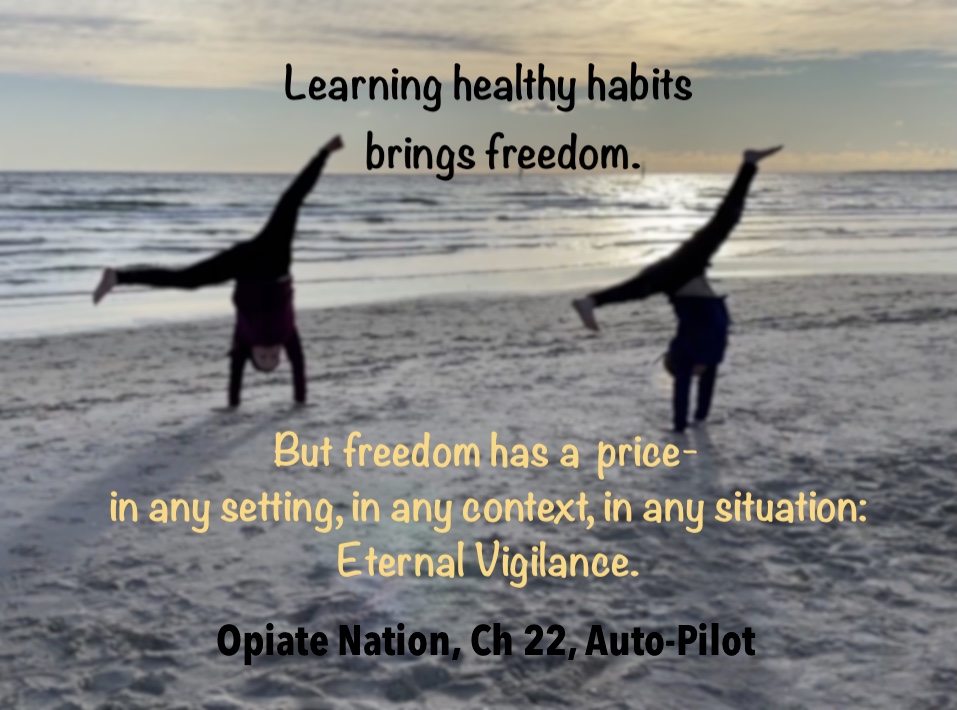
I’ve heard a saying: “The chains of habit are too weak to be felt until they are too strong to be broken.” And just like chains, some habits are stronger and deadlier than others. Conversely, healthy habits can be just as strong and powerful – but instead of bondage, they bring freedom to live our lives to the fullest.  

In The Power of Habit, Charles Duhigg says, “Habits are a three-step loop: The cue, the routine, the reward. They become automatic beginning with a cue that triggers a routine and a craving for a clear reward. Craving is an essential part of the formula for creating new habits…You can never truly extinguish bad habits. So in order to change a habit, you must keep the old cue and deliver the old reward (that you are craving), BUT insert a new routine.”

Continue reading “The Freedom of Habits”
Malcolm Guite

Blog for poet and singer-songwriter Malcolm Guite

The Gift of Need

How Need Can Strengthen Individuals and Communities

Memoirs and Musings

David Bradley Such

Dave Barnhart

Church planter, pastor, author, coach

RecoveryLife101

Just another WordPress.com site

Abbie In Wondrland

life...on Gods' terms.

Living In Graceland

"..learn the unforced rhythms of grace" matt 11:28

Janaburson's Blog

All about opioid addiction and its treatment with medication

Breaking In News Network

Seeking the truth and bypassing the MSM

Junkbox Diaries

Trauma, PTSD, Mental Health, Addiction, and Recovery

Ohio Society of Addiction Medicine

The Ohio Society of Addiction Medicine is a chapter of ASAM - A professional society actively seeking to define and expand the field of addiction medicine.

traceyh415

Addiction, Recovery, Loss, Grief

WordPress.com News

The latest news on WordPress.com and the WordPress community.