HEALTHCARE – Privilege or Basic Need?

(Translation into most languages at tab to right)

If access to health care is considered a human right, who is considered human enough to have that right?

I critique market-based medicine not because I haven’t seen its heights but because I’ve seen its depths.

~Paul Farmer, M.D., Ph.D. (1)

In sorting through bins of old notes and letters, I knew one bin in particular would bring up painful memories. It was our son, JL’s. It was difficult, as I had imagined. And one of the – no, THE – most painful reminder related to his death from an overdose. It was the fact that we played a role in his preventable death. And so does the American capitalistic healthcare debacle.

The previous New Year’s eve, he was with two of his friends who overdosed and one died. It shook him to his core and he came to us and asked for help. We went together to his addiction doctor and after separate sessions, we then talked together. His doctor said: “This young man cannot start using again because if he does, he will die.” This came from his years of experience working with young people who had been inadverntently caught up in the opioid epidemic of the 2000’s. He felt JL would need to be on Suboxone for a long period of time and maybe for the rest of his life.

JL was hesitant because he had been on Suboxone years ago when it was very expensive and being prescribed at 32 mg a day – a huge amount that left patients feeling like they were drugged. And the worse part was trying to get off it. Tapering off was extremely difficult and took forever – like extended withdrawals.

Aside from the physical hurdles was the cost. It was very expensive and, guess what? It was, of course, not covered by our private health insurance (which cost us almost $1000/mo as self-employed workers) because addiction was not considered a healthcare issue. As a matter of fact, if a person said they had an illegal drug addiction, they would likely be dropped from health insurance coverage and be reported to the police.

What is so painful for us now is that we made the decision that January to drop JL from our costly policy and to not cover his getting Suboxone due to the expenses (it would have been hundreds of dollars a month for the Rx). And in the mistaken belief that he just needed to try harder. We thought this would force him to stay clean – good old fashioned will power and hard work. He did go into a detox program for a month and then into a great sober living program where he did so well we thought we had turned the corner in his 10-year struggle with opioid addiction (which had started when he was 14 and experimenting with Oxy’s).

What we didn’t understand at that time was that opioid addiction is not overcome by willpower. The result was after 6 months, he finally had impacted wisdom teeth surgery and weeks of opioid pain meds – because we thought there was no other option and we thought he could handle it. Within 3 weeks he began using heroin again and after a few days, overdosed and died. August 2, 2014.

What our family did not have as an option was what was finally put into law in 2014: The Affordable Care Act (ACA). This law mandates that all new individual and small-group plans cover substance use disorder (SUD) treatment as one of the ten essential health benefits. It also prevents insurers from denying coverage or charging more because of a pre-existing condition, including addiction.

Sadly, there are politicians who want to revoke the ACA or limit much of its coverage. As the supposed leading nation in the developed world, we are the only one without universal health care for every person from cradle to grave. All of our peer nations have it. Some systems work better than others. Regardless, health care is not seen as an option or a privilege for those who can afford it. It is considered part of a healthy and egalitarian society.

But in order for our government to save money (since our elected officials don’t want to tax millionaires and billionaires equitably), there have been significant cuts to Medicaid and SNAP and changes to the Affordable Care Act (ACA), that are projected to increase costs and reduce coverage for millions. There are too many details to go into here, but the bottom line to me is this:

Why are we even debating how much coverage these programs and health insurance companies offer when we should be pressing for complete health care coverage for all Americans – especially for the least of us who can barely afford food?

If we consider ourselves a nation built on Judeo-Christian principles, how can we not believe that as a society it is our responsibility to care for the sick – as people of faith have always done?

 If how we viewed health care changed – as a basic need instead of a privilege –  then the necessary changes to our taxing structure and health insurance would change. Where there is a will, there is a way.

  1. Dr. Paul Farmer. https://www.pih.org/paul

Just Normal

(Translation into most languages at tab to the right.)

Eleven years ago today my husband John and I woke up thinking it would be just another normal, hot August Saturday morning. But when the sheriff knocked on the door, the day – and our lives – were no longer normal. It is surprising how quickly our lives can go from normal to abnormal.

         I was sorting through some files and found a drawing that our son, John Leif (JL) had done when he was around nine. It was obviously of Van Gogh’s “Starry Night” but it was also obviously done by a normal nine-year-old – not an artistic prodigy. And it made me think about how JL was just like any other normal kid growing up in middle-class America in the 1990’s-2000’s. He learned to ride a 2-wheel bike at around five, he played with Lego’s, he took swimming lessons, he loved monster trucks and lasagna and macaroni & cheese with ketchup. But something so abnormal for normal young teenagers ended up ruining some of what should have been the best years of his life and ultimately taking his life – and the lives of many of his friends and hundreds of thousand other normal kids.

         What was abnormal was the criminal promotion and availability of highly addictive medicine to young kids by Purdue Pharmaceuticals and the Sackler family. Never before had American kids been exposed to legal drugs (that were promoted as “non-addictive”) that they experimented with as if they were simply trying a joint. And the results were the devastation of the Opioid Epidemic. Which is not over, especially for the once normal kids who are still alive and living with the cancer of addictions. We see many of them on the street corners and under bridges, living from hand to mouth, barely surviving, living anything but a normal life.

         Sadly, seeing these shells of once normal kids has become a “new normal” as our society doesn’t seem to agree on how to best provide lasting recovery options with a continuum of care – or whether we even should. In my last Substack podcast and article with special guest Sam Quinones we discuss some ideas from his book “The Least of Us” for how to help get these once normal kids from normal families the help they need to try to return to something like a normal life. (1) Let’s not forget that those addicted people were once normal kids.

  1. JudeDiMeglioTrang1.substack.com

The Tattoo – Stigma

(Translation into most languages at tab to right.)

In the Greek and Roman worlds, a stigma was a tattoo or brand, especially for a slave, identifying the person as “inferior.” As stigma moved into English, it referred to a mark you couldn’t actually see but which was nonetheless powerful. Social stigmas are based on perceivable characteristics, associated with certain behaviors that distinguish a person from other members of society. They convey disapproval and disgrace. Dis-approval. Non-approval. Dis-grace. Non-grace.

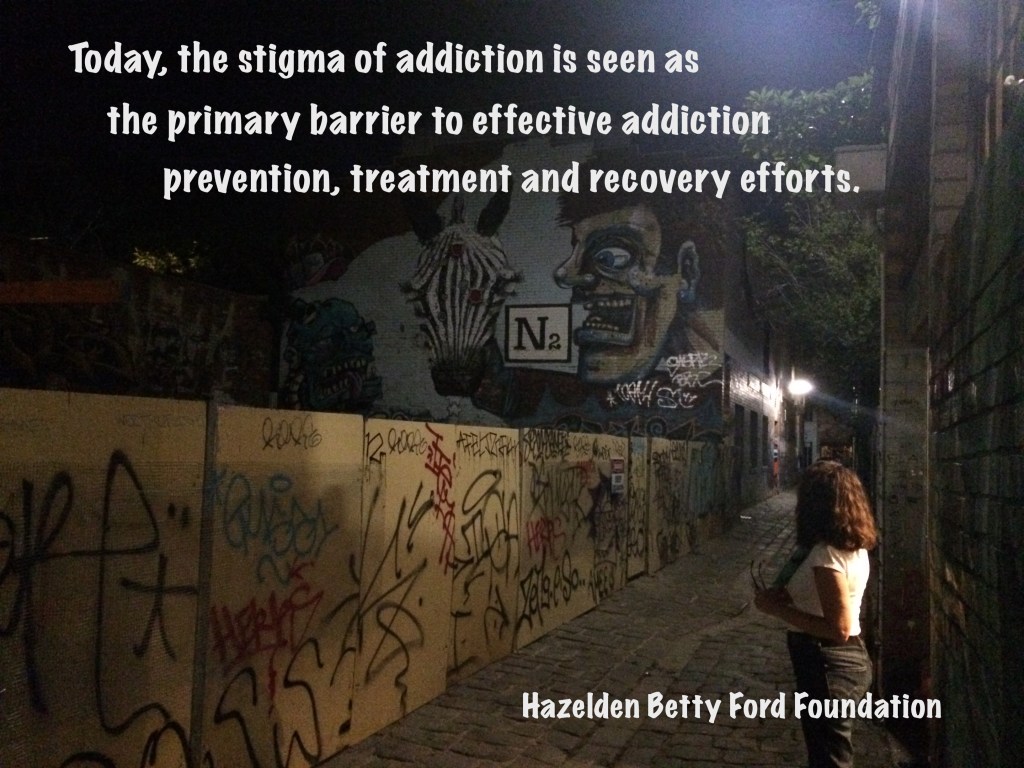
In an article on The Stigma of Addiction from Hazelden Recovery we learn: “The stigma of addiction stems from behavioral symptoms of substance use disorder…which can result in negative consequences including legal, occupational and relationship problems. Understandably, these consequences cause embarrassment and shame among those affected. They also create stigmatized attitudes and perceptions among the wider public, a response that perpetuates and exacerbates the private shame associated with drug addiction. For generations, this combination of personal shame and public stigma has produced tremendous obstacles to addressing the problem of alcoholism and addiction. Today, the stigma of addiction is seen as a primary barrier to effective addiction prevention, treatment and recovery efforts at the individual, family, societal levels. Addiction stigma prevents too many people from getting the help they need.” Yes, only one in 10 people struggling with addiction receive treatment. The article goes on to discuss the irony that many of these stigmatizing behaviors diminish and/or disappear when a person is appropriately treated in recovery.

When talking recently with some of our son’s friends, they have been unwilling to let their past drug use become public knowledge because of the potential negative repercussions they justifiably fear in their careers and relationships. How much worse would it be if they were still living with addiction? What does this say about us as individuals, communities, employers, and society in general? When an individual is seen as having a moral failure instead of a chronic health condition, stigma is the logical result. But no one makes the decision about how their brain will react to a substance and whether they will become addicted after minimal use or hate how it makes them feel and never use it again.

Negative labels stick like glue to our hearts and soul and, for those struggling with addiction and alcoholism, the personal shame becomes how they define themselves. The public stigma that follows is the tattoo they never asked to have. If we can reject stigmatizing and instead provide a safe and listening ear to those struggling with addiction, inviting them to share their stories and encourage them to consider recovery options, they may be willing to join the many people who do learn to manage their disease and successfully recover. Let’s remember that they are just as valuable and able and worthy of love – and as human – as you and me.

https://www.hazeldenbettyford.org/recovery-advocacy/stigma-of-addiction

Malcolm Guite

Blog for poet and singer-songwriter Malcolm Guite

The Gift of Need

How Need Can Strengthen Individuals and Communities

Memoirs and Musings

David Bradley Such

Dave Barnhart

Church planter, pastor, author, coach

RecoveryLife101

Just another WordPress.com site

Abbie In Wondrland

life...on Gods' terms.

Living In Graceland

"..learn the unforced rhythms of grace" matt 11:28

Janaburson's Blog

All about opioid addiction and its treatment with medication

Breaking In News Network

Seeking the truth and bypassing the MSM

Junkbox Diaries

Trauma, PTSD, Mental Health, Addiction, and Recovery

Ohio Society of Addiction Medicine

The Ohio Society of Addiction Medicine is a chapter of ASAM - A professional society actively seeking to define and expand the field of addiction medicine.

traceyh415

Addiction, Recovery, Loss, Grief

WordPress.com News

The latest news on WordPress.com and the WordPress community.