The Importance of Friends – Pt 2

(Translation into most languages at tab to the right.)

How do clean and sober friends stay involved with a friend who is in active addiction and/or alcoholism? I ended last month’s blog asking this question. In particular, I want to discuss ways that teens and young adults can deal with this difficult and at times very frustrating problem.

What does being a good friend to someone who is addicted look like? 

The first thing is to not pretend you don’t know about their addiction. Talk about it openly but without judgment. Understand that they may deny any problem, so you may have to cite specifics that have made you concerned. Express that you care about them and don’t think less of them as a person because of their struggles. Risk your comfort zone. “Greater love has no one than this: to lay down your life for your friends.” (1)

Be a good listener. A problem with drugs or alcohol may start from just experimenting with drugs at a party or concert. It may then turn into addiction and be fueled by problems at home or with friends or underlying mental health issues. When your friend feels cared for and accepted and not confronted with more guilt or shame, they will be willing to open up. Nobody planned to become addicted and nobody wants to be an addict. Here’s links to good info on how to help someone trapped in addiction. (2,3)

But, if you remain a good friend to someone who is living a self-destructive life, how do you help them without enabling their addiction? For young people who are good friends, enabling might be keeping secrets for them about their problem, especially from adults who may need to know in order to take life-saving action. It may be loaning them money or driving them to get drugs. The pressure would sound something like: “If you’re my real friend, you won’t tell…”  Or “If you really want to help me you would…” Basically, when you support their problematic behavior in the name of ‘helping’ them, you are actually keeping them from living with the consequences of their poor choices. And this will only prolong their problems and delay change. (4) 

Encourage them to get help through programs like SMART Recovery groups or AA for alcohol and NA for narcotics. Very few people overcome addictive behaviors alone. Community is key. Go with them if you can or drive them. And remember, drug and alcohol recovery take lots of time and most people don’t succeed the first time they try to quit. Dr. John F. Kelly, clinical psychologist and addiction medicine expert, says it can take 8 years and 4-5 treatment attempts at recovery to achieve one year of sobriety from opioid and other drug addiction. It can take years to achieve stable recovery and Medication Assisted Treatment (MAT) is an important aspect. Gone are the times when a 30-day detox/treatment was seen as the solution to addiction. It may be an important first step in the process of ongoing recovery. People can and do recover, but it will likely be a lifetime journey. Here’s a YouTube 2025 video of Dr. Kelly giving a session on: The New Science on Addiction Recovery. (5)

You can encourage your friend with each small step and success, even through relapses. In our son’s recovery program, we ended each session by saying together: “Keep coming back ‘cause it works if you work it.” It takes hard work and it can be very discouraging for your friend to relapse because your friend wants to be free. No one wants to live controlled by addiction. No one. Encouragement to stick with it is vital.

If your friend or family member is using opioids, you should get naloxone (a medicine that can temporarily reverse the effects of an opioid overdose) and keep it handy. Available through local community-based programs or pharmacies.  

It’s worth saying again: Friends are SO important for people in active addiction.

Don’t ever give up on your friends trapped in addiction. They need friends more than ever, friends who love them and will invest in their lives and let them know they are a worthwhile human – while you also need to encourage them to seek help in order to become sober and stable. And to remind them by example of what a normal and joy-filled life is like and one that they too can have. 

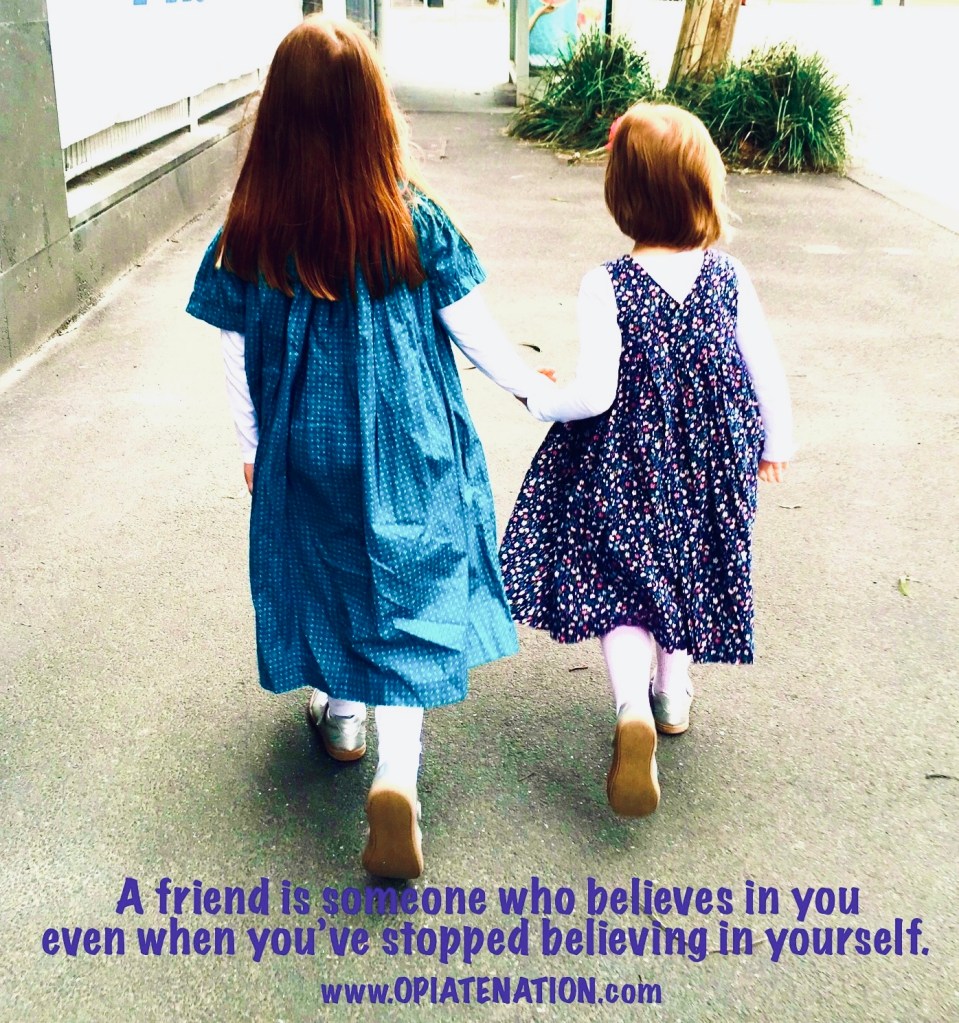
A best friend is someone who believes in you 

even when you’ve stopped believing in yourself.

– Unknown

  1. John 15:13, New Testament 
  2. Helping Someone with a Drug Addiction

https://www.helpguide.org/mental-health/addiction/helping-someone-with-drug-addiction

  • How to help someone who is misusing drugs or alcohol:

https://www.healthdirect.gov.au/help-someone-who-is-misusing-drugs-or-alcohol#:~:text=Celebrate%20small%20successes%20and%20try,Narcotics%20Anonymous%20and%20SMART%20Recovery.

  • Four Signs of Enabling and How to Stop

https://health.clevelandclinic.org/enabling

  • Dr. John F. Kelly, Ph.D. The New Science on Addiction Recovery (lecture)

The Importance of Friends – Part 1

(Translation into most language at tab to the right.)

Approaching what would be my son’s 36th birthday, I thought about the last year of his life. I don’t think about it often because it is painful – so many wishes that things had gone differently for him.

One sadness is that when in active addiction, he was very alone. It’s not that JL didn’t have lots of friends – he did. He was friendly and likeable and the large group of friends who came to his memorial is a testament to that. But most of his high school and university-era friends were not involved in his life during the last few years of his life, and the last year in particular. After his accidental fall and relapse to opiates in 2008 and the next seven years in and out of recovery programs, his life became narrower and something he was ashamed of.

An event that stands out was during a time of heroin use that we were not fully aware of as he lived in our rental house, and we thought he was attending his classes at university. We received an urgent call from two of his friends telling us that they knew he was back to spending all his time with his friend that used heroin with him and they were not getting an answer to their calls. They were at his house and he wasn’t responding to their knocks on his door – did they have our permission to break his door down? Our frightened response was “Yes!” They found him deep in drugged sleep and alive but very startled when they burst in. They confronted him with what they knew and their concern about his drug use. He of course was defensive and pretended that nothing was wrong.

Gradually, these friends, along with others, were no longer part of his life. JL did make a good friend or two in his recovery programs, but he always kept his addicted friends and dealers separate from his sober friends who were mostly not aware of his use and relapses – he had a pretty good poker face. Most of them were shocked to hear of his overdose death because he had been in a sober living house for six months and doing well.

Many of the friends who had such good times together when JL was clean (although not necessarily sober, as they enjoyed drinking with him not realizing how that always led back to drugs for JL) felt guilt after his death. Guilt because he called several of them the week before his death when he had just relapsed. It seems he wanted a friend to talk to and perhaps perceive that he was struggling. And guilt because they wished they had stayed in touch with JL and not distanced themselves from him when he continued to struggle with addiction. 

But there’s the rub: How do sober friends stay involved with a friend who is in active addiction? I think it is especially difficult for young people, who don’t know what they can do, who may be more concerned with their own lives and issues, and who are not yet mature. This is not to suggest that any human is ever totally selfless regardless of how old we are – I know myself too well to hold this delusion. But the passing of years does bring relational experience and can help us focus more on those around us.

Next month I will try to share some insights and ideas for teens and young adults for how to truly be a friend to someone who is struggling with addiction and sobriety. Just remember: 

Don’t ever give up on your friends or family who are trapped in addiction. They need good friends more than ever. King Solomon gave this wise insight 3,000 years ago: Two are better than one, because they have a good return for their labor: If either of them falls down, one can help the other up. But pity anyone who falls and has no one to help them up. (1)

Many people will walk in and out of your life,

 but only true friends will leave footprints in your heart.

—Eleanor Roosevelt

  1. Ecclesiastes 4:9-10

Recovery Options for Teens

 Statue by Gustav Vigeland, Vigeland Park in Oslo, Norway.

(Translation into most languages at tab to the right.)

Understanding the teenage brain was the topic of my last post: Is Teenage Turmoil Inevitable? It is important to digest before parents consider a recovery program for their teen. Knowing that adolescents and teens feel and process information differently than adults is why they require a different approach to addiction and recovery.

Regardless of the type of program considered, the one absolute necessity is that the family be involved in the process – because family dynamics are an integral part of a young persons’ sober and addicted life. And the best place to start this discussion is to focus on the CRAFT model.

The American Psychological Association has an informative article, below. (1) In it they point to studies discussing how programs like Al-Anon for family members with an addicted loved one “may improve the well-being of friends and family members, they are not effective in getting the addicted person into treatment.”

Intervention programs, designed to help “family and friends work with a counselor to confront a substance user and urge him or her to get treatment” is only used by 30 percent of families due to discomfort with confrontation. And treatment is only the first step on the long road to recovery. After that, the family still needs other tools.

CRAFT (Community Reinforcement Approach to Family Training) originated at the University of New Mexico and was developed by Robert Meyers, Ph.D. and colleagues. Research on CRAFT shows that approximately 70% of families who receive CRAFT are able to help their loved ones start treatment within a year (Miller, Meyers, & Tonigan, 1999). CRAFT also helps family members improve their own lives, whether their loved one ends up seeking treatment or not.

CRAFT teaches real life skills to use connection to encourage positive change, because CRAFT is rooted in the belief that connection is the opposite of addiction. It teaches positive communications skills to foster the connection that is desired by the person who is struggling with addiction and their loved ones.

Helping Families Help is a great non-profit website resource for CRAFT information. (2)

SMART Recovery was established in 1994, here in the USA, to meet the increasing demand of those seeking a secular and evidence-informed alternative to the widespread 12-Step addiction recovery program. It is intended for adults over 18 and those seeking flexibility and independence, while AA offers structure and strong community support. It may be best for young adults in their 20’s, as most 18- to 25-year-olds who struggle with addiction are not yet “adult” in their thinking and coping skills. Smart Recovery is now in 23 countries. See info below. (3) 

Basically, the steps in helping your teen who is addicted are this:

  1. Getting them into treatment
  2. Choose a program – inpatient or outpatient
  3. Detox 
  4. Individual Therapy
  5. Family Therapy 
  6. Contingency Management
  1. Getting your loved one into treatment: sign up for CRAFT 10-week email training course through Helping Families Help or investigate other options.
  2. Choose a program: based on the drugs involved and length of time used.
  3. Detox: Most drugs will still be in your child’s system. Detox flushes them out. Detoxing under the care of professionals ensures that it’s done safely out of reach from harmful substances. Your teen will likely experience withdrawal symptoms as well.
  4. Individual Therapy: To understand a teen’s problem and to address it comprehensively. The first course of action in rehab is one or more types of therapy, both one-on-one and group settings. Motivational Interviewing uses a person-centered, non-confrontational style where the teen is encouraged to examine the pros and cons of their use and to create goals to help them achieve a healthier lifestyle. This helps them gradually realize the consequences of their actions. Cognitive Behavioral Therapy (CBT) is goal-oriented therapy that helps teens express and understand their feelings and cope with difficult emotions. They learn to replace negative behaviors (such as using substances) with positive ones (like sports or art or service endeavors).
  5. Family Therapy: Based on the premise that family carries the most profound and long-lasting influence on development, and in modeling both good and bad behaviors and beliefs. These sessions bring together those closest to an addicted teen and address issues such as poor family communication, cohesiveness and problem solving. Again, CRAFT is crucial here.
  6. Contingency Management: This form of therapy tracks each patient’s progress in rehab, including each day they succeed in staying sober, and rewards them with a prize. The more teens feel satisfied with their rewards, not only will they continue striving to stay sober, but their brain will relearn how to appreciate rewards that aren’t drugs or alcohol. Following rehab, a teenager is thrust back into the world. Temptations lie around every corner and their problem stays with them for years after treatment. After you’ve helped your child kick their habit you must help prepare them with a plan to prevent relapse – or for all of you to know what to do when relapse occurs, which is likely especially for certain drugs like opioids. MAT (Medication Assisted Treatment) is vital for opioid addiction and the long-lasting changes in the brain that will continue to undermine all the best plans and determination to stay clean and sober. Our son and many of the hundreds of thousands of young people who died from opioids are the sad evidence of this truth.

I do not offer these steps and advice as a medical or addiction professional. I can only offer my opinion based on our personal experience and the stories from others, along with the research I’ve done over the past 20 years since my husband and I first discovered that our 15 year old son was using heroin. What we wish we had known I share with you in the hope that your story will end differently than ours.

1. An underappreciated intervention

The CRAFT model is giving family and friends the skills they need to help get loved one’s treatment for substance use problems  By Katherine Lee – December 2017, Vol 48, No. 11

https://www.apa.org/monitor/2017/12/underappreciated-intervention

2. Helping Families Help – CRAFT Information

https://helpingfamilieshelp.com/about-craft

https://www.npr.org/sections/health-shots/2018/08/10/636556573/families-choose-empathy-over-tough-love-to-rescue-loved-ones-from-opioids

3. SMART Recovery

https://smartrecovery.org/what-is-smart-recovery

4. The Different Types of Adolescent Treatment Programs

New Horizons Recovery Centers (USA)

https://www.newhorizonscenters.com/blog/the-different-types-of-adolescent-addiction-treatment-programs

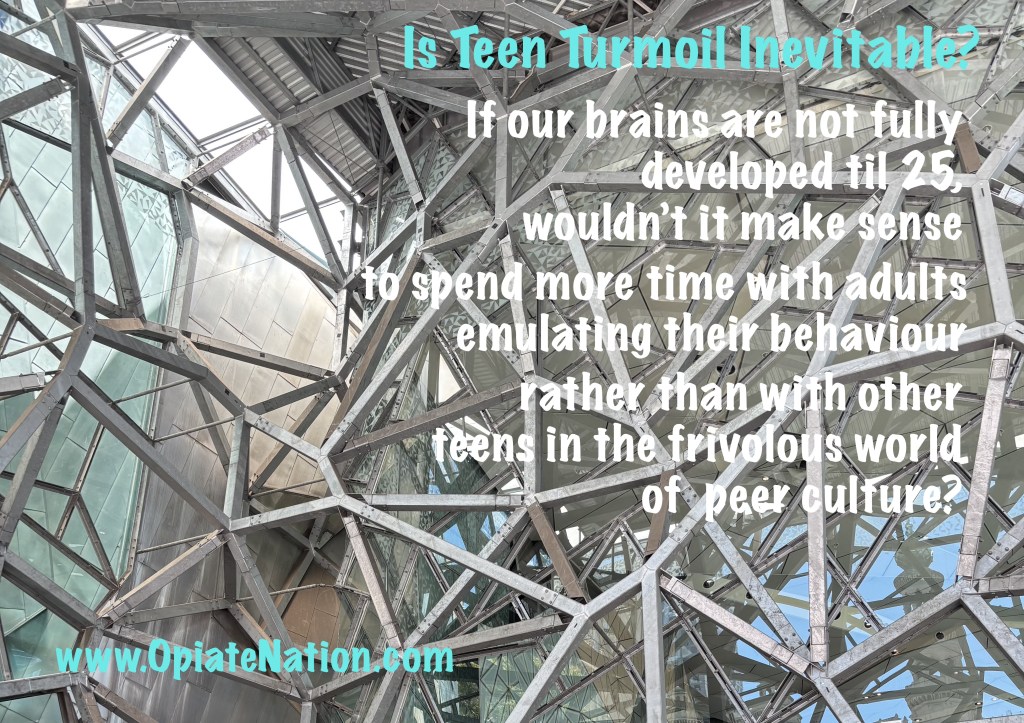
Is Teen Turmoil Inevitable?

(Translation into most languages at tab to the right)

I want to continue with the thoughts from my November blog on The Cycle of Harm and how we now know that the War on Drugs has failed miserably. And especially in attempting to dissuade teens and young adults from using drugs, a punitive approach to drug use has failed spectacularly. There are many reasons for this: the development of the teen brain, the growing need for autonomy, and the influence of culture and their friends, among other things.

There have been innumerable research studies on the teen brain. “The rational part of a teen’s brain isn’t fully developed and won’t be until age 25 or so. In fact, recent research has found that adult and teen brains work differently. Adults think with the prefrontal cortex, the brain’s rational part. This is the part of the brain that responds to situations with good judgment and an awareness of long-term consequences. Teens process information with the amygdala. This is the emotional part.” (1) 

While the teen years are when our brains can comprehend and store new information at its highest rates, the ability to process that information in light of future consequences just isn’t there yet. And during these years there is a need to separate from our parents and begin the process of becoming an adult. 

David Robson, in an article for the BBC, says, “Adolescents often desperately crave the approval and acceptance of their parents. So while they certainly do want independence, it is not at any cost. Brain imaging studies show that the regions of the brain associated with reward generally develop more quickly than those associated with inhibition and self-control. They have greater activity in their dopamine signaling – a neurotransmitter associated with pleasure and curiosity – compared to both adults and younger children, with bigger spikes when they experience something that is novel or exciting. In this light, it’s little wonder that teens are more likely to be tempted to try new experiences…with impulsive and risky decision making.” (2) 

Continue reading “Is Teen Turmoil Inevitable?”

Holiday Perspectives and Prospects

(Translation into most languages at tab to the right.)

The holidays are upon us. Some believe that it’s our perspective that makes all the difference in how we feel about them. Looking ahead may fill a person with joyful anticipation of what’s planned, dogged determination to make it through, or a feeling of dread and desire to escape. But are these situations only just a matter of one’s perspective or one’s prospects? Is much of how we feel based on what is happening in our life: are we living with abundance, security, good health, and healthy relationships? Unsatisfying work, too much debt, illness, and strained relationships? Or is our income irregular or non-existent, our housing insecure or non-existent, and our relationships like vampires or non-existent?  

Continue reading “Holiday Perspectives and Prospects”

The Cycle of Harm – End It For Good 

(Translation into most langugages at tab to the right.)

Recently, I connected with Christina Dent, Founder & President of End It For Good. The mutual connection came through a drug advocacy organization in Australia where they also promote options other than incarceration for drug addiction.

The End It For Good website is a treasure worth exploring (see below). Although Christina has been mainly focused on her home state of Mississippi, they are now expanding and reaching out across the United States. Their website states:

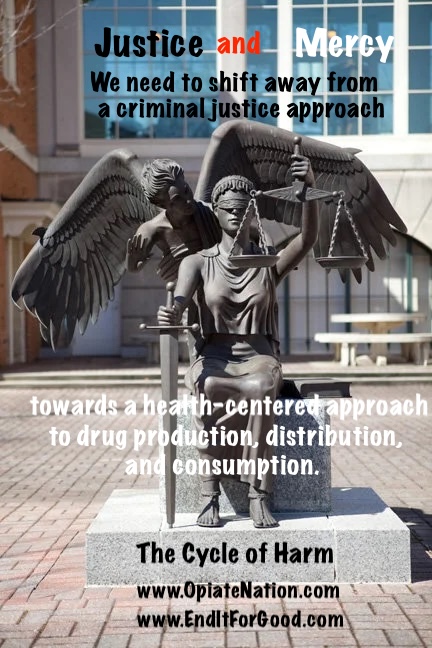
Our goal is a future where fewer people are harmed by drugs. To get there, we need to shift away from a criminal justice approach and towards a health-centered approach to drug production, distribution, and consumption. As a 501(c)(3), we educate citizens, advocates, and policymakers to elevate solutions that prioritize life, health, strong families, and safe communities. This is the path to a world where more people have an opportunity to thrive.

In her TED Talk, Christina shares her learning journey about the destructive impact of a criminal justice approach to drugs and addiction, as well as the mounting evidence that a health-centered approach would be much more effective.

And Christina has written an award winning and very favorably reviewed book: 

CURIOUS: A Foster Mom’s Discovery of an Unexpected Solution to Drugs and Addiction. It gives a vision for unexpected solutions that save lives, heal families, and promote public safety.

The reason I used this particular statue for the blog graphic this month relates perfectly to this subject. Justice & Mercy was designed by sculptor L. Glynn Acree III and stands in front of the Cumberland School of Law at Samford University in Birmingham, Alabama. Justice is blindfolded and the scales she holds are perfectly balanced. The angel, Mercy, is whispering in Justice’s ear. An important reminder that in order for justice to be true and impartial, mercy and kindness must temper her decisions – because as humans, we are all imperfect and fail in many ways. 

Frankenstein Opioids

(Translation into most languages at tab to right)

Just when we thought everyone was aware of the fatal danger of fentanyl and it being mixed into every drug of abuse available on the street, a new threat arises. Nitazene or Isotonitazene (ISO) or Protonitazene, new lab-made opioids, are showing up at hospitals and morgues around the world in the bodies of people thinking they were taking their drug-of-choice only to find it was laced with one more deadly drug. It is being mixed in with cocaine, or formulated into fake Oxy’s and other pills. In the US, it first showed up in 2019 in the Midwest and spread rapidly.

Nitazenes were developed in the 1950’s by pharmaceutical companies as an alternative to morphine but shelved due to the risks of overdose. There is still no approved medical use for nitazenes today. Another ‘Designer Drug’ being made in illicit labs around the world, Nitazenes are up to 40 times stronger than fentanyl. Fentanyl is already 50 times more powerful than heroin and up to 800 times more powerful than morphine.

No wonder these drugs are referred to as ‘Frankenstein Opioids’ – only an insane, evil intentioned scientist would work to create such a drug. But in reality, the motivation is greed more than insanity because synthetic drugs are cheap to make and easy to ship and deliver – and highly profitable. But evil is the correct description for the immoral heads of the drug syndicates and cartels around the world whose entire life and business is dealing death. 

What can be done?

For parents with children still at home, community connection and education are the best preventative measures. As I have said before, my husband and I were totally unaware of what substances were readily available to our middle school son in the early 2000’s. Our concern was smoking and marijuana. Little did we know. General discussions about drug abuse were the extent of our educational conversations. But we would have been much better prepared and had much more information if we had been involved with our kids’ school community. Instead, we were insulated from vital resources because we spent so much time with our church community. But make no mistake. Many of the families at church with kids in youth group were just like us – unaware and ill prepared and sadly many of them suffered the same loss as we did.

There are other important aspects in raising self-reliant kids who are not subject to the lures of the “cool” kids or “in” crowd. Below is a link to a previous blog dedicated to the perils modern teens and their parents face with important resources. I hope it will be helpful to you and those you love.

https://www.dea.gov/stories/2022/2022-06/2022-06-01/new-dangerous-synthetic-opioid-dc-emerging-tri-state-area

Prescriptions in Adolescence and Future Opioid Misuse

(Translation into most languages at tab to the right)

We recently spent some time with a young man who was a close friend and fellow opioid user with our son. While he has survived dying from an overdose and has been clean on and off for almost 20 years, he has been on Suboxone for the past nine months, trying once again to be clean after one more cycle of opioid addiction. He has tried many ways to get free of the stranglehold that opioids have on his brain, to no avail. How did this happen?

Our son, like millions of other adolescents, were prescribed opioids for some type of pain: oral surgeries, sports injuries, accidents, etc. John Leif (JL) had his first experience with opioids at 12 when he had teeth extracted before wearing braces. What we didn’t know then (2001) were the facts about opioids and addiction. Why we didn’t know – and most doctors and dentists didn’t either – was due to Purdue Pharma and other drug companies’ propaganda on the safety of oral opioids: “Opioids are not addictive if a person is in pain.” That, of course, is a lie and one they knew perfectly well. The opioid epidemic is the result of their lies.

The more recent information from multiple drug studies is what we wish we would have known 20 years ago: Legitimate use of prescribed opioids before the 12th grade is independently associated with a 33% increase in the risk of future opioid misuse after high school by age 23 compared to those with no history of an opioid prescription. This was among patients with little drug experience and who disapprove of illegal drug use. (1)

Why does an opioid prescription predict future opioid misuse most strongly among individuals with little to no experience with use of illegal drugs – i.e., adolescents? For drug-naïve individuals, an opioid prescription is likely to be their first experience with an addictive substance. Most likely the pain relief is pleasurable, and a safe initial experience with opioids may reduce perceived risk. A pleasurable and safe initial experience with a psychotropic drug is a central factor in theories of who goes on to misuse drugs. (2)

Continue reading “Prescriptions in Adolescence and Future Opioid Misuse”

10th Anniversary Tribute

(Translation in most languages at tab to the right)

August 2, 2024

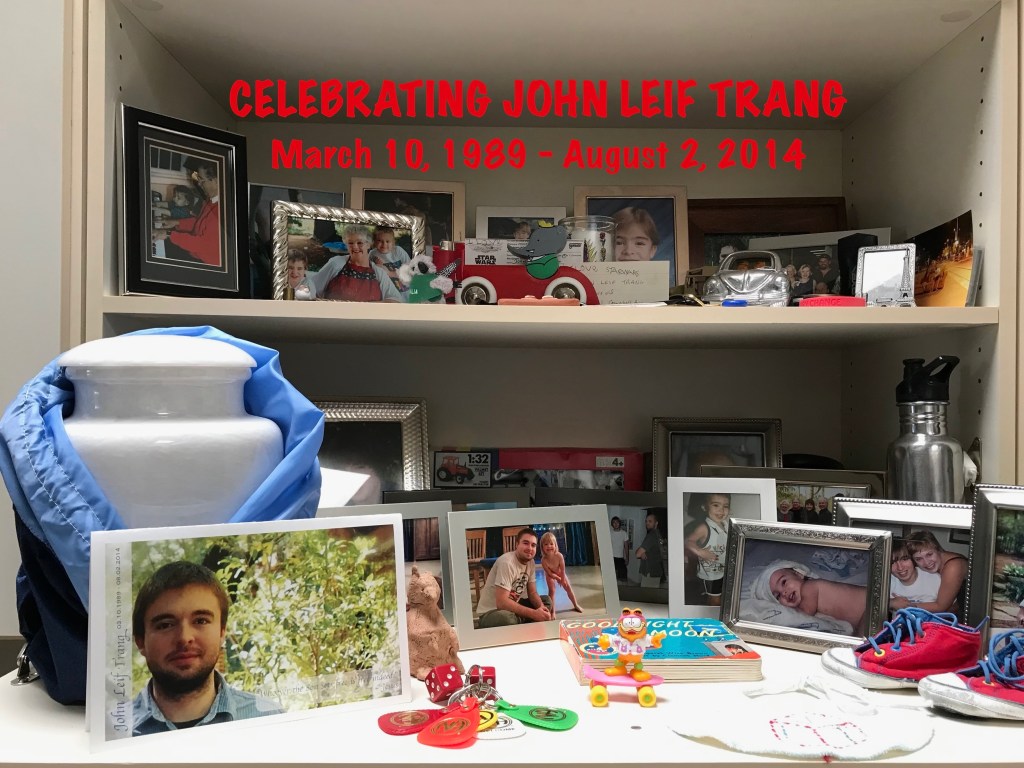
It has been 10 years since we woke up on a hot Saturday morning in August not thinking about anything in particular – other than the house projects we wanted to focus on for the day. Little did we know what had happened in the wee hours of the morning or how a knock on the door at 11am would change our lives forever.

John Leif (J.L.) had many friends in high school and university, many whom we stay in touch with. We have asked them to write their thoughts in remembrance of him on this 10th anniversary of his death. Three of the tributes are the people who wrote the “Stories of Hope” at the end of Opiate Nation. Some of the tributes below are from friends that JL started using alcohol and Oxy’s with in middle or high school – before there was any open discussion about opioids and before their brains were mature enough to understand the deadly consequences of this particular addiction. And many went through years of struggling to get free from how opioids changed the neurological pathways in their brains. We are proud of them and love and thank them for their openness in sharing their stories and for all these heartfelt tributes expressing love for our son and for us.

Here is the YouTube link (or you can watch a mini version on the sidebar) for the photo/video tribute of JL’s life that Johanna and her cousins made: https://youtu.be/70rg4dqfFxU

My Brother

I have so many fond memories of my childhood growing up with John Leif. Our parents created an idyllic environment for us to grow up in; our mornings were spent doing our homeschool work and our afternoons were free for playing. JL and I spent many hours creating imaginary worlds with characters in Lego and Playmobil, racing his Hot Wheels cars or digging in the dirt with his Tonka Trucks. When he was little, he would also happily play baby dolls or dress ups with me, and we would create puppet shows or build forts in the living room or back yard. JL shared my love of animals, and we spent a lot of time playing with and caring for our many pets: cats, rats, hermit crabs, frogs and fish. While we had plenty of sibling fights over the years, he was the playmate I had been waiting for and I cherish the carefree time we were so privileged to have together. I wish that we could have continued growing up together into adulthood, sharing even more adventures and exploring new places. I miss him very much.

Johanna

You Are Always With Me 

J. L. – It’s been 10 years – a full decade since your passing. My memory of your face is slightly fading. Your voice and your laugh aren’t as crisp in my mind anymore. Your appearances in my dreams have become less and less over the years. While I’m scared of forgetting about you, I’m relieved that I’m finally moving on. Your death has affected me tremendously, and there has been a hole in my heart that has felt bottomless for so long. Fortunately that has changed and that hole has been filled. Although I lost you – my best friend – I found another. Man, I wish you could meet her. You’d laugh because she’s exactly who I used to describe as my “perfect woman” during our long rooftop conversations while watching the sun rise after a long, rowdy night. 

I have a full life though I still can’t delete your number from my phone contacts or your gamertag on Xbox (which I haven’t played in years). Life still doesn’t quite feel complete without you around. Memories of you, however, are becoming more a feeling of pleasant remembrance rather than a haunting reminder of your absence in this world. I like to think that this comes from your soul telling mine of your acceptance of the afterlife. Whatever the reason, you’ll always be with me as I enter the next chapters of my life. While I wish we were experiencing them together, I know you’re looking out and guiding me from above. I love you, my brother.

Kyle Thornton 

His Death Changed Me

J.L. had an infectious laugh and smile, and a sort of curiosity like a coyote – a twinkle in his eye always. He was really damn smart and twice as funny. Also, very loyal to friends and those close to him. His death changed me, has forever changed me. The seriousness of addiction was clear before – but him suddenly being gone shook me to my core. 

He’s missed, and I speak of him often to not forget him – to newcomers and men I take through the twelve steps, and to my friends and family.

Benjamin W.

He Was a Gift

John & Jude – Everyone you meet in life is someone you have no idea what effect they will have on you until you get to know them. And sometimes, people show up and blow you away. That was JL for me.

In high school, a lot was happening, and a lot went wrong for me. When I went to Social Studies with JL though, he made my day better. I can still clearly see the high school hallway during our breaks, and how I wanted to be around JL because he always made us laugh.

On weekends, when everyone went to parties, if I saw JL I felt safe – plain and simple. We talked and joked – there was never a negative part to being around him. I really loved the friendship I had with your son. I also really, really appreciate the respect he showed me as a friend. Although I wasn’t a best friend to him, he did impact my life and I hope you know that, because that’s due to you. JL was my friend, and I still think about him all the time.

He is happy where he is though – I know you know that – but just remember it when things get hard. I can’t even imagine the pain you go through every day. He was a gift.

Brittney Kline

Grateful for the Perspective You’ve Given Me

John & Jude – I have thought about JL often over the course of these past 10 years. Honestly, I find myself thinking about him more now that he is gone. I think about how much I have grown and changed over the last decade and wonder what changes and season of life he would be in if he were still with us. It makes me smile to think of JL having a wife and a kid and observing him being in that role.

J.L. – I miss you and I am grateful for what you’ve given me. The perspective you’ve given me, the thoughts you’ve brought to the surface, the memories you are part of and the reminder of just how fortunate we all are to still be fighting the good fight.

Rich Jacome

I Wish He Was Here

Ten years ago, news of JL’s death was unreal. I knew he was getting help for his addiction and had been clean for many months. Everything seemed like life was getting better for him. It did not seem real that he passed away. There was no tragic car accident, but a single slip of willpower. A moment of weakness, and poof! Like a vapor in the wind, he was gone.

I have many regrets with my end of our relationship. The biggest one was that I did not take the time to really get to know him as a teen and as a young adult. He was my kid-cousin, and I always assumed he’d be fine, just like myself. We were young, after all. I assumed he would have a long life and we’d have plenty of time to connect. But life is short. For him, much shorter. 

His death opened my eyes to the extreme danger of self-medication and opiate addiction. I used to think of drug use as “bad decisions.” Now I understand it’s a lethal death sentence, especially now with even minor drugs laced with fentanyl. No one knows if “their pill” is the one pill that will end their life. 

I wish he was here. I wish he knew how much he is loved. I wish he was not missing out on this beautiful world. I miss you JL. 

Love, Cousin Justine

My Best Friend

Not a single day goes by that I don’t think about my best friend and my brother JL he was easily the closest bond that I’ve ever had in life. I have so many fun stories of JL and I find myself telling stories of him and I on a weekly basis. 

JL taught me how to embrace life – he really knew how to have fun and he knew how to express how he felt about things. I would argue that he lived more in his life than most people could ever dream to do. 

His intelligent and mischievous thoughts resonate through all my life’s great decisions. When I find myself talking to my own subconscious I don’t see me. I see JL.

William Skylar Helfrich

No Other Friend Like You

Dear J.L. – I’ll start this by saying the obvious which is you are dearly missed. I can’t believe I haven’t talked to you in almost 10 years. Some days it feels so long ago. Other days it feels like it was yesterday I was in culinary school, and we would talk at night and text. No matter where I was living you were my best friend. No judgment ever between us. Such a rare thing. We completely understood each other on every level. I had never had a friend I connected with on the level I did with you. I haven’t since either. 

Your funeral was so surreal to me. It still hurts so bad, so often. I think of you and the things we will never get to do. Losing you and my father so close together is a wound that will never heal, no matter the time passed. I wish you could see my life today and share it with me. I think of you often and still say to myself a lot of the phrases we always said to each other. The memories we made together will always live within me. I hope to see you again one day.  

Love, Matt

A Significant Impact

I never knew John Leif, but his life had an impact on me that has been significant. I met Jude & John Trang through their friendship with my own parents, and I heard their story with addiction, which so closely mirrored what I had put my parents through with my own substance dependence. When I met the Trang’s, I didn’t know any other families like mine. John Leif and I had a lot in common. We had two parents who loved us, we had a nice home life, we had options and opportunities, we were the same age. And we did heroin anyway. John Leif lost his life, but I did not. Why? 

The Trang’s are deeply religious, spiritual people, whose beliefs guide them through life’s joys and sorrows. I have witnessed the power of their faith as it illuminates the space around them wherever they go. As for me, the question of “why?” has no answer. Why him, and not me? Why should I be so lucky? Why couldn’t he have been saved? Why should the Trang’s be the ones with broken hearts, while I get to sing and dance with my parents today, almost 12 years since I used a syringe? Neither my belief system nor my experience of life has provided any kind of reason. It is part of the great mystery. To me, the question itself is where the lesson resides: be grateful. Appreciate life’s beautiful moments and be present when life is challenging. 

Through knowing the Trang’s, I remind myself to feel ALL my feelings without trying to numb, distract, or turn to harmful habits. I am deeply connected to the Trang family because of our shared experiences. My life is enriched because of them, and I keep John Leif in my meditations. 

Mattea Tampio

SCOTUS Decision on Purdue Pharma and the Sackler Family

Can money compensate for a life destroyed by a greedy family and their products?

(Translation available in most languages at tab on the right)

My husband and I recently returned from visiting his relatives in Norway. Even in that enviable nation, a mother shared her anguish about the 45 yr old son who is still “living” with addiction to prescription opioids. He is not really living – he is just surviving with little hope for his future as rehab failures mount up.

On Thursday, June 27 the Supreme Court handed down their decision on the Purdue Pharma bankruptcy case in which it would have paid billions for victims and states BUT would have shielded the Sackler family from any future liability. 

The majority (5-4) ruled that the bankruptcy court did not have the authority to release the Sackler family members from opioid victims’ legal claims. The Biden administration had argued the bankruptcy court could not release the Sacklers from the claims.

The U.S. Trustee, which oversees bankruptcies under the Justice Department, as well as eight states, Washington, D.C., and the city of Seattle, objected to the Purdue Pharma deal. The trustee argued that the liability the Sacklers face could induce voluntary settlements more favorable than those under the plan and that a win for the Sacklers “would provide a ‘roadmap for corporations and wealthy individuals to misuse the bankruptcy system’ in future cases,” Gorsuch wrote in the opinion.(1)

Continue reading “SCOTUS Decision on Purdue Pharma and the Sackler Family”
Malcolm Guite

Blog for poet and singer-songwriter Malcolm Guite

The Gift of Need

How Need Can Strengthen Individuals and Communities

Memoirs and Musings

David Bradley Such

Dave Barnhart

Church planter, pastor, author, coach

RecoveryLife101

Just another WordPress.com site

Abbie In Wondrland

life...on Gods' terms.

Living In Graceland

"..learn the unforced rhythms of grace" matt 11:28

Janaburson's Blog

All about opioid addiction and its treatment with medication

Breaking In News Network

Seeking the truth and bypassing the MSM

Junkbox Diaries

Trauma, PTSD, Mental Health, Addiction, and Recovery

Ohio Society of Addiction Medicine

The Ohio Society of Addiction Medicine is a chapter of ASAM - A professional society actively seeking to define and expand the field of addiction medicine.

traceyh415

Addiction, Recovery, Loss, Grief

WordPress.com News

The latest news on WordPress.com and the WordPress community.