Not the Time to Rest on Our Laurels

(Translation into most languages a tab to the right.)

Resting on your laurels is as dangerous as resting when you are walking in the snow. You doze off and die in your sleep.

― Ludwig Wittgenstein, Culture and Value

In ancient Greece, when athletes competed and won, they were given a laurel wreath as a crown to show off their success. The idiom “resting on one’s laurels” refers to being content with our past accomplishments and not working towards any further improvement. Not exerting any effort and becoming complacent. 

         I am concerned that we might become complacent after hearing the recent encouraging news from the CDC that drug-related deaths among young people under the age of 35 are finally declining. This after more than two decades of year after year grim news about young people dying from opioid overdoses. And especially from the last 10 years from fentanyl. “Provisional data from the CDC’s National Center for Health Statistics indicate there were an estimated 80,391 drug overdose deaths in the United States during 2024—a decrease of 26.9% from the 110,037 deaths estimated in 2023.Annual drug overdose deaths are projected to reach their lowest level since 2019.” (1)

         NPR’s Morning Edition discussed the possible reasons for this decline. (2) In Gen Z young people, the fear of overdose has caused a change in what they experiment with as opposed to Millennials like my son. When he was at the age of experimentation in middle school, highly addictive prescription opioids were the drug of choice. Now, Gen Z experimentation is mostly with weed and psychoactive drugs which normally won’t cause death, although they can be laced with fentanyl which may lead to a new and more deadly addiction. But those age 35 and older who are still living desperate lives addicted to ever-stronger synthetic opioids and/or meth are still dying from overdoses.

         And then there is Narcan, the opioid overdose reversal medication that is now widely available and is attributed with saving thousands of lives. Parents and advocates have been working for a decade to make it easy to obtain and administer. But it is not the silver bullet many people hail it as. For opioid addicted people, many have been brought back from overdose only to continue using drugs and thinking they have a quick solution to their long-term problem. But repeated overdoses are causing serious brain injuries from oxygen deprivation, as Sam Quinones writes (3).

Author of Dreamland: True Tales of America’s Opiate Epidemic (2015) and The Least of Us: True Tales of America and Hope in the Time of Fentanyl and Meth (2022), Sam says, “By leaving people on the street to suffer more overdoses, believing that with Narcan they’ll be revived and return to ‘normal,’ we are creating a population of people less able to make rational decisions, more given to erratic behavior, and more at the mercy of the street and its trauma…(Narcan) has great benefits, but also serious limits, particularly in a time of fentanyl and meth, and particularly when it is used virtually without any other tool.”

What’s the answer to this blight that was unleashed on our young people?

Sam continues, “After reporting on this for more than a decade, I believe the solution must start with getting people off those lethal streets and — crucially — into places they cannot leave when the drugs insist that they must. That way, their brains will have a fighting chance to heal. When that happens, readiness for treatment is far more likely to emerge than it will on those streets, where drugs and brain injury so easily conspire and lead to death.” 

         I encourage you to read Sam’s article for other great insights and pass it along to others. We need to be informed with a perspective gained from all the facts and then work for comprehensive reforms in policies and health care.

  1. U.S. Overdose Deaths Decrease Almost 27% in 2024. May 14, 2025

https://www.cdc.gov/nchs/pressroom/nchs_press_releases/2025/20250514.htm

2. Drug deaths plummet among young Americans as fentanyl carnage eases.

Morning Edition June 10, 2025

3. Sam Quinones. The Limits of Narcan Alone. June 04, 2025.

https://samquinones.substack.com/p/the-limits-of-narcan-alone
The Importance of Friends – Pt 2

(Translation into most languages at tab to the right.)

How do clean and sober friends stay involved with a friend who is in active addiction and/or alcoholism? I ended last month’s blog asking this question. In particular, I want to discuss ways that teens and young adults can deal with this difficult and at times very frustrating problem.

What does being a good friend to someone who is addicted look like? 

The first thing is to not pretend you don’t know about their addiction. Talk about it openly but without judgment. Understand that they may deny any problem, so you may have to cite specifics that have made you concerned. Express that you care about them and don’t think less of them as a person because of their struggles. Risk your comfort zone. “Greater love has no one than this: to lay down your life for your friends.” (1)

Be a good listener. A problem with drugs or alcohol may start from just experimenting with drugs at a party or concert. It may then turn into addiction and be fueled by problems at home or with friends or underlying mental health issues. When your friend feels cared for and accepted and not confronted with more guilt or shame, they will be willing to open up. Nobody planned to become addicted and nobody wants to be an addict. Here’s links to good info on how to help someone trapped in addiction. (2,3)

But, if you remain a good friend to someone who is living a self-destructive life, how do you help them without enabling their addiction? For young people who are good friends, enabling might be keeping secrets for them about their problem, especially from adults who may need to know in order to take life-saving action. It may be loaning them money or driving them to get drugs. The pressure would sound something like: “If you’re my real friend, you won’t tell…”  Or “If you really want to help me you would…” Basically, when you support their problematic behavior in the name of ‘helping’ them, you are actually keeping them from living with the consequences of their poor choices. And this will only prolong their problems and delay change. (4) 

Encourage them to get help through programs like SMART Recovery groups or AA for alcohol and NA for narcotics. Very few people overcome addictive behaviors alone. Community is key. Go with them if you can or drive them. And remember, drug and alcohol recovery take lots of time and most people don’t succeed the first time they try to quit. Dr. John F. Kelly, clinical psychologist and addiction medicine expert, says it can take 8 years and 4-5 treatment attempts at recovery to achieve one year of sobriety from opioid and other drug addiction. It can take years to achieve stable recovery and Medication Assisted Treatment (MAT) is an important aspect. Gone are the times when a 30-day detox/treatment was seen as the solution to addiction. It may be an important first step in the process of ongoing recovery. People can and do recover, but it will likely be a lifetime journey. Here’s a YouTube 2025 video of Dr. Kelly giving a session on: The New Science on Addiction Recovery. (5)

You can encourage your friend with each small step and success, even through relapses. In our son’s recovery program, we ended each session by saying together: “Keep coming back ‘cause it works if you work it.” It takes hard work and it can be very discouraging for your friend to relapse because your friend wants to be free. No one wants to live controlled by addiction. No one. Encouragement to stick with it is vital.

If your friend or family member is using opioids, you should get naloxone (a medicine that can temporarily reverse the effects of an opioid overdose) and keep it handy. Available through local community-based programs or pharmacies.  

It’s worth saying again: Friends are SO important for people in active addiction.

Don’t ever give up on your friends trapped in addiction. They need friends more than ever, friends who love them and will invest in their lives and let them know they are a worthwhile human – while you also need to encourage them to seek help in order to become sober and stable. And to remind them by example of what a normal and joy-filled life is like and one that they too can have. 

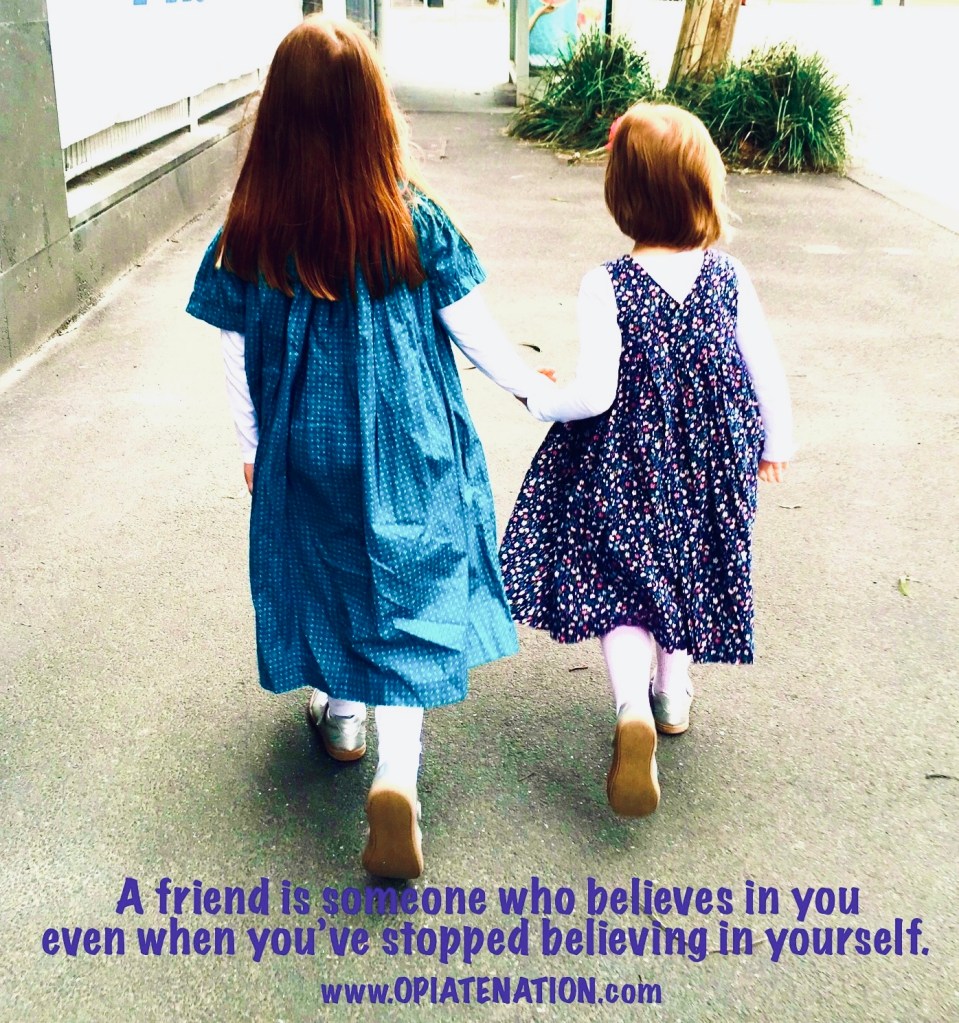
A best friend is someone who believes in you 

even when you’ve stopped believing in yourself.

– Unknown

  1. John 15:13, New Testament 
  2. Helping Someone with a Drug Addiction

https://www.helpguide.org/mental-health/addiction/helping-someone-with-drug-addiction

  • How to help someone who is misusing drugs or alcohol:

https://www.healthdirect.gov.au/help-someone-who-is-misusing-drugs-or-alcohol#:~:text=Celebrate%20small%20successes%20and%20try,Narcotics%20Anonymous%20and%20SMART%20Recovery.

  • Four Signs of Enabling and How to Stop

https://health.clevelandclinic.org/enabling

  • Dr. John F. Kelly, Ph.D. The New Science on Addiction Recovery (lecture)

No Magic Bullets

Last week here in Tucson, Arizona, some young people were together at a house using heroin. They were unaware it was laced with fentanyl. Friends ran to a nearby restaurant and flagged down police to help one person who was unresponsive from an overdose. He was revived with Narcan (naloxone). The officers were then taken to the house where six others had overdosed. One 19-yr old did not make it. Tucson Police all carry naloxone because they are usually the “first responders” to victims of overdose. Sadly, our Pima County Sheriff officers do not carry it – with the line of reasoning being that it is too costly for the training and they are not usually the first responders.

Naloxone (Narcan, Evzio, injectable or intranasal spray) was patented in 1961, and is an opioid antagonist—meaning that it binds to opioid receptors and can reverse and block the effects of other opioids by displacing them from the opioid receptor sites in the brain. Whereas an agonist causes an action, an antagonist blocks the action of the agonist. It has been used in hospital “code arrest” emergency situations for decades. It is being carried by emergency personnel and families of addicts because it can very quickly restore normal respiration to a person whose breathing has slowed or stopped as a result of overdosing with heroin or prescription opioid pain medications.

But it is not a magic bullet. Statistically, most opioid overdoses happen when the user is alone. By the time they are found, usually many hours later, it is too late for resuscitation. Another reason is that public safety experts are concerned, and rightly so, because addicts may be less motivated to find a way to quit using opioids since they can be revived. Their family and friends will also feel less anxiety and less concerned about urging their addict to get long term help. A recent news special interviewed several opiate addicts who had been revived multiple times with naloxone. One was an older man who is a “career addict”. He has no real desire to get clean and carries naloxone in case any of his friends need it. The other was a young woman who had overdosed and been revived several times and had finally gone through a recovery program and is clean and sober. She is very thankful for the times she did not die because finally, finally she was able to get to the point where she wanted to leave her miserable life of addiction and be free. But let’s remember: she needed a recovery program option. We cannot just turn those addicted to opioids back onto the streets after reviving them.

She is an example of the recent statistics that it takes on average 10-12 recovery attempts before an opiate addict can stay clean and sober long-term. Ten to twelve. It is a fact that relates to the addictive quality of opioids. For many of those addicted to opiates, those 10-12 attempts will never happen without overdoses and then being revived with naloxone. We, as a society, must be willing to offer this chance to those who are trapped by addiction to substances that have poured onto our streets and into our schools at an unprecedented rate. Our son went through several recovery programs and was at the point of really wanting to be free of his addiction. But without the needed medication, such as Suboxone, his last relapse proved fatal. He died of a heroin overdose at 25 yrs old – alone. There was no magic bullet for him.

BLOG: MAT, Part 2

MAT––Medication Assisted Treatment. Dr. Hillary Kunins, a clinical addiction expert, dispels the notion that treating an addiction patient with medication is simply exchanging one drug with another. Here is a link for a 2 min video where Dr Kunins offers a simple explanation of why physical dependence is not the same as addiction.

Here are the drugs that are currently in use for opioid addiction. Methadone has historically been used for heroin addiction, since the early 1970’s, when it was authorized by the FDA but restricted to daily dispensing clinics. Because it is an opioid-like drug, it has tended to only keep addicts alive, but never really able to be drug-free.

Nearly a half-century ago, buprenorphine was developed in England, where chemists were competing to invent a less addictive painkiller than morphine––it turned out to be far more addictive. It is now sold as Subutex and is an opioid partial agonist. An agonist is a chemical that binds to a receptor and activates it, producing a biological response. Like heroin, buprenorphine attaches to the brain’s opioid receptors creating euphoria, but it does not plug in as completely, so its effects are reduced. It is slower acting and longer lasting, attenuating the rush of sensation and eliminating the plummets afterward. But there is still potential for abuse and it can produce side effects such as respiratory depression.

Naloxone (Narcan, Evzio, injectable or intranasal spray) was patented in 1961, and is an opioid antagonist—meaning that it binds to opioid receptors and can reverse and block the effects of other opioids by displacing them from the opioid receptor sites in the brain.Whereas an agonist causes an action, an antagonist blocks the action of the agonist. It has been used in hospital “code arrest” emergency situations for decades. It was used on me before a surgery when I had been given too much anesthesia and was beginning to go in to respiratory arrest. It is being carried by emergency personnel and families of addicts because it can very quickly restore normal respiration to a person whose breathing has slowed or stopped as a result of overdosing with heroin or prescription opioid pain medications.

Naltrexone (Vivitrol, monthly injection) is an opiate antagonist that is more slowly released than naloxone. It is primarily used to manage opioid dependence or alcohol dependence and abuse by blocking neural pathways to the brain for dopamine neurotransmitters. It requires going through complete withdrawals and detoxification first because it will not work until opioids are out of the system. People who try to take opioids after taking naltrexone are at risk for opioid overdose and death since it takes using large amount of opioids to overcome its effects.

Suboxone––four parts buprenorphine, one part naloxone––was approved by the FDA in late 2002. Generally, although not accurate, when the word “buprenorphine” is used, people are referring to Suboxone. In addition to side effects from the buprenorphine in Suboxone, if a person has been taking it for a long time and they no longer receive it, they will suffer withdrawal symptoms similar to those suffered when stopping other forms of opiates. And, suffering from these withdrawal symptoms can worsen underlying mental disorders like anxiety or depression. At times, withdrawal can become overwhelming, which happened to jL, which sends patients into buprenorphine abuse and dependency. This has created a debate over the use of Suboxone and Subutex for addiction treatment.

A new study in The Lancet (January 27, 2018), sponsored by the National Institute on Drug Abuse (NIDA), compared the effectiveness of extended-release naltrexone with buprenorphine-naloxone in the US. The results were both promising and disappointing. While naltrexone is as effective as buprenorphine-naloxone once treatment begins, it is also significantly more difficult to actually start naltrexone because of the prolonged detox period—which can span more than a week—that buprenorphine-naloxone does not.

The biggest regret we have had since our son’s death in 2014 is that we did not take his doctors advice and have John Leif on Suboxone. There were many reasons that went into this decision, but the main one was that our health insurance did not pay the costs for any “mental health” coverage. Since we had so many years of our son’s relapses and recovery expenses, we decided to let him just “try harder” with the 12-steps and a sober living house. Sadly, it was not enough for a young man who desperately wanted to be clean and free of his enslaving addiction––he need MAT and we believe he would be alive today if he had been given that option.

Malcolm Guite

Blog for poet and singer-songwriter Malcolm Guite

The Gift of Need

How Need Can Strengthen Individuals and Communities

Memoirs and Musings

David Bradley Such

Dave Barnhart

Church planter, pastor, author, coach

RecoveryLife101

Just another WordPress.com site

Abbie In Wondrland

life...on Gods' terms.

Living In Graceland

"..learn the unforced rhythms of grace" matt 11:28

Janaburson's Blog

All about opioid addiction and its treatment with medication

Breaking In News Network

Seeking the truth and bypassing the MSM

Junkbox Diaries

Trauma, PTSD, Mental Health, Addiction, and Recovery

Ohio Society of Addiction Medicine

The Ohio Society of Addiction Medicine is a chapter of ASAM - A professional society actively seeking to define and expand the field of addiction medicine.

traceyh415

Addiction, Recovery, Loss, Grief

WordPress.com News

The latest news on WordPress.com and the WordPress community.