Making Use of Wastewater Surveillance

(Translation into most languages at tab to the right.)

Wastewater monitoring is an effective tool in detecting emerging opioid threats, predicting overdoses, and tailoring treatments, according to new research from Biobot Analytics, Mathematica, and the Washington/Baltimore High Intensity Drug Trafficking Area (W/B HIDTA) program. (1)

My husband and I live in Melbourne, Australia part of the year so we can be close to our daughter and family. We love Australians and their friendly and balanced way of  approaching life and politics. It is a federal parliamentary democracy similar to England.

One area where they are ahead of the USA is in their approach to illicit drugs. As a nation with comprehensive health care for all from cradle to grave, they have a more communal attitude than our American individualistic posture. They view caring for each other as part of being a healthy and functioning society.

This necessarily affects how they treat people who use illicit drugs. They aggressively pursue educational and preventative measures while also working to keep those who use drugs as safe as possible until they are ready to seek recovery. While they don’t have a fluid border with a drug-producing country like we do with Mexico, they still have a problem with illicit drugs arriving from China and Asia.

One area that they use as a public health strategy is wastewater surveillance such as was used during the Covid-19 pandemic. Samples are collected from wastewater treatment plants, sewer systems, or targeted populations such as college dorms or prisons. When pooled together, they provide a community view of drugs circulating in the population. The samples are analyzed and the data is calculated through very sophisticated methods. The data then give objective, community-wide information on drug use trends. This is of great benefit in tracking changes and identifying new drug use and outbreaks and as an early warning tool. In the US, Biobot Analytics and Mathematica are leading the way with the “Drug-Surge” algorithm. (1) In a study involving five counties across four states, the algorithm correctly flagged between 71% and 100% of drug overdoses.

The US Drug Enforcement Agency (DEA) uses this wastewater testing to detect trends in illicit substances well in advance of reported overdoses. Xylazine was detectable a month before suspected overdoses from it were reported. Geographic and socioeconomic trends can be tracked also. If put to use, a national alert system would give early warning of at least a week in order to alert the public to a new or more potent drug threat.

In the US, the National Wastewater Surveillance System (NWSS) that is run by the CDC began in response to the Covid-19 pandemic. The CDC coordinates a national system primarily for infectious disease monitoring. While drug consumption can also be targeted, a national program does not yet exist. (3,4) Meanwhile, the National Institute on Drug Abuse (NIDA) is working with Biobot and Mathematica and has regional programs focusing on illicit drug use as a response to the opioid crisis. 

With the CDC in the midst of worrisome changes, let’s be vocal proponents for increased national coordinated surveillance of illicit drugs in our wastewater and the use of that information to help prevent overdoses and deaths.

  1. Wastewater Data Offers Powerful Tool in Confronting Opioid Epidemic

https://www.mathematica.org/news/wastewater-data-offers-powerful-tool-in-confronting-opioid-epidemic#:~:text=Wastewater%20monitoring%20is%20an%20effective,early%20warning%20for%20new%20threats.

2. DEA Releases 2025 National Drug Threat Assessment

https://www.dea.gov/press-releases/2025/05/15/dea-releases-2025-national-drug-threat-assessment

3. Correlation between wastewater-based substance use prevalence and syringe distribution in a harm reduction program in the United States

https://www.sciencedirect.com/science/article/abs/pii/S0048969725018261#:~:text=In%20the%20U.S.%2C%20although%20the,2019;%20NFLIS%2C%202024).

4. Wastewater-based monitoring could help guide responses to the USA opioid epidemic

https://www.nature.com/articles/s44221-023-00082-9

Not the Time to Rest on Our Laurels

(Translation into most languages a tab to the right.)

Resting on your laurels is as dangerous as resting when you are walking in the snow. You doze off and die in your sleep.

― Ludwig Wittgenstein, Culture and Value

In ancient Greece, when athletes competed and won, they were given a laurel wreath as a crown to show off their success. The idiom “resting on one’s laurels” refers to being content with our past accomplishments and not working towards any further improvement. Not exerting any effort and becoming complacent. 

         I am concerned that we might become complacent after hearing the recent encouraging news from the CDC that drug-related deaths among young people under the age of 35 are finally declining. This after more than two decades of year after year grim news about young people dying from opioid overdoses. And especially from the last 10 years from fentanyl. “Provisional data from the CDC’s National Center for Health Statistics indicate there were an estimated 80,391 drug overdose deaths in the United States during 2024—a decrease of 26.9% from the 110,037 deaths estimated in 2023.Annual drug overdose deaths are projected to reach their lowest level since 2019.” (1)

         NPR’s Morning Edition discussed the possible reasons for this decline. (2) In Gen Z young people, the fear of overdose has caused a change in what they experiment with as opposed to Millennials like my son. When he was at the age of experimentation in middle school, highly addictive prescription opioids were the drug of choice. Now, Gen Z experimentation is mostly with weed and psychoactive drugs which normally won’t cause death, although they can be laced with fentanyl which may lead to a new and more deadly addiction. But those age 35 and older who are still living desperate lives addicted to ever-stronger synthetic opioids and/or meth are still dying from overdoses.

         And then there is Narcan, the opioid overdose reversal medication that is now widely available and is attributed with saving thousands of lives. Parents and advocates have been working for a decade to make it easy to obtain and administer. But it is not the silver bullet many people hail it as. For opioid addicted people, many have been brought back from overdose only to continue using drugs and thinking they have a quick solution to their long-term problem. But repeated overdoses are causing serious brain injuries from oxygen deprivation, as Sam Quinones writes (3).

Author of Dreamland: True Tales of America’s Opiate Epidemic (2015) and The Least of Us: True Tales of America and Hope in the Time of Fentanyl and Meth (2022), Sam says, “By leaving people on the street to suffer more overdoses, believing that with Narcan they’ll be revived and return to ‘normal,’ we are creating a population of people less able to make rational decisions, more given to erratic behavior, and more at the mercy of the street and its trauma…(Narcan) has great benefits, but also serious limits, particularly in a time of fentanyl and meth, and particularly when it is used virtually without any other tool.”

What’s the answer to this blight that was unleashed on our young people?

Sam continues, “After reporting on this for more than a decade, I believe the solution must start with getting people off those lethal streets and — crucially — into places they cannot leave when the drugs insist that they must. That way, their brains will have a fighting chance to heal. When that happens, readiness for treatment is far more likely to emerge than it will on those streets, where drugs and brain injury so easily conspire and lead to death.” 

         I encourage you to read Sam’s article for other great insights and pass it along to others. We need to be informed with a perspective gained from all the facts and then work for comprehensive reforms in policies and health care.

  1. U.S. Overdose Deaths Decrease Almost 27% in 2024. May 14, 2025

https://www.cdc.gov/nchs/pressroom/nchs_press_releases/2025/20250514.htm

2. Drug deaths plummet among young Americans as fentanyl carnage eases.

Morning Edition June 10, 2025

3. Sam Quinones. The Limits of Narcan Alone. June 04, 2025.

https://samquinones.substack.com/p/the-limits-of-narcan-alone

An Entire Generation

Translation into most languages at tab to the right.

A generation is usually considered the years during which children are born, grow up, become adults, and begin to have children of their own. Approximately  20-30 years, averaging 25 years. Each generation becomes known by what characterizes the lives of those in it – what they do and how they impact society.

I’ve been thinking about my son, who would be 36 this year – if he had survived the opioid plague that began in the 1990’s with the prescribing of opioids for every ache and pain. What Purdue Pharma did is old news and well documented. But the effect of the immorality of the Sackler family set a course  that destroyed the lives of an entire generation – the “Millennials” generation of my son and his contemporaries. 

Far more than a million Americans have died due to a drug overdose in the past 25 years and the majority of those deaths are from opioids. (1) Initially it was prescription opioids, then heroin, then fentanyl. And now a daily variation of synthetic opioids mixed in with every variety of street drug. These are made from precursor chemicals from China and shipped around the globe where they are “formulated” into fake prescription pills or street drugs in jungle or backyard labs. Quality control is non-existent. 

Beyond the deaths, there are millions of Americans who are suffering from life-threatening addiction. They will either be another statistic or live the life of an empty shell surviving from one fix to the next just to not feel “dope sick.” Many are homeless and jobless. All experience despair and hopelessness. It will take years to gain long-term recovery if they can access health care and programs.

There has been some good news. After the peak years of the Covid pandemic, when the rates of addiction and deaths from overdoses rose substantially, the statistics for 2024 finally show a decline in both. (2) It may be due to less anxiety and depression since the pandemic ended. It may also be due to more awareness of Medicated Assisted Treatment and better access to Harm Reduction tools such as pill testing and overdose reversal medication naloxone.

I think the best area for hope is the common knowledge the “Gen Z” kids are growing up with about the deadly dangers of drug addiction. That their parents are also more aware of the drug supply than parents of Millennials like me. The 2023 National Survey on Drug Use & Health found that the majority of adolescents (12-17 yrs. old) in the USA are not using substances, alcohol, tobacco products or vaping. (3) But ongoing effort is imperative. “Continued prevention programming, education, and public messaging focused on adolescents can delay or prevent substance use and avoid the negative impacts of substance use that have been widely documented.”  

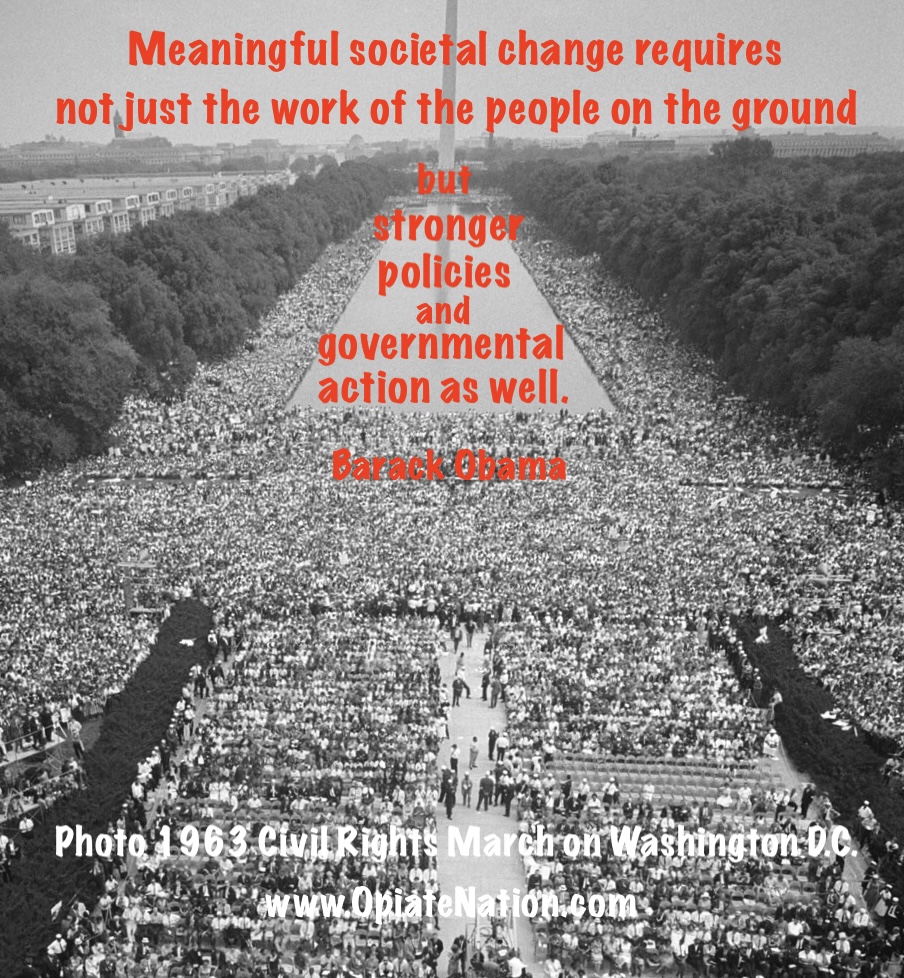
If we truly want to see future generations of children have the opportunity to grow up without the continual pull to use drugs, we need to keep our relationships with them open and healthy. Every year we can delay experimentation with addictive substances allows children’s brains to develop more fully in the area of judgment. We must all stay informed and aware and work in whatever arena we are able. As Barack Obama told Michelle when he was working for her as an intern, that he was in law school because grass roots organizing had shown him that meaningful societal change requires not just the work of the people on the ground, but stronger policies and governmental action as well. (4)

  1. Fentanyl and the U.S. Opioid Epidemic

https://www.cfr.org/backgrounder/fentanyl-and-us-opioid-epidemic

2. The Opioid Crises and The Pandemic

3. NSDUH Data Show Most Adolescents in the US Are Not Using Substances

    4. Becoming, by Michelle Obama, Chapter 8

    The Cycle of Harm – End It For Good 

    (Translation into most langugages at tab to the right.)

    Recently, I connected with Christina Dent, Founder & President of End It For Good. The mutual connection came through a drug advocacy organization in Australia where they also promote options other than incarceration for drug addiction.

    The End It For Good website is a treasure worth exploring (see below). Although Christina has been mainly focused on her home state of Mississippi, they are now expanding and reaching out across the United States. Their website states:

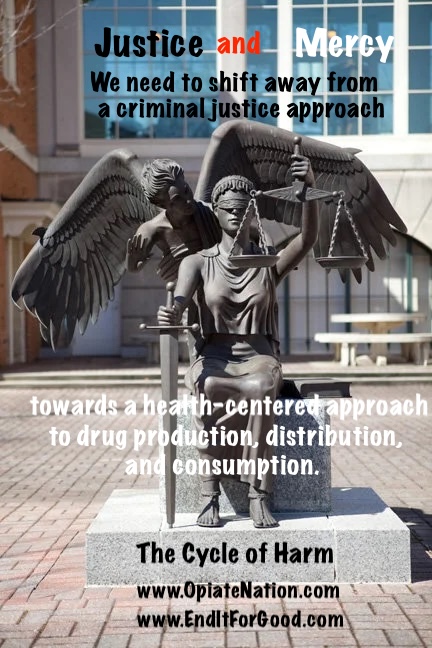
    Our goal is a future where fewer people are harmed by drugs. To get there, we need to shift away from a criminal justice approach and towards a health-centered approach to drug production, distribution, and consumption. As a 501(c)(3), we educate citizens, advocates, and policymakers to elevate solutions that prioritize life, health, strong families, and safe communities. This is the path to a world where more people have an opportunity to thrive.

    In her TED Talk, Christina shares her learning journey about the destructive impact of a criminal justice approach to drugs and addiction, as well as the mounting evidence that a health-centered approach would be much more effective.

    And Christina has written an award winning and very favorably reviewed book: 

    CURIOUS: A Foster Mom’s Discovery of an Unexpected Solution to Drugs and Addiction. It gives a vision for unexpected solutions that save lives, heal families, and promote public safety.

    The reason I used this particular statue for the blog graphic this month relates perfectly to this subject. Justice & Mercy was designed by sculptor L. Glynn Acree III and stands in front of the Cumberland School of Law at Samford University in Birmingham, Alabama. Justice is blindfolded and the scales she holds are perfectly balanced. The angel, Mercy, is whispering in Justice’s ear. An important reminder that in order for justice to be true and impartial, mercy and kindness must temper her decisions – because as humans, we are all imperfect and fail in many ways. 

    Frankenstein Opioids

    (Translation into most languages at tab to right)

    Just when we thought everyone was aware of the fatal danger of fentanyl and it being mixed into every drug of abuse available on the street, a new threat arises. Nitazene or Isotonitazene (ISO) or Protonitazene, new lab-made opioids, are showing up at hospitals and morgues around the world in the bodies of people thinking they were taking their drug-of-choice only to find it was laced with one more deadly drug. It is being mixed in with cocaine, or formulated into fake Oxy’s and other pills. In the US, it first showed up in 2019 in the Midwest and spread rapidly.

    Nitazenes were developed in the 1950’s by pharmaceutical companies as an alternative to morphine but shelved due to the risks of overdose. There is still no approved medical use for nitazenes today. Another ‘Designer Drug’ being made in illicit labs around the world, Nitazenes are up to 40 times stronger than fentanyl. Fentanyl is already 50 times more powerful than heroin and up to 800 times more powerful than morphine.

    No wonder these drugs are referred to as ‘Frankenstein Opioids’ – only an insane, evil intentioned scientist would work to create such a drug. But in reality, the motivation is greed more than insanity because synthetic drugs are cheap to make and easy to ship and deliver – and highly profitable. But evil is the correct description for the immoral heads of the drug syndicates and cartels around the world whose entire life and business is dealing death. 

    What can be done?

    For parents with children still at home, community connection and education are the best preventative measures. As I have said before, my husband and I were totally unaware of what substances were readily available to our middle school son in the early 2000’s. Our concern was smoking and marijuana. Little did we know. General discussions about drug abuse were the extent of our educational conversations. But we would have been much better prepared and had much more information if we had been involved with our kids’ school community. Instead, we were insulated from vital resources because we spent so much time with our church community. But make no mistake. Many of the families at church with kids in youth group were just like us – unaware and ill prepared and sadly many of them suffered the same loss as we did.

    There are other important aspects in raising self-reliant kids who are not subject to the lures of the “cool” kids or “in” crowd. Below is a link to a previous blog dedicated to the perils modern teens and their parents face with important resources. I hope it will be helpful to you and those you love.

    https://www.dea.gov/stories/2022/2022-06/2022-06-01/new-dangerous-synthetic-opioid-dc-emerging-tri-state-area

    SCOTUS Decision on Purdue Pharma and the Sackler Family

    Can money compensate for a life destroyed by a greedy family and their products?

    (Translation available in most languages at tab on the right)

    My husband and I recently returned from visiting his relatives in Norway. Even in that enviable nation, a mother shared her anguish about the 45 yr old son who is still “living” with addiction to prescription opioids. He is not really living – he is just surviving with little hope for his future as rehab failures mount up.

    On Thursday, June 27 the Supreme Court handed down their decision on the Purdue Pharma bankruptcy case in which it would have paid billions for victims and states BUT would have shielded the Sackler family from any future liability. 

    The majority (5-4) ruled that the bankruptcy court did not have the authority to release the Sackler family members from opioid victims’ legal claims. The Biden administration had argued the bankruptcy court could not release the Sacklers from the claims.

    The U.S. Trustee, which oversees bankruptcies under the Justice Department, as well as eight states, Washington, D.C., and the city of Seattle, objected to the Purdue Pharma deal. The trustee argued that the liability the Sacklers face could induce voluntary settlements more favorable than those under the plan and that a win for the Sacklers “would provide a ‘roadmap for corporations and wealthy individuals to misuse the bankruptcy system’ in future cases,” Gorsuch wrote in the opinion.(1)

    Continue reading “SCOTUS Decision on Purdue Pharma and the Sackler Family”
    Malcolm Guite

    Blog for poet and singer-songwriter Malcolm Guite

    The Gift of Need

    How Need Can Strengthen Individuals and Communities

    Memoirs and Musings

    David Bradley Such

    Dave Barnhart

    Church planter, pastor, author, coach

    RecoveryLife101

    Just another WordPress.com site

    Abbie In Wondrland

    life...on Gods' terms.

    Living In Graceland

    "..learn the unforced rhythms of grace" matt 11:28

    Janaburson's Blog

    All about opioid addiction and its treatment with medication

    Breaking In News Network

    Seeking the truth and bypassing the MSM

    Junkbox Diaries

    Trauma, PTSD, Mental Health, Addiction, and Recovery

    Ohio Society of Addiction Medicine

    The Ohio Society of Addiction Medicine is a chapter of ASAM - A professional society actively seeking to define and expand the field of addiction medicine.

    traceyh415

    Addiction, Recovery, Loss, Grief

    WordPress.com News

    The latest news on WordPress.com and the WordPress community.