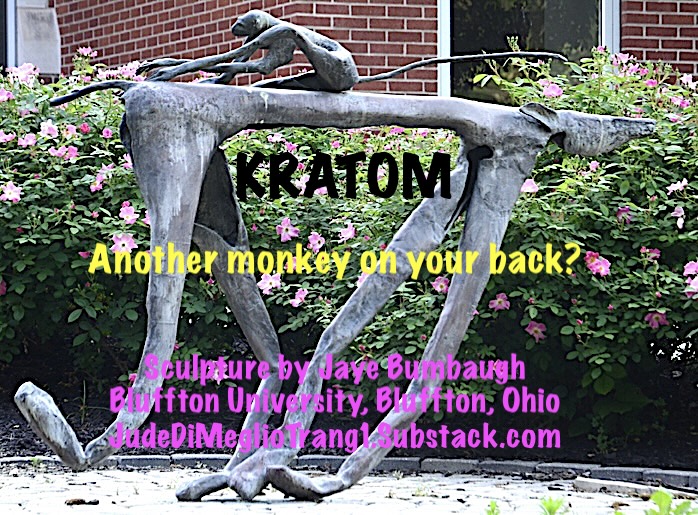
KRATOM: Another monkey on your back?

(Translation into most languages at tab to the right.)

It’s a new year around the world. Most developed and industrialized nations have similar hopes and concerns. Yet when one travels outside of the USA, we find some striking differences in how other leading countries in the world govern themselves. This is obvious in one particular area – when it comes to what substances are legal, allowed, or illegal.

Kratom is a good example. It is a Thai traditional medicine. The plant is in the coffee family and when used traditionally – i.e., chewed or dried for tea – it can produce mild stimulant or sedative-like effects. (1) But in the last decade, people driven by greed and profit (it is a billion-dollar industry), have once again figured out how to chemically super-charge the derivatives in Kratom in order to create a market with a highly addictive substance in the guise of a “natural” product sold at convenience stores and gas stations in all but six states in the USA. These concentrated derivatives contain 7-hydroxymitragynine (7-OH), a powerful psychoactive compound that occurs naturally in tiny amounts in kratom. 7-OH affects the same receptors in the brain as morphine and heroin – thus, the same effects that people seek in those drugs. And in these new potencies, kratom has the same strong potential for addiction.

A recent FDA report states that “7-OH is a naturally occurring substance in the kratom plant (Mitragyna speciosa), but only a minor constituent that comprises less than 2% of the total alkaloid content in natural kratom leaves. However, 7-OH demonstrates substantially greater mu-opioid receptor potency than kratom’s primary alkaloid constituent mitragynine, as well as other classical opioids such as morphine.” (2) There are too many articles documenting its opioid-like properties and side effects that I cannot cite them here, but the facts are easy to find, including its addictive qualities and associated deaths. I’ve given links to a few articles that are easy to read at the end of the blog.

Australia criminalized possession, supply, manufacture, production, growth or importation in 2005 and classified it as a Schedule 9 prohibited substance in all states and territories. It cannot be legally sold in health food stores or online in Australia. The only exceptions are for approved medical or scientific research, analytical, teaching, or training purposes, which require specific government authorization and licenses. (3)

What is interesting and frustrating is to see how one country can quicklky and efficiently act in agreement about a public health threat and create legislation that protects its citizens while it also leaves room for ongoing scientific investigation. Think about how many decades it has taken for the USA to come up with a similar approach for cannabis. It is currently illegal under federal law as a Schedule 1 controlled substance, but 40 of our 50 states have legalized it for medical use and 24 for recreational use. Schedule 1 classification places it alongside drugs like heroin and LSD. It can be scientifically studied legally, but there are complex federal regulations that require approval from the DEA (Drug Enforcement Agency) and the FDA. We just can’t seem to get our congress to simply function like other countries in a timely manner. 

Kratom is a perfect example. In 2016 the DEA intended to put 7-OH into the Schedule 1 category, which would have banned it. But there was pushback from the public and congress who argued that it had potential for chronic pain relief or even opioid withdrawal. So why couldn’t we make it illegal or at least regulate it while also allowing for scientific research? Why?

In the meantime, young people and adults who listen to friends or influencers are being lured once again into experimenting with something that will sooner or later prove to be a monkey on their back. If there are young people in your life who are curious about any substance, take the time to do the homework and discuss the facts with them. And if you see “Natural” or “Organic” Kratom being sold at your local gas station or convenience store, let the owners know you will not be shopping there until they remove these addictive products from their shelves.

NOTE: Thank you to Dr. Bayo Curry-Winchell for her very informative article (5)

The Least of Us, Pt 3: Reasons for Hope

(Translation into most language at tab to the right)

Sam Quinones is a quintessential storyteller in an investigative journalists’ body. And he uses his skill to weave in stories from families and communities along with the “true tales” from recent history of greed, corruption, deceit, and the politics surrounding the drug epidemic we are living with today. It is his reason for hope that I want to focus on now. Heaven knows we need some hope for The Least of Us… In the Time of Fentanyl and Meth. (1)

Part of the hope he feels comes from positive changes beginning in how drugs and addiction are viewed now compared to previous decades. ‘…greatly expanded drug treatment is part of what America needs…recovering addicts face scary odds as long as the drugs that torment them are widely available, potent, and almost free. The now-cliché is “We can’t arrest our way out of this.” We can’t treat our way out of it, either, as long as supply is so potent and cheap.’ (2) He discusses the mistake of drug criminalization, the possibilities and problems associated with drug legalization and drug decriminalization – all very well thought through and discussed. He traveled across America and interviewed professionals in every field to gain insights into this nightmare that is swallowing lives from every socio-economic group. (For those unclear about what opiates or meth do to our brains, there are detailed explanations woven in throughout the book.)

But his biggest reason for hope came from when Quinones traveled and also extensively interviewed another segment of American society: the addicted, their families, and those working in the many fields who are trying to restore the lives of those taken captive by these powerful substances. I have to say, many of the stories were hard to read, but it is from these people in the trenches and their stories that Quinones began to have hope.

Drug courts are one reason to hope. Because synthetic dope today does not allow users to hit rock bottom before seeking treatment – because ‘Today, rock bottom is death. We can use arrests – but not as a reason to send someone to prison. Instead, criminal charges are leverage we can use to pry users from the dope that will consume them otherwise.’ (3) It helps to put some space between their brain and dope so they can embrace sobriety where life repair can begin. Drug courts are not a luxury – they are a necessity.

Yet Quinones found that ‘…our best defense, perhaps our only defense, lies in bolstering community. America is strongest when we understand that we cannot succeed alone, and weakest when it’s every man for himself…That’s why the lesson we must learn is that we’re only as strong as the most vulnerable, as people who are in pain. (4)

As he traveled and listened, Quinones saw that it was people who loved those who are ‘the least of us’ who were making the sacrifices on a daily basis to help in ways they could. But they need help and support – from others and from the policies that are in place in our country.

Recently, I was sharing with a woman the contrast we experienced while we lived in Australia with our daughter and family for two years from the beginning of the Covid pandemic. I said that we were struck by the self-centered mentality – in private life and politics – we encountered when we returned to America and how different it is from the sense of being part of a community and responsibility to others that pervades Australian society. She responded: ‘I’d rather be selfish and self-centered than have my rights and freedoms taken away.’ I was literally speechless. What have we become?

Bolstering community will take a change from our self-centered culture where we who have plenty think we don’t have enough. Where we at the top of the food chain, instead of helping to maintain our communities, have corroded them in isolating and insulating ourselves by abandoning the places where we used to come together like neighborhood parks and community gatherings. ‘We need to again make policy of the belief that we can’t go it alone. The spirit of community needs to be built out, collectively, not just a shift of heart, which is necessary, but in taxation, in health care, in improved infrastructure – in other words, a shift in where the resources go…much of what neuroscience has learned about our brain confirms religion’s truths: humans need love, purpose, compassion, patience, forgiveness, and engagement with others. We’re built for simple things – for empathy and community. That is our defense.’ (5)

He ends his book, his plea to all of us, with this:

‘Community reconstruction doesn’t have to always be complex. It comes down to the unnoticed “constant habit of kindness” that French observer Alexis de Tocqueville, in the mid-1800’s, saw strengthened us locally and kept Americans from destructive isolation and the worst of individualism…The lessons are that we are strongest in community, as weak as our most vulnerable, and the least of us lie within us all.’ (6)

Thank you, Sam.

  1. The Least of Us: True Tales of America and Hope in the Time of Fentanyl and Meth by Sam Quinones
  2. Ibid, pg. 364
  3. Ibid, pg. 367
  4. Ibid, pg. 367
  5. Ibid, pg. 369
  6. Ibid, pg. 369

Remembering The Least of Us on Int’l Overdose Awareness Day August 31st, 2022

(Translation into most languages at tab to the right)

I wish everyone could read the penultimate chapter of The Least of Us by Sam Quinones. Its title is the same as that of the book. I have almost every line underlined and starred. In it, he describes the dire state we in Western society are in with addiction, the well-thought out reasons many of our public policies are still getting it wrong, and the slivers of hope that encourage us that the world could look differently for the next generation of young people. Some poignant quotes:

“Underground chemists seem to be searching the chemistry literature for drugs that might be molecularly modified to be more potent…The world Gary Henderson predicted when he coined the term ‘designer drugs’ in 1988 is now with us. Counterfeit pills laced with fentanyl (and new synthetics every day) and made in Mexico now dominate the market…There seems now no way to stop all the bizarre drugs devised by those whose own brain chemistry has been twisted by the profits of the underworld’s free market…recovering addicts face scary odds as long as the drugs that torment them are widely available, potent, and almost free. The now-cliché is ‘We can’t arrest our way out of this.’ We can’t treat our way out of it either, as long as supply is so potent and cheap.”

Continue reading “Remembering The Least of Us on Int’l Overdose Awareness Day August 31st, 2022”
Malcolm Guite

Blog for poet and singer-songwriter Malcolm Guite

The Gift of Need

How Need Can Strengthen Individuals and Communities

Memoirs and Musings

David Bradley Such

Dave Barnhart

Church planter, pastor, author, coach

RecoveryLife101

Just another WordPress.com site

Abbie In Wondrland

life...on Gods' terms.

Living In Graceland

"..learn the unforced rhythms of grace" matt 11:28

Janaburson's Blog

All about opioid addiction and its treatment with medication

Breaking In News Network

Seeking the truth and bypassing the MSM

Junkbox Diaries

Trauma, PTSD, Mental Health, Addiction, and Recovery

Ohio Society of Addiction Medicine

The Ohio Society of Addiction Medicine is a chapter of ASAM - A professional society actively seeking to define and expand the field of addiction medicine.

traceyh415

Addiction, Recovery, Loss, Grief

WordPress.com News

The latest news on WordPress.com and the WordPress community.