(Translation into most languages at tab to the right)
What is a recovery community and what should it look like?
The answer to these questions is not simple – real solutions to real problems rarely are.
To recover means to return to a normal state of health or strength. When someone is injured in an accident or undergone surgery, they usually recover in hospital for a period of time where they can receive the special medical care that is required to keep them alive. If the injury or illness was severe or life-threatening, after hospitalization they would be moved to a rehabilitation facility where they receive appropriate and specialized care and therapy as they convalesce – they wouldn’t just go home. Convalescing is the recovery process of returning to health.
Recovery can also refer to the process of regaining possession or control of something lost or stolen. In a real sense, those who have become addicted to a substance or damaging behavior have had something stolen. That’s not a cop-out if we consider what happens to a person’s brain when addiction takes over. The chemical changes that take place in the brain steadily decrease the individual’s original ability to think clearly and make logical choices. Especially with substances, I consider that capacity to have been stolen.
Translation to most languages available at tab to the right.
The human brain is a miracle – there is nothing on earth that comes close to its capabilities. Although the brain and the heart are the only two organs that can’t regenerate, our brain can form new connections and pathways. Neuroplasticity is this amazing ability of our neural networks to grow and reorganize – to change and adapt as a result of experiences.
Until recently, it was thought that neuroplasticity stops after about 25, but with new research, we now know that it isn’t all downhill from there. Neuroplasticity can be facilitated by physical exercise, paying attention, and learning new things.
Physical exercise that increases blood flow to the brain is now a no-brainer. Paying attention is when we are doing something that is not out of habit – when we switch off autopilot and pay attention to what is happening. This is called mindfulness. Learning new things and being open to change becomes harder the older we get – and it will become increasingly more difficult if we don’t intentionally challenge ourselves mentally.
But what happens when drugs – any drug really, but drugs/substances of abuse are my topic here – enter the scene? Neuroplasticity then becomes the facilitator of addiction as our brain learns to adapt to the new stimulus, increasingly over time.
(Translation in most languages available at tab on right)
Int’l Overdose Awareness Day Sale on eBook & Paperback through Sept 1st
Most of us have heard that the category of “teenager” came about after WWII. Before that, in a mostly agrarian society, you were either a child or an adult and the demarcation was when you went from being directed and cared for by your parents to being responsible for yourself and caring for others.
The word “teen” was introduced as early as 1818 referring to a person who was 13-19, “teener” from 1894, and “teen-ager” from 1922 (1). But the terms didn’t stick and didn’t carry a sociological group identity until after WWII. Being a teenager became its own sub-culture that revolved around like-ness, popularity and a fear of being on the outside.
Increasingly, the modern teenager relies more on peer-pressure than family relationships and values. And, peer pressure and group dynamics is known to be one of the highest risks for adolescent drug and alcohol experimentation and use. In one chapter of Hit Makers: The Science of Popularity in an Age of Distraction, Derek Thompson discusses teenagers at length (2). He writes, “Psychologist Laurence Steinberg, put people of various ages in a simulated driving game. Adults drove the same, whether or not they had an audience. But teenagers took twice as many “chances” when their friends were watching. Teenagers are exquisitely sensitive to the influence of their peers.”
(Short topical blogs based on Opiate Nation – translation into most languages in tab on right.)
When we hear the phrase “ghost stories” most of us think of scary and spooky stories shared around a campfire with the intended, and predicable, consequence of keeping us awake at night.
But when H Lee (aka Harris Insler) decided to call his new podcast series “These Ghosts Must Be Heard”, it wasn’t because he would be interviewing people with paranormal experiences. And although the stories his guests share aren’t scary in the ghoulish sense, they have kept their narrators awake at night for days, weeks, and months on end. John and I included. (To hear our interview with Harris, see links below for Podbean, Amazon, Spotify.)
These are real-life experiences and these “ghosts” are the spirits of our deceased loved ones: children, friends, partners who have succumbed to premature and preventable deaths from opioid overdoses.
(I am re-posting this from July 4th for those who were on holiday and missed it.)
Topical blogs taken from OPIATE NATION. Translation into most languages at tab on right.
I was listening to a young man who had been heavily addicted to crystal meth. As he told his story, one of his “ah-ha” moments was walking into a bathroom in his parents’ home and seeing himself in the mirror. As he looked at the vestige of his former self – an emaciated, festered, hollow-eyed man – he remembered who he once was: a happy and carefree young person with good friends, a star athlete, a kind and honest person, a loving son. That moment of realization caused him to reach out and ask for help which eventually led to the beginning of his recovery journey.
As I heard his story, a photo flashed before my eyes of my son, JL – one we found on his phone after he died from a heroin overdose. It was a selfie he had taken after he had relapsed, just days before he died, standing in front of a full-length mirror in a public bathroom. He was dressed for work in slacks and a dress shirt. No smile. I have always wondered why he took that photo. Was it to remind himself of who he really was? To be able to be honest with himself when he might look at it later when he was high? Was he attempting to make himself stop using? To ask someone for help?
Topical blogs taken from OPIATE NATION. Translation into most languages at tab on right.
I was listening to a young man who had been heavily addicted to crystal meth. As he told his story, one of his “ah-ha” moments was walking into a bathroom in his parents’ home and seeing himself in the mirror. As he looked at the vestige of his former self – an emaciated, festered, hollow-eyed man – he remembered who he once was: a happy and carefree young person with good friends, a star athlete, a kind and honest person, a loving son. That moment of realization caused him to reach out and ask for help which eventually led to the beginning of his recovery journey.
As I heard his story, a photo flashed before my eyes of my son, JL – one we found on his phone after he died from a heroin overdose. It was a selfie he had taken after he had relapsed, just days before he died, standing in front of a full-length mirror in a public bathroom. He was dressed for work in slacks and a dress shirt. No smile. I have always wondered why he took that photo. Was it to remind himself of who he really was? To be able to be honest with himself when he might look at it later when he was high? Was he attempting to make himself stop using? To ask someone for help?
I’ll never know.
But after listening to this other young man, I’m guessing my son had similar thoughts going through his mind. Yet, what seems to have happened is that his addicted mind told himself that he could handle it on his own – that he could just cut down his use and not have to go through withdrawal one more time, not have to be embarrassed by telling us he had relapsed after 6 months of sobriety, not have to start all over again.
Perception refers to how we interpret things and it is the motivation behind our actions and reactions. His perception of his ability to use his willpower was skewed, because our self-perception is influenced by many factors including our perceived needs, our experiences, and our expectations.
Beneath self-perception is our self-concept, our view of our self, which influences our decisions, our feelings, and our judgement. It may include genuine self-knowledge or varying degrees of distortion.
Many times, we choose – albeit unconsciously – to be self-deceived because it is too painful to be honest with ourselves, to interpret what we see in the mirror with unbiased and accurate judgement. There is a saying written in the first century AD that sums this up:
“Those who hear (a clear direction) and don’t act are like those who glance in the mirror, walk away, and two minutes later have no idea who they are or what they look like.”
Because of this very human tendency, we all need a few close friends and a safe community who love us enough to honestly reflect back what we saw in the mirror – which we can so conveniently forget.
(Twenty-ninth in a series of topical blogs based on chapter by chapter excerpts from Opiate Nation. Translation into most languages is available to the right.)
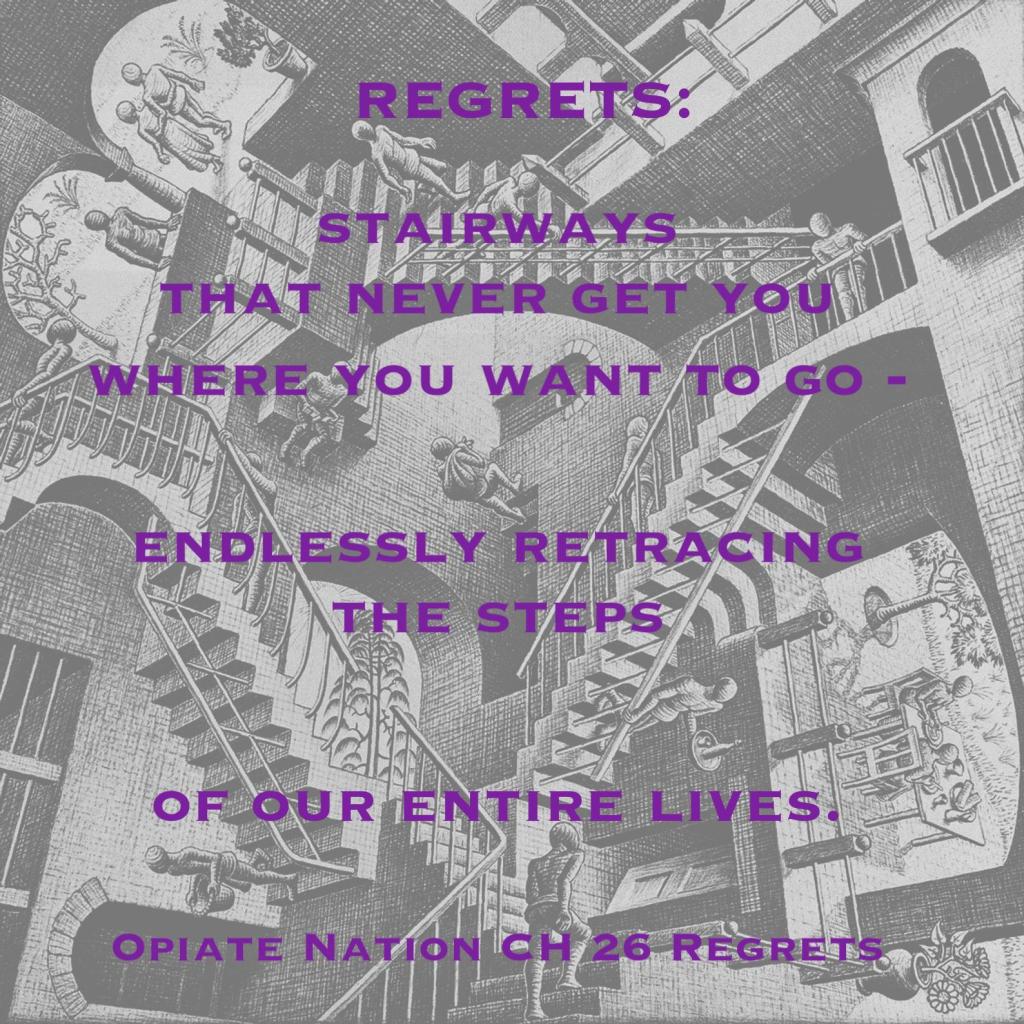
Our family loves the art of Dutch mathematician and artist M. C. Escher: the buildings that open into themselves, the school of fish that become a flock of birds, the circuitous stairways that go up and down throughout multiple buildings without an end point. Yes, stairways that never get you where you want to go, but keep you endlessly retracing your steps. They are no longer interesting art to wonder at. They now mirror how John and I have felt many times since August 2nd—regrets—retracing the steps of our entire lives.
(Twenty-sixth in a series of topical blogs based on chapter by chapter excerpts from Opiate Nation. Translation into most languages is available to the right.)
Nine months after our son, JL’s, sudden death, we were gradually unearthing our grief, as we gradually unearthed pieces of his life. We were miners searching for something precious, digging through the layers of years as if through layers of rock. Or perhaps we were more like survivors of an earthquake. Our entire earth, with everything we had built on it, was suddenly shaken to the point of collapse, and we were sifting through the remaining buildings and rubble to see what was left. Deciding what to keep and what to dispose of. “Dispose of” has new and unwelcome meanings now. Clothing, personal belongings, furniture, files, photos, childhood toys, keys, memorabilia.
John’s journal entry on May 12, 2015 expresses some of our feelings:
Dear JL,
It’s dad again. We are going through more of your things and I spent a half-day shredding your old papers and notes. It is so odd that much of our lives comes down to boxes of paper to shred. This is very, very hard for me. Shredding your life.
I love you – Dad
Grief is about what is going on inside us after a loss—how we feel. We have no more control over it than we have control over other feelings. Our choice involves how we deal with it.
Mourning is the action of dealing with our loss—what we do, the common rituals, the external part of the tragedy. Again, we choose how we mourn.
Some people put acts of mourning off indefinitely – leaving a deceased loved one’s belongings just as they were when they died until they die themselves. Others, urged on by society or their own distraught emotions, will almost immediately begin sorting and throwing. For us, there were some natural milestones when deep inside we seemed to know it was time to face the loss of another part of our son’s life. The grief-work we were engaged in – being aware of the various stages of grief and facing them as they surfaced – was our internal guide. We never let societal custom or any external pressure guide us, while we did read and listen to other’s experiences.
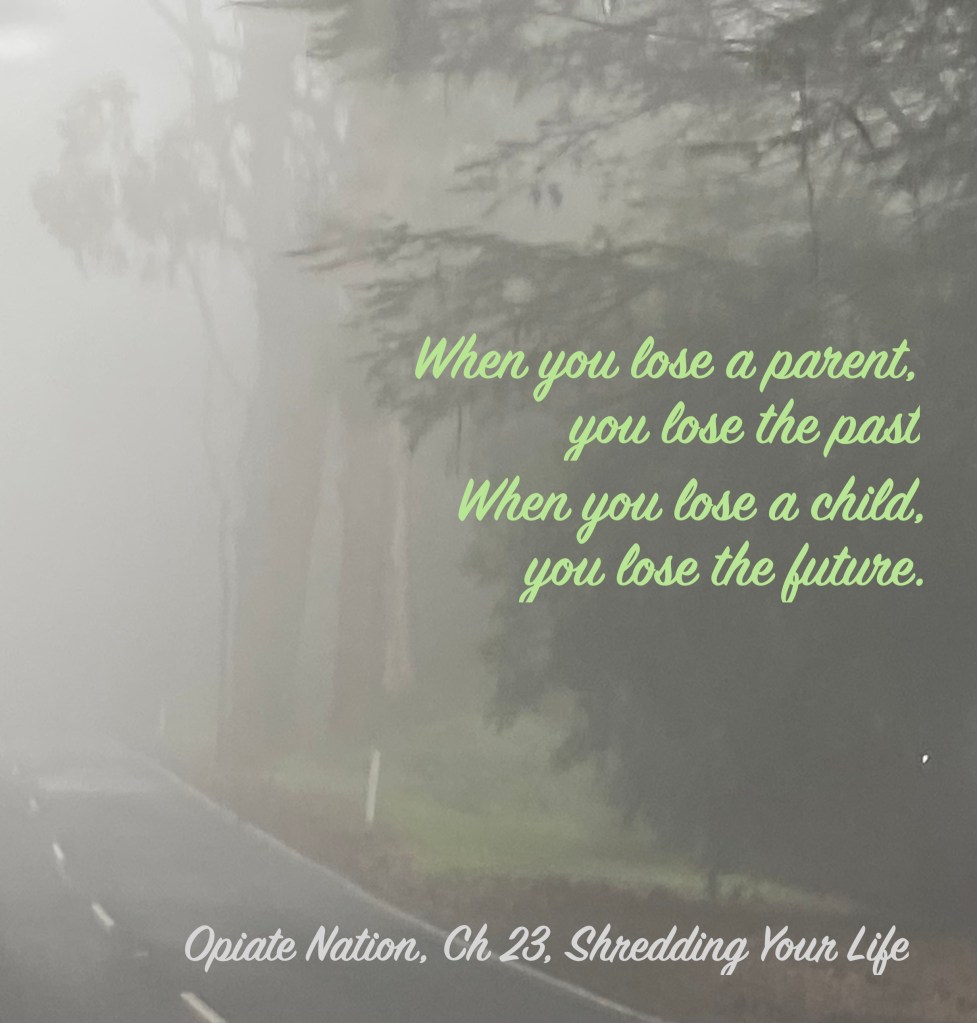
One thing became clear: this loss of our child was very, very different than the loss of our parents or siblings. Although each of those were difficult in their own distinct ways, the level of personal pain with our son’s death was unique. He was an intimate part of who we are – of course – he came from us. As he grew and became his own person, he yet remained a part of our life and more significantly, our future. All is engulfed in a thick fog. Which is why the quote in the photo is so poignant:
When you lose a parent, you lose the past. When you lose a child, you lose the future.
(Twenty-fourth in a series of topical blogs based on chapter by chapter excerpts from Opiate Nation. Translation into most languages is available to the right.)
Historically, “enabling” referred to facilitating or empowering someone in order to help them accomplish something. By teaching children to read, we enable them to develop their intellect and further their learning. Or, as in 1933 Germany, “The Enabling Act” gave Adolf Hitler the power to enact laws without the involvement of the legislative bodies: he was enabled to become a legal dictator. In modern psychology, enabling can be positive, but it is also used in a negative sense when it encourages dysfunctional, unhealthy behavior and habits, as it is used in addiction and recovery vocabulary. Rescuing and caretaking are terms that mean what they say. They are closely connected to enabling: we rescue people from their responsibilities and we take care of people’s responsibilities for them.
Melody Beattie (Codependent No More) refers to the “Drama Triangle” roles of victim, persecutor, rescuer, and says “Rescuing/caretaking looks like a much friendlier act than it is. It requires a victim who is actually capable of taking care of themselves even though we and they don’t admit it…After we rescue, we will inevitably move to the next corner of the triangle, persecutor. We become resentful and angry at the person we have so generously helped…Then we move to the victim corner of the triangle, at the bottom, the predictable and unavoidable result of a rescue.”
(Twenty-third in a series of topical blogs based on chapter by chapter excerpts from Opiate Nation. Translation into most languages is available to the right.)
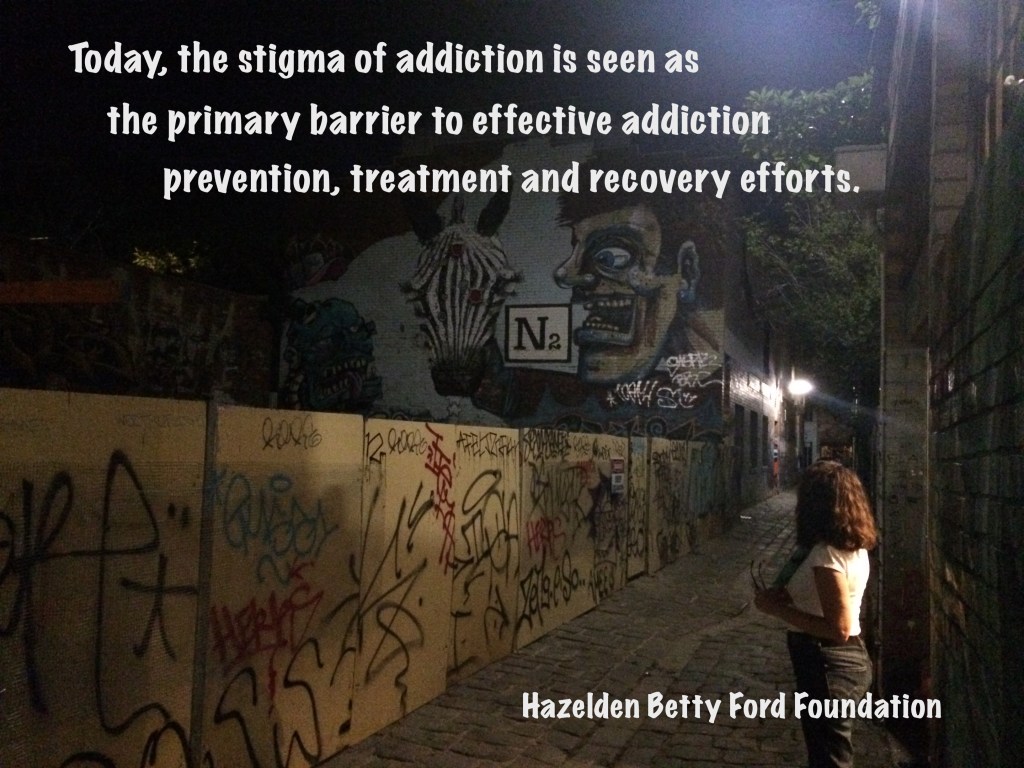
For generations, the combination of personal shame and public stigma has produced tremendous obstacles to addressing the problem of alcoholism and drug addiction in America. Addiction stigma prevents too many people from getting the help they need.–Hazelden-Betty Ford Institute for Recovery
Historically, the word shame was used interchangeably with guilt – the appropriate pang of conscience that followed doing something wrong. In reality, there is an important distinction between shame and guilt. Shame is about who you think you are; guilt is about what you have done.
Stigmas are linked to shame. In the Greek and Latin worlds, a stigma was a mark or brand, especially for a slave, identifying them as “inferior.” Later, it became known as a mark or stain we can’t see with our eyes: social stigmas that are based on perceivable characteristics, associated with certain behaviors that distinguish a person from other members of society. They convey disapproval and disgrace.
The Ohio Society of Addiction Medicine is a chapter of ASAM - A professional society actively seeking to define and expand the field of addiction medicine.