All Souls, All Saints, All of Us

(Translation into most languages at tab to the right.)

This year, the All-Souls’ Procession in Tucson, where I live, is today. The traditional date for celebrating All Souls’ Day (the Day of the Dead) is November 2nd. It was delayed this year because Halloween was on the same weekend. Tucson has one of the largest processions in the country with several hundred thousand people participating. Preceding this is All Saints Day on November 1st.

All Saints Day had its beginnings in Roman Church tradition dating back to the early centuries when Christians were martyred for their faith or who had publicly confessed and somehow survived the Roman persecution. The belief was that they were saints and immediately taken up into heaven. By the mid 800’s, Pope Gregory IV assigned Nov. 1st as the holy feast of All Saints.

All Souls’ Day evolved sometime around 1000 as a time to pray for the souls of all who had died. This is tied in directly with the Catholic Church belief in purgatory and those who are awaiting the joys of heaven. In pleading for them, we are reminded of our own offenses and so inspired to lead purer lives.

My husband, John, and I have walked many times in the procession here in Tucson although we are not Catholics and we believe that all those who have faith in and follow Jesus are saints, as the New Testament teaches.(1) Many Evangelical Christians think it is wrong to participate in All Souls’ events because it is not biblical to pray for the dead and they reject the concept of purgatory because nothing we do can alter ones destination in the afterlife. (2)

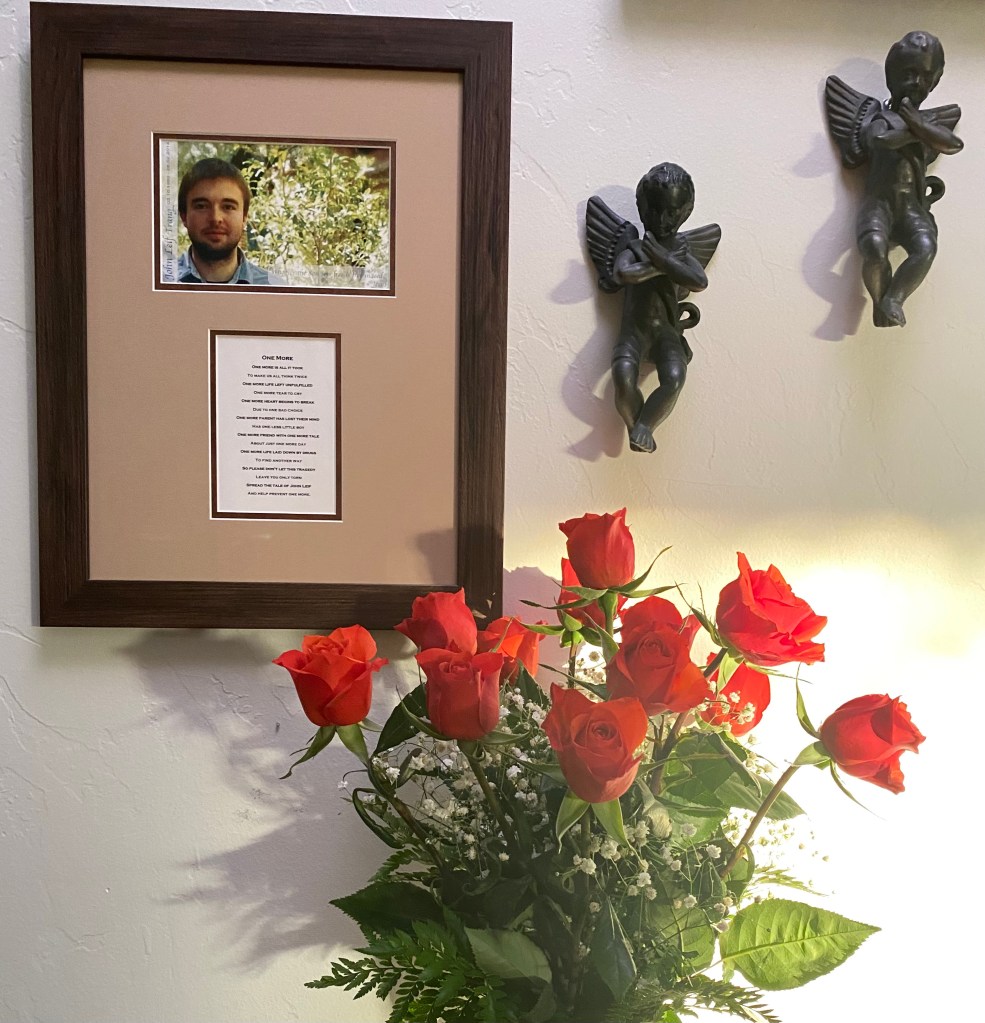
While we hold to basic New Testament beliefs, we do not find it contradictory to be part of the All-Souls’ procession in remembrance of our son, John Leif. The procession is a public ceremony to honor the dead and celebrate their lives, allowing participants to release and integrate their grief. Our son’s death from a heroin overdose – a reason many others are there – continues to be a source of sadness and regret. To remember and celebrate him as a person worthy of love is important for us. We do not want to shame him and do not want him to be forgotten. 

What is sad to us is the way in which this holiday is treated with similar vitriol that partisan politics infiltrates so many areas of American life these days. There are “Christians” who stand along the procession route shouting out ugly and sinful – yes, sinful – rebukes to those walking in remembrance of their loved ones. Sadly, many people feel it necessary to take a side on almost every issue – and supposed Christians are some of the leading voices. The unholy mixture of politics and “faith” in our country is deeply disturbing to us and absolutely un-Biblical. 

While we hold that our beliefs are true and worthy of sharing with others, we also feel it imperative that we respect others’ beliefs and faith traditions without mocking or denigrating them as all New Testament writing demonstrates. This is especially important when it comes to how people choose to remember and honor their loved ones who have died. 

In the past several decades, opioid addiction has taken the lives of hundreds of thousands of beautiful young people. We believe they are worthy of being remembered without shame and with love in whatever way their loved ones choose. And in so doing, we hope their lives stand as a warning for other young people tempted into experimenting with increasingly deadly drugs.

  1. I Corinthians 1:2, Romans 1:7, Philippians 1:1, Ephesians 2:19
  2. Hebrews 9:27
  3. History behind All Saints and All Souls:
Death: Painful or Beautiful?

(Translation into most languages at tab to right)

My husband and I recently watched the streaming memorial service for his niece who died of cancer at 51 years old. Her mother, husband, children, sister and extended family all mourning the inescapable truth that there is now a gaping hole in their hearts and lives where once a beautiful woman had lived. She has been torn from their lives like when a thief grabs a bag from your hand and you struggle and try to hang on to it but, in the end, it’s gone. Weeping is the only thing that feels appropriate.

Although it’s been nine years since our son JL died from an accidental heroin overdose, the sense of him being torn away from us remains. Whether it was the death of our son, my siblings, our parents, or friends, the undeniable fact remains that death is painful. Almost always painful for the person dying, especially with a protracted illness or debilitating condition. But always painful for those left to live with the empty space where the person they knew and loved used to reside. We will never forget the Sherriff’s knock at our door that Saturday morning and hearing him say, “I’m sorry to have to tell you…”

We all naturally focus on our loved one’s beautiful life and the memories we have of them. This is only right and good. And there can be beauty in the way someone dies – this I have seen, and this has been recorded throughout history. Regardless of the kind of death – whether by illness, accident, torture, or plain old age – history tells us about those who have faced pain and death with grace. How? Because they saw beyond this world and had hope for life in the next.

What I bristle against is the thought that death is somehow beautiful. There is nothing beautiful about the tearing away and finality of death. Sentimental and romanticized thoughts about death have never helped me when I have had to stare into the cold face of a dead loved one. I have watched people facing the intense and unpredictable emotions after the death of a loved one as they try to make sense of something senseless. Those who have no hope of seeing their loved one again and who do not have the hope of existence in another realm, often try to transform death into something else – as if the only way to survive their pain is to imbue death itself with beauty. Or perhaps attempt to ignore it altogether.

For me, I believe that there is a good God who will one day put this world back to the way he created it. In my view, death and the tearing separation and sadness that accompany it are a temporary condition of living in a fallen world. We are told that death is an enemy and that one day it will be abolished. Yet, knowing I will see my son and siblings and parents and beloved friends again one day, where there will be no more sickness or pain or tears, doesn’t change the sorrow and grief that I feel now. I am a mortal living in a physical body in a physical world facing real physical triumphs and tragedies. And until this life is over and this world is made new, death will be painful. Our response to pain, suffering, and death is what concerns us now. And comforting those who mourn and offering compassion, regardless of the circumstances surrounding their death, is something tangible that does not minimize or romanticize the pain of death.

UPDATE:

This morning, August 2nd, I just happened to find and listen to an affirming podcast on Hope In The Face of Death by Dr. Timothy Keller. It is well worth the 40 minutes of your time. He says what I am trying to communicate more eloquently and thoroughly.

https://podcast.gospelinlife.com/e/hope-in-the-face-of-death/

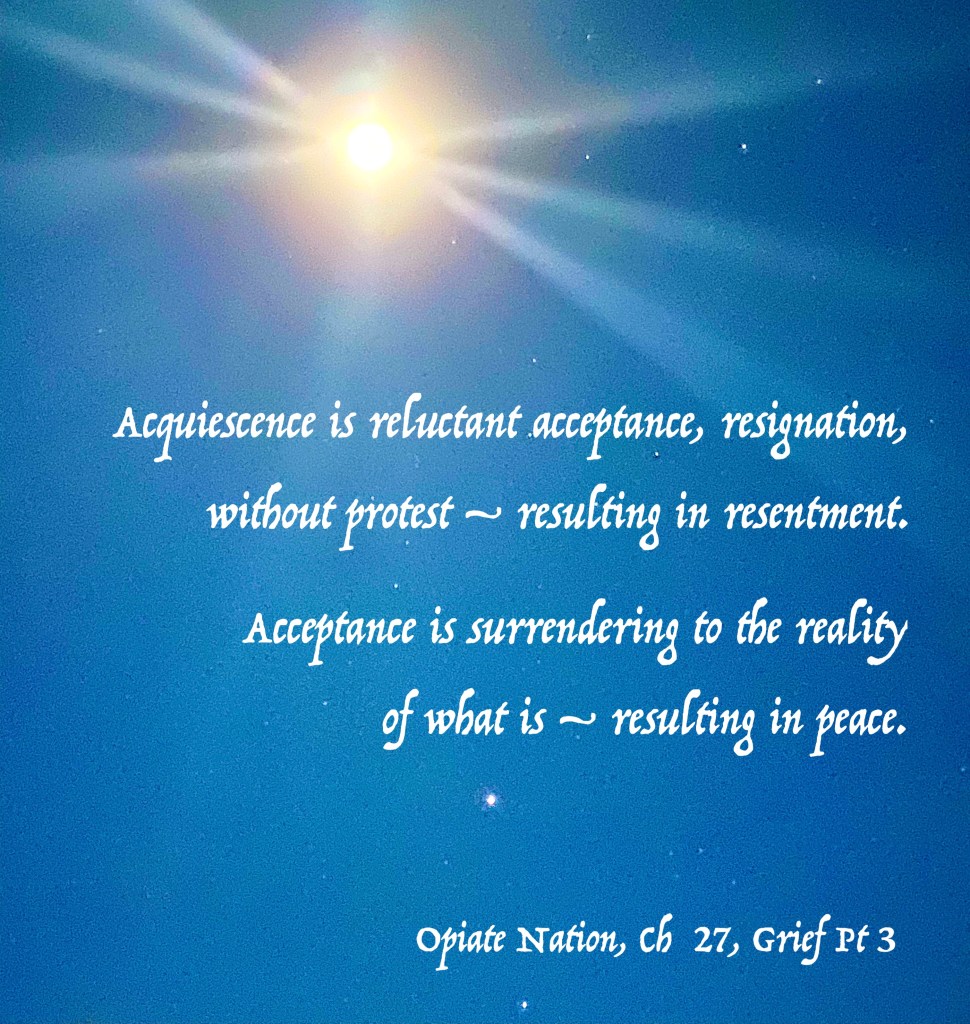
Grief: Acceptance or Acquiescence?

(Twenty-ninth in a series of topical blogs based on chapter by chapter excerpts from Opiate Nation. Translation into most languages is available to the right.)

I have never been one to accept something without question – anyone who knows me well, knows this – and they live with the frustration my incessant questions create. But it’s the way I need to process what is happening to or in or around me in order for me to honestly make the decision to accept or reject whatever the issue is at hand. I don’t think I could live with myself if I pretended I agreed or accepted something when I didn’t – the dishonesty would keep me in turmoil. And many times, it is ultimately for self-preservation that I accept something distasteful or painful when I finally understand there is no other option.

Death leaves us no other option – it is not negotiable. For most of us, our survival instinct brings us to the realization that in order to retain our sanity, we must eventually accept death – even of those we love the most in this world – whether we like it or not.

Continue reading “Grief: Acceptance or Acquiescence?”

Time & Eternity

(Twenty-seventh in a series of topical blogs based on chapter by chapter excerpts from Opiate Nation. Translation into most languages is available to the right.)

Death naturally brings up thoughts and questions about existence beyond this life, this earthly existence. I love how John Milton said it: “Death is the golden key that opens the palace of eternity.” For us, after a death so intimate as our son’s, one can imagine how often we thought about it, particularly in the subsequent months.

One thought that continues to captivate John and I is the possibility that others can look into our time while they are in eternity, in heaven, like someone looking into a cell under a microscope at us, the human specimens. Or are they frozen in time, like being in a time capsule?

Six weeks after JL’s death, my journal entry highlights these questionings:

JL,

Mom here. I’ve been wondering, and wishing I knew the answer for sure, if you and others who are gone can hear us and are conscious of what is happening on earth and in our lives. Can you hear when Dad and I talk to you? If you can, I think you would be crying for us many times as you see and hear our pain. I hope we are not causing you any more pain…

Dad and I went out to dinner and talked about this. What he brought up was that eternity, by definition, is the absence of time as we know it here on earth. So, if those of you who are dead are also in “no time,” even though present with the Lord, you may not experience any consciousness between death and the final resurrection we believe in—it may just be a flash. Hmmm…I don’t like that concept. I want to know you hear me and my apologies and love and thoughts towards you.

Singer-songwriter Phil Keaggy’s song “Time” from his album Love Broke Thru expresses the limits in which Father Time exists:

My friend, David Such (a mechanical engineer, writer, artist) wrote a blog about the Elasticity of Time. Here is a relevant thought from that blog:

Most of us human beings are locked into “earth time” so it can sometimes be difficult to understand, but Einstein taught that “time” is elastic depending on one’s position, perspective, and velocity. I am merely a mechanical engineer and do not fully understand all the physics or all the mathematics, but I do understand the concept as follows. As we increase our velocity, we reduce the difference between our own speed and the speed of light. This is insignificant unless our velocity is extremely high. As we approach the speed of light, “time” slows to a standstill (and apparently, even “matter” takes on different shapes and densities).

Genesis One and the Elasticity of Time

In 1676, the Danish astronomer, Olaus Roemer, first successfully measured the speed of light: Lightspeed. For those of us who believe in God and that his intelligence designed the Universe, his words “Let there be light” have much significance. Eternity must at least be full of light, beyond time, beyond darkness and death. In death do we instantaneously exist in lightspeed and the absence of time?

If so, is JL zipping and zooming around the universe at lightspeed now, with all the other souls who have left this earthly constraint of time? I have no clue, but I smile at the thought.

A Lament and A Love Song – for Our Son

Lament for a Son is an intensely personal tribute by Nicholas Wolterstorff to his 25-yr-old son who died in a climbing accident. It is eloquent and unforgettable as he gives voice to a grief that is both unique and universal: the tortured pain of losing an individual, a child, your child.

We lost our 25-yr-old son to a heroin overdose six years ago on August 2, 2014. Lament for a Son has been one of our go-to books since that time. Wolterstorff expresses the incomprehension and sense of unfairness that, I believe, parents worldwide feel when they lose a child – someone who is supposed to bury you, not the other way around. It doesn’t fit with the cycle of life we expect – it is jarring, unsettling, bewildering, frustrating, disquieting.

In the Preface he relates:

A friend told me he gave a copy of Lament to all of his children. “Why?” I asked. “Because it’s a love song,” he said. That took me aback. But, Yes, it is a love-song. Every lament is a love song. Will love-songs one day no longer be laments?

Yet, while the book expresses the common feelings brought on by sudden unexpected death, what he doesn’t share with those of us who have lost a child to drug/alcohol addiction are the previous long years, sometimes decades, of turmoil, anxiety, fear, and depression that we experience on top of all the normal grief.

And shame.

There is no glory in being the parent of someone who is an addict or alcoholic.

Continue reading “A Lament and A Love Song – for Our Son”
Malcolm Guite

Blog for poet and singer-songwriter Malcolm Guite

The Gift of Need

How Need Can Strengthen Individuals and Communities

Memoirs and Musings

David Bradley Such

Dave Barnhart

Church planter, pastor, author, coach

RecoveryLife101

Just another WordPress.com site

Abbie In Wondrland

life...on Gods' terms.

Living In Graceland

"..learn the unforced rhythms of grace" matt 11:28

Janaburson's Blog

All about opioid addiction and its treatment with medication

Breaking In News Network

Seeking the truth and bypassing the MSM

Junkbox Diaries

Trauma, PTSD, Mental Health, Addiction, and Recovery

Ohio Society of Addiction Medicine

The Ohio Society of Addiction Medicine is a chapter of ASAM - A professional society actively seeking to define and expand the field of addiction medicine.

traceyh415

Addiction, Recovery, Loss, Grief

WordPress.com News

The latest news on WordPress.com and the WordPress community.