All Souls, All Saints, All of Us

(Translation into most languages at tab to the right.)

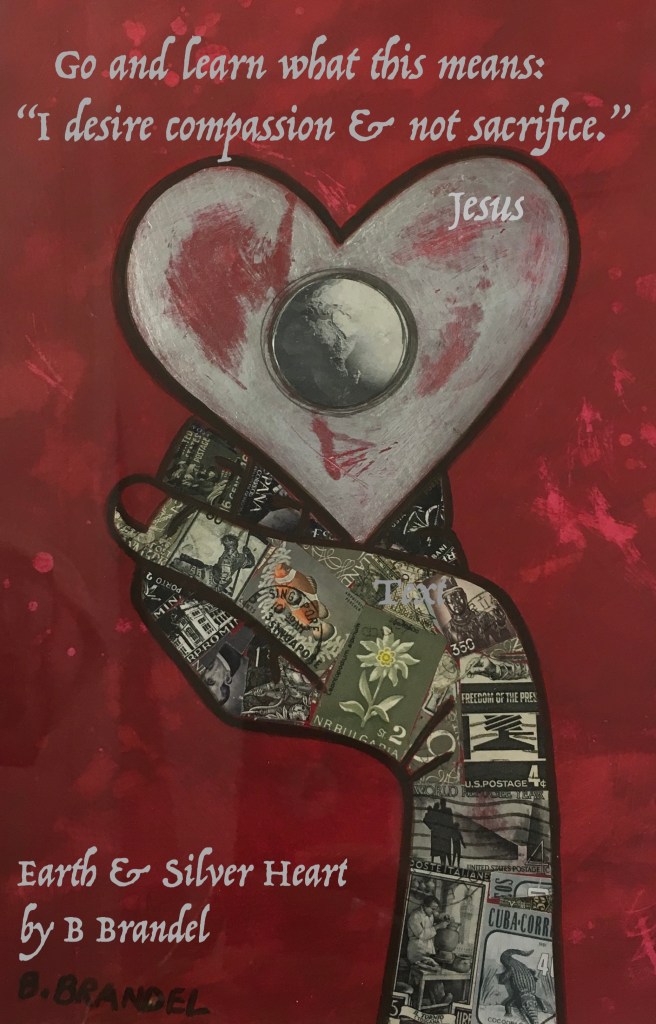
This year, the All-Souls’ Procession in Tucson, where I live, is today. The traditional date for celebrating All Souls’ Day (the Day of the Dead) is November 2nd. It was delayed this year because Halloween was on the same weekend. Tucson has one of the largest processions in the country with several hundred thousand people participating. Preceding this is All Saints Day on November 1st.

All Saints Day had its beginnings in Roman Church tradition dating back to the early centuries when Christians were martyred for their faith or who had publicly confessed and somehow survived the Roman persecution. The belief was that they were saints and immediately taken up into heaven. By the mid 800’s, Pope Gregory IV assigned Nov. 1st as the holy feast of All Saints.

All Souls’ Day evolved sometime around 1000 as a time to pray for the souls of all who had died. This is tied in directly with the Catholic Church belief in purgatory and those who are awaiting the joys of heaven. In pleading for them, we are reminded of our own offenses and so inspired to lead purer lives.

My husband, John, and I have walked many times in the procession here in Tucson although we are not Catholics and we believe that all those who have faith in and follow Jesus are saints, as the New Testament teaches.(1) Many Evangelical Christians think it is wrong to participate in All Souls’ events because it is not biblical to pray for the dead and they reject the concept of purgatory because nothing we do can alter ones destination in the afterlife. (2)

While we hold to basic New Testament beliefs, we do not find it contradictory to be part of the All-Souls’ procession in remembrance of our son, John Leif. The procession is a public ceremony to honor the dead and celebrate their lives, allowing participants to release and integrate their grief. Our son’s death from a heroin overdose – a reason many others are there – continues to be a source of sadness and regret. To remember and celebrate him as a person worthy of love is important for us. We do not want to shame him and do not want him to be forgotten. 

What is sad to us is the way in which this holiday is treated with similar vitriol that partisan politics infiltrates so many areas of American life these days. There are “Christians” who stand along the procession route shouting out ugly and sinful – yes, sinful – rebukes to those walking in remembrance of their loved ones. Sadly, many people feel it necessary to take a side on almost every issue – and supposed Christians are some of the leading voices. The unholy mixture of politics and “faith” in our country is deeply disturbing to us and absolutely un-Biblical. 

While we hold that our beliefs are true and worthy of sharing with others, we also feel it imperative that we respect others’ beliefs and faith traditions without mocking or denigrating them as all New Testament writing demonstrates. This is especially important when it comes to how people choose to remember and honor their loved ones who have died. 

In the past several decades, opioid addiction has taken the lives of hundreds of thousands of beautiful young people. We believe they are worthy of being remembered without shame and with love in whatever way their loved ones choose. And in so doing, we hope their lives stand as a warning for other young people tempted into experimenting with increasingly deadly drugs.

  1. I Corinthians 1:2, Romans 1:7, Philippians 1:1, Ephesians 2:19
  2. Hebrews 9:27
  3. History behind All Saints and All Souls:

Learning Compassion

(Translation into most languages at tab to the right.)

The other day, I was thinking back over the tragic deaths of many of my family members. And I thought about how I felt towards people a few decades ago when they suffered various illnesses or struggled with disease or addiction. I didn’t have much compassion because I hadn’t ever experienced those types of painful and heart-wrenching needs myself or in anyone I loved.

But in 2000, when my younger brother was in intensive care for two months on a ventilator and in a coma, I began to learn about the sorrow and desperation that hover around situations like this – for the one who is ill and for those who love them and who cannot do a thing to help or change the outcome. His diagnosis of HIV/AIDS and slow but impending death broke my heart – maybe for the first time in my life.

Continue reading “Learning Compassion”

Grieving The Living

(Translation into most languages at tab to the right)

In a world where ‘nothing is certain except death and taxes’ and loss is unavoidable, grief is guaranteed to be an emotion each of us will experience in our lives sooner or later. If we have lost a loved one and grieved well, we can understand grief in others and empathize more fully.

But what about those who are living with a loved one with mental health problems, or in active addiction, or in a recovery program for the umpteenth time, or whose whereabouts are unknown? How do they live with the constant flux between hoping against hope, waiting, and praying for a miraculous change, and discouragement and depression as they watch their loved one struggle against an unrelenting enemy no one can see? My husband and I lived in this twilight zone for years – as do millions of others. While he was still living, we were grieving the loss of the son we loved and raised and had hoped to see move successfully into adulthood.

In an excellent article, Grieving the Living, Dr. Susan D. Writer shared insights that are an invaluable help and source of comfort for this all too common situation:

Continue reading “Grieving The Living”

Grief: Acceptance or Acquiescence?

(Twenty-ninth in a series of topical blogs based on chapter by chapter excerpts from Opiate Nation. Translation into most languages is available to the right.)

I have never been one to accept something without question – anyone who knows me well, knows this – and they live with the frustration my incessant questions create. But it’s the way I need to process what is happening to or in or around me in order for me to honestly make the decision to accept or reject whatever the issue is at hand. I don’t think I could live with myself if I pretended I agreed or accepted something when I didn’t – the dishonesty would keep me in turmoil. And many times, it is ultimately for self-preservation that I accept something distasteful or painful when I finally understand there is no other option.

Death leaves us no other option – it is not negotiable. For most of us, our survival instinct brings us to the realization that in order to retain our sanity, we must eventually accept death – even of those we love the most in this world – whether we like it or not.

Continue reading “Grief: Acceptance or Acquiescence?”

The Paradox of Memories

(Twenty-eighth in a series of topical blogs based on chapter by chapter excerpts from Opiate Nation. Translation into most languages is available to the right.)

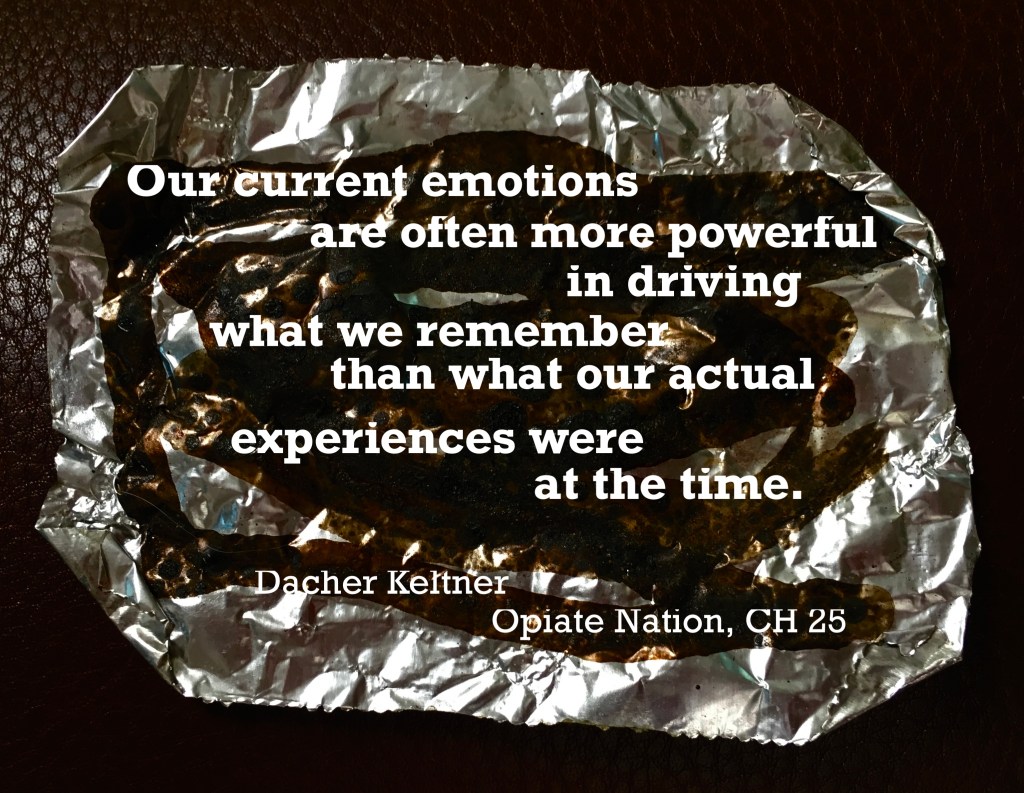
Memories are strange things. How much control do we have over them? What triggers bring up which memories? How do triggers differ with each individual personality? Does grief affect memory? I know it does mine because I continue to experience new associations and memories being formed from what were once familiar items with no particular memory attached before—which now, after my son’s battle with addiction and death, have a specific memory related to him.

Like aluminum foil.

Continue reading “The Paradox of Memories”

Shredding A Life – Losing the Future

(Twenty-sixth in a series of topical blogs based on chapter by chapter excerpts from Opiate Nation. Translation into most languages is available to the right.)

Nine months after our son, JL’s, sudden death, we were gradually unearthing our grief, as we gradually unearthed pieces of his life. We were miners searching for something precious, digging through the layers of years as if through layers of rock. Or perhaps we were more like survivors of an earthquake. Our entire earth, with everything we had built on it, was suddenly shaken to the point of collapse, and we were sifting through the remaining buildings and rubble to see what was left. Deciding what to keep and what to dispose of. “Dispose of” has new and unwelcome meanings now. Clothing, personal belongings, furniture, files, photos, childhood toys, keys, memorabilia.

John’s journal entry on May 12, 2015 expresses some of our feelings:

Dear JL,

It’s dad again. We are going through more of your things and I spent a half-day shredding your old papers and notes. It is so odd that much of our lives comes down to boxes of paper to shred. This is very, very hard for me. Shredding your life.

I love you – Dad

Grief is about what is going on inside us after a loss—how we feel. We have no more control over it than we have control over other feelings. Our choice involves how we deal with it.

Mourning is the action of dealing with our loss—what we do, the common rituals, the external part of the tragedy. Again, we choose how we mourn.

Some people put acts of mourning off indefinitely – leaving a deceased loved one’s belongings just as they were when they died until they die themselves. Others, urged on by society or their own distraught emotions, will almost immediately begin sorting and throwing. For us, there were some natural milestones when deep inside we seemed to know it was time to face the loss of another part of our son’s life. The grief-work we were engaged in – being aware of the various stages of grief and facing them as they surfaced – was our internal guide. We never let societal custom or any external pressure guide us, while we did read and listen to other’s experiences.

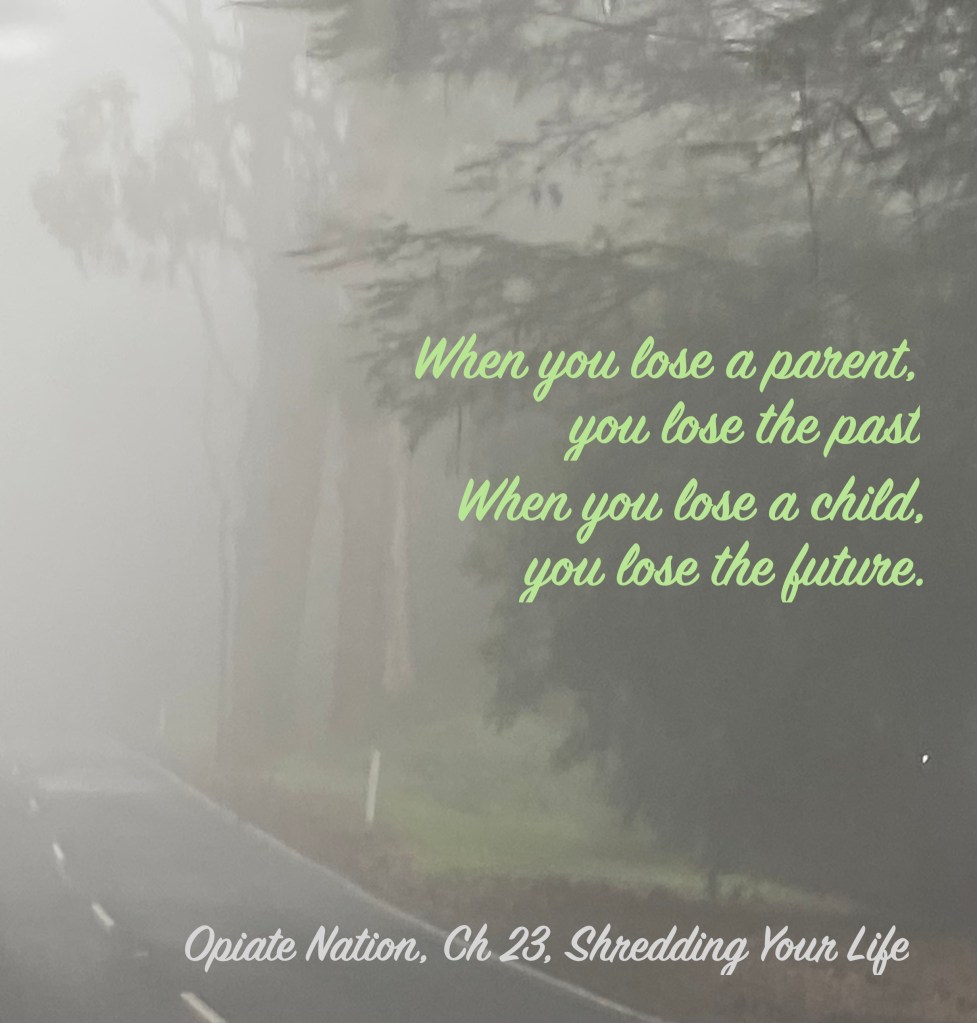
One thing became clear: this loss of our child was very, very different than the loss of our parents or siblings. Although each of those were difficult in their own distinct ways, the level of personal pain with our son’s death was unique. He was an intimate part of who we are – of course – he came from us. As he grew and became his own person, he yet remained a part of our life and more significantly, our future. All is engulfed in a thick fog. Which is why the quote in the photo is so poignant:

When you lose a parent, you lose the past. When you lose a child, you lose the future.

Singing The Blues

(Eleventh in a series of topical blogs based on chapter by chapter excerpts from Opiate Nation. Translation into most languages is available to the right.)

Honesty is one of the main themes that ripple under the surface of “The Blues.” Expressions of honest feelings, whatever they may be at the moment – themes of lost love, painful relationships, dashed hopes, and heartache. The majority of us have or will experience heartache in our lives. Although it seems counterintuitive, most of us feel consoled by songs that express what we are feeling deep inside but may have a hard time putting into words. In order for me to be honest, I have to acknowledge that I am singing The Blues.

Continue reading “Singing The Blues”

A Seismic Disturbance

(Tenth in a series of topical blogs based on chapter by chapter excerpts from Opiate Nation. Translation into most languages is available to the right.)

When there is a rupture in the earth’s crust it creates a seismic disturbance, the prelude to an earthquake. Something seismic happened deep inside us the day our son died – a fissure opened, and all our energy was expelled. What followed that shock was the onset of grief and, as with earthquakes, the aftershocks. But unlike earthquakes, the aftershocks of grief continue for days and months and even years.

Continue reading “A Seismic Disturbance”

The In’s and Out’s of Grieving & Mourning

(Eighth in a series of topical blogs based on chapter by chapter excerpts from Opiate Nation. Translation into most languages is available to the right.)

When I was young, I only went to one funeral. I can’t remember who it was for or where it was, but it must have been for a close relative or I wouldn’t have been there. I do remember seeing everyone dressed in black. It was a very somber setting, people talking in hushed voices, and I didn’t comprehend what was happening. I just knew everyone was sad. After that day, I never thought about that person again – and even if my parents thought about him or her, their acts of mourning seemed to stop with the funeral. And I had no knowledge of any grieving on their part because at that time and in their cultural setting, people kept feelings regarding their grief to themselves.

It wasn’t until 20 years ago when my younger brother died from AIDS that I was faced with a death that was so close I felt a personal loss that tore at my heart. There was no way to just quickly plan a funeral and burial and then move on. My life as I had known it, now had a gaping chasm where my brother had once been and it was not going to close up anytime in the near future. I needed someone who had travelled this path before me to guide me through the overwhelmingly disturbing and depressing feelings. None of my friends had experienced a close loss like this. So, I looked to the books that were most recommended: On Grief and Grieving by Elisabeth Kübler-Ross and A Grief Observed by C. S. Lewis.

Continue reading “The In’s and Out’s of Grieving & Mourning”

The Politics of Drugs: Purdue & the DOJ

(Seventh in a series of topical blogs based on chapter by chapter excerpts from Opiate Nation. Translation into most languages is available to the right.)

When public health is at risk, one can only wonder about the motives behind politicians’ decisions – our “public servants” as they used to be referred to – regardless of what they may say. But we don’t have to guess their motives because actions speak louder than words and the actions of the US Department of Justice (DOJ) this week regarding Purdue Pharma and the Sackler family are unconscionable. This deal is not justice for the victims and their families for this pervasive and criminal corporate greed.

Continue reading “The Politics of Drugs: Purdue & the DOJ”
Malcolm Guite

Blog for poet and singer-songwriter Malcolm Guite

The Gift of Need

How Need Can Strengthen Individuals and Communities

Memoirs and Musings

David Bradley Such

Dave Barnhart

Church planter, pastor, author, coach

RecoveryLife101

Just another WordPress.com site

Abbie In Wondrland

life...on Gods' terms.

Living In Graceland

"..learn the unforced rhythms of grace" matt 11:28

Janaburson's Blog

All about opioid addiction and its treatment with medication

Breaking In News Network

Seeking the truth and bypassing the MSM

Junkbox Diaries

Trauma, PTSD, Mental Health, Addiction, and Recovery

Ohio Society of Addiction Medicine

The Ohio Society of Addiction Medicine is a chapter of ASAM - A professional society actively seeking to define and expand the field of addiction medicine.

traceyh415

Addiction, Recovery, Loss, Grief

WordPress.com News

The latest news on WordPress.com and the WordPress community.