Making Use of Wastewater Surveillance

(Translation into most languages at tab to the right.)

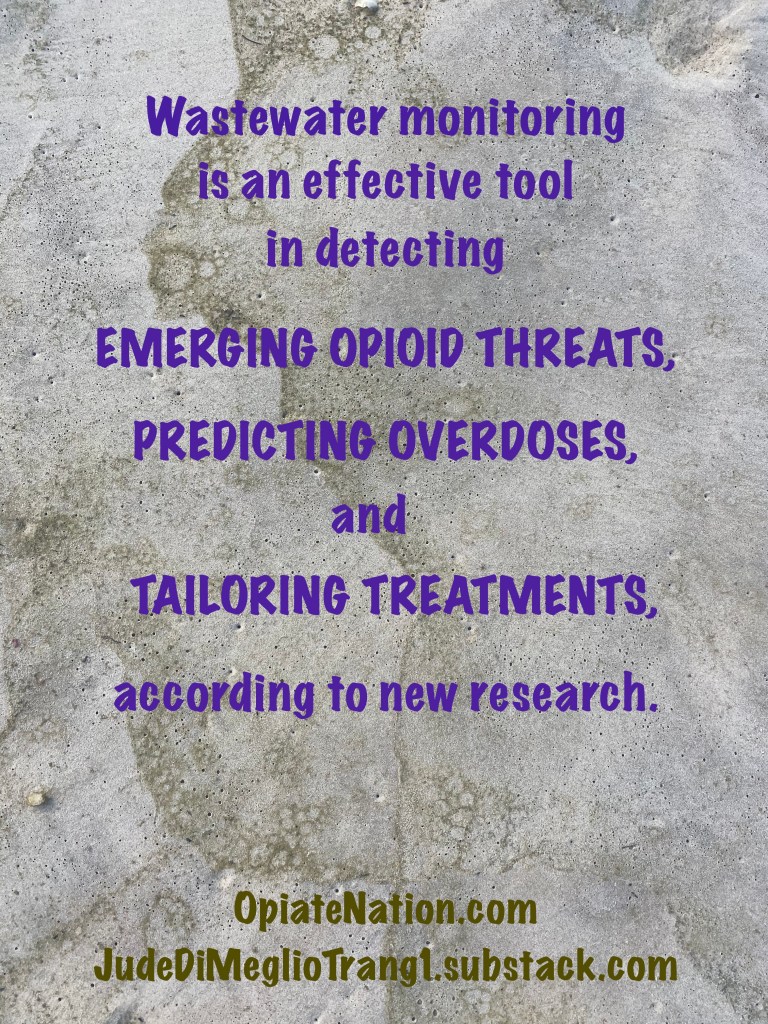
Wastewater monitoring is an effective tool in detecting emerging opioid threats, predicting overdoses, and tailoring treatments, according to new research from Biobot Analytics, Mathematica, and the Washington/Baltimore High Intensity Drug Trafficking Area (W/B HIDTA) program. (1)

My husband and I live in Melbourne, Australia part of the year so we can be close to our daughter and family. We love Australians and their friendly and balanced way of  approaching life and politics. It is a federal parliamentary democracy similar to England.

One area where they are ahead of the USA is in their approach to illicit drugs. As a nation with comprehensive health care for all from cradle to grave, they have a more communal attitude than our American individualistic posture. They view caring for each other as part of being a healthy and functioning society.

This necessarily affects how they treat people who use illicit drugs. They aggressively pursue educational and preventative measures while also working to keep those who use drugs as safe as possible until they are ready to seek recovery. While they don’t have a fluid border with a drug-producing country like we do with Mexico, they still have a problem with illicit drugs arriving from China and Asia.

One area that they use as a public health strategy is wastewater surveillance such as was used during the Covid-19 pandemic. Samples are collected from wastewater treatment plants, sewer systems, or targeted populations such as college dorms or prisons. When pooled together, they provide a community view of drugs circulating in the population. The samples are analyzed and the data is calculated through very sophisticated methods. The data then give objective, community-wide information on drug use trends. This is of great benefit in tracking changes and identifying new drug use and outbreaks and as an early warning tool. In the US, Biobot Analytics and Mathematica are leading the way with the “Drug-Surge” algorithm. (1) In a study involving five counties across four states, the algorithm correctly flagged between 71% and 100% of drug overdoses.

The US Drug Enforcement Agency (DEA) uses this wastewater testing to detect trends in illicit substances well in advance of reported overdoses. Xylazine was detectable a month before suspected overdoses from it were reported. Geographic and socioeconomic trends can be tracked also. If put to use, a national alert system would give early warning of at least a week in order to alert the public to a new or more potent drug threat.

In the US, the National Wastewater Surveillance System (NWSS) that is run by the CDC began in response to the Covid-19 pandemic. The CDC coordinates a national system primarily for infectious disease monitoring. While drug consumption can also be targeted, a national program does not yet exist. (3,4) Meanwhile, the National Institute on Drug Abuse (NIDA) is working with Biobot and Mathematica and has regional programs focusing on illicit drug use as a response to the opioid crisis. 

With the CDC in the midst of worrisome changes, let’s be vocal proponents for increased national coordinated surveillance of illicit drugs in our wastewater and the use of that information to help prevent overdoses and deaths.

  1. Wastewater Data Offers Powerful Tool in Confronting Opioid Epidemic

https://www.mathematica.org/news/wastewater-data-offers-powerful-tool-in-confronting-opioid-epidemic#:~:text=Wastewater%20monitoring%20is%20an%20effective,early%20warning%20for%20new%20threats.

2. DEA Releases 2025 National Drug Threat Assessment

https://www.dea.gov/press-releases/2025/05/15/dea-releases-2025-national-drug-threat-assessment

3. Correlation between wastewater-based substance use prevalence and syringe distribution in a harm reduction program in the United States

https://www.sciencedirect.com/science/article/abs/pii/S0048969725018261#:~:text=In%20the%20U.S.%2C%20although%20the,2019;%20NFLIS%2C%202024).

4. Wastewater-based monitoring could help guide responses to the USA opioid epidemic

https://www.nature.com/articles/s44221-023-00082-9

Not the Time to Rest on Our Laurels

(Translation into most languages a tab to the right.)

Resting on your laurels is as dangerous as resting when you are walking in the snow. You doze off and die in your sleep.

― Ludwig Wittgenstein, Culture and Value

In ancient Greece, when athletes competed and won, they were given a laurel wreath as a crown to show off their success. The idiom “resting on one’s laurels” refers to being content with our past accomplishments and not working towards any further improvement. Not exerting any effort and becoming complacent. 

         I am concerned that we might become complacent after hearing the recent encouraging news from the CDC that drug-related deaths among young people under the age of 35 are finally declining. This after more than two decades of year after year grim news about young people dying from opioid overdoses. And especially from the last 10 years from fentanyl. “Provisional data from the CDC’s National Center for Health Statistics indicate there were an estimated 80,391 drug overdose deaths in the United States during 2024—a decrease of 26.9% from the 110,037 deaths estimated in 2023.Annual drug overdose deaths are projected to reach their lowest level since 2019.” (1)

         NPR’s Morning Edition discussed the possible reasons for this decline. (2) In Gen Z young people, the fear of overdose has caused a change in what they experiment with as opposed to Millennials like my son. When he was at the age of experimentation in middle school, highly addictive prescription opioids were the drug of choice. Now, Gen Z experimentation is mostly with weed and psychoactive drugs which normally won’t cause death, although they can be laced with fentanyl which may lead to a new and more deadly addiction. But those age 35 and older who are still living desperate lives addicted to ever-stronger synthetic opioids and/or meth are still dying from overdoses.

         And then there is Narcan, the opioid overdose reversal medication that is now widely available and is attributed with saving thousands of lives. Parents and advocates have been working for a decade to make it easy to obtain and administer. But it is not the silver bullet many people hail it as. For opioid addicted people, many have been brought back from overdose only to continue using drugs and thinking they have a quick solution to their long-term problem. But repeated overdoses are causing serious brain injuries from oxygen deprivation, as Sam Quinones writes (3).

Author of Dreamland: True Tales of America’s Opiate Epidemic (2015) and The Least of Us: True Tales of America and Hope in the Time of Fentanyl and Meth (2022), Sam says, “By leaving people on the street to suffer more overdoses, believing that with Narcan they’ll be revived and return to ‘normal,’ we are creating a population of people less able to make rational decisions, more given to erratic behavior, and more at the mercy of the street and its trauma…(Narcan) has great benefits, but also serious limits, particularly in a time of fentanyl and meth, and particularly when it is used virtually without any other tool.”

What’s the answer to this blight that was unleashed on our young people?

Sam continues, “After reporting on this for more than a decade, I believe the solution must start with getting people off those lethal streets and — crucially — into places they cannot leave when the drugs insist that they must. That way, their brains will have a fighting chance to heal. When that happens, readiness for treatment is far more likely to emerge than it will on those streets, where drugs and brain injury so easily conspire and lead to death.” 

         I encourage you to read Sam’s article for other great insights and pass it along to others. We need to be informed with a perspective gained from all the facts and then work for comprehensive reforms in policies and health care.

  1. U.S. Overdose Deaths Decrease Almost 27% in 2024. May 14, 2025

https://www.cdc.gov/nchs/pressroom/nchs_press_releases/2025/20250514.htm

2. Drug deaths plummet among young Americans as fentanyl carnage eases.

Morning Edition June 10, 2025

3. Sam Quinones. The Limits of Narcan Alone. June 04, 2025.

https://samquinones.substack.com/p/the-limits-of-narcan-alone

10th Anniversary Tribute

(Translation in most languages at tab to the right)

August 2, 2024

It has been 10 years since we woke up on a hot Saturday morning in August not thinking about anything in particular – other than the house projects we wanted to focus on for the day. Little did we know what had happened in the wee hours of the morning or how a knock on the door at 11am would change our lives forever.

John Leif (J.L.) had many friends in high school and university, many whom we stay in touch with. We have asked them to write their thoughts in remembrance of him on this 10th anniversary of his death. Three of the tributes are the people who wrote the “Stories of Hope” at the end of Opiate Nation. Some of the tributes below are from friends that JL started using alcohol and Oxy’s with in middle or high school – before there was any open discussion about opioids and before their brains were mature enough to understand the deadly consequences of this particular addiction. And many went through years of struggling to get free from how opioids changed the neurological pathways in their brains. We are proud of them and love and thank them for their openness in sharing their stories and for all these heartfelt tributes expressing love for our son and for us.

Here is the YouTube link (or you can watch a mini version on the sidebar) for the photo/video tribute of JL’s life that Johanna and her cousins made: https://youtu.be/70rg4dqfFxU

My Brother

I have so many fond memories of my childhood growing up with John Leif. Our parents created an idyllic environment for us to grow up in; our mornings were spent doing our homeschool work and our afternoons were free for playing. JL and I spent many hours creating imaginary worlds with characters in Lego and Playmobil, racing his Hot Wheels cars or digging in the dirt with his Tonka Trucks. When he was little, he would also happily play baby dolls or dress ups with me, and we would create puppet shows or build forts in the living room or back yard. JL shared my love of animals, and we spent a lot of time playing with and caring for our many pets: cats, rats, hermit crabs, frogs and fish. While we had plenty of sibling fights over the years, he was the playmate I had been waiting for and I cherish the carefree time we were so privileged to have together. I wish that we could have continued growing up together into adulthood, sharing even more adventures and exploring new places. I miss him very much.

Johanna

You Are Always With Me 

J. L. – It’s been 10 years – a full decade since your passing. My memory of your face is slightly fading. Your voice and your laugh aren’t as crisp in my mind anymore. Your appearances in my dreams have become less and less over the years. While I’m scared of forgetting about you, I’m relieved that I’m finally moving on. Your death has affected me tremendously, and there has been a hole in my heart that has felt bottomless for so long. Fortunately that has changed and that hole has been filled. Although I lost you – my best friend – I found another. Man, I wish you could meet her. You’d laugh because she’s exactly who I used to describe as my “perfect woman” during our long rooftop conversations while watching the sun rise after a long, rowdy night. 

I have a full life though I still can’t delete your number from my phone contacts or your gamertag on Xbox (which I haven’t played in years). Life still doesn’t quite feel complete without you around. Memories of you, however, are becoming more a feeling of pleasant remembrance rather than a haunting reminder of your absence in this world. I like to think that this comes from your soul telling mine of your acceptance of the afterlife. Whatever the reason, you’ll always be with me as I enter the next chapters of my life. While I wish we were experiencing them together, I know you’re looking out and guiding me from above. I love you, my brother.

Kyle Thornton 

His Death Changed Me

J.L. had an infectious laugh and smile, and a sort of curiosity like a coyote – a twinkle in his eye always. He was really damn smart and twice as funny. Also, very loyal to friends and those close to him. His death changed me, has forever changed me. The seriousness of addiction was clear before – but him suddenly being gone shook me to my core. 

He’s missed, and I speak of him often to not forget him – to newcomers and men I take through the twelve steps, and to my friends and family.

Benjamin W.

He Was a Gift

John & Jude – Everyone you meet in life is someone you have no idea what effect they will have on you until you get to know them. And sometimes, people show up and blow you away. That was JL for me.

In high school, a lot was happening, and a lot went wrong for me. When I went to Social Studies with JL though, he made my day better. I can still clearly see the high school hallway during our breaks, and how I wanted to be around JL because he always made us laugh.

On weekends, when everyone went to parties, if I saw JL I felt safe – plain and simple. We talked and joked – there was never a negative part to being around him. I really loved the friendship I had with your son. I also really, really appreciate the respect he showed me as a friend. Although I wasn’t a best friend to him, he did impact my life and I hope you know that, because that’s due to you. JL was my friend, and I still think about him all the time.

He is happy where he is though – I know you know that – but just remember it when things get hard. I can’t even imagine the pain you go through every day. He was a gift.

Brittney Kline

Grateful for the Perspective You’ve Given Me

John & Jude – I have thought about JL often over the course of these past 10 years. Honestly, I find myself thinking about him more now that he is gone. I think about how much I have grown and changed over the last decade and wonder what changes and season of life he would be in if he were still with us. It makes me smile to think of JL having a wife and a kid and observing him being in that role.

J.L. – I miss you and I am grateful for what you’ve given me. The perspective you’ve given me, the thoughts you’ve brought to the surface, the memories you are part of and the reminder of just how fortunate we all are to still be fighting the good fight.

Rich Jacome

I Wish He Was Here

Ten years ago, news of JL’s death was unreal. I knew he was getting help for his addiction and had been clean for many months. Everything seemed like life was getting better for him. It did not seem real that he passed away. There was no tragic car accident, but a single slip of willpower. A moment of weakness, and poof! Like a vapor in the wind, he was gone.

I have many regrets with my end of our relationship. The biggest one was that I did not take the time to really get to know him as a teen and as a young adult. He was my kid-cousin, and I always assumed he’d be fine, just like myself. We were young, after all. I assumed he would have a long life and we’d have plenty of time to connect. But life is short. For him, much shorter. 

His death opened my eyes to the extreme danger of self-medication and opiate addiction. I used to think of drug use as “bad decisions.” Now I understand it’s a lethal death sentence, especially now with even minor drugs laced with fentanyl. No one knows if “their pill” is the one pill that will end their life. 

I wish he was here. I wish he knew how much he is loved. I wish he was not missing out on this beautiful world. I miss you JL. 

Love, Cousin Justine

My Best Friend

Not a single day goes by that I don’t think about my best friend and my brother JL he was easily the closest bond that I’ve ever had in life. I have so many fun stories of JL and I find myself telling stories of him and I on a weekly basis. 

JL taught me how to embrace life – he really knew how to have fun and he knew how to express how he felt about things. I would argue that he lived more in his life than most people could ever dream to do. 

His intelligent and mischievous thoughts resonate through all my life’s great decisions. When I find myself talking to my own subconscious I don’t see me. I see JL.

William Skylar Helfrich

No Other Friend Like You

Dear J.L. – I’ll start this by saying the obvious which is you are dearly missed. I can’t believe I haven’t talked to you in almost 10 years. Some days it feels so long ago. Other days it feels like it was yesterday I was in culinary school, and we would talk at night and text. No matter where I was living you were my best friend. No judgment ever between us. Such a rare thing. We completely understood each other on every level. I had never had a friend I connected with on the level I did with you. I haven’t since either. 

Your funeral was so surreal to me. It still hurts so bad, so often. I think of you and the things we will never get to do. Losing you and my father so close together is a wound that will never heal, no matter the time passed. I wish you could see my life today and share it with me. I think of you often and still say to myself a lot of the phrases we always said to each other. The memories we made together will always live within me. I hope to see you again one day.  

Love, Matt

A Significant Impact

I never knew John Leif, but his life had an impact on me that has been significant. I met Jude & John Trang through their friendship with my own parents, and I heard their story with addiction, which so closely mirrored what I had put my parents through with my own substance dependence. When I met the Trang’s, I didn’t know any other families like mine. John Leif and I had a lot in common. We had two parents who loved us, we had a nice home life, we had options and opportunities, we were the same age. And we did heroin anyway. John Leif lost his life, but I did not. Why? 

The Trang’s are deeply religious, spiritual people, whose beliefs guide them through life’s joys and sorrows. I have witnessed the power of their faith as it illuminates the space around them wherever they go. As for me, the question of “why?” has no answer. Why him, and not me? Why should I be so lucky? Why couldn’t he have been saved? Why should the Trang’s be the ones with broken hearts, while I get to sing and dance with my parents today, almost 12 years since I used a syringe? Neither my belief system nor my experience of life has provided any kind of reason. It is part of the great mystery. To me, the question itself is where the lesson resides: be grateful. Appreciate life’s beautiful moments and be present when life is challenging. 

Through knowing the Trang’s, I remind myself to feel ALL my feelings without trying to numb, distract, or turn to harmful habits. I am deeply connected to the Trang family because of our shared experiences. My life is enriched because of them, and I keep John Leif in my meditations. 

Mattea Tampio

Death: Painful or Beautiful?

(Translation into most languages at tab to right)

My husband and I recently watched the streaming memorial service for his niece who died of cancer at 51 years old. Her mother, husband, children, sister and extended family all mourning the inescapable truth that there is now a gaping hole in their hearts and lives where once a beautiful woman had lived. She has been torn from their lives like when a thief grabs a bag from your hand and you struggle and try to hang on to it but, in the end, it’s gone. Weeping is the only thing that feels appropriate.

Although it’s been nine years since our son JL died from an accidental heroin overdose, the sense of him being torn away from us remains. Whether it was the death of our son, my siblings, our parents, or friends, the undeniable fact remains that death is painful. Almost always painful for the person dying, especially with a protracted illness or debilitating condition. But always painful for those left to live with the empty space where the person they knew and loved used to reside. We will never forget the Sherriff’s knock at our door that Saturday morning and hearing him say, “I’m sorry to have to tell you…”

We all naturally focus on our loved one’s beautiful life and the memories we have of them. This is only right and good. And there can be beauty in the way someone dies – this I have seen, and this has been recorded throughout history. Regardless of the kind of death – whether by illness, accident, torture, or plain old age – history tells us about those who have faced pain and death with grace. How? Because they saw beyond this world and had hope for life in the next.

What I bristle against is the thought that death is somehow beautiful. There is nothing beautiful about the tearing away and finality of death. Sentimental and romanticized thoughts about death have never helped me when I have had to stare into the cold face of a dead loved one. I have watched people facing the intense and unpredictable emotions after the death of a loved one as they try to make sense of something senseless. Those who have no hope of seeing their loved one again and who do not have the hope of existence in another realm, often try to transform death into something else – as if the only way to survive their pain is to imbue death itself with beauty. Or perhaps attempt to ignore it altogether.

For me, I believe that there is a good God who will one day put this world back to the way he created it. In my view, death and the tearing separation and sadness that accompany it are a temporary condition of living in a fallen world. We are told that death is an enemy and that one day it will be abolished. Yet, knowing I will see my son and siblings and parents and beloved friends again one day, where there will be no more sickness or pain or tears, doesn’t change the sorrow and grief that I feel now. I am a mortal living in a physical body in a physical world facing real physical triumphs and tragedies. And until this life is over and this world is made new, death will be painful. Our response to pain, suffering, and death is what concerns us now. And comforting those who mourn and offering compassion, regardless of the circumstances surrounding their death, is something tangible that does not minimize or romanticize the pain of death.

UPDATE:

This morning, August 2nd, I just happened to find and listen to an affirming podcast on Hope In The Face of Death by Dr. Timothy Keller. It is well worth the 40 minutes of your time. He says what I am trying to communicate more eloquently and thoroughly.

https://podcast.gospelinlife.com/e/hope-in-the-face-of-death/

Unwelcome Reminders & Another Anniversary

(Translation into most languages at tab to the right)

“We were trying, all of us, so hard, and he just wanted to live.” (1)

Ursula Rauh said this about her brother, Tommy, after his death from a fentanyl overdose and a dozen stints in rehab in ten years. He became addicted to Oxy’s at 23 after being prescribed an unlimited amount for tendinitis and a year later, another prescription for wisdom teeth extraction. Sam Quinones retells the family story in The Least of Us: True Tales of America and Hope in the Times of Fentanyl and Meth. “The tragedy wasn’t just the death of her brother; it was all the time, effort, love, and pain that the family traversed, the hoping and living for the smallest encouragement.” (1)

When my husband, John, and I returned from Australia in May, we decided that we needed to address the decades of files we had saved and ‘stuff’ we had accumulated and ‘stuffed’ away in closets. We have shredded and recycled dozens of boxes of documents, cleared out half the books in our library, and now I have moved on to scanning and sorting thousands of photos. While I was pulling bins of photos and albums out of closets, I came upon a few more file bins. I sighed out loud to John, “Oh boy…more of JL’s file’s I’d forgotten about.”

Continue reading “Unwelcome Reminders & Another Anniversary”

Advocacy or Cheerleading?

(Translation into most languages at tab to the right.)

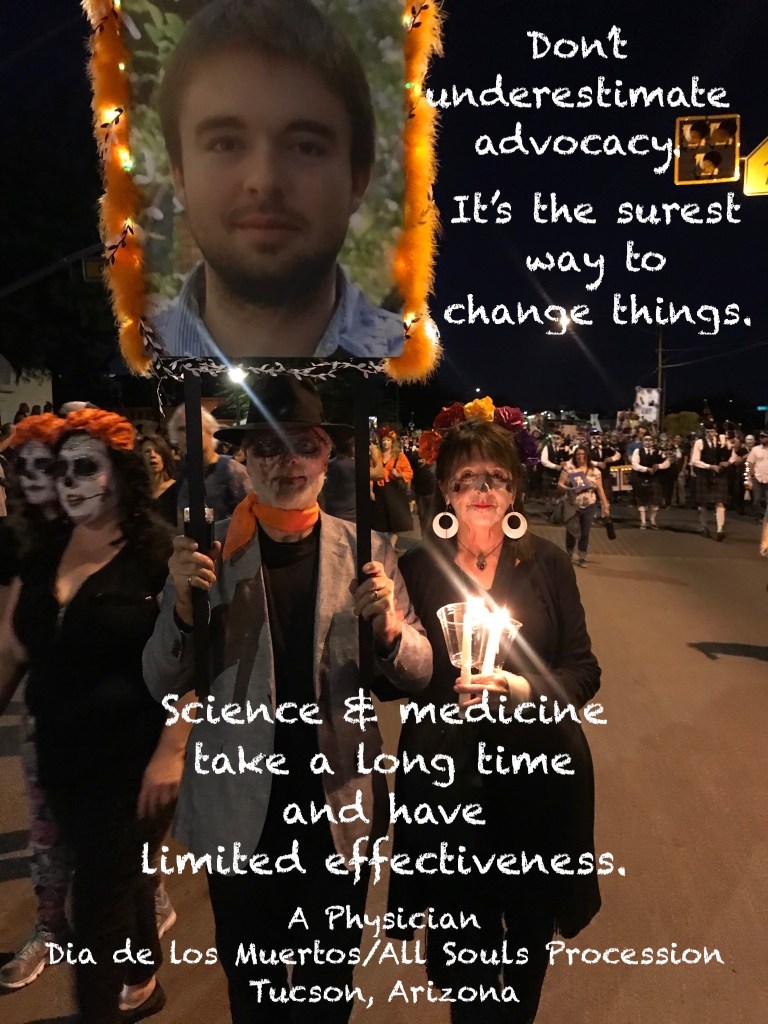
A few months ago, John was on a phone call with a physician who was asking his input about a new drug to help with opioid addiction. John shared about our son’s addiction and death and how we hoped that by speaking openly about his life and writing our book and blog we could help in some small way. His response was something I did not expect and will never forget. He said, “Don’t underestimate advocacy because it is the surest way to change things. Science and medicine take a long time and have limited effectiveness.”

An advocate is someone who works by speaking, acting, or writing truthfully on behalf of a person or group in order to promote, protect, and defend their welfare and to seek justice for their rights. To speak out for those who have no voice. But advocacy is not cheerleading. A cheerleader is someone who only supports their team or player – since they are in competition against another team. They are indiscriminate about what their team does or doesn’t do. They don’t necessarily look at the big picture or causes and effects. Their role is to simply cheer on their team or player and boost support from their fans with slogans that may or may not be true.

Serious problems that affect the wellbeing of individuals, communities, and entire societies, such as the Covid-19 pandemic, addictions, and racial prejudice and inequality, are not helped by cheerleading. People in danger and suffering need advocates who have compassion, who are truth-tellers, and who will vigorously and untiringly work for a solution.

When I see a young person on the streets, homeless and struggling, enslaved to a substance that is stealing their life – or anyone living with addiction of any sort – I long to be helpful in a meaningful way and become discouraged at my inability to do so. And if I feel discouraged, how must they feel? What will help bring real, substantive change and hope to these lives and in these circumstances?

As parents of a son with a deadly addiction, we were sometimes cheerleaders when we needed to be advocates. Cheering him on and telling him he could do it without any medical help was not being realistic or being the advocates he needed. I think it is difficult to be an effective advocate for those we love because we are too close to have a clear perspective. Which is why a supportive recovery community – for both the family and the one struggling – is vital. We must try and use whatever resources we have: our voice for those who are not being heard, our writing to bring clarity to public thinking, our physical presence to stand or march with others, and our time, energy, and finances to step in where we can or offer help to find those resources.

There are as many ways to be an advocate as there are needs in this world. I have friends involved in racial justice, in refugee struggles, in stopping sexual exploitation and abuse, homelessness and poverty – the list is endless. The question is: How can each one of us be an advocate for the people and needs we are aware of and that we have a passion for?

Isolation Loneliness

It has been said thatthe opposite of addiction is not sobriety, it is connection – to others, to a community.The Coronavirus pandemic has brought disconnection and magnified loneliness and stress for people the world over due to social isolation, economic instability, reduced access to spiritual communities, and overall national anxiety and fear of the future. “We certainly have data from years of multiple studies showing that social isolation and social stress plays a significant role in relapse…relapsing to drug use can play a role in overdose.” Dr. Wilson Compton, deputy director NIDA.

The acronym HALT: Hungry, Angry, Lonely, Tired, is used in Alcoholics Anonymous and most recovery programs. It is a simple reminder that when our basic human needs are not met, one is susceptible to toxic thoughts and self-destructive behaviors including relapse and suicide.

Regardless of where you live, there have likely been restrictions imposed to limit the number of people who can gather together – from dozens in some countries to only the members of your immediate household in others – in order to slow down the high-speed train that is Covid-19. For many of us, we have been able to maintain our emotional equilibrium because we know this is for a limited time and we can look forward with hope to the future.

But what about those vulnerable members of society who already struggle on a daily basis with insecure housing and food supplies and to maintain their mental health, sobriety, or recovery? In the midst of one of the most isolating crises the modern world has known, it is no surprise then that cities across America, and around the world, are reporting dramatic increases in drug overdoses, alcohol relapses, and suicides.

In-person community meetings are at the foundation of recovery programs. And no wonder. It is in community where individuals become part of something greater than themselves. And I believe it is in the breakdown of communal life in individualistic American ideology that has, to a great degree, contributed to the anxiety, insecurity, and depression that so characterizes our national psyche and has led to the pursuit of finding relief in so many unhealthy ways.

A friend of our son who is an alcoholic who has been working his recovery for the past 8 years, put it this way: 

“Self-isolation breeds relapse for people in recovery. With quarantine, people are losing the accountability they have relied on from in-person meetings and it’s a lot easier for people to further isolate and close off their emotions. Attending virtual meetings keeps me grounded and gets the message across as much as regular in-person meetings but lacks the fellowship aspect. This will no doubt expose many in recovery to loneliness.”

Even though increasing numbers of people around the world are vaccinated, it will not stop some of the isolation and loneliness. Is there anything those of us who are not isolated emotionally can do to help? The one thing my husband and I have made as a priority in our weekly schedule is to check in with friends around the world via texts, emails, letters, phone or video calls – including our young friends who are in recovery and elderly friends who just need to know they are not forgotten. With our social networks and finances, we can support organizations that are working the front lines to serve the addiction/mental health population. We can make or purchase masks, buy food and basic supplies, to give to those in need and support recovery programs in our area.

Gilded Grief

(Short topical blogs based on Opiate Nation – translation into most languages in tab on right.)

While reading Rising Strong by Brené Brown, I was struck by a thought she shared about our American culture and the absence of honest conversation and the hard work it takes for us to rise strong after a fall on our face – a failure. She worries that “this lack of honesty about overcoming adversity has created a Gilded Age of Failure.”

Gilding is a perfect word-picture for this characteristically human behavior: applying a very thin coating of gold to a plain, inexpensive object that gives it the appearance of gold. This is what we do when we are dishonest about our feelings. We are choosing to make our real, plain, and common story appear better than it is.

“We’ve all fallen…but scars are easier to talk about than they are to show with all the remembered feelings laid bare…We much prefer stories about falling and rising to be inspirational and sanitized…We like recovery stories to move quickly through the dark so we can get to the sweeping redemptive ending.”  (Rising Strong, Introduction)

Continue reading “Gilded Grief”

Grief: Acceptance or Acquiescence?

(Twenty-ninth in a series of topical blogs based on chapter by chapter excerpts from Opiate Nation. Translation into most languages is available to the right.)

I have never been one to accept something without question – anyone who knows me well, knows this – and they live with the frustration my incessant questions create. But it’s the way I need to process what is happening to or in or around me in order for me to honestly make the decision to accept or reject whatever the issue is at hand. I don’t think I could live with myself if I pretended I agreed or accepted something when I didn’t – the dishonesty would keep me in turmoil. And many times, it is ultimately for self-preservation that I accept something distasteful or painful when I finally understand there is no other option.

Death leaves us no other option – it is not negotiable. For most of us, our survival instinct brings us to the realization that in order to retain our sanity, we must eventually accept death – even of those we love the most in this world – whether we like it or not.

Continue reading “Grief: Acceptance or Acquiescence?”

The Paradox of Memories

(Twenty-eighth in a series of topical blogs based on chapter by chapter excerpts from Opiate Nation. Translation into most languages is available to the right.)

Memories are strange things. How much control do we have over them? What triggers bring up which memories? How do triggers differ with each individual personality? Does grief affect memory? I know it does mine because I continue to experience new associations and memories being formed from what were once familiar items with no particular memory attached before—which now, after my son’s battle with addiction and death, have a specific memory related to him.

Like aluminum foil.

Continue reading “The Paradox of Memories”
Malcolm Guite

Blog for poet and singer-songwriter Malcolm Guite

The Gift of Need

How Need Can Strengthen Individuals and Communities

Memoirs and Musings

David Bradley Such

Dave Barnhart

Church planter, pastor, author, coach

RecoveryLife101

Just another WordPress.com site

Abbie In Wondrland

life...on Gods' terms.

Living In Graceland

"..learn the unforced rhythms of grace" matt 11:28

Janaburson's Blog

All about opioid addiction and its treatment with medication

Breaking In News Network

Seeking the truth and bypassing the MSM

Junkbox Diaries

Trauma, PTSD, Mental Health, Addiction, and Recovery

Ohio Society of Addiction Medicine

The Ohio Society of Addiction Medicine is a chapter of ASAM - A professional society actively seeking to define and expand the field of addiction medicine.

traceyh415

Addiction, Recovery, Loss, Grief

WordPress.com News

The latest news on WordPress.com and the WordPress community.