Mirror Mirror

Topical blogs taken from OPIATE NATION. Translation into most languages at tab on right.

I was listening to a young man who had been heavily addicted to crystal meth. As he told his story, one of his “ah-ha” moments was walking into a bathroom in his parents’ home and seeing himself in the mirror. As he looked at the vestige of his former self – an emaciated, festered, hollow-eyed man – he remembered who he once was: a happy and carefree young person with good friends, a star athlete, a kind and honest person, a loving son. That moment of realization caused him to reach out and ask for help which eventually led to the beginning of his recovery journey.

As I heard his story, a photo flashed before my eyes of my son, JL – one we found on his phone after he died from a heroin overdose. It was a selfie he had taken after he had relapsed, just days before he died, standing in front of a full-length mirror in a public bathroom. He was dressed for work in slacks and a dress shirt. No smile. I have always wondered why he took that photo. Was it to remind himself of who he really was? To be able to be honest with himself when he might look at it later when he was high? Was he attempting to make himself stop using? To ask someone for help?

I’ll never know.

But after listening to this other young man, I’m guessing my son had similar thoughts going through his mind. Yet, what seems to have happened is that his addicted mind told himself that he could handle it on his own – that he could just cut down his use and not have to go through withdrawal one more time, not have to be embarrassed by telling us he had relapsed after 6 months of sobriety, not have to start all over again.

Perception refers to how we interpret things and it is the motivation behind our actions and reactions. His perception of his ability to use his willpower was skewed, because our self-perception is influenced by many factors including our perceived needs, our experiences, and our expectations.

Beneath self-perception is our self-concept, our view of our self, which influences our decisions, our feelings, and our judgement. It may include genuine self-knowledge or varying degrees of distortion.

Many times, we choose – albeit unconsciously – to be self-deceived because it is too painful to be honest with ourselves, to interpret what we see in the mirror with unbiased and accurate judgement. There is a saying written in the first century AD that sums this up:

“Those who hear (a clear direction) and don’t act are like those who glance in the mirror, walk away, and two minutes later have no idea who they are or what they look like.”

Because of this very human tendency, we all need a few close friends and a safe community who love us enough to honestly reflect back what we saw in the mirror – which we can so conveniently forget.
The Paradox of Memories

(Twenty-eighth in a series of topical blogs based on chapter by chapter excerpts from Opiate Nation. Translation into most languages is available to the right.)

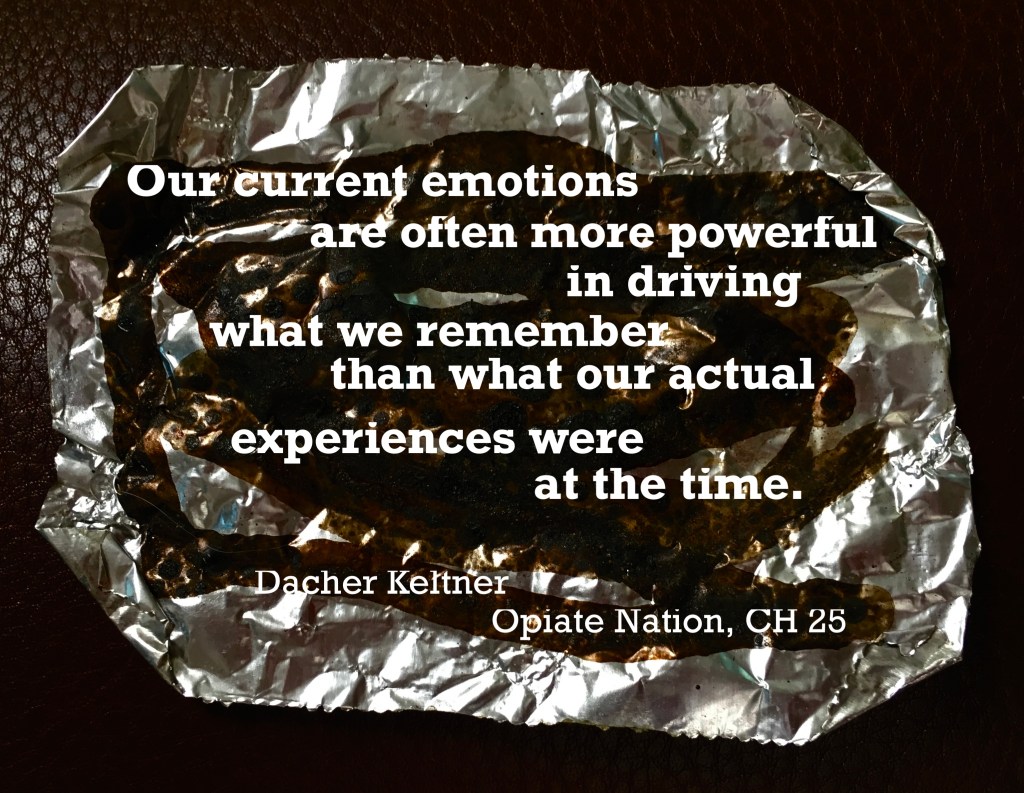
Memories are strange things. How much control do we have over them? What triggers bring up which memories? How do triggers differ with each individual personality? Does grief affect memory? I know it does mine because I continue to experience new associations and memories being formed from what were once familiar items with no particular memory attached before—which now, after my son’s battle with addiction and death, have a specific memory related to him.

Like aluminum foil.

Continue reading “The Paradox of Memories”

Time & Eternity

(Twenty-seventh in a series of topical blogs based on chapter by chapter excerpts from Opiate Nation. Translation into most languages is available to the right.)

Death naturally brings up thoughts and questions about existence beyond this life, this earthly existence. I love how John Milton said it: “Death is the golden key that opens the palace of eternity.” For us, after a death so intimate as our son’s, one can imagine how often we thought about it, particularly in the subsequent months.

One thought that continues to captivate John and I is the possibility that others can look into our time while they are in eternity, in heaven, like someone looking into a cell under a microscope at us, the human specimens. Or are they frozen in time, like being in a time capsule?

Six weeks after JL’s death, my journal entry highlights these questionings:

JL,

Mom here. I’ve been wondering, and wishing I knew the answer for sure, if you and others who are gone can hear us and are conscious of what is happening on earth and in our lives. Can you hear when Dad and I talk to you? If you can, I think you would be crying for us many times as you see and hear our pain. I hope we are not causing you any more pain…

Dad and I went out to dinner and talked about this. What he brought up was that eternity, by definition, is the absence of time as we know it here on earth. So, if those of you who are dead are also in “no time,” even though present with the Lord, you may not experience any consciousness between death and the final resurrection we believe in—it may just be a flash. Hmmm…I don’t like that concept. I want to know you hear me and my apologies and love and thoughts towards you.

Singer-songwriter Phil Keaggy’s song “Time” from his album Love Broke Thru expresses the limits in which Father Time exists:

My friend, David Such (a mechanical engineer, writer, artist) wrote a blog about the Elasticity of Time. Here is a relevant thought from that blog:

Most of us human beings are locked into “earth time” so it can sometimes be difficult to understand, but Einstein taught that “time” is elastic depending on one’s position, perspective, and velocity. I am merely a mechanical engineer and do not fully understand all the physics or all the mathematics, but I do understand the concept as follows. As we increase our velocity, we reduce the difference between our own speed and the speed of light. This is insignificant unless our velocity is extremely high. As we approach the speed of light, “time” slows to a standstill (and apparently, even “matter” takes on different shapes and densities).

Genesis One and the Elasticity of Time

In 1676, the Danish astronomer, Olaus Roemer, first successfully measured the speed of light: Lightspeed. For those of us who believe in God and that his intelligence designed the Universe, his words “Let there be light” have much significance. Eternity must at least be full of light, beyond time, beyond darkness and death. In death do we instantaneously exist in lightspeed and the absence of time?

If so, is JL zipping and zooming around the universe at lightspeed now, with all the other souls who have left this earthly constraint of time? I have no clue, but I smile at the thought.

The Vortex of Shame

(Twenty-third in a series of topical blogs based on chapter by chapter excerpts from Opiate Nation. Translation into most languages is available to the right.)

For generations, the combination of personal shame and public stigma has produced tremendous obstacles to addressing the problem of alcoholism and drug addiction in America. Addiction stigma prevents too many people from getting the help they need. –Hazelden-Betty Ford Institute for Recovery

Historically, the word shame was used interchangeably with guilt – the appropriate pang of conscience that followed doing something wrong. In reality, there is an important distinction between shame and guilt. Shame is about who you think you are; guilt is about what you have done.

Stigmas are linked to shame. In the Greek and Latin worlds, a stigma was a mark or brand, especially for a slave, identifying them as “inferior.” Later, it became known as a mark or stain we can’t see with our eyes: social stigmas that are based on perceivable characteristics, associated with certain behaviors that distinguish a person from other members of society. They convey disapproval and disgrace.

Continue reading “The Vortex of Shame”

A Cure for Broken Hearts

(Twenty-second in a series of topical blogs based on chapter by chapter excerpts from Opiate Nation. Translation into most languages is available to the right.)

What can we do when our hearts break – not just a hairline crack or even a fissure but when they break wide open and all we are feels as if it is pouring out until we can no longer live? Music, and more specifically songs, is what many of us turn to in an attempt to stanch the flow of our life-force and regain our emotional equilibrium.

Songs have been part of our salvation since John Leif died. We have gone back to them repeatedly, listening and singing with them to steady ourselves, to bolster our failing resolve, to soothe our broken hearts, especially in the first year after his death. Clapton’s “Broken Hearted” was one of our best-loved at that time in our lives because we share broken hearts from the loss of a son to a tragic death: “Who alone will comfort you? Only the broken hearted.”

There are scientific reasons for why singing makes us feel good. When we sing, large parts of our brain “light up” with activity, says Sarah Wilson, a clinical neuropsychologist and head of the School of Psychological Sciences at the University of Melbourne. “There is a singing network in the brain [which is] quite broadly distributed,” Wilson said in an interview with Sarah Keating in May 2020. When we speak, the hemisphere of the brain dealing with language lights up, as we might expect. When we sing, however, both sides of the brain spark into life.

Continue reading “A Cure for Broken Hearts”

Who Is My Neighbor?

(Sixteenth in a series of topical blogs based on chapter by chapter excerpts from Opiate Nation. Translation into most languages is available to the right.)

(I am re-posting this blog due to a glitch on some platforms in January)

In 2020, overdose deaths have increased worldwide, and by as much as 25% in the US. Deaths from acute intoxication have also increased dramatically. People are isolated and anxious, their treatment and recovery programs have been disrupted, and the illicit drug supply has become dangerous. Health officials believe that the majority of these deaths have occurred because hospitals are full and emergency services are overwhelmed with Covid-19 patients, thus removing the urgent, lifesaving care of overdose reversal that has been established in the past few years. Funding for all mental health services has also been diverted to pandemic care, which has complicated access to basic resources. Suicides are rising at an alarming rate.

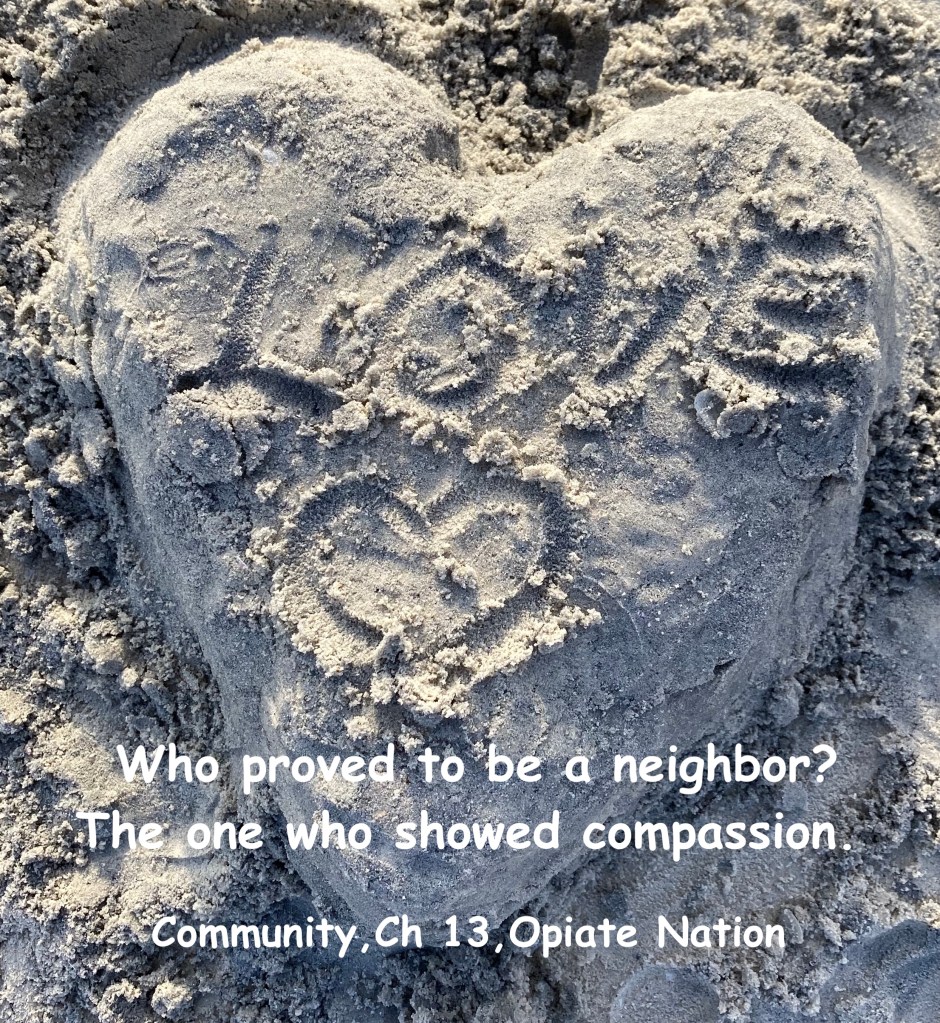
A conversation that I believe is relevant to the current times came to mind this week. A lawyer asked Jesus “Who is my neighbor?” as he was trying to wriggle out of the command to “Love your neighbor as yourself.” Jesus told him about a man beaten and robbed while on a journey. As the man lay almost dead on the road, he was passed by several religious leaders who refused to help him. Then a man, who was not the same nationality or religion, came and bandaged and rescued him and paid for his care until he was well. Jesus asked the lawyer, “Which of these men proved to be a neighbor?” The lawyer replied, “The one who showed compassion.” Jesus responded, “Go and do the same.” *

Continue reading “Who Is My Neighbor?”

Missing Community

(Fifteenth in a series of topical blogs based on chapter by chapter excerpts from Opiate Nation. Translation into most languages is available to the right.)

(This blog was posted on December 27, 2020, but due to technical glitches, it was not shared on some platforms – here it is again for those who missed it.)

For much of the world, Christmas and the holiday season this year has been nothing like our normal times of celebrating with family and friends. Togetherness is dangerous in most countries due to Covid-19. Yet, despite all the health and safety warnings, many have travelled and gathered with their loved ones. Why would people risk the well-being of themselves and their beloveds just to spend a few hours or days together?

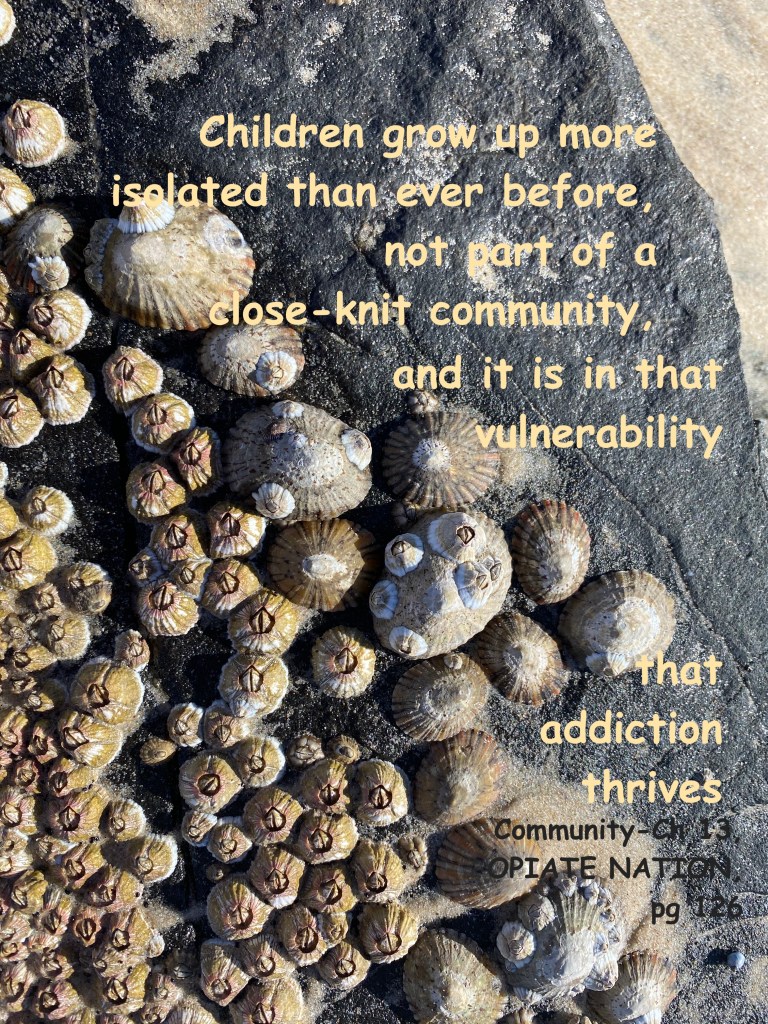
Community. We all need it and ultimately cannot live without it. Communities may seem optional when all is well, but they become indispensable during hard times, whether personally or corporately. They can be small or large and most of us have several different sizes and types that we are part of: our family, school, sports, church, work, etc. What communities have in common are shared interests, beliefs, and needs, even while the individuals may have diverse characteristics. They are united and working towards a common goal and understand that they can achieve it because of, and with, the support and encouragement of others.

Continue reading “Missing Community”

First: Do No Harm

(Seventeenth in a series of topical blogs based on chapter by chapter excerpts from Opiate Nation. Translation into most languages is available to the right.)

Perhaps it is impossible for a person who does no good to do no harm.

–Harriet Beecher Stowe

A fitting quote and post for Martin Luther King Jr day 2021. Harriet was an emancipation champion. Another tribute to MLK Jr – Colored People by DCTalk:

I think Harriet was on to something. Raised in a prominent family in Connecticut during the early years of the 19th century, her father was a preacher who spoke vehemently against slavery. The 13 children were taught to fight injustice and to influence their society towards doing what was right. The Fugitive Slave Act of 1850 was the result of Southerner’s new justification for slavery: a societal good ordained by God and Scriptures. Northern Christian abolitionists felt the Bible clearly taught the opposite: slavery was common throughout history but was not God’s plan.

Activists on both sides were in a deadlock and they needed to persuade the majority of citizens to commit to one side or the other. Harriet’s firsthand knowledge of the abusive treatment and plight of many escaped slaves prompted her to write Uncle Tom’s Cabin in 1851. It was an overnight success that exposed Northerners to the truths about slavery because her story vividly dramatized the horrible and violent experiences of slaves so people could relate to them personally.It was a turning point for the abolitionist movement that grew into a large social-political force while inciting anger in the South. Uncle Tom’s Cabin is considered one of the primary contributing factors leading to the Civil War.

Clearly, if you don’t do anything, you may not directly hurt someone. But inaction won’t help anyone and it is likely to cause harm. We actually do harm when we withhold good. This is what Harm Reduction and Medication Assisted Treatment (MAT) is about. After decades of unnecessary and premature deaths from drug overdoses, the medical and addiction recovery community realized that addiction is not a one-dimensional moral issue. Telling someone they can simply decide to not use drugs and to not help them in ways that we can is harm-full. The Hippocratic oath for physicians: First, Do No Harm, serves as a moral and ethical guide to practice medicine to the best of one’s ability, and to give sympathy, compassion, and understanding.

Sadly, I relate personally to the antiquated approach to addiction when it comes to our son and his decade-long battle with opioid addiction as reflected in this journal entry from Chapter 14:

October 27, 2014

JL,

Mom here. My heart breaks as I think again of you at our appointment with Dr. Cai last January saying, “I never want to use opiates again.” It is a sadness I will always remember and feel strongly about because we didn’t “get” that you needed more than 12-Steps or Alcoholics Anonymous to support that desire. You needed physical help (i.e. medicine), too. And I tell people this every time I tell your story, and someone says they know someone or a relative who is an opiate addict. Maybe it will give someone else a second chance for their loved one before it is too late.

To this day, over 6 years since JL’s death, it is hard for me to look back to the last year of his life. To be fair, before our son died in 2014 we hadn’t heard of Harm Reduction or MAT, although we knew medication was an option. Our regrets lie in not taking the advice of his doctor. By doing so, our inaction inadvertently caused harm, leading to our son’s death.

What I can do now is to work to influence as many parents and loved ones as I can to actively do good for those who struggle with addiction and not just watch them self-destruct without throwing them any and every lifeline available.

Some of the best options available for opioid addiction treatment:

  • Suboxone Sublingual Film® – A combination of buprenorphine and naloxone (also known as Narcan®). This is the most widely used form.
  • Subutex Sublingual Tablets® – Contains only buprenorphine.
  • Buvidal® is a modified release formulation of buprenorphine for administration by subcutaneous injection once a week (Buvidal® Weekly) or once a month (Buvidal® Monthly).
  • Sublocade® is an extended-release formulation of BPN, administered monthly by SC injection.

Who Is My Neighbor?

(Sixteenth in a series of topical blogs based on chapter by chapter excerpts from Opiate Nation. Translation into most languages is available to the right.)

In 2020, overdose deaths have increased worldwide, and by as much as 25% in the US. Deaths from acute intoxication have also increased dramatically. People are isolated and anxious, their treatment and recovery programs have been disrupted, and the illicit drug supply has become dangerous. Health officials believe that the majority of these deaths have occurred because hospitals are full and emergency services are overwhelmed with Covid-19 patients, thus removing the urgent, lifesaving care of overdose reversal that has been established in the past few years. Funding for all mental health services has also been diverted to pandemic care, which has complicated access to basic resources. Suicides are rising at an alarming rate.

A conversation that I believe is relevant to the current times came to mind this week. A lawyer asked Jesus “Who is my neighbor?” as he was trying to wriggle out of the command to “Love your neighbor as yourself.” Jesus told him about a man beaten and robbed while on a journey. As the man lay almost dead on the road, he was passed by several religious leaders who refused to help him. Then a man, who was not the same nationality or religion, came and bandaged and rescued him and paid for his care until he was well. Jesus asked the lawyer, “Which of these men proved to be a neighbor?” The lawyer replied, “The one who showed compassion.” Jesus responded, “Go and do the same.” *

Continue reading “Who Is My Neighbor?”

Missing Community

(Fifteenth in a series of topical blogs based on chapter by chapter excerpts from Opiate Nation. Translation into most languages is available to the right.)

For much of the world, Christmas and the holiday season this year has been nothing like our normal times of celebrating with family and friends. Togetherness is dangerous in most countries due to Covid-19. Yet, despite all the health and safety warnings, many have travelled and gathered with their loved ones. Why would people risk the well-being of themselves and their beloveds just to spend a few hours or days together?

Community. We all need it and ultimately cannot live without it. Communities may seem optional when all is well, but they become indispensable during hard times, whether personally or corporately. They can be small or large and most of us have several different sizes and types that we are part of: our family, school, sports, church, work, etc. What communities have in common are shared interests, beliefs, and needs, even while the individuals may have diverse characteristics. They are united and working towards a common goal and understand that they can achieve it because of, and with, the support and encouragement of others.

Continue reading “Missing Community”
Malcolm Guite

Blog for poet and singer-songwriter Malcolm Guite

The Gift of Need

How Need Can Strengthen Individuals and Communities

Memoirs and Musings

David Bradley Such

Dave Barnhart

Church planter, pastor, author, coach

RecoveryLife101

Just another WordPress.com site

Abbie In Wondrland

life...on Gods' terms.

Living In Graceland

"..learn the unforced rhythms of grace" matt 11:28

Janaburson's Blog

All about opioid addiction and its treatment with medication

Breaking In News Network

Seeking the truth and bypassing the MSM

Junkbox Diaries

Trauma, PTSD, Mental Health, Addiction, and Recovery

Ohio Society of Addiction Medicine

The Ohio Society of Addiction Medicine is a chapter of ASAM - A professional society actively seeking to define and expand the field of addiction medicine.

traceyh415

Addiction, Recovery, Loss, Grief

WordPress.com News

The latest news on WordPress.com and the WordPress community.