Just Normal

(Translation into most languages at tab to the right.)

Eleven years ago today my husband John and I woke up thinking it would be just another normal, hot August Saturday morning. But when the sheriff knocked on the door, the day – and our lives – were no longer normal. It is surprising how quickly our lives can go from normal to abnormal.

         I was sorting through some files and found a drawing that our son, John Leif (JL) had done when he was around nine. It was obviously of Van Gogh’s “Starry Night” but it was also obviously done by a normal nine-year-old – not an artistic prodigy. And it made me think about how JL was just like any other normal kid growing up in middle-class America in the 1990’s-2000’s. He learned to ride a 2-wheel bike at around five, he played with Lego’s, he took swimming lessons, he loved monster trucks and lasagna and macaroni & cheese with ketchup. But something so abnormal for normal young teenagers ended up ruining some of what should have been the best years of his life and ultimately taking his life – and the lives of many of his friends and hundreds of thousand other normal kids.

         What was abnormal was the criminal promotion and availability of highly addictive medicine to young kids by Purdue Pharmaceuticals and the Sackler family. Never before had American kids been exposed to legal drugs (that were promoted as “non-addictive”) that they experimented with as if they were simply trying a joint. And the results were the devastation of the Opioid Epidemic. Which is not over, especially for the once normal kids who are still alive and living with the cancer of addictions. We see many of them on the street corners and under bridges, living from hand to mouth, barely surviving, living anything but a normal life.

         Sadly, seeing these shells of once normal kids has become a “new normal” as our society doesn’t seem to agree on how to best provide lasting recovery options with a continuum of care – or whether we even should. In my last Substack podcast and article with special guest Sam Quinones we discuss some ideas from his book “The Least of Us” for how to help get these once normal kids from normal families the help they need to try to return to something like a normal life. (1) Let’s not forget that those addicted people were once normal kids.

  1. JudeDiMeglioTrang1.substack.com

The Importance of Friends – Pt 2

(Translation into most languages at tab to the right.)

How do clean and sober friends stay involved with a friend who is in active addiction and/or alcoholism? I ended last month’s blog asking this question. In particular, I want to discuss ways that teens and young adults can deal with this difficult and at times very frustrating problem.

What does being a good friend to someone who is addicted look like? 

The first thing is to not pretend you don’t know about their addiction. Talk about it openly but without judgment. Understand that they may deny any problem, so you may have to cite specifics that have made you concerned. Express that you care about them and don’t think less of them as a person because of their struggles. Risk your comfort zone. “Greater love has no one than this: to lay down your life for your friends.” (1)

Be a good listener. A problem with drugs or alcohol may start from just experimenting with drugs at a party or concert. It may then turn into addiction and be fueled by problems at home or with friends or underlying mental health issues. When your friend feels cared for and accepted and not confronted with more guilt or shame, they will be willing to open up. Nobody planned to become addicted and nobody wants to be an addict. Here’s links to good info on how to help someone trapped in addiction. (2,3)

But, if you remain a good friend to someone who is living a self-destructive life, how do you help them without enabling their addiction? For young people who are good friends, enabling might be keeping secrets for them about their problem, especially from adults who may need to know in order to take life-saving action. It may be loaning them money or driving them to get drugs. The pressure would sound something like: “If you’re my real friend, you won’t tell…”  Or “If you really want to help me you would…” Basically, when you support their problematic behavior in the name of ‘helping’ them, you are actually keeping them from living with the consequences of their poor choices. And this will only prolong their problems and delay change. (4) 

Encourage them to get help through programs like SMART Recovery groups or AA for alcohol and NA for narcotics. Very few people overcome addictive behaviors alone. Community is key. Go with them if you can or drive them. And remember, drug and alcohol recovery take lots of time and most people don’t succeed the first time they try to quit. Dr. John F. Kelly, clinical psychologist and addiction medicine expert, says it can take 8 years and 4-5 treatment attempts at recovery to achieve one year of sobriety from opioid and other drug addiction. It can take years to achieve stable recovery and Medication Assisted Treatment (MAT) is an important aspect. Gone are the times when a 30-day detox/treatment was seen as the solution to addiction. It may be an important first step in the process of ongoing recovery. People can and do recover, but it will likely be a lifetime journey. Here’s a YouTube 2025 video of Dr. Kelly giving a session on: The New Science on Addiction Recovery. (5)

You can encourage your friend with each small step and success, even through relapses. In our son’s recovery program, we ended each session by saying together: “Keep coming back ‘cause it works if you work it.” It takes hard work and it can be very discouraging for your friend to relapse because your friend wants to be free. No one wants to live controlled by addiction. No one. Encouragement to stick with it is vital.

If your friend or family member is using opioids, you should get naloxone (a medicine that can temporarily reverse the effects of an opioid overdose) and keep it handy. Available through local community-based programs or pharmacies.  

It’s worth saying again: Friends are SO important for people in active addiction.

Don’t ever give up on your friends trapped in addiction. They need friends more than ever, friends who love them and will invest in their lives and let them know they are a worthwhile human – while you also need to encourage them to seek help in order to become sober and stable. And to remind them by example of what a normal and joy-filled life is like and one that they too can have. 

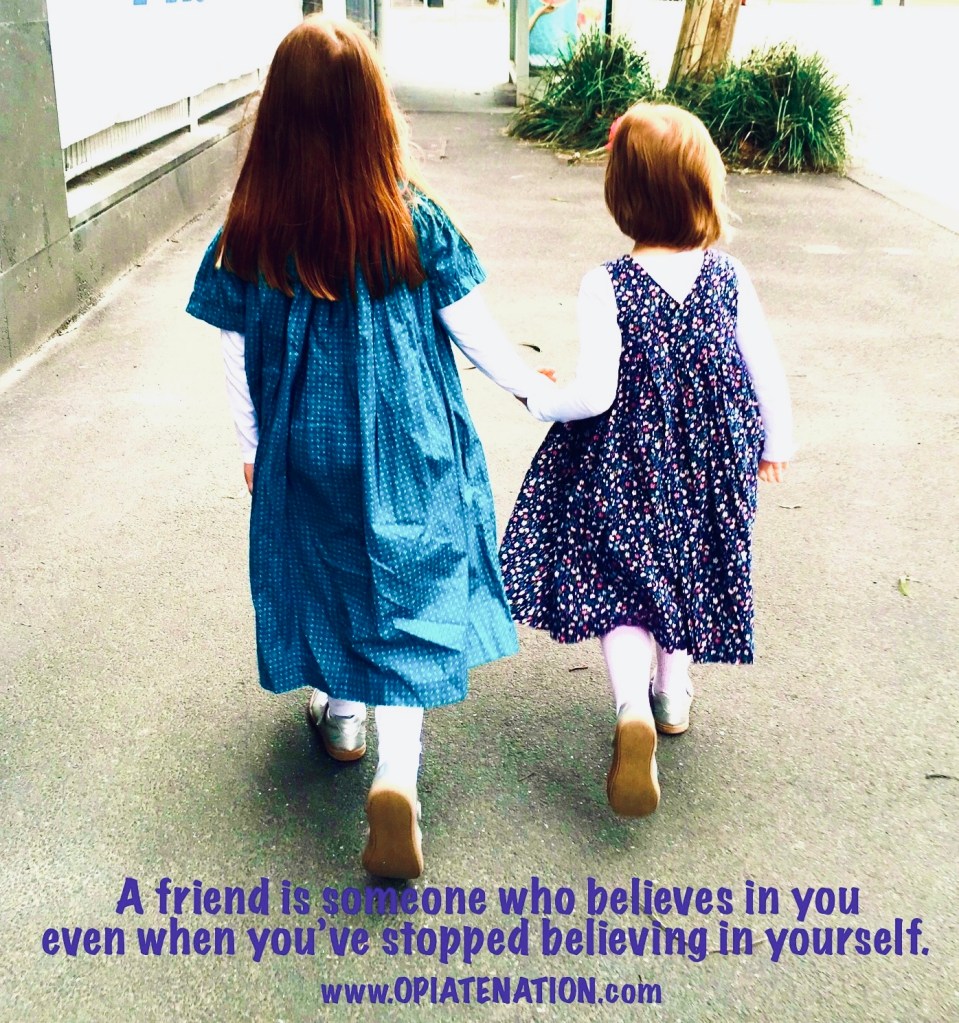
A best friend is someone who believes in you 

even when you’ve stopped believing in yourself.

– Unknown

  1. John 15:13, New Testament 
  2. Helping Someone with a Drug Addiction

https://www.helpguide.org/mental-health/addiction/helping-someone-with-drug-addiction

  • How to help someone who is misusing drugs or alcohol:

https://www.healthdirect.gov.au/help-someone-who-is-misusing-drugs-or-alcohol#:~:text=Celebrate%20small%20successes%20and%20try,Narcotics%20Anonymous%20and%20SMART%20Recovery.

  • Four Signs of Enabling and How to Stop

https://health.clevelandclinic.org/enabling

  • Dr. John F. Kelly, Ph.D. The New Science on Addiction Recovery (lecture)

Frankenstein Opioids

(Translation into most languages at tab to right)

Just when we thought everyone was aware of the fatal danger of fentanyl and it being mixed into every drug of abuse available on the street, a new threat arises. Nitazene or Isotonitazene (ISO) or Protonitazene, new lab-made opioids, are showing up at hospitals and morgues around the world in the bodies of people thinking they were taking their drug-of-choice only to find it was laced with one more deadly drug. It is being mixed in with cocaine, or formulated into fake Oxy’s and other pills. In the US, it first showed up in 2019 in the Midwest and spread rapidly.

Nitazenes were developed in the 1950’s by pharmaceutical companies as an alternative to morphine but shelved due to the risks of overdose. There is still no approved medical use for nitazenes today. Another ‘Designer Drug’ being made in illicit labs around the world, Nitazenes are up to 40 times stronger than fentanyl. Fentanyl is already 50 times more powerful than heroin and up to 800 times more powerful than morphine.

No wonder these drugs are referred to as ‘Frankenstein Opioids’ – only an insane, evil intentioned scientist would work to create such a drug. But in reality, the motivation is greed more than insanity because synthetic drugs are cheap to make and easy to ship and deliver – and highly profitable. But evil is the correct description for the immoral heads of the drug syndicates and cartels around the world whose entire life and business is dealing death. 

What can be done?

For parents with children still at home, community connection and education are the best preventative measures. As I have said before, my husband and I were totally unaware of what substances were readily available to our middle school son in the early 2000’s. Our concern was smoking and marijuana. Little did we know. General discussions about drug abuse were the extent of our educational conversations. But we would have been much better prepared and had much more information if we had been involved with our kids’ school community. Instead, we were insulated from vital resources because we spent so much time with our church community. But make no mistake. Many of the families at church with kids in youth group were just like us – unaware and ill prepared and sadly many of them suffered the same loss as we did.

There are other important aspects in raising self-reliant kids who are not subject to the lures of the “cool” kids or “in” crowd. Below is a link to a previous blog dedicated to the perils modern teens and their parents face with important resources. I hope it will be helpful to you and those you love.

https://www.dea.gov/stories/2022/2022-06/2022-06-01/new-dangerous-synthetic-opioid-dc-emerging-tri-state-area

Our Electric Elastic Amazing Brains

 Translation to most languages available at tab to the right.

The human brain is a miracle – there is nothing on earth that comes close to its capabilities. Although the brain and the heart are the only two organs that can’t regenerate, our brain can form new connections and pathways. Neuroplasticity is this amazing ability of our neural networks to grow and reorganize – to change and adapt as a result of experiences.

Until recently, it was thought that neuroplasticity stops after about 25, but with new research, we now know that it isn’t all downhill from there. Neuroplasticity can be facilitated by physical exercise, paying attention, and learning new things.

Physical exercise that increases blood flow to the brain is now a no-brainer. Paying attention is when we are doing something that is not out of habit – when we switch off autopilot and pay attention to what is happening. This is called mindfulness. Learning new things and being open to change becomes harder the older we get – and it will become increasingly more difficult if we don’t intentionally challenge ourselves mentally.

But what happens when drugs – any drug really, but drugs/substances of abuse are my topic here – enter the scene? Neuroplasticity then becomes the facilitator of addiction as our brain learns to adapt to the new stimulus, increasingly over time.

Continue reading “Our Electric Elastic Amazing Brains”

Australian Real Drug Talk

Translation into most languages at tab to the right.

One of the things I have come to appreciate about the Australian way is their straightforward approach to life. They are easy-going yet they say what they mean and you know where you stand. A lack of pretense – with a large dose of slightly off-color humor added in.

I think that is why they are more advanced in their drug policies and treatments than America – they are more honest and have less taboos. They benefit from having had comprehensive public health for decades which has facilitated progressive drug policies such as clean needle exchanges, safe-injecting sites, and medication assisted treatment.

John and I had an interesting conversation a few weeks ago here in Australia with Jack Nagel. Jack does the “Real Drug Talk” podcast from Melbourne and also runs the Connection Based Living Recovery Programs. We were preparing to record a podcast with Jack – see links below – and were asking about his experiences and what the current trends are here with drugs of abuse.

https://podcasts.apple.com/us/podcast/saying-goodbye-to-my-son-in-a-body-bag/id1507177011?i=1000533422150

In discussing opioids, I wondered why methamphetamines seems to be the main drug of choice and why heroin is not as common here as it is in the States. Jack said that in the 1990’s there was a big problem with heroin coming in from the Golden Triangle of SE Asia and lots of overdose deaths. And the heroin use was IV, not smoking. So, there is a collective memory of street people using heroin and dying which created a lot of stigma and fear associated with IV use.

After that trend slowed, people began using meth – young people like Jack –because smoking or snorting meth seems more innocuous and a less intrusive way to take a powerful drug than IV. Jack said that there is a huge cohort of people who don’t live on the streets and who smoke meth for years. Sadly, they don’t seek help because the public messaging that portrays meth addicts as homeless people with sores and missing teeth doesn’t apply to them. But meth addiction will eventually burst that bubble and ruin their lives too.

There is also a growing problem with cocaine. While once considered the drug of the wealthy city dweller with some high-flying users in Australia spending $10-$20K per week, statistics reveal cocaine usage has now spread much further. Consumption has grown in other areas and demographics where prosperity has increased such as middle-class teachers, tradesmen, etc. Australia is now the highest per capita user of the drug in the world. And the rise in use is being driven by men aged in their 20’s, with Sydney leading the country in use. The most recent stats reveal that there are nearly 1 million weekly cocaine users in Australia out of a population of 26 million. (1,2,3)

We also talked with Jack about what the entry drugs are for kids here in Australia. After alcohol and pot, they usually begin with hard “party” drugs used at house parties and concerts like ecstasy/MDMA, benzodiazepines, GHB/GBL. All mood-altering drugs that create different types of euphoria, but which are dangerous because many times they are mixed with alcohol and other drugs, sometimes without the user’s knowledge.

Even though heroin is in the background in Australia, it is still available and becoming more dangerous due to fentanyl being mixed in to the supply of much of the heroin, and all opioids, along with other drugs of abuse. (4)

When our son, JL, began using Oxy’s he never thought he would even try heroin. Then, as Oxy’s became more expensive and heroin was cheaper, he started smoking heroin. He then swore he would never stick a needle in his vein – the danger and stigma to him was clear. Eventually, just like 95% of heroin users, he did just that. He was living under the delusion that smoking opioids – or any drug – would never lead him to become a “junkie”, an IV drug user.

My concern for the young people and families of Australia is that, as The Age reported in 2020, pain management with opioids has increased here too, although not to the degree it had in the States. Opioid-related deaths have increased in the past decade and today at least three people die from opioid harm each day and 150 are hospitalized. (5) Fentanyl is showing up in wastewater testing and drug overdoses of cocaine and meth, drugs where the users are not expecting a potent narcotic. Because it is synthetic and cheaper to produce in China and India, it brings its criminal networks a greater profit margin.

As I’ve said before and will continue to say: We will not treat our way out of the opioid/drug epidemic. Prevention is key. Let’s continue to stay aware and educated about what we all can do to keep our children and their future safe and healthy.

http://www.RealDrugTalk.com.au

1. Why cocaine is most used drug in Australia behind cannabis

https://www.heraldsun.com.au/news/national/why-cocaine-is-most-used-drug-in-australia-behind-cannabis/news-story/0fa9bbcec60dfe0ecfb52a5cb58a38f5

2. Australia the highest per capita cocaine user in the world

https://www.news.com.au/national/australia-the-highest-per-capita-cocaine-user-in-the-world/news-story/c91869d4e2b2adeef266917d82f705e0

3. Sydney and cocaine: an illicit love affair for the ages

https://www.smh.com.au/national/nsw/sydney-and-cocaine-an-illicit-love-affair-for-the-ages-20210225-p575uz.html

4. Fentanyl in the Australian illicit drug market

https://adf.org.au/insights/fentanyl-australian-illicit-drug/

5. Australia’s opioid crisis: How pain management got out of control

Mirror Mirror

(I am re-posting this from July 4th for those who were on holiday and missed it.)

Topical blogs taken from OPIATE NATION. Translation into most languages at tab on right.

I was listening to a young man who had been heavily addicted to crystal meth. As he told his story, one of his “ah-ha” moments was walking into a bathroom in his parents’ home and seeing himself in the mirror. As he looked at the vestige of his former self – an emaciated, festered, hollow-eyed man – he remembered who he once was: a happy and carefree young person with good friends, a star athlete, a kind and honest person, a loving son. That moment of realization caused him to reach out and ask for help which eventually led to the beginning of his recovery journey.

As I heard his story, a photo flashed before my eyes of my son, JL – one we found on his phone after he died from a heroin overdose. It was a selfie he had taken after he had relapsed, just days before he died, standing in front of a full-length mirror in a public bathroom. He was dressed for work in slacks and a dress shirt. No smile. I have always wondered why he took that photo. Was it to remind himself of who he really was? To be able to be honest with himself when he might look at it later when he was high? Was he attempting to make himself stop using? To ask someone for help?

Continue reading “Mirror Mirror”

Mirror Mirror

Topical blogs taken from OPIATE NATION. Translation into most languages at tab on right.

I was listening to a young man who had been heavily addicted to crystal meth. As he told his story, one of his “ah-ha” moments was walking into a bathroom in his parents’ home and seeing himself in the mirror. As he looked at the vestige of his former self – an emaciated, festered, hollow-eyed man – he remembered who he once was: a happy and carefree young person with good friends, a star athlete, a kind and honest person, a loving son. That moment of realization caused him to reach out and ask for help which eventually led to the beginning of his recovery journey.

As I heard his story, a photo flashed before my eyes of my son, JL – one we found on his phone after he died from a heroin overdose. It was a selfie he had taken after he had relapsed, just days before he died, standing in front of a full-length mirror in a public bathroom. He was dressed for work in slacks and a dress shirt. No smile. I have always wondered why he took that photo. Was it to remind himself of who he really was? To be able to be honest with himself when he might look at it later when he was high? Was he attempting to make himself stop using? To ask someone for help?

I’ll never know.

But after listening to this other young man, I’m guessing my son had similar thoughts going through his mind. Yet, what seems to have happened is that his addicted mind told himself that he could handle it on his own – that he could just cut down his use and not have to go through withdrawal one more time, not have to be embarrassed by telling us he had relapsed after 6 months of sobriety, not have to start all over again.

Perception refers to how we interpret things and it is the motivation behind our actions and reactions. His perception of his ability to use his willpower was skewed, because our self-perception is influenced by many factors including our perceived needs, our experiences, and our expectations.

Beneath self-perception is our self-concept, our view of our self, which influences our decisions, our feelings, and our judgement. It may include genuine self-knowledge or varying degrees of distortion.

Many times, we choose – albeit unconsciously – to be self-deceived because it is too painful to be honest with ourselves, to interpret what we see in the mirror with unbiased and accurate judgement. There is a saying written in the first century AD that sums this up:

“Those who hear (a clear direction) and don’t act are like those who glance in the mirror, walk away, and two minutes later have no idea who they are or what they look like.”

Because of this very human tendency, we all need a few close friends and a safe community who love us enough to honestly reflect back what we saw in the mirror – which we can so conveniently forget.

Lifespan of Heroin & Opioid Addicts

(Second in a series of topical blogs based on chapter by chapter excerpts from Opiate Nation. Translation into most languages is available to the right. If you feel this blog is important, please repost to your social media using the buttons below. Thank You!)

When our 25 yr old son died of a heroin overdose in 2014, the statistics for the average life-span of a heroin addict was 5 years. Five years. Not very long if you are 15 or 20 or even 30, the age when most young adults’ nowadays are just getting in gear with their career, a long-term relationship, and planning a family. To have your life swept away before you have a chance to experience some of the most wonderful years of living on this earth is painful to consider.

Continue reading “Lifespan of Heroin & Opioid Addicts”

Woefully Unprepared

(Today begins a series of topical blogs based on excerpts from Opiate Nation, chapter by chapter, that will run for 28 weeks. Translation into most languages is available to the right.)

It’s a bit ironic that as I begin blogging through Opiate Nation we are in the midst of a pandemic. Ironic in several significant ways.

Opiate Nation was written because of the opioid epidemic – which, in reality, is a pandemic. Every industrialized nation, and many emerging and third-world nations too, are dealing with the results from the ease of availability of opioids, whether natural and home-grown, or synthetic and imported. Or both, as is the case in America.

And like the Coronavirus pandemic that crept up on us so gradually that it’s deadliness caught us by surprise and mostly unprepared as nations, the opioid epidemic crept up on us too. In both cases, certain international players were unscrupulous for various reasons, causing delays in awareness when there might have been a chance for all of us to not be caught off balance.

The “inoculation” that should have happened, especially in the United States, by way of accurate scientific information disseminated by responsible leaders, didn’t happen. Instead, false information fueled by political agendas and financial motivation created a scenario that so crippled a timely public health response that, for many nations, it became too little too late.

Continue reading “Woefully Unprepared”

Advocacy Makes a Difference

A few months ago, John was on a phone call with a physician who was asking his input about a new drug to help with opioid addiction. At the end of the call, as I walked into the room, John told him about our son’s addiction and death and how we hoped that by speaking openly about him and through our book and blog we could help in some small way. His response was something I will never forget. He said “Don’t underestimate advocacy because it is the surest way to change things. Science and medicine take a long time and have limited effectiveness.”

His comment came to mind in the recent weeks as I watched millions of people around the world protesting against racial prejudice that lay at the heart of police brutality to People of Color (POC). They are advocates of racial equality as a basic human right. I thought: how I wish I could be helpful in a practical way to a problem I have watched change very little over the decades of my life. I felt anger and also frustration, wondering if all the sacrifice and effort would actually bring about real, lasting change.

It is the same feeling I have when I see a young person on the streets, homeless and struggling, enslaved to a substance that is stealing their life. Or anyone living with addiction of any sort. And if I feel discouraged and hopeless, how must they feel? What will help bring real, substantive change and hope in all these circumstances?

Continue reading “Advocacy Makes a Difference”
Malcolm Guite

Blog for poet and singer-songwriter Malcolm Guite

The Gift of Need

How Need Can Strengthen Individuals and Communities

Memoirs and Musings

David Bradley Such

Dave Barnhart

Church planter, pastor, author, coach

RecoveryLife101

Just another WordPress.com site

Abbie In Wondrland

life...on Gods' terms.

Living In Graceland

"..learn the unforced rhythms of grace" matt 11:28

Janaburson's Blog

All about opioid addiction and its treatment with medication

Breaking In News Network

Seeking the truth and bypassing the MSM

Junkbox Diaries

Trauma, PTSD, Mental Health, Addiction, and Recovery

Ohio Society of Addiction Medicine

The Ohio Society of Addiction Medicine is a chapter of ASAM - A professional society actively seeking to define and expand the field of addiction medicine.

traceyh415

Addiction, Recovery, Loss, Grief

WordPress.com News

The latest news on WordPress.com and the WordPress community.