(Fourteenth in a series of topical blogs based on chapter by chapter excerpts from Opiate Nation. Translation into most languages is available to the right.)
When Breaking Bad was released in 2008, our son, and most of his generation of young people, watched it. He told us about it and encouraged us to watch it while also warning us that there would be some parts we wouldn’t like – but to keep watching. We did and he was right. But JL knew that we wanted to be connected to his life through the media he viewed and so we became fully engaged and finished the series.
When I think back about it now I realize that we didn’t fully ‘get’ why JL wanted us to watch this series. I believe now that he wanted us to understand the complications and conflicts that drug use brings into a life, perhaps knowing it would reveal secrets that he just couldn’t talk about with us directly. His life was complicated and so he lived with many inner conflicts. It is the inescapable nature of any addiction.
(Thirteenth in a series of topical blogs based on chapter by chapter excerpts from Opiate Nation. Translation into most languages is available to the right.)
We are living in particularly precarious times – for people born since WWII, unprecedented problems the world over – seemingly beyond our ability to control or to deal with effectively. With the Coronavirus pandemic, complex problems have arisen for our global society to attempt to solve, from the manufacturing and transport of medical supplies and personal protective equipment to the best medical treatments and the development of a vaccine – which is viewed by many as the magic potion but only if the majority of people could be convinced to ‘get the jab.’
During this extraordinary year pain has come into most of our lives in ways we have not experienced previously: physical pain from contracting Covid19, emotional pain from being isolated or from watching those we know or care for becoming sick and dying, and mental pain from the anxiety caused by all the unknowns surrounding the pandemic. For people living in poverty, these problems are compounded.
(Eleventh in a series of topical blogs based on chapter by chapter excerpts from Opiate Nation. Translation into most languages is available to the right.)
Honesty is one of the main themes that ripple under the surface of “The Blues.” Expressions of honest feelings, whatever they may be at the moment – themes of lost love, painful relationships, dashed hopes, and heartache. The majority of us have or will experience heartache in our lives. Although it seems counterintuitive, most of us feel consoled by songs that express what we are feeling deep inside but may have a hard time putting into words. In order for me to be honest, I have to acknowledge that I am singing The Blues.
(Tenth in a series of topical blogs based on chapter by chapter excerpts from Opiate Nation. Translation into most languages is available to the right.)
When there is a rupture in the earth’s crust it creates a seismic disturbance, the prelude to an earthquake. Something seismic happened deep inside us the day our son died – a fissure opened, and all our energy was expelled. What followed that shock was the onset of grief and, as with earthquakes, the aftershocks. But unlike earthquakes, the aftershocks of grief continue for days and months and even years.
(Eighth in a series of topical blogs based on chapter by chapter excerpts from Opiate Nation. Translation into most languages is available to the right.)
When I was young, I only went to one funeral. I can’t remember who it was for or where it was, but it must have been for a close relative or I wouldn’t have been there. I do remember seeing everyone dressed in black. It was a very somber setting, people talking in hushed voices, and I didn’t comprehend what was happening. I just knew everyone was sad. After that day, I never thought about that person again – and even if my parents thought about him or her, their acts of mourning seemed to stop with the funeral. And I had no knowledge of any grieving on their part because at that time and in their cultural setting, people kept feelings regarding their grief to themselves.
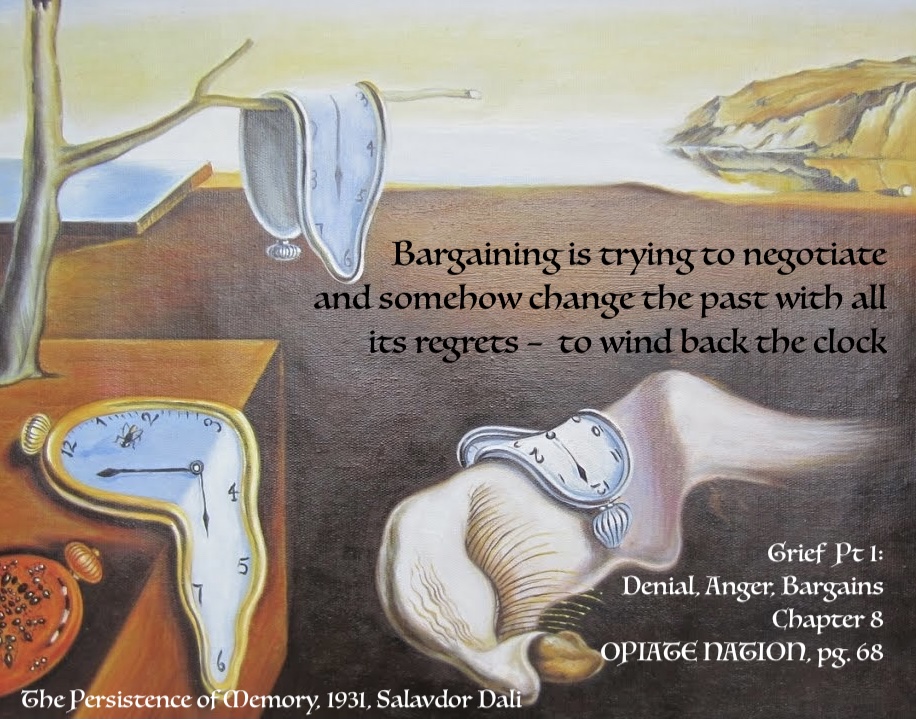
It wasn’t until 20 years ago when my younger brother died from AIDS that I was faced with a death that was so close I felt a personal loss that tore at my heart. There was no way to just quickly plan a funeral and burial and then move on. My life as I had known it, now had a gaping chasm where my brother had once been and it was not going to close up anytime in the near future. I needed someone who had travelled this path before me to guide me through the overwhelmingly disturbing and depressing feelings. None of my friends had experienced a close loss like this. So, I looked to the books that were most recommended: On Grief and Grieving by Elisabeth Kübler-Ross and A Grief Observed by C. S. Lewis.
(Seventh in a series of topical blogs based on chapter by chapter excerpts from Opiate Nation. Translation into most languages is available to the right.)
When public health is at risk, one can only wonder about the motives behind politicians’ decisions – our “public servants” as they used to be referred to – regardless of what they may say. But we don’t have to guess their motives because actions speak louder than words and the actions of the US Department of Justice (DOJ) this week regarding Purdue Pharma and the Sackler family are unconscionable. This deal is not justice for the victims and their families for this pervasive and criminal corporate greed.
(Sixth in a series of topical blogs based on chapter by chapter excerpts from Opiate Nation. Translation into most languages is available to the right.)
I have always loved Star Trek. From the early 1960’s shows with the corny scripts and goofy hairdos to the 21st century high-tech and high-stakes extravaganzas. Science fiction envisions the future for us and pushes inventions and technology from getting “beamed-up” in a flash to having a force field to deflect foreign objects.
The concept of a force field would be an incredible tool to have at our disposal – to be able to switch it on and off at will. And I can think of no better time to employ an emotional force field than during the early days and weeks after a sudden death. When it takes all your energy just to exist, to wake up and to face the next moment. An invisible barrier for self-protection.
(Fifth in a series of topical blogs based on chapter by chapter excerpts from Opiate Nation. Translation into most languages is available to the right.)
After many years of not having a dog, we decided to adopt one from our local shelter. We found a beautiful German-shepherd/wolf mix who was 18 months old. Bella was docile, sweet and quiet. The next day, as I headed out to the grocery store, I gave her a hug and saw her watch me through the window as I got into the car.
When I returned an hour later, I was met with a shock. I found her, panting rapidly and pacing nervously in our bedroom where our wooden shutters were open and had bite marks. She had tried to escape while I was gone. I had no idea why. I immediately called the shelter. “She is having separation anxiety: she needed to escape being left alone.” We found out that she had been with two families previously when she was dumped at the shelter because she continued to try to escape when she was left alone for hours on end. They gave us the name of a dog behaviorist and we started down the long road of helping Bella manage her fear when we had to leave her at home.
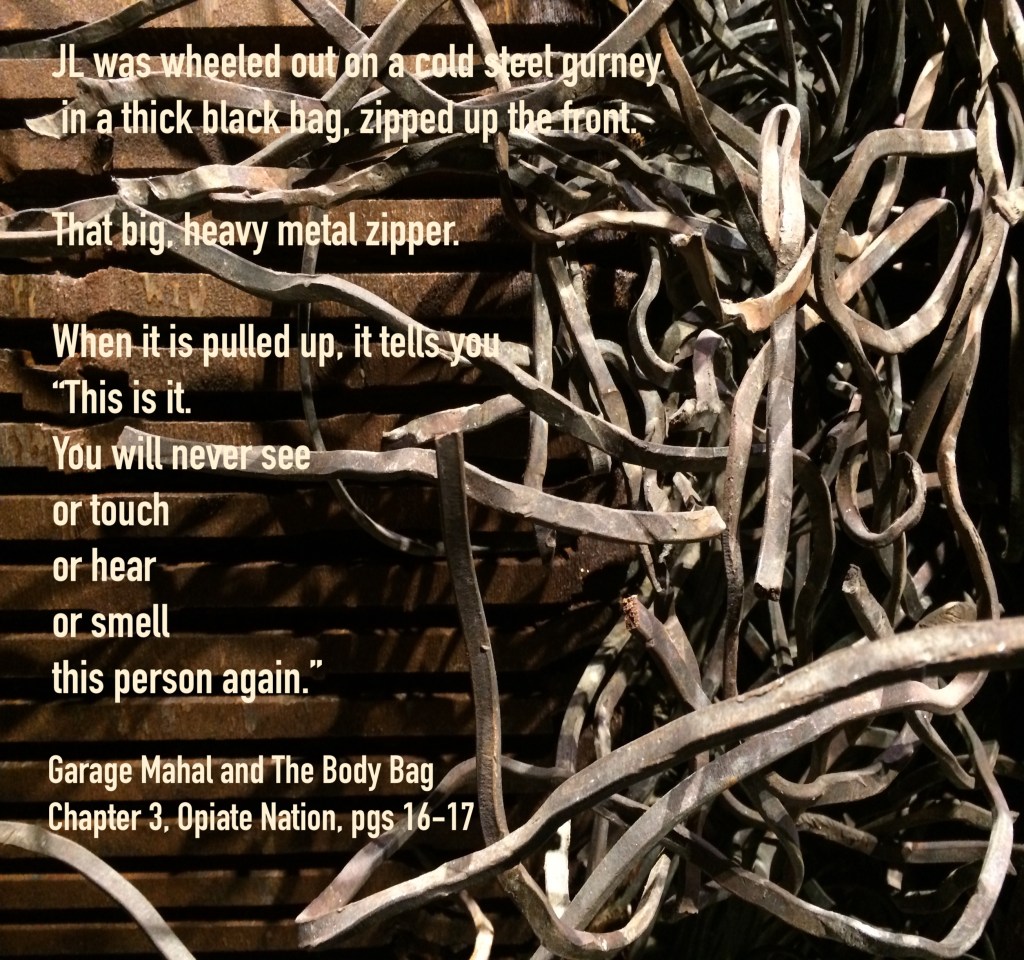
Children and adults can experience separation anxiety when someone they are attached to leaves them. They can have recurrent and excessive distress just anticipating being separated from loved ones and the anxiety can be so intense that it is hard to function in everyday life. Panic attacks and physical symptoms such as nausea and headaches can occur. For me and my husband, on the morning of our son’s death from overdose, standing over our son in that body bag we experienced the ultimate separation anxiety. The overriding emotion we felt was fear: fear of the unknown future we were facing. We couldn’t visualize how we would survive without our son as part of our lives and the future we thought we all had together. He had not only been an integral part of our lives for 25 years but he was literally a part of us–the combination of our DNA that formed him as a particular and unique human being. To say that it was like having part of you taken away doesn’t describe it. This was having our hearts torn out.
We would never embrace or kiss or stroke the cheek of our son again. We were facing an existential crisis, shaken to the core, questioning our reason for living. Regardless of our strong faith that had seen us through many other deaths in our families, this separation seemed incomprehensible and cruel. It was only by falling down on our faces and waiting for Mercy to gradually pick us up that we were able to survive this traumatic separation from our son and move forward again in life.
The Ohio Society of Addiction Medicine is a chapter of ASAM - A professional society actively seeking to define and expand the field of addiction medicine.





 Opiate Nation