An Entire Generation

Translation into most languages at tab to the right.

A generation is usually considered the years during which children are born, grow up, become adults, and begin to have children of their own. Approximately  20-30 years, averaging 25 years. Each generation becomes known by what characterizes the lives of those in it – what they do and how they impact society.

I’ve been thinking about my son, who would be 36 this year – if he had survived the opioid plague that began in the 1990’s with the prescribing of opioids for every ache and pain. What Purdue Pharma did is old news and well documented. But the effect of the immorality of the Sackler family set a course  that destroyed the lives of an entire generation – the “Millennials” generation of my son and his contemporaries. 

Far more than a million Americans have died due to a drug overdose in the past 25 years and the majority of those deaths are from opioids. (1) Initially it was prescription opioids, then heroin, then fentanyl. And now a daily variation of synthetic opioids mixed in with every variety of street drug. These are made from precursor chemicals from China and shipped around the globe where they are “formulated” into fake prescription pills or street drugs in jungle or backyard labs. Quality control is non-existent. 

Beyond the deaths, there are millions of Americans who are suffering from life-threatening addiction. They will either be another statistic or live the life of an empty shell surviving from one fix to the next just to not feel “dope sick.” Many are homeless and jobless. All experience despair and hopelessness. It will take years to gain long-term recovery if they can access health care and programs.

There has been some good news. After the peak years of the Covid pandemic, when the rates of addiction and deaths from overdoses rose substantially, the statistics for 2024 finally show a decline in both. (2) It may be due to less anxiety and depression since the pandemic ended. It may also be due to more awareness of Medicated Assisted Treatment and better access to Harm Reduction tools such as pill testing and overdose reversal medication naloxone.

I think the best area for hope is the common knowledge the “Gen Z” kids are growing up with about the deadly dangers of drug addiction. That their parents are also more aware of the drug supply than parents of Millennials like me. The 2023 National Survey on Drug Use & Health found that the majority of adolescents (12-17 yrs. old) in the USA are not using substances, alcohol, tobacco products or vaping. (3) But ongoing effort is imperative. “Continued prevention programming, education, and public messaging focused on adolescents can delay or prevent substance use and avoid the negative impacts of substance use that have been widely documented.”  

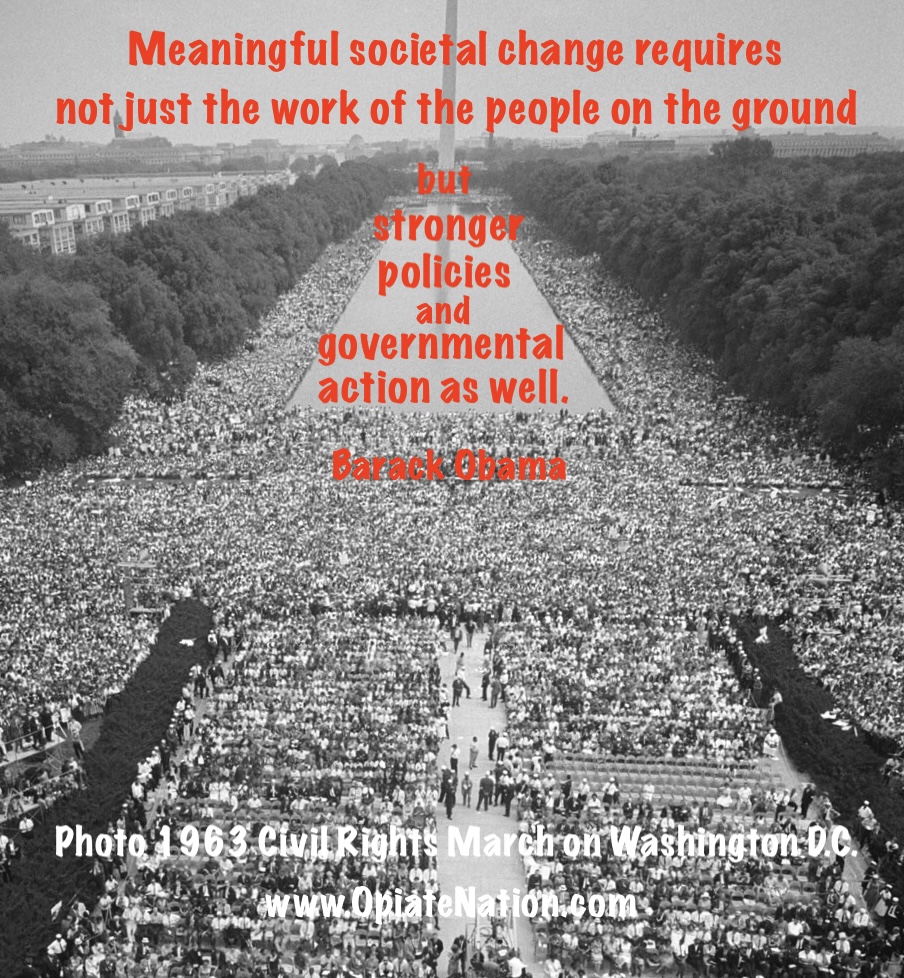
If we truly want to see future generations of children have the opportunity to grow up without the continual pull to use drugs, we need to keep our relationships with them open and healthy. Every year we can delay experimentation with addictive substances allows children’s brains to develop more fully in the area of judgment. We must all stay informed and aware and work in whatever arena we are able. As Barack Obama told Michelle when he was working for her as an intern, that he was in law school because grass roots organizing had shown him that meaningful societal change requires not just the work of the people on the ground, but stronger policies and governmental action as well. (4)

  1. Fentanyl and the U.S. Opioid Epidemic

https://www.cfr.org/backgrounder/fentanyl-and-us-opioid-epidemic

2. The Opioid Crises and The Pandemic

3. NSDUH Data Show Most Adolescents in the US Are Not Using Substances

    4. Becoming, by Michelle Obama, Chapter 8
    The Cycle of Harm – End It For Good 

    (Translation into most langugages at tab to the right.)

    Recently, I connected with Christina Dent, Founder & President of End It For Good. The mutual connection came through a drug advocacy organization in Australia where they also promote options other than incarceration for drug addiction.

    The End It For Good website is a treasure worth exploring (see below). Although Christina has been mainly focused on her home state of Mississippi, they are now expanding and reaching out across the United States. Their website states:

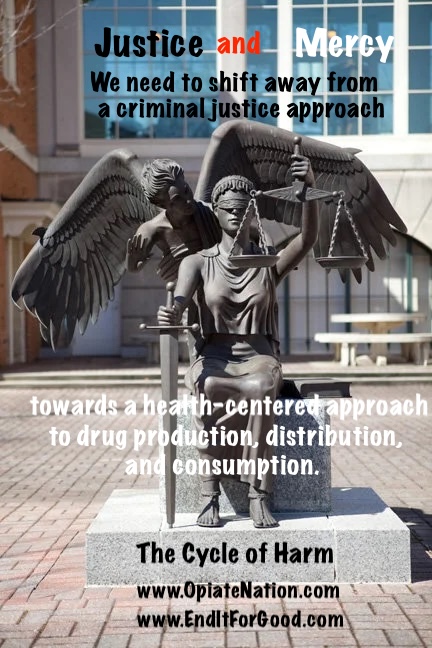
    Our goal is a future where fewer people are harmed by drugs. To get there, we need to shift away from a criminal justice approach and towards a health-centered approach to drug production, distribution, and consumption. As a 501(c)(3), we educate citizens, advocates, and policymakers to elevate solutions that prioritize life, health, strong families, and safe communities. This is the path to a world where more people have an opportunity to thrive.

    In her TED Talk, Christina shares her learning journey about the destructive impact of a criminal justice approach to drugs and addiction, as well as the mounting evidence that a health-centered approach would be much more effective.

    And Christina has written an award winning and very favorably reviewed book: 

    CURIOUS: A Foster Mom’s Discovery of an Unexpected Solution to Drugs and Addiction. It gives a vision for unexpected solutions that save lives, heal families, and promote public safety.

    The reason I used this particular statue for the blog graphic this month relates perfectly to this subject. Justice & Mercy was designed by sculptor L. Glynn Acree III and stands in front of the Cumberland School of Law at Samford University in Birmingham, Alabama. Justice is blindfolded and the scales she holds are perfectly balanced. The angel, Mercy, is whispering in Justice’s ear. An important reminder that in order for justice to be true and impartial, mercy and kindness must temper her decisions – because as humans, we are all imperfect and fail in many ways. 

    Slavery or Freedom?

    (Translation into most languages at tab to the right)

    I’ve been thinking about slavery and the people throughout the millennia who have been slaves – and the estimated 50 million people worldwide who are currently enslaved. (1) Every empire from the beginning of recorded history has functioned and prospered on the backs of slaves: people captured during war or kidnapped, enslaved against their will.

    In the modern world, people can end up in ‘slavery’ in a variety of ways: economic, sexual, labor, etc. They may have been enticed or tricked into their captivity by promises of adventure or money, coerced or blackmailed because of a past circumstance, or forced into it due to poverty and debt.

    How does it feel to be enslaved? Much of the time, it destroys one’s sense of personhood. Your ability to exercise your will and make choices has been stolen from you. Control and exploitation by another person or entity has robbed you of your dignity and ability to determine the direction of your life. It can feel like being on endless stairways that lead nowhere.

    One thing is certain: no one ever consciously chooses to be enslaved. No one. But the many lures currently dangling in front of young people to have fun and feel free and to be in control of their own life and happiness can be so deceptive. Yet they are not mature enough to be capable of discerning that they are actually making a choice to become imprisoned – whether it is with alcohol, drugs, promiscuity, gambling, power, success, etc.

    I think it is safe to say that anyone who has struggled with any type of addiction knows they are enslaved. They are in servitude to an all-consuming, dominating, master. Their world is restricted due to the demands their addiction places on them. I saw this play out in pitiful detail in our son’s long struggle with heroin and alcohol. I didn’t understand why he would want to cut a trip short or not go at all if we were flying. It was due to needing to use and/or maintain a supply of illegal drugs. As he became unable to focus on his university classes, he had to drop out and work at jobs frustratingly inconsistent with his interests and well below his God-given abilities.

    He was not free in any sense of the word.

    What is real freedom? Is it to be ‘a free agent’ able to do whatever one wants regardless of society or others’ thoughts or needs? To not be responsible to anyone? To chant the modern mantra that individual freedom is our right and supersedes all other claims? Or is it something more, something that starts in our mind and soul and that results in the ability to make good choices in order to be healthy and safe and productive and of service to others? Webster’s Dictionary describes freedom as “the absence of necessity, coercion, or constraint in choice or action; liberation from slavery.” Liberty is not the power of doing what we like, but the right to do what we ought. (John Dalberg-Acton)

    Once someone is addicted, how can they escape the slavery of addiction? We need reformers and abolitionists who know specifics of ‘the slave trade’ and how to liberate individuals. And also, how to reform not only the laws and principles of society but how we think about addiction in order to accurately view those who are enslaved. In the past, in whatever culture slavery was embraced, the way a society could justify its policies was to consider those people as ‘less than’ – less than human, less than worthy of normal rights, even less than deserving of wanting another way of living. And even further, that these slaves should be content with their bondage.

    I love this song by Kim Hill, She’ll Come Around. It speaks to this point.

    https://www.youtube.com/watch?v=uwf6rQnqkXQ

    We all know that is not true because if we put ourselves in their place for a moment – walk a mile in their shoes – we would do anything to be free. But do we all understand and admit that most people who are living in addiction, if given a choice and a viable option, would choose to be free? If so, let’s get rid of denigrating thoughts and words and help change public policies to teach preventative measures to parents and young people and provide restorative solutions to those fighting addiction. (2) And may each of us encourage those who struggle by helping them find real, lasting solutions to the weight of bondage they stagger under.

    Our freedom can be measured by the number of things we can walk away from.
    Vernon Howard

    1. https://www.antislavery.org/slavery-today/modern-slavery/
    2. https://www.washingtonpost.com/health/2023/02/05/drug-deaths-prevention/

    Mark Heard’s Victims of the Age is a song all about what young people have been and continue to be struggling with growing up in the modern world.

    2021 International Overdose Awareness Day August 31

    Translation into most languages at tab to the right.

    The need has never been more urgent to alert us all to the risk of overdose facing millions of people worldwide. During the 18 months of the Covid-19 pandemic, overdose deaths have risen approximately 30% in many parts of the world due to isolation, unstable drug sources, and lack of reliable medical and recovery help. Even the normal inadequate support services have been seriously disrupted and diverted. And the hope of C19 disappearing sometime soon is now seen as wishful thinking – it is a new deadly virus we will have to learn how to live with.

    So, what can we do to help prevent further loss of lives for those already struggling with addiction?

    Continue reading “2021 International Overdose Awareness Day August 31”

    Looking Back to See the Future

    (Translation into most languages is available to the right.)

    When I am doing research for an upcoming blog post, I can get lost. There is so much information now on drug addiction and the opioid epidemic that I suddenly look at the clock and realize I’ve been wandering virtually around the world and becoming more discouraged with each new article or report: Scotland has more drug overdose deaths per capita than any European country (1); Fentanyl is  flooding California with overdose deaths skyrocketing (2); the use of over-the-counter codeine (an opiate) cough medicine among eighth graders in the US has increased (3); and, Australia now has the eighth-highest per-capita opioid consumption in the world (4).

    Continue reading “Looking Back to See the Future”

    Celebrating Freedom and New Life

    April 4, 2021

     (I am taking a break from the chapter by chapter topics from Opiate Nation to focus on the significance of this holy week. Translations into most languages available at tab to the right.)

    Spring is the season of regeneration, freedom, new life. The time of year when the whole earth seems excited to be alive after being dormant all winter. For the northern hemisphere, March and April are Spring – for our friends and family in Australia, right now it is Autumn. Regardless of what season it is where you live on this planet, it is Easter Sunday and the end of Passover week. Both the Christian and Jewish traditions celebrate the freedom from bondage and the beginning of a new life, although from differing perspectives and beliefs. Both begin the time with reflection and prayer. (I don’t understand Islamic tradition well enough to comment on it except to say that Ramadan is observed around this same time of year with introspection and fasting in remembrance of Muhammad receiving the Quran.)

    For Christians, the freedom is from the bondage to sin in one’s life; for Jews, it is the freedom from bondage that the Israelites suffered under in Egypt. Both faiths look to an historical event in the past. They also remind us that while bondage was dealt with symbolically once – whether personally or communally – it is an ongoing problem in this imperfect world.

    Continue reading “Celebrating Freedom and New Life”

    An Ounce of Prevention

    (Eighteenth in a series of topical blogs based on chapter by chapter excerpts from Opiate Nation. Translation into most languages is available to the right.)

    In 1735, Benjamin Franklin wrote a letter to his own newspaper, The Pennsylvania Gazette, where he used this now-famous phrase: An ounce of prevention is worth a pound of cure. He wasn’t referring to a pandemic or keeping your roof in good condition so it won’t leak or changing the oil in your car so you won’t ruin your engine or, my personal example, brushing your teeth to avoid tooth decay and gum disease.

    When I was growing up in the 1960’s, brushing our teeth every day was a new habit for most Americans. Even though the toothbrush was invented in 1857, it wasn’t until after WWII that we got in the habit of regularly brushing our teeth. When I was young, I didn’t give much thought to personal care and it seems I didn’t brush my teeth often – I was too busy living life – which is why my two older sisters gave me the endearing nick-name “moss-mouth”.  (FYI, I must have good teeth genetics because I didn’t have my first cavity until I was 30.)

    Continue reading “An Ounce of Prevention”

    Who Is My Neighbor?

    (Sixteenth in a series of topical blogs based on chapter by chapter excerpts from Opiate Nation. Translation into most languages is available to the right.)

    (I am re-posting this blog due to a glitch on some platforms in January)

    In 2020, overdose deaths have increased worldwide, and by as much as 25% in the US. Deaths from acute intoxication have also increased dramatically. People are isolated and anxious, their treatment and recovery programs have been disrupted, and the illicit drug supply has become dangerous. Health officials believe that the majority of these deaths have occurred because hospitals are full and emergency services are overwhelmed with Covid-19 patients, thus removing the urgent, lifesaving care of overdose reversal that has been established in the past few years. Funding for all mental health services has also been diverted to pandemic care, which has complicated access to basic resources. Suicides are rising at an alarming rate.

    A conversation that I believe is relevant to the current times came to mind this week. A lawyer asked Jesus “Who is my neighbor?” as he was trying to wriggle out of the command to “Love your neighbor as yourself.” Jesus told him about a man beaten and robbed while on a journey. As the man lay almost dead on the road, he was passed by several religious leaders who refused to help him. Then a man, who was not the same nationality or religion, came and bandaged and rescued him and paid for his care until he was well. Jesus asked the lawyer, “Which of these men proved to be a neighbor?” The lawyer replied, “The one who showed compassion.” Jesus responded, “Go and do the same.” *

    Continue reading “Who Is My Neighbor?”

    Missing Community

    (Fifteenth in a series of topical blogs based on chapter by chapter excerpts from Opiate Nation. Translation into most languages is available to the right.)

    (This blog was posted on December 27, 2020, but due to technical glitches, it was not shared on some platforms – here it is again for those who missed it.)

    For much of the world, Christmas and the holiday season this year has been nothing like our normal times of celebrating with family and friends. Togetherness is dangerous in most countries due to Covid-19. Yet, despite all the health and safety warnings, many have travelled and gathered with their loved ones. Why would people risk the well-being of themselves and their beloveds just to spend a few hours or days together?

    Community. We all need it and ultimately cannot live without it. Communities may seem optional when all is well, but they become indispensable during hard times, whether personally or corporately. They can be small or large and most of us have several different sizes and types that we are part of: our family, school, sports, church, work, etc. What communities have in common are shared interests, beliefs, and needs, even while the individuals may have diverse characteristics. They are united and working towards a common goal and understand that they can achieve it because of, and with, the support and encouragement of others.

    Continue reading “Missing Community”

    What’s Inside the Shell?

    (Ninth in a series of topical blogs based on chapter by chapter excerpts from Opiate Nation. Translation into most languages is available to the right.)

    Shells are beautiful and fascinating to me. Each and every one is unique, differing from others just like our fingerprints. John and I just spent time at the central eastern coast of Australia and on our daily walks on the beach I just couldn’t stop picking up shells – especially the Nautilus shells with their logarithmic spirals of every size, shape, and color. These are empty shells that were once the home of a sea creature.

    The exoskeleton of mollusks is the hard, outer layer that protects the tender creature inside. As the creature grows, layers are added to accommodate it. One day, as I was picking up shells in the surf, the inhabitant was still inside. It immediately retreated as far back into its shell as possible.

    Continue reading “What’s Inside the Shell?”
    Malcolm Guite

    Blog for poet and singer-songwriter Malcolm Guite

    The Gift of Need

    How Need Can Strengthen Individuals and Communities

    Memoirs and Musings

    David Bradley Such

    Dave Barnhart

    Church planter, pastor, author, coach

    RecoveryLife101

    Just another WordPress.com site

    Abbie In Wondrland

    life...on Gods' terms.

    Living In Graceland

    "..learn the unforced rhythms of grace" matt 11:28

    Janaburson's Blog

    All about opioid addiction and its treatment with medication

    Breaking In News Network

    Seeking the truth and bypassing the MSM

    Junkbox Diaries

    Trauma, PTSD, Mental Health, Addiction, and Recovery

    Ohio Society of Addiction Medicine

    The Ohio Society of Addiction Medicine is a chapter of ASAM - A professional society actively seeking to define and expand the field of addiction medicine.

    traceyh415

    Addiction, Recovery, Loss, Grief

    WordPress.com News

    The latest news on WordPress.com and the WordPress community.