Translation into most languages at tab to the right.
The need has never been more urgent to alert us all to the risk of overdose facing millions of people worldwide. During the 18 months of the Covid-19 pandemic, overdose deaths have risen approximately 30% in many parts of the world due to isolation, unstable drug sources, and lack of reliable medical and recovery help. Even the normal inadequate support services have been seriously disrupted and diverted. And the hope of C19 disappearing sometime soon is now seen as wishful thinking – it is a new deadly virus we will have to learn how to live with.
So, what can we do to help prevent further loss of lives for those already struggling with addiction?
(Translation in most languages available at tab on right)
Int’l Overdose Awareness Day Sale on eBook & Paperback through Sept 1st
Most of us have heard that the category of “teenager” came about after WWII. Before that, in a mostly agrarian society, you were either a child or an adult and the demarcation was when you went from being directed and cared for by your parents to being responsible for yourself and caring for others.
The word “teen” was introduced as early as 1818 referring to a person who was 13-19, “teener” from 1894, and “teen-ager” from 1922 (1). But the terms didn’t stick and didn’t carry a sociological group identity until after WWII. Being a teenager became its own sub-culture that revolved around like-ness, popularity and a fear of being on the outside.
Increasingly, the modern teenager relies more on peer-pressure than family relationships and values. And, peer pressure and group dynamics is known to be one of the highest risks for adolescent drug and alcohol experimentation and use. In one chapter of Hit Makers: The Science of Popularity in an Age of Distraction, Derek Thompson discusses teenagers at length (2). He writes, “Psychologist Laurence Steinberg, put people of various ages in a simulated driving game. Adults drove the same, whether or not they had an audience. But teenagers took twice as many “chances” when their friends were watching. Teenagers are exquisitely sensitive to the influence of their peers.”
(Short topical blog based on Opiate Nation – translation into most languages in tab on right.)
August 2nd is the seventh anniversary of our son’s death. JL died of a heroin overdose in the early morning hours of that Saturday in 2014. He was 25 years old.
In 2020 alone, 93,000 people died of drug overdoses in the USA – hundreds of thousands more worldwide. Millions in the past few decades. These were beloved daughters, sons, partners, parents, friends, relatives. I think I can confidently say they did not want to be addicted and if they could have turned back the clock to the time before they began using drugs, they would have.
(Short topical blogs based on Opiate Nation – translation into most languages in tab on right.)
When we hear the phrase “ghost stories” most of us think of scary and spooky stories shared around a campfire with the intended, and predicable, consequence of keeping us awake at night.
But when H Lee (aka Harris Insler) decided to call his new podcast series “These Ghosts Must Be Heard”, it wasn’t because he would be interviewing people with paranormal experiences. And although the stories his guests share aren’t scary in the ghoulish sense, they have kept their narrators awake at night for days, weeks, and months on end. John and I included. (To hear our interview with Harris, see links below for Podbean, Amazon, Spotify.)
These are real-life experiences and these “ghosts” are the spirits of our deceased loved ones: children, friends, partners who have succumbed to premature and preventable deaths from opioid overdoses.
(I am re-posting this from July 4th for those who were on holiday and missed it.)
Topical blogs taken from OPIATE NATION. Translation into most languages at tab on right.
I was listening to a young man who had been heavily addicted to crystal meth. As he told his story, one of his “ah-ha” moments was walking into a bathroom in his parents’ home and seeing himself in the mirror. As he looked at the vestige of his former self – an emaciated, festered, hollow-eyed man – he remembered who he once was: a happy and carefree young person with good friends, a star athlete, a kind and honest person, a loving son. That moment of realization caused him to reach out and ask for help which eventually led to the beginning of his recovery journey.
As I heard his story, a photo flashed before my eyes of my son, JL – one we found on his phone after he died from a heroin overdose. It was a selfie he had taken after he had relapsed, just days before he died, standing in front of a full-length mirror in a public bathroom. He was dressed for work in slacks and a dress shirt. No smile. I have always wondered why he took that photo. Was it to remind himself of who he really was? To be able to be honest with himself when he might look at it later when he was high? Was he attempting to make himself stop using? To ask someone for help?
Topical blogs taken from OPIATE NATION. Translation into most languages at tab on right.
I was listening to a young man who had been heavily addicted to crystal meth. As he told his story, one of his “ah-ha” moments was walking into a bathroom in his parents’ home and seeing himself in the mirror. As he looked at the vestige of his former self – an emaciated, festered, hollow-eyed man – he remembered who he once was: a happy and carefree young person with good friends, a star athlete, a kind and honest person, a loving son. That moment of realization caused him to reach out and ask for help which eventually led to the beginning of his recovery journey.
As I heard his story, a photo flashed before my eyes of my son, JL – one we found on his phone after he died from a heroin overdose. It was a selfie he had taken after he had relapsed, just days before he died, standing in front of a full-length mirror in a public bathroom. He was dressed for work in slacks and a dress shirt. No smile. I have always wondered why he took that photo. Was it to remind himself of who he really was? To be able to be honest with himself when he might look at it later when he was high? Was he attempting to make himself stop using? To ask someone for help?
I’ll never know.
But after listening to this other young man, I’m guessing my son had similar thoughts going through his mind. Yet, what seems to have happened is that his addicted mind told himself that he could handle it on his own – that he could just cut down his use and not have to go through withdrawal one more time, not have to be embarrassed by telling us he had relapsed after 6 months of sobriety, not have to start all over again.
Perception refers to how we interpret things and it is the motivation behind our actions and reactions. His perception of his ability to use his willpower was skewed, because our self-perception is influenced by many factors including our perceived needs, our experiences, and our expectations.
Beneath self-perception is our self-concept, our view of our self, which influences our decisions, our feelings, and our judgement. It may include genuine self-knowledge or varying degrees of distortion.
Many times, we choose – albeit unconsciously – to be self-deceived because it is too painful to be honest with ourselves, to interpret what we see in the mirror with unbiased and accurate judgement. There is a saying written in the first century AD that sums this up:
“Those who hear (a clear direction) and don’t act are like those who glance in the mirror, walk away, and two minutes later have no idea who they are or what they look like.”
Because of this very human tendency, we all need a few close friends and a safe community who love us enough to honestly reflect back what we saw in the mirror – which we can so conveniently forget.
(Thirty-fifth in a series of topical blogs based on chapter by chapter excerpts from Opiate Nation. Translation into most languages is available to the right.)
This week’s Story of Hope is from a friend of JL’s, Peter (not his real name). Here are some excerpts from his story in Opiate Nation (5 min read):
My name is Peter and I’m an alcoholic and addict. This is how I introduce myself at the AA meetings I attend several times every week, as I have done for over 10 years. I am from a fairly affluent family, raised with high moral standards, and attended the best schools. So how is it that I became an alcoholic by the time I was a senior in high school and an opioid addict and dealer by the time I was 20?
The first time I used alcohol was in my junior year in high school. I was new to the school and I felt like I didn’t get the playbook for how to be a part of the group. I had been raised with strong values against using drugs and alcohol – but I wanted to fit in with the popular kids.
I tried a capful of vodka—that was it. I hated the way it tasted. The next day I was sick—not so much from the alcohol, but with guilt. This would be a consistent theme in my drinking and using: I always felt guilt and the consequences of doing something soul-crushing and bending the moral line I had deep within me. Once that barrier had been crossed, then anything was permissible. Initially I only drank on weekends at parties so that I wouldn’t be the outsider.
(Thirty-fourth in a series of topical blogs based on chapter by chapter excerpts from Opiate Nation. Translation into most languages is available to the right.)
This week’s Story of Hope is from a young friend of ours, Anne (not her real name). Here are some excerpts from her story in Opiate Nation (5 min read):
I was eleven years old when I first experienced shooting heroin. Looking back, I can hardly believe it and I am so thankful to be alive, and to be sharing my story.
My boyfriend and I watched the movies Trainspotting and Requiem for a Dream and they really piqued our interest in drugs. The way it was portrayed in those movies made me think using heroin would be an amazing dream sequence, when in actuality, it made me violently ill. My boyfriend insisted we keep trying. He became obsessed with all drugs: ecstasy, LSD, cocaine, and various pills and so I tried them all.
(Twenty-ninth in a series of topical blogs based on chapter by chapter excerpts from Opiate Nation. Translation into most languages is available to the right.)
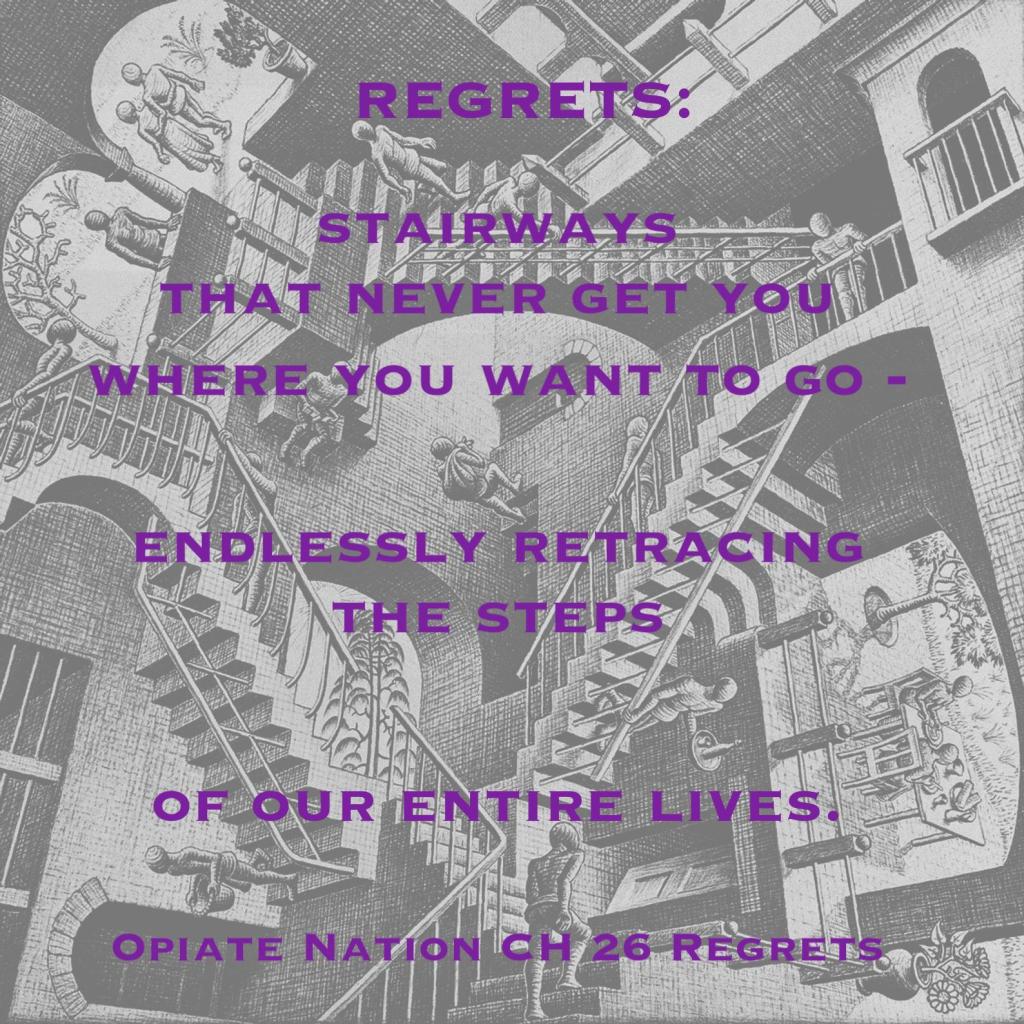
Our family loves the art of Dutch mathematician and artist M. C. Escher: the buildings that open into themselves, the school of fish that become a flock of birds, the circuitous stairways that go up and down throughout multiple buildings without an end point. Yes, stairways that never get you where you want to go, but keep you endlessly retracing your steps. They are no longer interesting art to wonder at. They now mirror how John and I have felt many times since August 2nd—regrets—retracing the steps of our entire lives.
(Twenty-sixth in a series of topical blogs based on chapter by chapter excerpts from Opiate Nation. Translation into most languages is available to the right.)
Nine months after our son, JL’s, sudden death, we were gradually unearthing our grief, as we gradually unearthed pieces of his life. We were miners searching for something precious, digging through the layers of years as if through layers of rock. Or perhaps we were more like survivors of an earthquake. Our entire earth, with everything we had built on it, was suddenly shaken to the point of collapse, and we were sifting through the remaining buildings and rubble to see what was left. Deciding what to keep and what to dispose of. “Dispose of” has new and unwelcome meanings now. Clothing, personal belongings, furniture, files, photos, childhood toys, keys, memorabilia.
John’s journal entry on May 12, 2015 expresses some of our feelings:
Dear JL,
It’s dad again. We are going through more of your things and I spent a half-day shredding your old papers and notes. It is so odd that much of our lives comes down to boxes of paper to shred. This is very, very hard for me. Shredding your life.
I love you – Dad
Grief is about what is going on inside us after a loss—how we feel. We have no more control over it than we have control over other feelings. Our choice involves how we deal with it.
Mourning is the action of dealing with our loss—what we do, the common rituals, the external part of the tragedy. Again, we choose how we mourn.
Some people put acts of mourning off indefinitely – leaving a deceased loved one’s belongings just as they were when they died until they die themselves. Others, urged on by society or their own distraught emotions, will almost immediately begin sorting and throwing. For us, there were some natural milestones when deep inside we seemed to know it was time to face the loss of another part of our son’s life. The grief-work we were engaged in – being aware of the various stages of grief and facing them as they surfaced – was our internal guide. We never let societal custom or any external pressure guide us, while we did read and listen to other’s experiences.
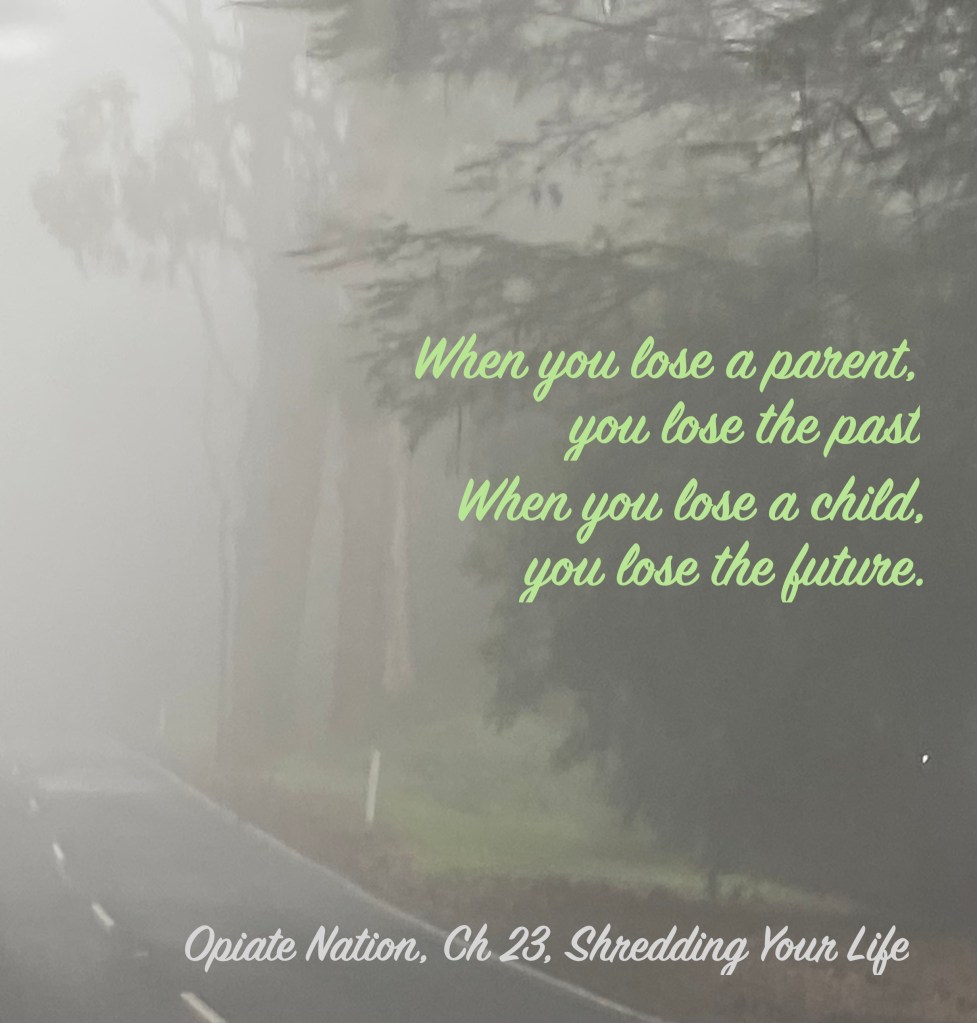
One thing became clear: this loss of our child was very, very different than the loss of our parents or siblings. Although each of those were difficult in their own distinct ways, the level of personal pain with our son’s death was unique. He was an intimate part of who we are – of course – he came from us. As he grew and became his own person, he yet remained a part of our life and more significantly, our future. All is engulfed in a thick fog. Which is why the quote in the photo is so poignant:
When you lose a parent, you lose the past. When you lose a child, you lose the future.
The Ohio Society of Addiction Medicine is a chapter of ASAM - A professional society actively seeking to define and expand the field of addiction medicine.


 Opiate Nation