Why We Need to Learn to Grieve

Why Grieve? First, those who grieve well, live well. Second, and most important, grief is the healing process of the heart, soul, and mind. It is the path that returns us to wholeness. Until we do, we suffer from the effect of unfinished business.  

~Elisabeth Kübler-Ross, On Grief and Grievingpg. 229

(Translation into most languages at tab to the right)

Like most people in Western societies, I was never taught how to grieve the loss of someone I loved. My family had not suffered the untimely loss of anyone close to us. Elderly grandparents passed and we would miss them, but quiet tears and sad faces was all I ever saw at those rare funerals. And grief is not something one normally thinks about when we are young. Unless it is a very close relative or friend, the empty space left by a person doesn’t drag us down to the depths of our soul when we are young and resilient. 

 When my younger brother died of AIDS at 40, it was the first death of someone I loved dearly and it was the first time I felt my heart break. I couldn’t seem to function because life had suddenly become dark and unknowable. If this could happen, anything could happen. I was afraid. How could I survive this? I had very few tools to help navigate the grief and didn’t know anyone who could empathize with this tragedy other than my husband John. My parents were devastated but mostly unable to talk about it. There were other deaths that followed: When my sister died of breast cancer that metastasized to her brain at 56. And when my youngest brother died a death of despair from suicide at 52. The feelings were much the same but by then I had one thing that helped. I knew from experience that I would survive. 

 Then in 2014, John and I experienced the most painful event of our lives. Our 25-year-old son died of an accidental heroin overdose. Today, he would have been 37. For this, we needed survival skills that went beyond the love and care of family and friends. Thankfully, we were introduced to On Grief and Grieving: Finding the Meaning of Grief Through the Five Stages of Loss by Elisabeth Kübler-Ross and David Kessler.(1,2) Knowing that everything we were feeling was normal was a comfort in and of itself. It is a guide for the process of grieving that has helped millions of people understand that grieving well takes time and cannot be rushed. These five stages follow a predictable pattern but are not necessarily linear or progressive because each response to loss is as unique as each loss. I wrote in detail about how we navigated the grief from our son’s death in Opiate Nation: A Memoir of Love, Loss and Acceptance. (3)  

The Five Stages of Loss are: denial, anger, bargaining, depression, and acceptance. Disbelief was perhaps a better way to describe our denial – feeling paralyzed by this sudden shock, and an inability and unwillingness to face what happened. Our bodies and our souls were in so much pain. We didn’t want to believe that our son was really gone from our lives, from this earth. But this stage is where many people get stuck. Moving out of denial and facing the facts will not happen until we feel safe and know that we are ready to handle what really is. 

Once we are ready to face reality, anger surfaces. It is part of the process of loss because anger brings a sense of temporary control we once thought we had and that is now gone. Kübler-Ross stresses that to not allow anger may slow down the grieving process. Many people, especially people of faith, avoid anger because isn’t “acceptable” and it is unthinkable to be angry at God. And there is an added sense of unfairness that complicates grief when the young die.

Bargaining is negotiating with reality while we vacillate between thinking there is something we can do and realizing there isn’t. The overwhelming pain involved with accepting reality causes us to alternate between hope and despair. John and my journal entries are full of “if only’s” and regrets, evidence that we tried to negotiate and somehow change the past. 

Truly feeling the overwhelming feelings of the reality of the loss leads to depression. This was the most difficult aspect of grief and the longest for us. We had to face the fact that the place our son occupied was now empty. Learning to sit with our feelings of deep sadness was not easy. It was a slow slog through each day and night.

The final stage of grieving is acceptance. It makes change possible and makes our present circumstances bearable and even good. For people of faith, we surrender to God’s ultimate plan and it can bring peace, forgiveness, healing, and a newfound freedom. That allowed us to move forward to a better, although different, future. This is where we begin to see some of the gifts that have accompanied the loss. 

Death is part of living as humans on this earth and death brings grief. It is one of life’s equalizers. Our learning to grieve well becomes a gift to others suffering through the death of a loved one as we also model how we mourn, which is the external part of loss. Learning to accept our humanness and our limitations helps us learn about grace and forgiveness, towards ourselves and others. When we experience grief, we have experienced the full cycle of being human. Greif transforms our broken and wounded souls and has the power to heal. Leo Tolstoy said, Only people who are capable of loving strongly can also suffer great sorrow, but this same necessity of loving serves to counteract their grief and heals themAnd when we heal and continue to live after the loss of our loved one, this is the gift that grief gives us and that we can share with others.  

  1. The Elizabeth Kübler-Ross Foundation. https://www.ekrfoundation.org/elisabeth-kubler-ross/
  2. David Kessler https://grief.com/the-five-stages-of-grief/
  3. www.OpiateNation.com

Born Imperfect, Complex, & Unique

(Translation into most languages at tab to the right.)

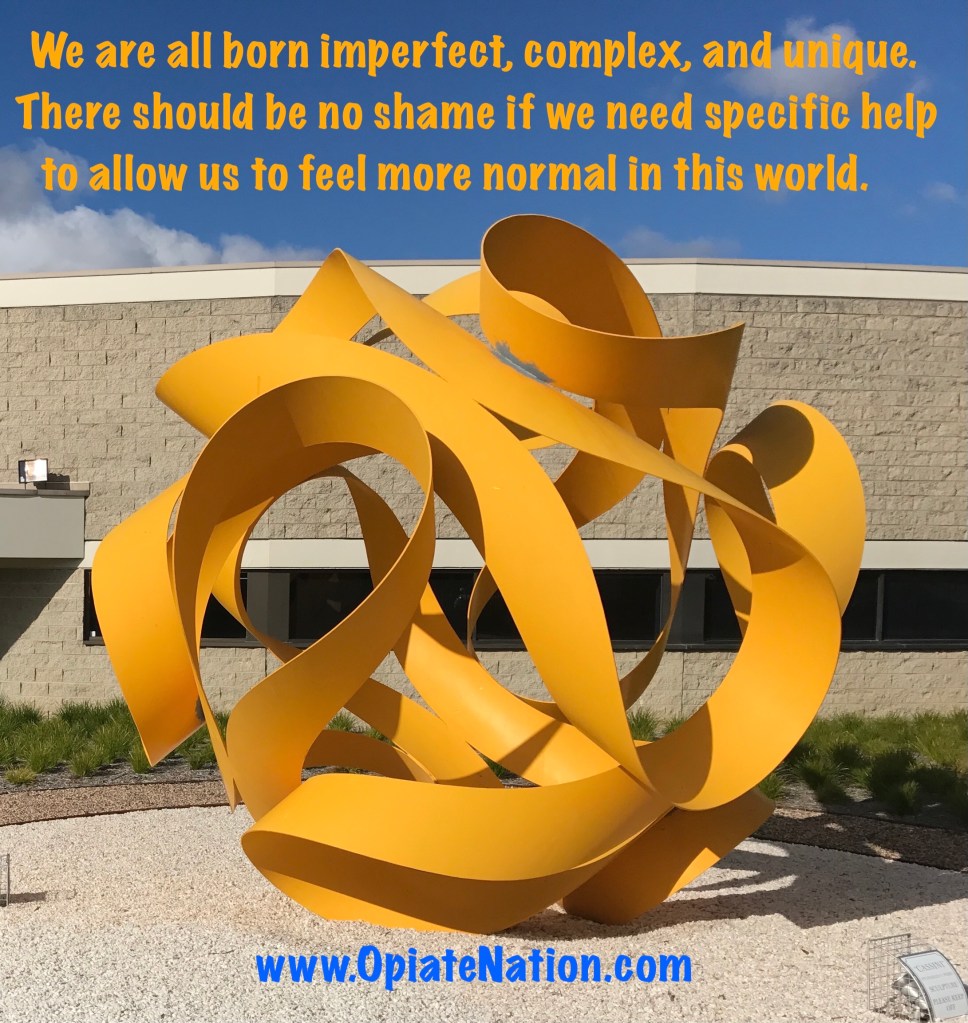
I think we would all agree that each and every one of us is born imperfect. There are so many complex and unique aspects to the human body which generations of genes have contributed. The things that make up our physical and mental attributes. One example is our face. It is estimated that only 2% of the world’s population has a truly symmetrical face. The right side usually appears larger than the left and eyes, nose and ears are not perfectly aligned. When you see a photo of a face with both sides exactly the same, its actually creepy. They lack character and look like AI.

Some of us are born with deficiencies that make life difficult and challenging, like being born blind, or deaf, or with a physical deformity. Because of amazing advances in science and medicine in the last century, many of these problems can be corrected. I had crowded teeth when I was young and am so thankful I was able to get braces and have a normal smile. We would not understand if someone had the opportunity to receive this kind of help and didn’t access it because they or others in their community thought they should just live as they are. We all want to feel comfortable and that we belong, are ‘normal’ in this world.

What about when someone is born with an internal deficiency such as a heart condition or kidney problem or blood disorder? We never think twice about having medical help or drugs and lifestyle changes to remediate the problem if it is possible. So why is there any discussion on whether someone who is born with an imbalance of normal brain chemicals or hormones should live in constant struggle and not access medication?

This thought came up as I considered the reasons behind why some people seem to need something like drugs to make them feel ‘normal’ to themselves and to the people around them. When everyone else seems to easily roll with the ups and downs of life while they get stuck on the downs. When how they think and process input and information is not the same as others. When their ability to be at peace or sleep is chronically unobtainable.

I’m not at all suggesting that individuals who seek drugs all have legitimate genetic or biochemical voids. As we know, many young people start drug use because of peer pressure and the environment that surrounds them. But underlying mental struggles or health conditions may be the determining factor that pushes them into, rather than away from, repeated use. I found it interesting that among my son’s high school and college friends, many tried all the drugs – uppers, downers, hallucinogenic – and some went on to addiction to uppers like cocaine and meth while others to downers like opioids and benzos and some walked away from all of them.

But once repeated and continual use happens, the chemicals and receptors in the brain are changed and more than ever, medication and therapy are going to be a big part of recovery from use and restoration of normalized brain signals. The need for medication may be short term or lifelong. Regardless, we all need to remember that just like shaming someone because they have a physical deformity is totally unacceptable, shaming someone who is struggling with mental health and/or addiction problems is also unacceptable. 

This does not mean we enable destructive behavior or stop supporting someone to get professional medical and psychological help along with a supportive community. Never. If we want to see someone who is struggling become as healthy as possible, our love and support are crucial. And we know that in a country where public health care is a privilege rather than part of a foundation of society, finding the right care can be daunting. Let us be there to help our family, friends, and community receive the care they need by being encouraging and supportive.

Stigma of Addiction: The Effects, The Reasons, and How to Reduce Stigma

by Chris Elkins, MA

https://www.drugrehab.com/addiction/stigma/

Cognitive Behavioral Therapy Info Hazelden Betty Ford:

https://www.hazeldenbettyford.org/mental-health-services/cognitive-behavioral-therapy#:~:text=Learn%20more%20about%20this%20popular,techniques%20in%20working%20with%20patients.

World Mental Health Day 

(Translation into most languages at tab to the right)

Mental Health and Addiction

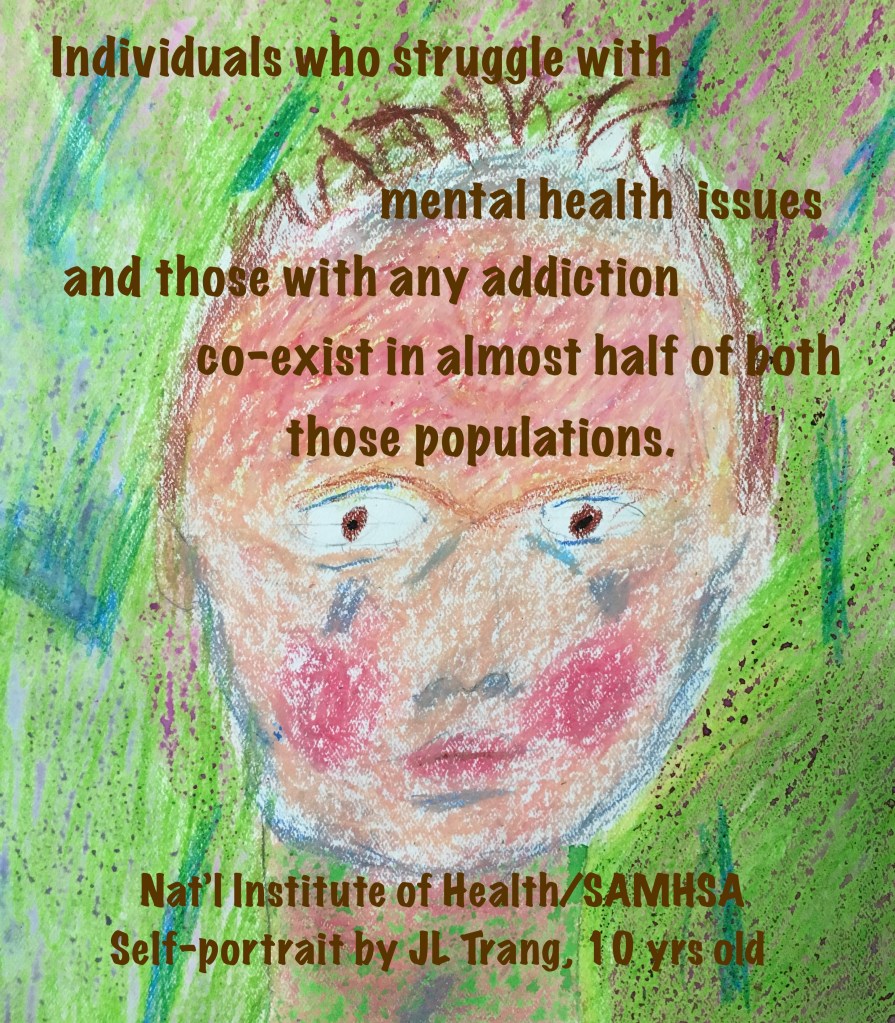
Individuals who struggle with mental health issues and those with any addiction co-exist in almost half of both those populations, as the data shows after decades of research by the National Institutes of Health (NIH). Not surprisingly, individuals who frequently abuse drugs or alcohol are likely to develop a co-occurring behavioral or mental health disorder. There is evidence, for example, that abusers of marijuana have an increased risk of psychosis while those who abuse opioid painkillers are at greater risk for depression. Regular methamphetamine use causes psychosis, anxiety and panic attacks, memory loss and depression. Cocaine users have increased anxiety, paranoia, delusions and depression.

Self-medicating to minimize our inner conflicts is not new, but it has reached new heights in the 21st century – perhaps due to the ease of availability. In Woman of Substances, Jenny Valentish discusses self-medicating at length. She says “In the initial pursuit of partying, people are likely to find themselves drawn to certain families of substances, and they will discover that these additionally offer relief to symptoms of mental illness, distress, or emotional pain.” Why do stimulants calm most people who have ADHD while they have the opposite effect on the rest of us? Why do some antihistamines sedate most people but for some others, cause stimulation?  Clearly, their brain chemistry needs something different than the ‘average’ person. It is for the same reason that for many, their drug of choice is a sedative. Their brains need something to turn off the rapid-fire stimulation that can be almost constant.

Informative and concerning statistics on mental health in the US:

Continue reading “World Mental Health Day ”

Hank’s Story: Drinking Loneliness

(Thirty-third in a series of topical blogs based on chapter by chapter excerpts from Opiate Nation. Translation into most languages is available to the right.)

This week’s Story of Hope is from our son’s friend, Hank (not his real name). Here are some excerpts from his story in Opiate Nation (5 min read):

I grew up in a loving home – the youngest of seven kids in a Catholic family. Although there are no alcoholics in my immediate family, my mother’s side of the family consists of proud Irish New Yorkers where alcoholism runs rampant. I experienced my first drunk at the age of 13.

Continue reading “Hank’s Story: Drinking Loneliness”

The Secret Keepers

(Twentieth in a series of topical blogs based on chapter by chapter excerpts from Opiate Nation. Translation into most languages is available to the right.)

National secrecy. Communal secrecy. Familial secrecy. Cloaked as “Discretion” it perpetuates problems. What it did for us when we found out that our son was addicted to heroin was to create a puzzle that we were forced to try to put together in the dark with many missing pieces. No one was talking – not friends, parents, school leaders. When the drug bust happened at his high school in the spring of 2005, and the administration didn’t call a meeting of all parents to alert us to what was going on, one wonders what motivation was behind that decision? Clearly, it wasn’t what was best for the rest of the students, families, or our community.

Years ago, while working through our angst with the systemic problems in organized Christianity, and continuing to run into absolute resistance, secrets, and denial, we came upon a quote that finally explained why we were not, and never would be, making headway: “If you speak about the problem, you become the problem.” This wisdom came from an important and insightful book, The Subtle Power of Spiritual Abuse. But the subtle power of abuse is not limited to churches: governments, schools, communities, families—no one wants to be seen as part of the problem, especially with drug addiction and alcoholism. So, if we just keep troublesome or messy things secret, if we don’t speak about them, we can all just get along.

Continue reading “The Secret Keepers”

Singing The Blues

(Eleventh in a series of topical blogs based on chapter by chapter excerpts from Opiate Nation. Translation into most languages is available to the right.)

Honesty is one of the main themes that ripple under the surface of “The Blues.” Expressions of honest feelings, whatever they may be at the moment – themes of lost love, painful relationships, dashed hopes, and heartache. The majority of us have or will experience heartache in our lives. Although it seems counterintuitive, most of us feel consoled by songs that express what we are feeling deep inside but may have a hard time putting into words. In order for me to be honest, I have to acknowledge that I am singing The Blues.

Continue reading “Singing The Blues”

Darkness & Light

Last week, our son would have turned 31. My husband and I still wonder what that would have been like? Would we have enjoyed celebrating as he got married like most of his friends have? Would he be living nearby or in a distant state for a new job? Would he and his wife be planning to start a family and give us grandchildren? These are questions we can only visit in our imaginations, and yes, they bring pain.

On our son’s FB memorial page and our Instagram this week, I posted a photo of the desert after a storm when a rainbow appeared, with this quote: “As in nature, so in life: it takes both clouds and sunshine to make a rainbow.” I have been pondering these apparent paradoxes in nature and in life, especially the concept of darkness & light. While reading A Grace Disguised by Jerry Sittser, I was reminded again of how we felt from the moment we heard the words from the sheriff’s mouth: “I’m sorry to have to tell you, but your son is dead.” Sittser lost his mother, his wife, and his daughter together in a head-on collision by a drunk driver and says, “Sudden and tragic loss leads to terrible darkness.” Yes. Existential darkness.

He describes a dream of seeing the sun setting and running frantically west toward it in order to remain in some vestige of light – but the sun was outpacing him to sink below the horizon. As he looked back over his shoulder, utter darkness and despair was closing in behind him. He later realized that “the quickest way to reach the light of day is to head east, plunging into the darkness, until one comes to the sunrise.”

Continue reading “Darkness & Light”
Malcolm Guite

Blog for poet and singer-songwriter Malcolm Guite

The Gift of Need

How Need Can Strengthen Individuals and Communities

Memoirs and Musings

David Bradley Such

Dave Barnhart

Church planter, pastor, author, coach

RecoveryLife101

Just another WordPress.com site

Abbie In Wondrland

life...on Gods' terms.

Living In Graceland

"..learn the unforced rhythms of grace" matt 11:28

Janaburson's Blog

All about opioid addiction and its treatment with medication

Breaking In News Network

Seeking the truth and bypassing the MSM

Junkbox Diaries

Trauma, PTSD, Mental Health, Addiction, and Recovery

Ohio Society of Addiction Medicine

The Ohio Society of Addiction Medicine is a chapter of ASAM - A professional society actively seeking to define and expand the field of addiction medicine.

traceyh415

Addiction, Recovery, Loss, Grief

WordPress.com News

The latest news on WordPress.com and the WordPress community.