Recovery Options for Teens

 Statue by Gustav Vigeland, Vigeland Park in Oslo, Norway.

(Translation into most languages at tab to the right.)

Understanding the teenage brain was the topic of my last post: Is Teenage Turmoil Inevitable? It is important to digest before parents consider a recovery program for their teen. Knowing that adolescents and teens feel and process information differently than adults is why they require a different approach to addiction and recovery.

Regardless of the type of program considered, the one absolute necessity is that the family be involved in the process – because family dynamics are an integral part of a young persons’ sober and addicted life. And the best place to start this discussion is to focus on the CRAFT model.

The American Psychological Association has an informative article, below. (1) In it they point to studies discussing how programs like Al-Anon for family members with an addicted loved one “may improve the well-being of friends and family members, they are not effective in getting the addicted person into treatment.”

Intervention programs, designed to help “family and friends work with a counselor to confront a substance user and urge him or her to get treatment” is only used by 30 percent of families due to discomfort with confrontation. And treatment is only the first step on the long road to recovery. After that, the family still needs other tools.

CRAFT (Community Reinforcement Approach to Family Training) originated at the University of New Mexico and was developed by Robert Meyers, Ph.D. and colleagues. Research on CRAFT shows that approximately 70% of families who receive CRAFT are able to help their loved ones start treatment within a year (Miller, Meyers, & Tonigan, 1999). CRAFT also helps family members improve their own lives, whether their loved one ends up seeking treatment or not.

CRAFT teaches real life skills to use connection to encourage positive change, because CRAFT is rooted in the belief that connection is the opposite of addiction. It teaches positive communications skills to foster the connection that is desired by the person who is struggling with addiction and their loved ones.

Helping Families Help is a great non-profit website resource for CRAFT information. (2)

SMART Recovery was established in 1994, here in the USA, to meet the increasing demand of those seeking a secular and evidence-informed alternative to the widespread 12-Step addiction recovery program. It is intended for adults over 18 and those seeking flexibility and independence, while AA offers structure and strong community support. It may be best for young adults in their 20’s, as most 18- to 25-year-olds who struggle with addiction are not yet “adult” in their thinking and coping skills. Smart Recovery is now in 23 countries. See info below. (3) 

Basically, the steps in helping your teen who is addicted are this:

  1. Getting them into treatment
  2. Choose a program – inpatient or outpatient
  3. Detox 
  4. Individual Therapy
  5. Family Therapy 
  6. Contingency Management
  1. Getting your loved one into treatment: sign up for CRAFT 10-week email training course through Helping Families Help or investigate other options.
  2. Choose a program: based on the drugs involved and length of time used.
  3. Detox: Most drugs will still be in your child’s system. Detox flushes them out. Detoxing under the care of professionals ensures that it’s done safely out of reach from harmful substances. Your teen will likely experience withdrawal symptoms as well.
  4. Individual Therapy: To understand a teen’s problem and to address it comprehensively. The first course of action in rehab is one or more types of therapy, both one-on-one and group settings. Motivational Interviewing uses a person-centered, non-confrontational style where the teen is encouraged to examine the pros and cons of their use and to create goals to help them achieve a healthier lifestyle. This helps them gradually realize the consequences of their actions. Cognitive Behavioral Therapy (CBT) is goal-oriented therapy that helps teens express and understand their feelings and cope with difficult emotions. They learn to replace negative behaviors (such as using substances) with positive ones (like sports or art or service endeavors).
  5. Family Therapy: Based on the premise that family carries the most profound and long-lasting influence on development, and in modeling both good and bad behaviors and beliefs. These sessions bring together those closest to an addicted teen and address issues such as poor family communication, cohesiveness and problem solving. Again, CRAFT is crucial here.
  6. Contingency Management: This form of therapy tracks each patient’s progress in rehab, including each day they succeed in staying sober, and rewards them with a prize. The more teens feel satisfied with their rewards, not only will they continue striving to stay sober, but their brain will relearn how to appreciate rewards that aren’t drugs or alcohol. Following rehab, a teenager is thrust back into the world. Temptations lie around every corner and their problem stays with them for years after treatment. After you’ve helped your child kick their habit you must help prepare them with a plan to prevent relapse – or for all of you to know what to do when relapse occurs, which is likely especially for certain drugs like opioids. MAT (Medication Assisted Treatment) is vital for opioid addiction and the long-lasting changes in the brain that will continue to undermine all the best plans and determination to stay clean and sober. Our son and many of the hundreds of thousands of young people who died from opioids are the sad evidence of this truth.

I do not offer these steps and advice as a medical or addiction professional. I can only offer my opinion based on our personal experience and the stories from others, along with the research I’ve done over the past 20 years since my husband and I first discovered that our 15 year old son was using heroin. What we wish we had known I share with you in the hope that your story will end differently than ours.

1. An underappreciated intervention

The CRAFT model is giving family and friends the skills they need to help get loved one’s treatment for substance use problems  By Katherine Lee – December 2017, Vol 48, No. 11

https://www.apa.org/monitor/2017/12/underappreciated-intervention

2. Helping Families Help – CRAFT Information

https://helpingfamilieshelp.com/about-craft

https://www.npr.org/sections/health-shots/2018/08/10/636556573/families-choose-empathy-over-tough-love-to-rescue-loved-ones-from-opioids

3. SMART Recovery

https://smartrecovery.org/what-is-smart-recovery

4. The Different Types of Adolescent Treatment Programs

New Horizons Recovery Centers (USA)

https://www.newhorizonscenters.com/blog/the-different-types-of-adolescent-addiction-treatment-programs

TEMPTATION: Fight it or Heed the warning signs?

(Translation into most languages at tab to the right)

I have been thinking about temptation recently and how differently we each respond when we face something that is hard for us to resist. How do we resist something that is alluring and that we have repeatedly succumbed to in the past? Something that we are addicted to like lying or shoplifting, alcohol or drugs, gossip or gambling, social media or overeating? The list of behaviors that can derail our lives in one way or the other is endless. It’s not just how an addiction can cause us harm, but also how it can debilitate or destroy our relationships, that makes learning how to beat temptation important.

So, when we are tempted to indulge in our pet addiction, what do we do? 

I read an article on Medium about temptation and willpower that supports the thoughts I’ve held throughout my life. Riikka Iivanainen (1) confesses that she has high self-control and discusses her research into why some people succeed at resisting temptation while others don’t. 

She says, High self-control does predict many positive life outcomes: People who’re good at self-control do better in school, have fewer mental health problems, have better relationships with friends and family, and generally exhibit fewer impulsive behaviors like binge eating and alcohol abuseThey’re even happier.

From the many scientific studies she researched, she goes on to say, Having good self-control doesn’t mean a constant battle against temptations. The kind of self-control that gets you all those good outcomes is more effortless than what’s commonly suggested by the term’s “willpower” and “self-discipline.”

Psychologists tell us that constantly resisting temptation is exhausting and will soon leave us with ego-depletion. Relying on self-control in the face of temptation is destined to fail. So what kind of self-control is “more effortless”? Riikka says, The people who reported fewer problematic desires and less conflict related to those desires were good at avoiding temptation, not resisting it.

Isn’t this insight what the basis of what most recovery programs are built upon? The acronym HALT is a tool to remind us to take a moment and avoid temptation by being aware of the primary things that can lead us to it: Hungry, Angry, Lonely, Tired. We are susceptible to self-destructive behaviors, temptations, and relapse when these basic human needs are unmet. HALT is a reminder, an early warning system. Being self-aware helps us recognize our needs and address them in a positive way before turning to harmful habits or destructive people.

Hungry – being hungry can be physical or emotional hunger

Angry – being angry at someone else or at yourself

Lonely – being lonely can be while in a crowd or from self-isolation

Tired – being tired affects our body, mind, and spirit

Some ways to deal with these needs is the subject of my Opiate Nation blog post April 14, 2018, H.A.L.T. https://opiatenation.com/2018/04/14/h-a-l-t/

We need to know ourselves and be honest about what our problematic desires are and avoid them rather than flirt with them. Desires are matters of the heart and we need to do all we can to support the healthy, life-affirming desires we have. I’ll end with pertinent insights from some of my favorite sources: 

There are several good protections against temptation, but the surest is cowardice.(2)

Strength comes prior to temptation, not during it. Overcoming is a prior act. It involves making a decision to remain pure before the temptation comes. (3)

Rather than waiting for temptation to raise its inevitable head and struggling to resist it, researchers at the University of Wyoming say it’s more effective to plan in advance to manage those temptations with well-thought-out self-control strategies. (4)

It is easier to prevent bad habits than to break them. (5)

Paul repeatedly told the early Christians in their very pagan cultures to “flee” temptation. (6)

Learning takes us through many states of life, but it fails utterly in the hour of danger and temptation. Then faith alone saves. (7)

But for persons needlessly to expose themselves to temptation, and to do those things that tend to sin, is unwarrantable, and contrary to that excellent example set before us. (8)

Jesus showed us by example when we are confronted with unavoidable temptation to speak the truth in order to help us resist until we are able to escape. (9)

Temptations, of course, cannot be avoided, but because we cannot prevent the birds from flying over our heads, there is no need that we should let them nest in our hair. (10)

  1. https://riikkaiivanainen.medium.com/the-secret-life-of-people-with-high-self-control-its-easier-than-you-think-7dd26fb5282c
  2. Mark Twain
  3. The Mind of Christ by T.W. Hunt & Claude V. King, 1990
  4. https://www.psychologytoday.com/au/blog/cravings/201911/4-ways-avoid-temptation-and-reach-your-goals
  5. Benjamin Franklin
  6. I Corinthians 10:14; I Timothy 6:11; II Timothy 2:22
  7. Mahatma Gandhi, Mohandas Gandhi, Homer A. Jack (2005). “The Wit and Wisdom of Gandhi”, p.40, Courier Corporation
  8. Jonathan Edwards, https://www.biblebb.com/files/edwards/temptation.htm
  9. Matthew 4:1-11
  10. Martin Luther

Dis-Couraged or En-Couraged?

Discouragement is the opposite of having the heart, the courage to face something. It’s when the heart has been sucked out of you. But the en in encouragement means “into”, the process of putting courage into someone. Giving them the heart and hope to go on. 

(Translation into most languages at tab to the right.)

It’s time for a confession. I have not been writing many blogs for Opiate Nation in the past two years – not because I haven’t had time but because I have felt discouraged. Decades into the Opioid Epidemic and all the information and media coverage, the hope that addiction and deaths from drug overdoses would decrease has proven unfounded. It seems that people in general are just tired of hearing about it, especially if it doesn’t particularly concern them. And I have felt that I didn’t have anything helpful to add to the conversation and wondered: what more needs to be said?

But I felt reprimanded in my heart and soul for being one more person who is fatigued by the persistence of a problem that seems to never get better, let alone go away. What about all the people living in active addiction? And what about their friends and family who spend sleepless nights and anxious days worried about them? And what of those who have lost loved ones to addiction and are living in debilitating grief?

I started thinking about discouragement and how to “snap out of it”? For me, there is no snapping out of it on my own. Once I’m dis-couraged, I have found that only being en-couraged changes things. And encouragement usually comes to me through two avenues: a few intimate friends and God, both of whom know me well. The words spoken out loud by friends and the ones directly into my soul by God are what lift my troubled and discouraged heart and bring hope and courage.

Courage comes from Latin cor meaning “heart”. The dis in discouragement means “opposite of”. Discouragement is the opposite of having the heart, the courage to face something. It’s when the heart has been sucked out of you. But the en in encouragement means “into”, the process of putting courage into someone. Giving them the heart and hope to go on. 

Although my life has not been characterized by addiction personally, encouragement has been important in my life, especially after my son died from addiction. How much more important would encouragement be to those struggling with addiction? And for the families and loved ones of those struggling or already lost? And how can we encourage without enabling?

So, I have been reminded of the importance of an encouraging word. Knowing this, how can I offer encouragement in the arena of addiction and Harm Reduction? Although people do recover from addiction and live full lives, there will always be people struggling with addiction and using drugs. When we acknowledge and accept this, we must try our best to help minimize the harm from that use in the ways we can. For me, that has been through writing to offer information, comfort, and encouragement. 

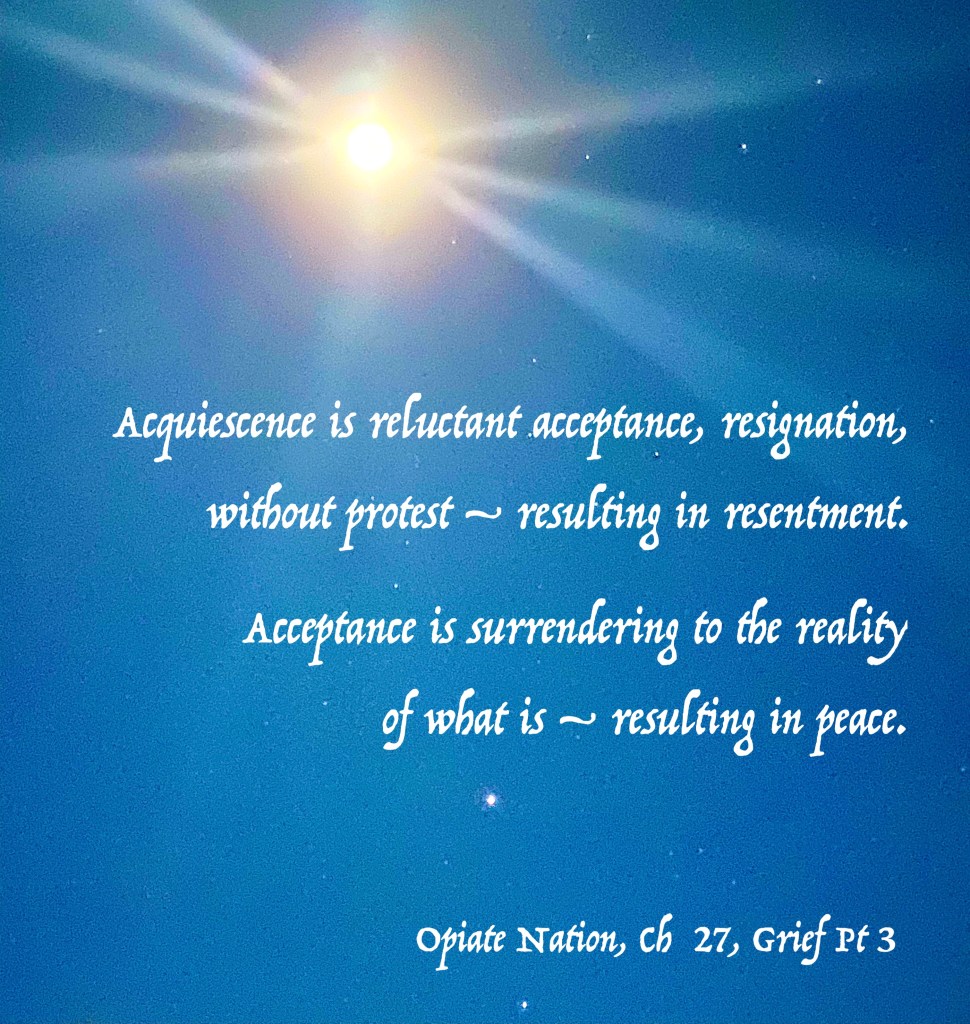
Grief: Acceptance or Acquiescence?

(Twenty-ninth in a series of topical blogs based on chapter by chapter excerpts from Opiate Nation. Translation into most languages is available to the right.)

I have never been one to accept something without question – anyone who knows me well, knows this – and they live with the frustration my incessant questions create. But it’s the way I need to process what is happening to or in or around me in order for me to honestly make the decision to accept or reject whatever the issue is at hand. I don’t think I could live with myself if I pretended I agreed or accepted something when I didn’t – the dishonesty would keep me in turmoil. And many times, it is ultimately for self-preservation that I accept something distasteful or painful when I finally understand there is no other option.

Death leaves us no other option – it is not negotiable. For most of us, our survival instinct brings us to the realization that in order to retain our sanity, we must eventually accept death – even of those we love the most in this world – whether we like it or not.

Continue reading “Grief: Acceptance or Acquiescence?”

Shredding A Life – Losing the Future

(Twenty-sixth in a series of topical blogs based on chapter by chapter excerpts from Opiate Nation. Translation into most languages is available to the right.)

Nine months after our son, JL’s, sudden death, we were gradually unearthing our grief, as we gradually unearthed pieces of his life. We were miners searching for something precious, digging through the layers of years as if through layers of rock. Or perhaps we were more like survivors of an earthquake. Our entire earth, with everything we had built on it, was suddenly shaken to the point of collapse, and we were sifting through the remaining buildings and rubble to see what was left. Deciding what to keep and what to dispose of. “Dispose of” has new and unwelcome meanings now. Clothing, personal belongings, furniture, files, photos, childhood toys, keys, memorabilia.

John’s journal entry on May 12, 2015 expresses some of our feelings:

Dear JL,

It’s dad again. We are going through more of your things and I spent a half-day shredding your old papers and notes. It is so odd that much of our lives comes down to boxes of paper to shred. This is very, very hard for me. Shredding your life.

I love you – Dad

Grief is about what is going on inside us after a loss—how we feel. We have no more control over it than we have control over other feelings. Our choice involves how we deal with it.

Mourning is the action of dealing with our loss—what we do, the common rituals, the external part of the tragedy. Again, we choose how we mourn.

Some people put acts of mourning off indefinitely – leaving a deceased loved one’s belongings just as they were when they died until they die themselves. Others, urged on by society or their own distraught emotions, will almost immediately begin sorting and throwing. For us, there were some natural milestones when deep inside we seemed to know it was time to face the loss of another part of our son’s life. The grief-work we were engaged in – being aware of the various stages of grief and facing them as they surfaced – was our internal guide. We never let societal custom or any external pressure guide us, while we did read and listen to other’s experiences.

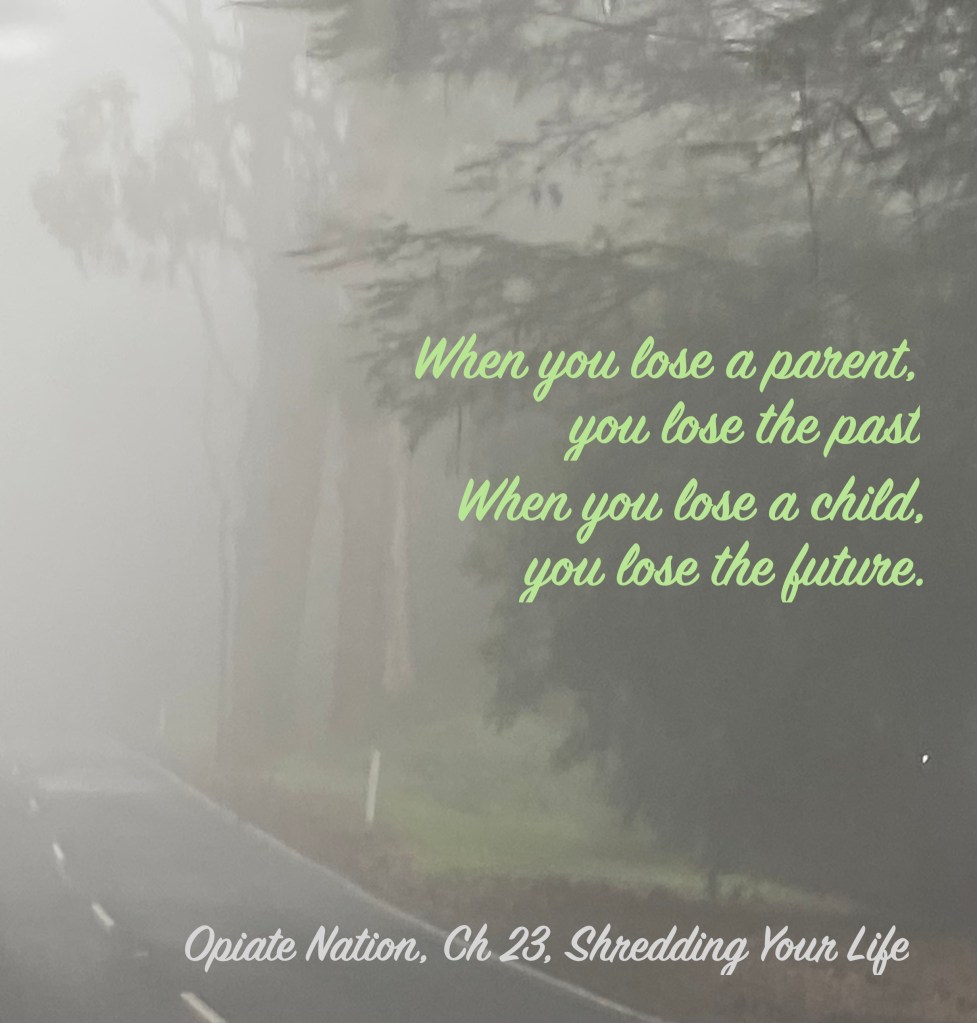
One thing became clear: this loss of our child was very, very different than the loss of our parents or siblings. Although each of those were difficult in their own distinct ways, the level of personal pain with our son’s death was unique. He was an intimate part of who we are – of course – he came from us. As he grew and became his own person, he yet remained a part of our life and more significantly, our future. All is engulfed in a thick fog. Which is why the quote in the photo is so poignant:

When you lose a parent, you lose the past. When you lose a child, you lose the future.

The Important 0.1 Percent

(Nineteenth in a series of topical blogs based on chapter by chapter excerpts from Opiate Nation. Translation into most languages is available to the right.)

DNA sequences for any human is approximately 99.9 percent identical to every other human. That means that only 0.1 percent of our genetic makeup is unique to us. Genes are functional units of DNA that make up the human genome. But don’t be fooled into thinking that 0.1 percent variation is insignificant. It is nearly 3 billion base pairs of DNA which boils down to 3 million differences that determine our physical features like hair and eye color and health risks or protection from diseases such as heart disease, diabetes – and addiction. Genes influence the numbers and types of receptors in peoples’ brains, how quickly their bodies metabolize drugs, and how well they respond to different medications.

The National Institute of Drug Abuse (NIDA) reports that family studies that include identical twins, fraternal twins, adoptees, and siblings suggest that as much as half of a person’s risk of becoming addicted to nicotine, alcohol, or other drugs depends on his or her genetic makeup. Scientists estimate that genes – including the effects environmental factors have on a person’s gene expression, called epigenetics – account for between 40 and 60 percent of a person’s risk of addiction.

Epigenetics – epi meaning “above” – is the study of functional, and sometimes inherited, changes in the regulation of gene activity and expression that are not dependent on gene sequence. This means exposures or choices people make can actually “mark” (remodel) the structure of DNA at the cell level. So epigenetic regulatory systems enable the development of different cell types (e.g., skin, liver, or nerve cells) in response to the environment. These epigenetic marks can affect health and even the expression of the traits passed to children. For example, when a person uses cocaine, it can “mark” the DNA, increasing the production of proteins common in addiction which is believed to correspond with drug-seeking behaviors.

Continue reading “The Important 0.1 Percent”

Guest Post

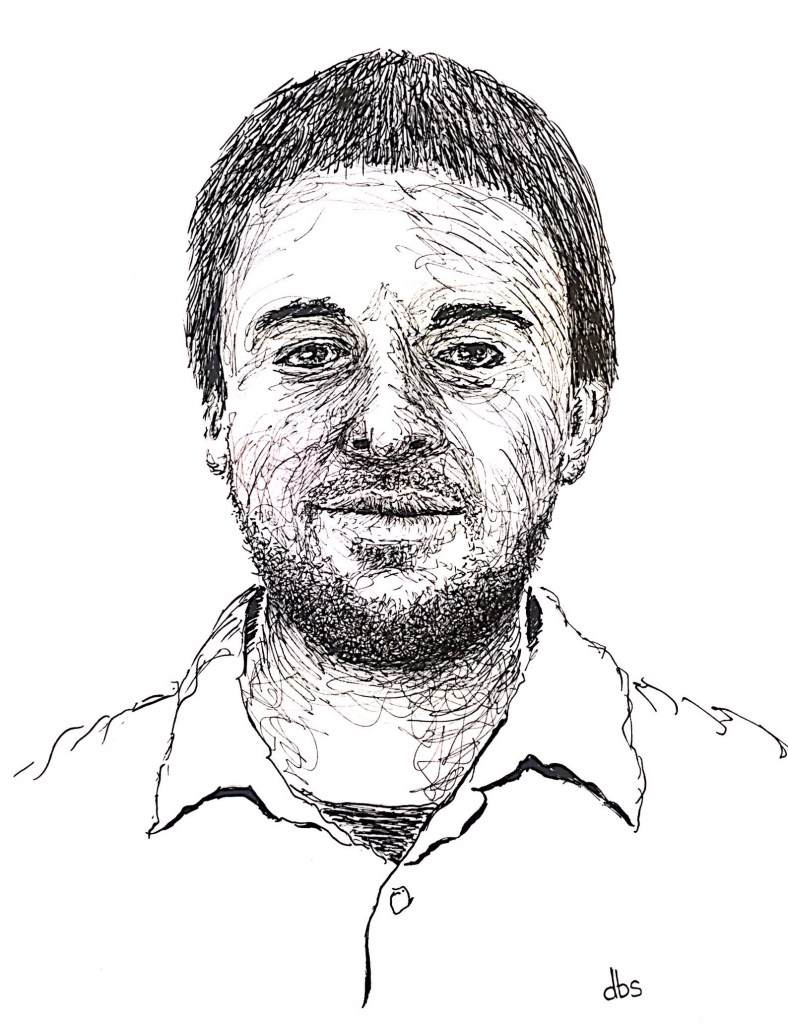
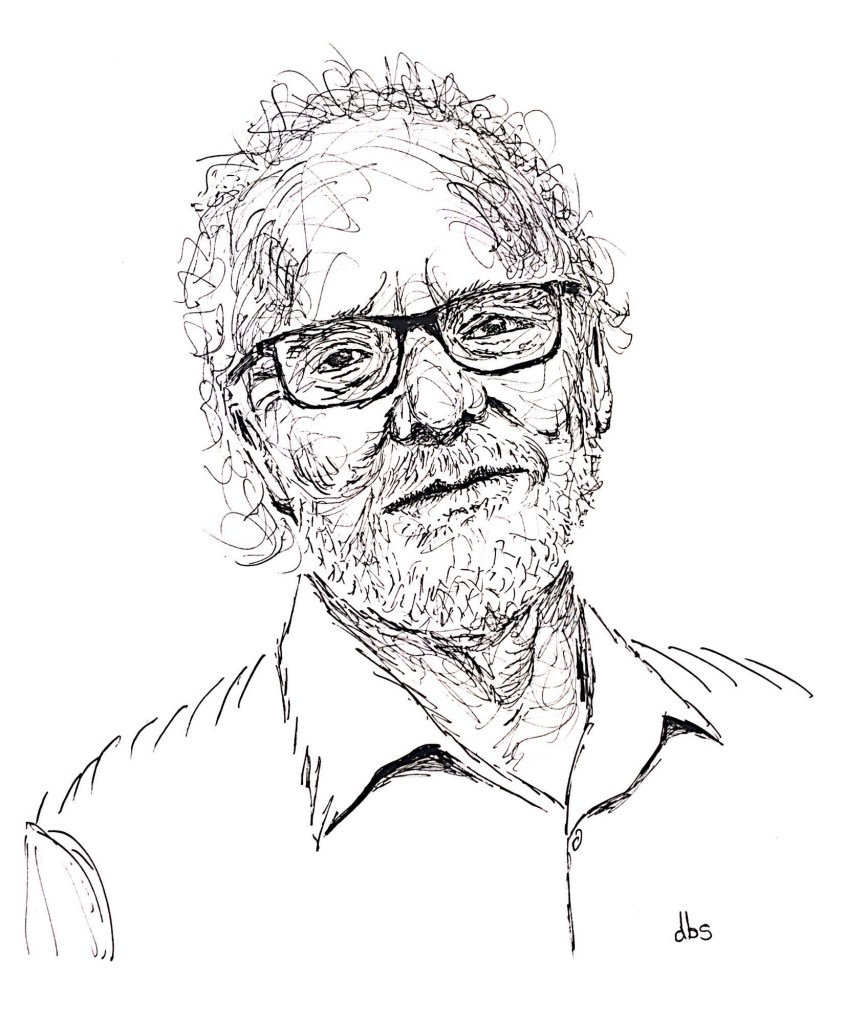
Fellow WordPress blogger, mechanical engineer, artist David Such has written a review of Opiate Nation and posted it on his blog site, Memoirs and Musings. Along with the review, David included some of his pen and ink drawings of our son, JL, and John and me. We feel honored and grateful for David’s desire to help reduce stigma and shame by bringing attention to the opioid epidemic that continues to steal the lives of our sons, daughters and loved ones.

I recently finished reading Opiate Nation: A Memoir of Love, Loss, and Acceptance, by Jude DiMeglio Trang (with John M. Trang). I admit, this book was a difficult journey to travel.

Jude and John’s son, John Leif Trang (“JL”) battled various addictions from his early teen years. This story chronicles JL’s long and difficult struggle in and out of recovery up to his accidental heroin overdose and death at the age of twenty-five, and the long road through grief to emotional recovery for Jude and John that followed. Throughout the book, she includes excerpts from their private journals which provide an extremely personal perspective. She offers comfort and sage advice for others who may find themselves in a similar situation. The book takes you on a strenuous path, but is very well written and places the reader within all the confusion, family dynamics, regrets, and mixed emotions they experienced throughout this journey. The narrative is eloquently written, yet raw and purposefully honest in a bold attempt to shine a bright light on this “secret epidemic” that has destroyed many lives across North America and around the globe.

Jude is no stranger to grief. She had previously lost two brothers and a sister to premature death. The loss of JL would have been the final blow to anyone else who did not have a strong spiritual foundation. Don’t worry, though, she offers none of the trite Christian platitudes. John and Jude’s confusion and frustration are palpable. She is transparently honest about their generational family dysfunction as well as their own perceived failings as parents. Her authenticity is refreshing.

Readers will note that Jude is well-read, quoting relevant wisdom from sages throughout the centuries, from Leonardo da Vinci to C. S. Lewis, and from Beethoven to Bob Dylan. Numerous apt analogies help those not living with addiction to understand the nature of the struggle. I personally appreciated her intellectual rabbit trails into topics like the nature of time, and the physiology of memories. I also like the way she weaves together connected events throughout the years rather than marching through a dry chronological sequence. However, be forewarned, Jude does not hold back in her discussion of reality. Some of it is horrifying, but be reassured that the final chapter, “Stories of Hope,” is the reader’s opportunity to slowly exhale.

This book is a must-read for anyone who knows someone who struggles with drug addiction and/or alcoholism. However, the basic takeaway for all of us, even for those who consider themselves or their loved ones immune from addiction is this: The culture of “pain management at any cost” produces large profits for pharmaceutical companies (“Big Pharma”) at the expense of ruined lives. The default prescription for situations like a wisdom tooth extraction or a broken collar bone is almost always a heavy-duty opiate. Medical doctors “rubber stamp” these prescriptions every day. See the content of the book for details. PLEASE, don’t just fill a prescription because the doctor recommends it, especially if there is any family history of substance abuse or alcoholism. Search for safe alternatives, learn that pain is not an enemy to vanquish, and only reach for the opiate “solution” as the very last option

Opiate Nation was the well-deserved winner of the 2020 “National Indie Excellence Award” for best Addiction/Recovery Book. You will not regret traveling with them through their journey.

David B. Such

https://dbsuch.wordpress.com/

Avoiding Pain

(Thirteenth in a series of topical blogs based on chapter by chapter excerpts from Opiate Nation. Translation into most languages is available to the right.)

We are living in particularly precarious times – for people born since WWII, unprecedented problems the world over – seemingly beyond our ability to control or to deal with effectively. With the Coronavirus pandemic, complex problems have arisen for our global society to attempt to solve, from the manufacturing and transport of medical supplies and personal protective equipment to the best medical treatments and the development of a vaccine – which is viewed by many as the magic potion but only if the majority of people could be convinced to ‘get the jab.’

During this extraordinary year pain has come into most of our lives in ways we have not experienced previously: physical pain from contracting Covid19, emotional pain from being isolated or from watching those we know or care for becoming sick and dying, and mental pain from the anxiety caused by all the unknowns surrounding the pandemic. For people living in poverty, these problems are compounded.

Continue reading “Avoiding Pain”

What’s Inside the Shell?

(Ninth in a series of topical blogs based on chapter by chapter excerpts from Opiate Nation. Translation into most languages is available to the right.)

Shells are beautiful and fascinating to me. Each and every one is unique, differing from others just like our fingerprints. John and I just spent time at the central eastern coast of Australia and on our daily walks on the beach I just couldn’t stop picking up shells – especially the Nautilus shells with their logarithmic spirals of every size, shape, and color. These are empty shells that were once the home of a sea creature.

The exoskeleton of mollusks is the hard, outer layer that protects the tender creature inside. As the creature grows, layers are added to accommodate it. One day, as I was picking up shells in the surf, the inhabitant was still inside. It immediately retreated as far back into its shell as possible.

Continue reading “What’s Inside the Shell?”

Science Fiction and Self-Protection

(Sixth in a series of topical blogs based on chapter by chapter excerpts from Opiate Nation. Translation into most languages is available to the right.)

I have always loved Star Trek. From the early 1960’s shows with the corny scripts and goofy hairdos to the 21st century high-tech and high-stakes extravaganzas. Science fiction envisions the future for us and pushes inventions and technology from getting “beamed-up” in a flash to having a force field to deflect foreign objects.

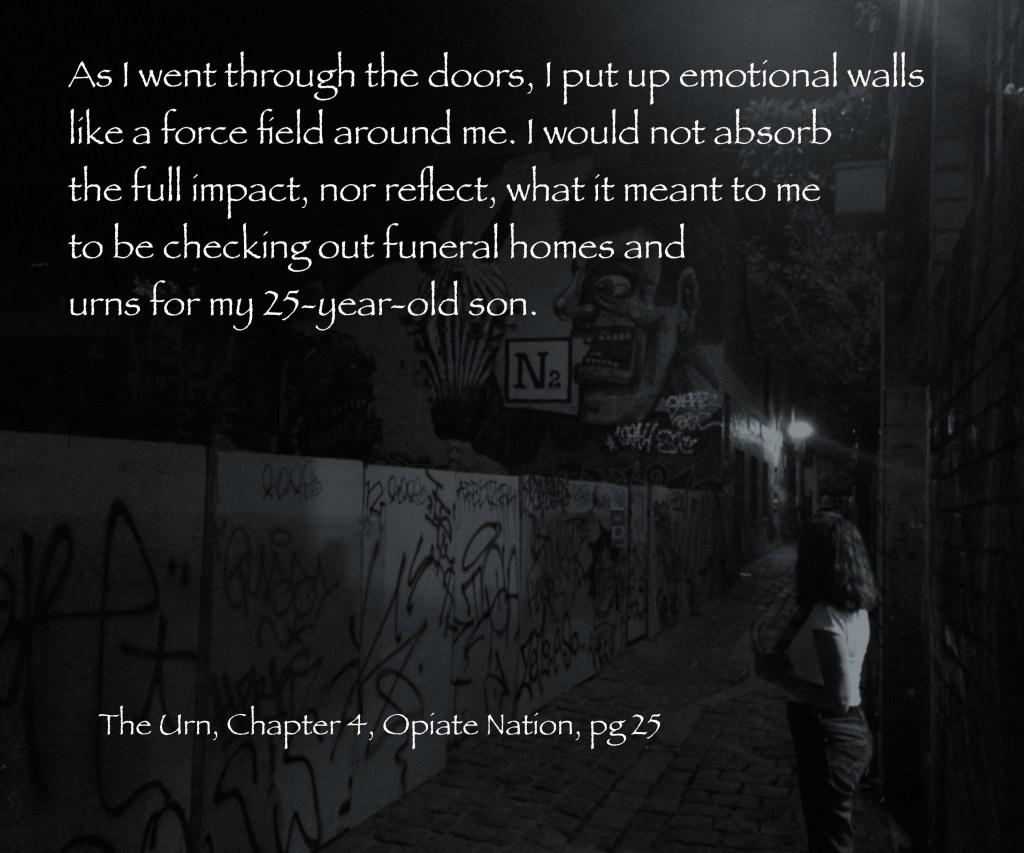
The concept of a force field would be an incredible tool to have at our disposal – to be able to switch it on and off at will. And I can think of no better time to employ an emotional force field than during the early days and weeks after a sudden death. When it takes all your energy just to exist, to wake up and to face the next moment. An invisible barrier for self-protection.

Continue reading “Science Fiction and Self-Protection”
Malcolm Guite

Blog for poet and singer-songwriter Malcolm Guite

The Gift of Need

How Need Can Strengthen Individuals and Communities

Memoirs and Musings

David Bradley Such

Dave Barnhart

Church planter, pastor, author, coach

RecoveryLife101

Just another WordPress.com site

Abbie In Wondrland

life...on Gods' terms.

Living In Graceland

"..learn the unforced rhythms of grace" matt 11:28

Janaburson's Blog

All about opioid addiction and its treatment with medication

Breaking In News Network

Seeking the truth and bypassing the MSM

Junkbox Diaries

Trauma, PTSD, Mental Health, Addiction, and Recovery

Ohio Society of Addiction Medicine

The Ohio Society of Addiction Medicine is a chapter of ASAM - A professional society actively seeking to define and expand the field of addiction medicine.

traceyh415

Addiction, Recovery, Loss, Grief

WordPress.com News

The latest news on WordPress.com and the WordPress community.