Dis-Couraged or En-Couraged?

Discouragement is the opposite of having the heart, the courage to face something. It’s when the heart has been sucked out of you. But the en in encouragement means “into”, the process of putting courage into someone. Giving them the heart and hope to go on. 

(Translation into most languages at tab to the right.)

It’s time for a confession. I have not been writing many blogs for Opiate Nation in the past two years – not because I haven’t had time but because I have felt discouraged. Decades into the Opioid Epidemic and all the information and media coverage, the hope that addiction and deaths from drug overdoses would decrease has proven unfounded. It seems that people in general are just tired of hearing about it, especially if it doesn’t particularly concern them. And I have felt that I didn’t have anything helpful to add to the conversation and wondered: what more needs to be said?

But I felt reprimanded in my heart and soul for being one more person who is fatigued by the persistence of a problem that seems to never get better, let alone go away. What about all the people living in active addiction? And what about their friends and family who spend sleepless nights and anxious days worried about them? And what of those who have lost loved ones to addiction and are living in debilitating grief?

I started thinking about discouragement and how to “snap out of it”? For me, there is no snapping out of it on my own. Once I’m dis-couraged, I have found that only being en-couraged changes things. And encouragement usually comes to me through two avenues: a few intimate friends and God, both of whom know me well. The words spoken out loud by friends and the ones directly into my soul by God are what lift my troubled and discouraged heart and bring hope and courage.

Courage comes from Latin cor meaning “heart”. The dis in discouragement means “opposite of”. Discouragement is the opposite of having the heart, the courage to face something. It’s when the heart has been sucked out of you. But the en in encouragement means “into”, the process of putting courage into someone. Giving them the heart and hope to go on. 

Although my life has not been characterized by addiction personally, encouragement has been important in my life, especially after my son died from addiction. How much more important would encouragement be to those struggling with addiction? And for the families and loved ones of those struggling or already lost? And how can we encourage without enabling?

So, I have been reminded of the importance of an encouraging word. Knowing this, how can I offer encouragement in the arena of addiction and Harm Reduction? Although people do recover from addiction and live full lives, there will always be people struggling with addiction and using drugs. When we acknowledge and accept this, we must try our best to help minimize the harm from that use in the ways we can. For me, that has been through writing to offer information, comfort, and encouragement. 

Ghost Stories

(Short topical blogs based on Opiate Nation – translation into most languages in tab on right.)

When we hear the phrase “ghost stories” most of us think of scary and spooky stories shared around a campfire with the intended, and predicable, consequence of keeping us awake at night.

But when H Lee (aka Harris Insler) decided to call his new podcast series “These Ghosts Must Be Heard”, it wasn’t because he would be interviewing people with paranormal experiences. And although the stories his guests share aren’t scary in the ghoulish sense, they have kept their narrators awake at night for days, weeks, and months on end. John and I included. (To hear our interview with Harris, see links below for Podbean, Amazon, Spotify.)

https://theseghostsmustbeheard.podbean.com/

https://music.amazon.com/podcasts/3392919b-b8bc-46b4-a486-5e34b7d8dd1d/episodes/580578a3-691f-418a-a179-8bc5f72dd138/these-ghosts-must-be-heard-episode-2-jl

These are real-life experiences and these “ghosts” are the spirits of our deceased loved ones: children, friends, partners who have succumbed to premature and preventable deaths from opioid overdoses.

Continue reading “Ghost Stories”

Gilded Grief

(Short topical blogs based on Opiate Nation – translation into most languages in tab on right.)

While reading Rising Strong by Brené Brown, I was struck by a thought she shared about our American culture and the absence of honest conversation and the hard work it takes for us to rise strong after a fall on our face – a failure. She worries that “this lack of honesty about overcoming adversity has created a Gilded Age of Failure.”

Gilding is a perfect word-picture for this characteristically human behavior: applying a very thin coating of gold to a plain, inexpensive object that gives it the appearance of gold. This is what we do when we are dishonest about our feelings. We are choosing to make our real, plain, and common story appear better than it is.

“We’ve all fallen…but scars are easier to talk about than they are to show with all the remembered feelings laid bare…We much prefer stories about falling and rising to be inspirational and sanitized…We like recovery stories to move quickly through the dark so we can get to the sweeping redemptive ending.”  (Rising Strong, Introduction)

Continue reading “Gilded Grief”

Grief: Closure or Finding Meaning?

(Thirtieth in a series of topical blogs based on chapter by chapter excerpts from Opiate Nation. Translation into most languages is available to the right.)

When I finished writing Chapter 27, Grief Part 3: Accepting the Mystery, I didn’t realize what I had actually done. It was four years after our son had died, the pain from the first few years had diminished, I had gone through four of the Five Stages of Grief, and was moving forward in what I thought was the final stage, Acceptance. I was not dealing with denial, anger, bargaining, or depression any longer.

One day I was on a call with a friend. She was telling me her thoughts about the book and asked: “Do you realize what you have done?” No, I guess not. What? “You have gone through the sixth stage of grief: finding meaning. Your book was your way to find, and then share, meaning in the loss of JL’s life.”

She was right. But it wasn’t a goal I set out to accomplish. I think it was intuitive for me, something I had to do. Even after we finally accept the reality of a tragic loss in our lives, many of us want to find meaning. While we can’t find reason in the death, we can choose how we ascribe meaning to the life. I did not want JL’s life to seem meaningless.

Continue reading “Grief: Closure or Finding Meaning?”

Time & Eternity

(Twenty-seventh in a series of topical blogs based on chapter by chapter excerpts from Opiate Nation. Translation into most languages is available to the right.)

Death naturally brings up thoughts and questions about existence beyond this life, this earthly existence. I love how John Milton said it: “Death is the golden key that opens the palace of eternity.” For us, after a death so intimate as our son’s, one can imagine how often we thought about it, particularly in the subsequent months.

One thought that continues to captivate John and I is the possibility that others can look into our time while they are in eternity, in heaven, like someone looking into a cell under a microscope at us, the human specimens. Or are they frozen in time, like being in a time capsule?

Six weeks after JL’s death, my journal entry highlights these questionings:

JL,

Mom here. I’ve been wondering, and wishing I knew the answer for sure, if you and others who are gone can hear us and are conscious of what is happening on earth and in our lives. Can you hear when Dad and I talk to you? If you can, I think you would be crying for us many times as you see and hear our pain. I hope we are not causing you any more pain…

Dad and I went out to dinner and talked about this. What he brought up was that eternity, by definition, is the absence of time as we know it here on earth. So, if those of you who are dead are also in “no time,” even though present with the Lord, you may not experience any consciousness between death and the final resurrection we believe in—it may just be a flash. Hmmm…I don’t like that concept. I want to know you hear me and my apologies and love and thoughts towards you.

Singer-songwriter Phil Keaggy’s song “Time” from his album Love Broke Thru expresses the limits in which Father Time exists:

My friend, David Such (a mechanical engineer, writer, artist) wrote a blog about the Elasticity of Time. Here is a relevant thought from that blog:

Most of us human beings are locked into “earth time” so it can sometimes be difficult to understand, but Einstein taught that “time” is elastic depending on one’s position, perspective, and velocity. I am merely a mechanical engineer and do not fully understand all the physics or all the mathematics, but I do understand the concept as follows. As we increase our velocity, we reduce the difference between our own speed and the speed of light. This is insignificant unless our velocity is extremely high. As we approach the speed of light, “time” slows to a standstill (and apparently, even “matter” takes on different shapes and densities).

Genesis One and the Elasticity of Time

In 1676, the Danish astronomer, Olaus Roemer, first successfully measured the speed of light: Lightspeed. For those of us who believe in God and that his intelligence designed the Universe, his words “Let there be light” have much significance. Eternity must at least be full of light, beyond time, beyond darkness and death. In death do we instantaneously exist in lightspeed and the absence of time?

If so, is JL zipping and zooming around the universe at lightspeed now, with all the other souls who have left this earthly constraint of time? I have no clue, but I smile at the thought.

Singing The Blues

(Eleventh in a series of topical blogs based on chapter by chapter excerpts from Opiate Nation. Translation into most languages is available to the right.)

Honesty is one of the main themes that ripple under the surface of “The Blues.” Expressions of honest feelings, whatever they may be at the moment – themes of lost love, painful relationships, dashed hopes, and heartache. The majority of us have or will experience heartache in our lives. Although it seems counterintuitive, most of us feel consoled by songs that express what we are feeling deep inside but may have a hard time putting into words. In order for me to be honest, I have to acknowledge that I am singing The Blues.

Continue reading “Singing The Blues”

A Seismic Disturbance

(Tenth in a series of topical blogs based on chapter by chapter excerpts from Opiate Nation. Translation into most languages is available to the right.)

When there is a rupture in the earth’s crust it creates a seismic disturbance, the prelude to an earthquake. Something seismic happened deep inside us the day our son died – a fissure opened, and all our energy was expelled. What followed that shock was the onset of grief and, as with earthquakes, the aftershocks. But unlike earthquakes, the aftershocks of grief continue for days and months and even years.

Continue reading “A Seismic Disturbance”

The In’s and Out’s of Grieving & Mourning

(Eighth in a series of topical blogs based on chapter by chapter excerpts from Opiate Nation. Translation into most languages is available to the right.)

When I was young, I only went to one funeral. I can’t remember who it was for or where it was, but it must have been for a close relative or I wouldn’t have been there. I do remember seeing everyone dressed in black. It was a very somber setting, people talking in hushed voices, and I didn’t comprehend what was happening. I just knew everyone was sad. After that day, I never thought about that person again – and even if my parents thought about him or her, their acts of mourning seemed to stop with the funeral. And I had no knowledge of any grieving on their part because at that time and in their cultural setting, people kept feelings regarding their grief to themselves.

It wasn’t until 20 years ago when my younger brother died from AIDS that I was faced with a death that was so close I felt a personal loss that tore at my heart. There was no way to just quickly plan a funeral and burial and then move on. My life as I had known it, now had a gaping chasm where my brother had once been and it was not going to close up anytime in the near future. I needed someone who had travelled this path before me to guide me through the overwhelmingly disturbing and depressing feelings. None of my friends had experienced a close loss like this. So, I looked to the books that were most recommended: On Grief and Grieving by Elisabeth Kübler-Ross and A Grief Observed by C. S. Lewis.

Continue reading “The In’s and Out’s of Grieving & Mourning”

Separation Anxiety

(Fifth in a series of topical blogs based on chapter by chapter excerpts from Opiate Nation. Translation into most languages is available to the right.)

After many years of not having a dog, we decided to adopt one from our local shelter. We found a beautiful German-shepherd/wolf mix who was 18 months old. Bella was docile, sweet and quiet. The next day, as I headed out to the grocery store, I gave her a hug and saw her watch me through the window as I got into the car.

            When I returned an hour later, I was met with a shock. I found her, panting rapidly and pacing nervously in our bedroom where our wooden shutters were open and had bite marks. She had tried to escape while I was gone. I had no idea why. I immediately called the shelter. “She is having separation anxiety: she needed to escape being left alone.” We found out that she had been with two families previously when she was dumped at the shelter because she continued to try to escape when she was left alone for hours on end. They gave us the name of a dog behaviorist and we started down the long road of helping Bella manage her fear when we had to leave her at home.

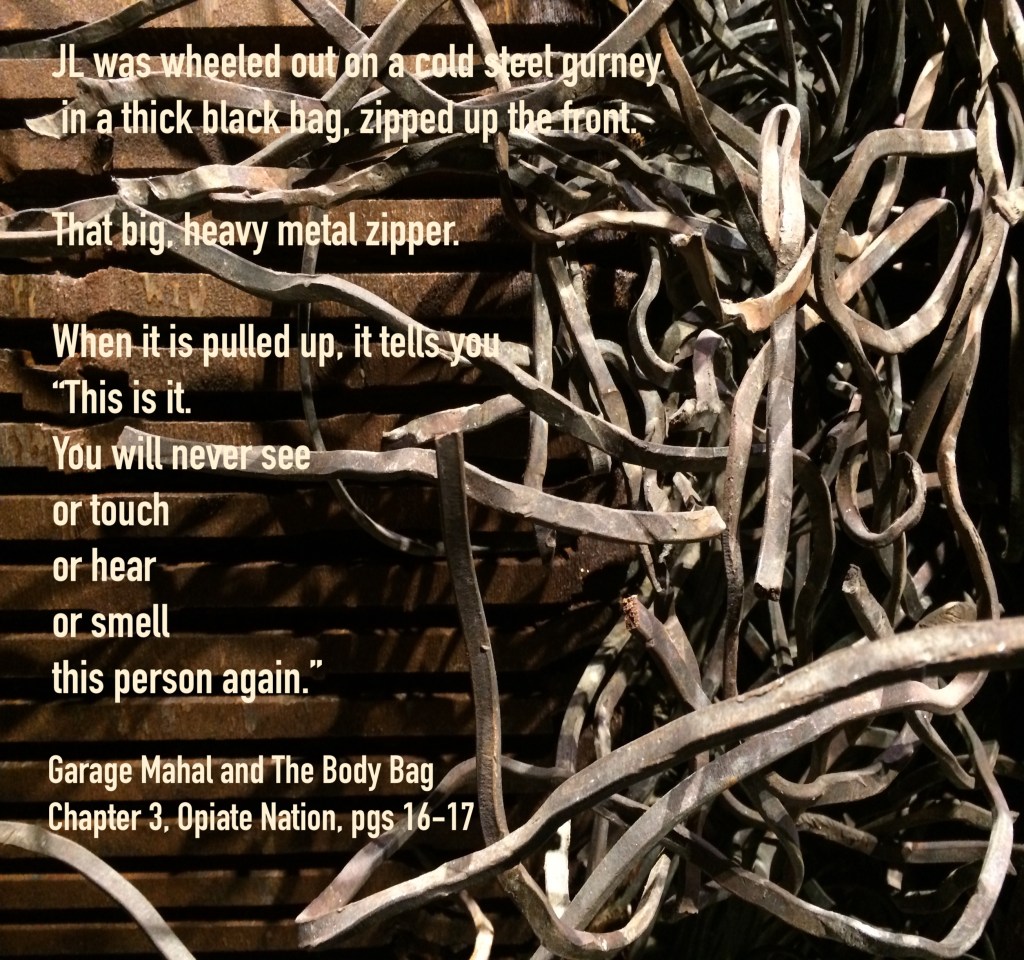
            Children and adults can experience separation anxiety when someone they are attached to leaves them. They can have recurrent and excessive distress just anticipating being separated from loved ones and the anxiety can be so intense that it is hard to function in everyday life. Panic attacks and physical symptoms such as nausea and headaches can occur. For me and my husband, on the morning of our son’s death from overdose, standing over our son in that body bag we experienced the ultimate separation anxiety. The overriding emotion we felt was fear: fear of the unknown future we were facing. We couldn’t visualize how we would survive without our son as part of our lives and the future we thought we all had together. He had not only been an integral part of our lives for 25 years but he was literally a part of us–the combination of our DNA that formed him as a particular and unique human being. To say that it was like having part of you taken away doesn’t describe it. This was having our hearts torn out.

            We would never embrace or kiss or stroke the cheek of our son again. We were facing an existential crisis, shaken to the core, questioning our reason for living. Regardless of our strong faith that had seen us through many other deaths in our families, this separation seemed incomprehensible and cruel. It was only by falling down on our faces and waiting for Mercy to gradually pick us up that we were able to survive this traumatic separation from our son and move forward again in life.

Woefully Unprepared

(Today begins a series of topical blogs based on excerpts from Opiate Nation, chapter by chapter, that will run for 28 weeks. Translation into most languages is available to the right.)

It’s a bit ironic that as I begin blogging through Opiate Nation we are in the midst of a pandemic. Ironic in several significant ways.

Opiate Nation was written because of the opioid epidemic – which, in reality, is a pandemic. Every industrialized nation, and many emerging and third-world nations too, are dealing with the results from the ease of availability of opioids, whether natural and home-grown, or synthetic and imported. Or both, as is the case in America.

And like the Coronavirus pandemic that crept up on us so gradually that it’s deadliness caught us by surprise and mostly unprepared as nations, the opioid epidemic crept up on us too. In both cases, certain international players were unscrupulous for various reasons, causing delays in awareness when there might have been a chance for all of us to not be caught off balance.

The “inoculation” that should have happened, especially in the United States, by way of accurate scientific information disseminated by responsible leaders, didn’t happen. Instead, false information fueled by political agendas and financial motivation created a scenario that so crippled a timely public health response that, for many nations, it became too little too late.

Continue reading “Woefully Unprepared”
Malcolm Guite

Blog for poet and singer-songwriter Malcolm Guite

The Gift of Need

How Need Can Strengthen Individuals and Communities

Memoirs and Musings

David Bradley Such

Dave Barnhart

Church planter, pastor, author, coach

RecoveryLife101

Just another WordPress.com site

Abbie In Wondrland

life...on Gods' terms.

Living In Graceland

"..learn the unforced rhythms of grace" matt 11:28

Janaburson's Blog

All about opioid addiction and its treatment with medication

Breaking In News Network

Seeking the truth and bypassing the MSM

Junkbox Diaries

Trauma, PTSD, Mental Health, Addiction, and Recovery

Ohio Society of Addiction Medicine

The Ohio Society of Addiction Medicine is a chapter of ASAM - A professional society actively seeking to define and expand the field of addiction medicine.

traceyh415

Addiction, Recovery, Loss, Grief

WordPress.com News

The latest news on WordPress.com and the WordPress community.