The Importance of Friends – Pt 2

(Translation into most languages at tab to the right.)

How do clean and sober friends stay involved with a friend who is in active addiction and/or alcoholism? I ended last month’s blog asking this question. In particular, I want to discuss ways that teens and young adults can deal with this difficult and at times very frustrating problem.

What does being a good friend to someone who is addicted look like? 

The first thing is to not pretend you don’t know about their addiction. Talk about it openly but without judgment. Understand that they may deny any problem, so you may have to cite specifics that have made you concerned. Express that you care about them and don’t think less of them as a person because of their struggles. Risk your comfort zone. “Greater love has no one than this: to lay down your life for your friends.” (1)

Be a good listener. A problem with drugs or alcohol may start from just experimenting with drugs at a party or concert. It may then turn into addiction and be fueled by problems at home or with friends or underlying mental health issues. When your friend feels cared for and accepted and not confronted with more guilt or shame, they will be willing to open up. Nobody planned to become addicted and nobody wants to be an addict. Here’s links to good info on how to help someone trapped in addiction. (2,3)

But, if you remain a good friend to someone who is living a self-destructive life, how do you help them without enabling their addiction? For young people who are good friends, enabling might be keeping secrets for them about their problem, especially from adults who may need to know in order to take life-saving action. It may be loaning them money or driving them to get drugs. The pressure would sound something like: “If you’re my real friend, you won’t tell…”  Or “If you really want to help me you would…” Basically, when you support their problematic behavior in the name of ‘helping’ them, you are actually keeping them from living with the consequences of their poor choices. And this will only prolong their problems and delay change. (4) 

Encourage them to get help through programs like SMART Recovery groups or AA for alcohol and NA for narcotics. Very few people overcome addictive behaviors alone. Community is key. Go with them if you can or drive them. And remember, drug and alcohol recovery take lots of time and most people don’t succeed the first time they try to quit. Dr. John F. Kelly, clinical psychologist and addiction medicine expert, says it can take 8 years and 4-5 treatment attempts at recovery to achieve one year of sobriety from opioid and other drug addiction. It can take years to achieve stable recovery and Medication Assisted Treatment (MAT) is an important aspect. Gone are the times when a 30-day detox/treatment was seen as the solution to addiction. It may be an important first step in the process of ongoing recovery. People can and do recover, but it will likely be a lifetime journey. Here’s a YouTube 2025 video of Dr. Kelly giving a session on: The New Science on Addiction Recovery. (5)

You can encourage your friend with each small step and success, even through relapses. In our son’s recovery program, we ended each session by saying together: “Keep coming back ‘cause it works if you work it.” It takes hard work and it can be very discouraging for your friend to relapse because your friend wants to be free. No one wants to live controlled by addiction. No one. Encouragement to stick with it is vital.

If your friend or family member is using opioids, you should get naloxone (a medicine that can temporarily reverse the effects of an opioid overdose) and keep it handy. Available through local community-based programs or pharmacies.  

It’s worth saying again: Friends are SO important for people in active addiction.

Don’t ever give up on your friends trapped in addiction. They need friends more than ever, friends who love them and will invest in their lives and let them know they are a worthwhile human – while you also need to encourage them to seek help in order to become sober and stable. And to remind them by example of what a normal and joy-filled life is like and one that they too can have. 

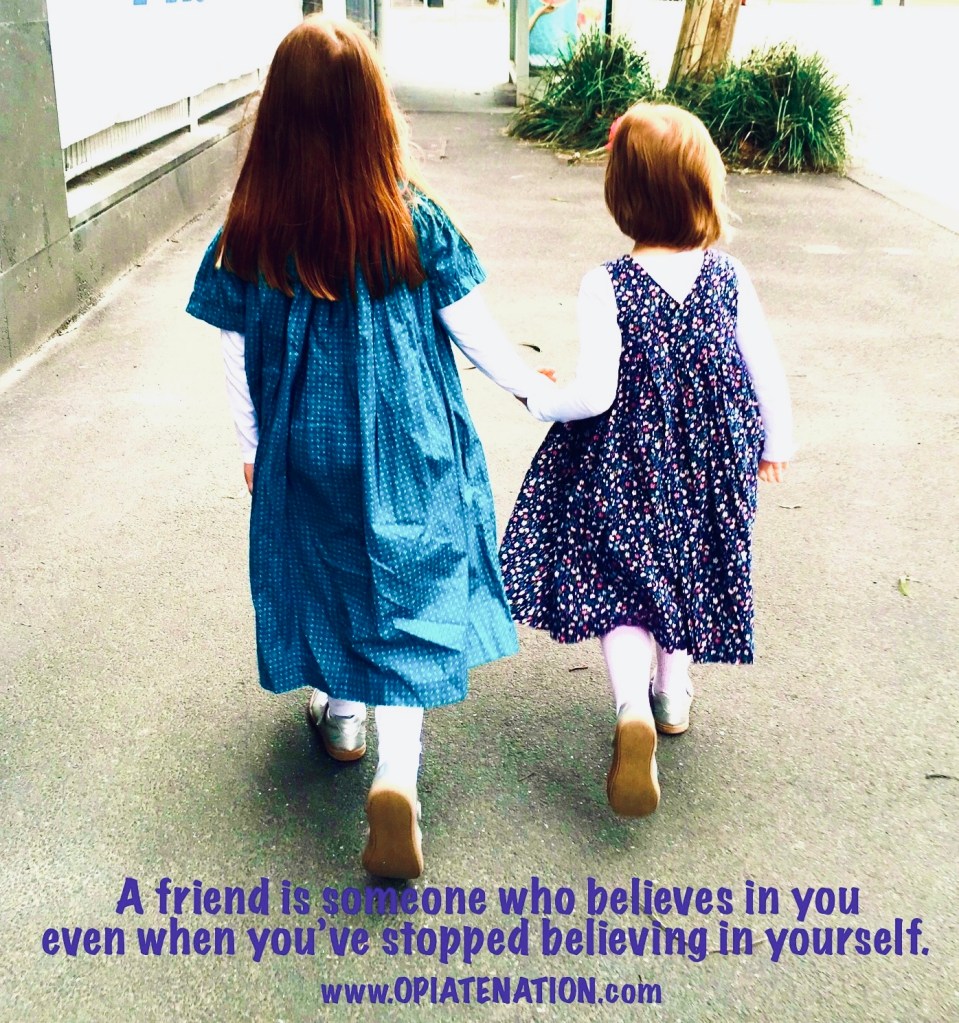
A best friend is someone who believes in you 

even when you’ve stopped believing in yourself.

– Unknown

  1. John 15:13, New Testament 
  2. Helping Someone with a Drug Addiction

https://www.helpguide.org/mental-health/addiction/helping-someone-with-drug-addiction

  • How to help someone who is misusing drugs or alcohol:

https://www.healthdirect.gov.au/help-someone-who-is-misusing-drugs-or-alcohol#:~:text=Celebrate%20small%20successes%20and%20try,Narcotics%20Anonymous%20and%20SMART%20Recovery.

  • Four Signs of Enabling and How to Stop

https://health.clevelandclinic.org/enabling

  • Dr. John F. Kelly, Ph.D. The New Science on Addiction Recovery (lecture)

Recovery Options for Teens

 Statue by Gustav Vigeland, Vigeland Park in Oslo, Norway.

(Translation into most languages at tab to the right.)

Understanding the teenage brain was the topic of my last post: Is Teenage Turmoil Inevitable? It is important to digest before parents consider a recovery program for their teen. Knowing that adolescents and teens feel and process information differently than adults is why they require a different approach to addiction and recovery.

Regardless of the type of program considered, the one absolute necessity is that the family be involved in the process – because family dynamics are an integral part of a young persons’ sober and addicted life. And the best place to start this discussion is to focus on the CRAFT model.

The American Psychological Association has an informative article, below. (1) In it they point to studies discussing how programs like Al-Anon for family members with an addicted loved one “may improve the well-being of friends and family members, they are not effective in getting the addicted person into treatment.”

Intervention programs, designed to help “family and friends work with a counselor to confront a substance user and urge him or her to get treatment” is only used by 30 percent of families due to discomfort with confrontation. And treatment is only the first step on the long road to recovery. After that, the family still needs other tools.

CRAFT (Community Reinforcement Approach to Family Training) originated at the University of New Mexico and was developed by Robert Meyers, Ph.D. and colleagues. Research on CRAFT shows that approximately 70% of families who receive CRAFT are able to help their loved ones start treatment within a year (Miller, Meyers, & Tonigan, 1999). CRAFT also helps family members improve their own lives, whether their loved one ends up seeking treatment or not.

CRAFT teaches real life skills to use connection to encourage positive change, because CRAFT is rooted in the belief that connection is the opposite of addiction. It teaches positive communications skills to foster the connection that is desired by the person who is struggling with addiction and their loved ones.

Helping Families Help is a great non-profit website resource for CRAFT information. (2)

SMART Recovery was established in 1994, here in the USA, to meet the increasing demand of those seeking a secular and evidence-informed alternative to the widespread 12-Step addiction recovery program. It is intended for adults over 18 and those seeking flexibility and independence, while AA offers structure and strong community support. It may be best for young adults in their 20’s, as most 18- to 25-year-olds who struggle with addiction are not yet “adult” in their thinking and coping skills. Smart Recovery is now in 23 countries. See info below. (3) 

Basically, the steps in helping your teen who is addicted are this:

  1. Getting them into treatment
  2. Choose a program – inpatient or outpatient
  3. Detox 
  4. Individual Therapy
  5. Family Therapy 
  6. Contingency Management
  1. Getting your loved one into treatment: sign up for CRAFT 10-week email training course through Helping Families Help or investigate other options.
  2. Choose a program: based on the drugs involved and length of time used.
  3. Detox: Most drugs will still be in your child’s system. Detox flushes them out. Detoxing under the care of professionals ensures that it’s done safely out of reach from harmful substances. Your teen will likely experience withdrawal symptoms as well.
  4. Individual Therapy: To understand a teen’s problem and to address it comprehensively. The first course of action in rehab is one or more types of therapy, both one-on-one and group settings. Motivational Interviewing uses a person-centered, non-confrontational style where the teen is encouraged to examine the pros and cons of their use and to create goals to help them achieve a healthier lifestyle. This helps them gradually realize the consequences of their actions. Cognitive Behavioral Therapy (CBT) is goal-oriented therapy that helps teens express and understand their feelings and cope with difficult emotions. They learn to replace negative behaviors (such as using substances) with positive ones (like sports or art or service endeavors).
  5. Family Therapy: Based on the premise that family carries the most profound and long-lasting influence on development, and in modeling both good and bad behaviors and beliefs. These sessions bring together those closest to an addicted teen and address issues such as poor family communication, cohesiveness and problem solving. Again, CRAFT is crucial here.
  6. Contingency Management: This form of therapy tracks each patient’s progress in rehab, including each day they succeed in staying sober, and rewards them with a prize. The more teens feel satisfied with their rewards, not only will they continue striving to stay sober, but their brain will relearn how to appreciate rewards that aren’t drugs or alcohol. Following rehab, a teenager is thrust back into the world. Temptations lie around every corner and their problem stays with them for years after treatment. After you’ve helped your child kick their habit you must help prepare them with a plan to prevent relapse – or for all of you to know what to do when relapse occurs, which is likely especially for certain drugs like opioids. MAT (Medication Assisted Treatment) is vital for opioid addiction and the long-lasting changes in the brain that will continue to undermine all the best plans and determination to stay clean and sober. Our son and many of the hundreds of thousands of young people who died from opioids are the sad evidence of this truth.

I do not offer these steps and advice as a medical or addiction professional. I can only offer my opinion based on our personal experience and the stories from others, along with the research I’ve done over the past 20 years since my husband and I first discovered that our 15 year old son was using heroin. What we wish we had known I share with you in the hope that your story will end differently than ours.

1. An underappreciated intervention

The CRAFT model is giving family and friends the skills they need to help get loved one’s treatment for substance use problems  By Katherine Lee – December 2017, Vol 48, No. 11

https://www.apa.org/monitor/2017/12/underappreciated-intervention

2. Helping Families Help – CRAFT Information

https://helpingfamilieshelp.com/about-craft

https://www.npr.org/sections/health-shots/2018/08/10/636556573/families-choose-empathy-over-tough-love-to-rescue-loved-ones-from-opioids

3. SMART Recovery

https://smartrecovery.org/what-is-smart-recovery

4. The Different Types of Adolescent Treatment Programs

New Horizons Recovery Centers (USA)

https://www.newhorizonscenters.com/blog/the-different-types-of-adolescent-addiction-treatment-programs

TEMPTATION: Fight it or Heed the warning signs?

(Translation into most languages at tab to the right)

I have been thinking about temptation recently and how differently we each respond when we face something that is hard for us to resist. How do we resist something that is alluring and that we have repeatedly succumbed to in the past? Something that we are addicted to like lying or shoplifting, alcohol or drugs, gossip or gambling, social media or overeating? The list of behaviors that can derail our lives in one way or the other is endless. It’s not just how an addiction can cause us harm, but also how it can debilitate or destroy our relationships, that makes learning how to beat temptation important.

So, when we are tempted to indulge in our pet addiction, what do we do? 

I read an article on Medium about temptation and willpower that supports the thoughts I’ve held throughout my life. Riikka Iivanainen (1) confesses that she has high self-control and discusses her research into why some people succeed at resisting temptation while others don’t. 

She says, High self-control does predict many positive life outcomes: People who’re good at self-control do better in school, have fewer mental health problems, have better relationships with friends and family, and generally exhibit fewer impulsive behaviors like binge eating and alcohol abuseThey’re even happier.

From the many scientific studies she researched, she goes on to say, Having good self-control doesn’t mean a constant battle against temptations. The kind of self-control that gets you all those good outcomes is more effortless than what’s commonly suggested by the term’s “willpower” and “self-discipline.”

Psychologists tell us that constantly resisting temptation is exhausting and will soon leave us with ego-depletion. Relying on self-control in the face of temptation is destined to fail. So what kind of self-control is “more effortless”? Riikka says, The people who reported fewer problematic desires and less conflict related to those desires were good at avoiding temptation, not resisting it.

Isn’t this insight what the basis of what most recovery programs are built upon? The acronym HALT is a tool to remind us to take a moment and avoid temptation by being aware of the primary things that can lead us to it: Hungry, Angry, Lonely, Tired. We are susceptible to self-destructive behaviors, temptations, and relapse when these basic human needs are unmet. HALT is a reminder, an early warning system. Being self-aware helps us recognize our needs and address them in a positive way before turning to harmful habits or destructive people.

Hungry – being hungry can be physical or emotional hunger

Angry – being angry at someone else or at yourself

Lonely – being lonely can be while in a crowd or from self-isolation

Tired – being tired affects our body, mind, and spirit

Some ways to deal with these needs is the subject of my Opiate Nation blog post April 14, 2018, H.A.L.T. https://opiatenation.com/2018/04/14/h-a-l-t/

We need to know ourselves and be honest about what our problematic desires are and avoid them rather than flirt with them. Desires are matters of the heart and we need to do all we can to support the healthy, life-affirming desires we have. I’ll end with pertinent insights from some of my favorite sources: 

There are several good protections against temptation, but the surest is cowardice.(2)

Strength comes prior to temptation, not during it. Overcoming is a prior act. It involves making a decision to remain pure before the temptation comes. (3)

Rather than waiting for temptation to raise its inevitable head and struggling to resist it, researchers at the University of Wyoming say it’s more effective to plan in advance to manage those temptations with well-thought-out self-control strategies. (4)

It is easier to prevent bad habits than to break them. (5)

Paul repeatedly told the early Christians in their very pagan cultures to “flee” temptation. (6)

Learning takes us through many states of life, but it fails utterly in the hour of danger and temptation. Then faith alone saves. (7)

But for persons needlessly to expose themselves to temptation, and to do those things that tend to sin, is unwarrantable, and contrary to that excellent example set before us. (8)

Jesus showed us by example when we are confronted with unavoidable temptation to speak the truth in order to help us resist until we are able to escape. (9)

Temptations, of course, cannot be avoided, but because we cannot prevent the birds from flying over our heads, there is no need that we should let them nest in our hair. (10)

  1. https://riikkaiivanainen.medium.com/the-secret-life-of-people-with-high-self-control-its-easier-than-you-think-7dd26fb5282c
  2. Mark Twain
  3. The Mind of Christ by T.W. Hunt & Claude V. King, 1990
  4. https://www.psychologytoday.com/au/blog/cravings/201911/4-ways-avoid-temptation-and-reach-your-goals
  5. Benjamin Franklin
  6. I Corinthians 10:14; I Timothy 6:11; II Timothy 2:22
  7. Mahatma Gandhi, Mohandas Gandhi, Homer A. Jack (2005). “The Wit and Wisdom of Gandhi”, p.40, Courier Corporation
  8. Jonathan Edwards, https://www.biblebb.com/files/edwards/temptation.htm
  9. Matthew 4:1-11
  10. Martin Luther

Addiction Constriction

John Leif Trang – March 10, 1989 – August 2, 2014

(Translation into most languages at tab on right)

On March 10th, our son would have been celebrating his 33rd birthday. That day is now a painful reminder of all the potentials and possibilities that a young person should be experiencing in the 4th decade of their life.

After JL died of a heroin overdose in 2014, I began the dreaded process of sorting through his belongings – which included his computer and phone. Many of the photos on his phone I had never seen and some have now become permanently seared into my visual memory. One is of JL with a Boa wrapped around his shoulders and neck.

Boas are constrictors. Constrictors don’t chase their prey. They are ambush hunters. A boa grabs its prey with its teeth, then quickly coils its body around the prey and squeezes. It doesn’t break the bones – it constricts so tightly that its prey can’t breathe. With each exhale, it tightens its coils until its prey dies slowly from an overwhelmed circulatory system due to blood not getting to the brain. Once dead, the snake swallows its prey whole.

Continue reading “Addiction Constriction”

Enjoying the Ride or Reaching the Destination?

(Translation into most languages available at tab on the right.)

My husband and I learned years ago that in many areas, we see and experience the world in very opposite ways. I live in the future, he enjoys the present. I am content with less, he needs more. I want to get to the destination, he enjoys the ride. Our theme song is The Beatles Hello Goodbye: ‘You say Goodbye, and I say Hello’. After living together so many years, some of our ingrained predispositions have begun to change as we have rubbed off on each other – and this is a good thing as I believe it makes us each a more balanced human.

This thought came to mind this week as I began to work on this blog post. Sometimes I am so focused on my destination or goal and being faithful to stick with it that it takes a while for me to realize I am not enjoying the ride. As I wondered why, I realized that it’s not that I don’t feel passionately about advocating for those struggling with addiction and mental health issues. Rather, it’s that I have begun to feel stretched too thin – which is not comfortable or healthy. With the holidays approaching, there are increasing family commitments and events that I want to enjoy and not just endure until they are over. The path to this goal is to be more realistic about what I can and cannot do within my finite energy and allotted time.

This contrast in ideologies applies to recovery strategies as well. When our son was trying to recover from opioid addiction 10-15 years ago, the goal was to complete a recovery program and once and for all become clean and sober – get to the destination. As unrealistic as this seems to us now, it is still a prevailing goal for many recovery programs. Sadly, what it did for our son – and for us – was to set us up for discouragement and shame with every inevitable relapse. Failure.

What I hear from current recovery advocates is that recovery is a goal and a process. If your desire and goal is to become clean and sober, you will embark on a plan of some sort. It is absolutely essential that you get to your destination because with many drugs, continued addiction often leads to death. But it’s also absolutely essential that you understand that it will be a journey with many ups and downs – and that you need to be able to enjoy the ride, the process, as much as possible so that you will have the continued desire to make it to the goal. And that those who are advocating for you, riding with you, will understand and assist you on your journey.

So, in attempting to take my own advice, I am going to discontinue weekly blog posts for a while. Instead, I will write blogs as often as I can and I look forward to your comments and ‘likes’ – every ‘like’ helps with visibility and brings new readers. After almost four years of posts on all aspects of addiction & substances, grief & loss, and mental health, if you search the site, you should find something to bring insight and encouragement for the issues that you are facing today. Let’s enjoy the ride as much as possible as we head toward our destinations.

Recovery Communities

(Translation into most languages at tab to the right)

What is a recovery community and what should it look like?

The answer to these questions is not simple – real solutions to real problems rarely are.

To recover means to return to a normal state of health or strength. When someone is injured in an accident or undergone surgery, they usually recover in hospital for a period of time where they can receive the special medical care that is required to keep them alive. If the injury or illness was severe or life-threatening, after hospitalization they would be moved to a rehabilitation facility where they receive appropriate and specialized care and therapy as they convalesce – they wouldn’t just go home. Convalescing is the recovery process of returning to health.

Recovery can also refer to the process of regaining possession or control of something lost or stolen. In a real sense, those who have become addicted to a substance or damaging behavior have had something stolen. That’s not a cop-out if we consider what happens to a person’s brain when addiction takes over. The chemical changes that take place in the brain steadily decrease the individual’s original ability to think clearly and make logical choices. Especially with substances, I consider that capacity to have been stolen.

Continue reading “Recovery Communities”

Reaction Recovery

Translation into most languages at tab to the right.

A few weeks ago, John and I were interviewed by Jeff Simone for his Surviving the Opioid Epidemic podcast (see YouTube link). We had a really great conversation about our family living with a teenage son with opioid addiction and how his death from overdose affected us and changed our lives. Jeff serves the addiction community with a coaching service called Reaction Recovery.

https://reactionrecovery.com

Here are some insights into his recovery approach.

Reaction Recovery is a private coaching service designed to help individuals thrive in their life of recovery from substance use disorders. It is a one to one, intensive behavioral approach to help individuals identify areas to make focused and intentional lifestyle modifications. Dr. Simone has been formally trained in clinical pharmaceutical and dietary supplementation advisory and management. He has earned degrees in nutrition, physiology, is a certified life coach, and has personally worked with over 200 people recovering from substance addictions.

Why ‘Reaction’ Recovery? Who is reacting and to what?

Reaction Recovery was started as a “reaction” to the current treatment approach to addiction. The medical community is doing a good job offering short-term acute care crisis management for addictive disorders, but are doing poorly offering long-term treatment for those who have become abstinent but not yet stabilized. This describes our son’s – and most others we know – situation perfectly. Addiction needs long-term care and support.

The basic coaching approach addresses the physiology of the addiction, post-acute withdrawal syndromes, nutritional interventions, dietary supplementation, and how this all can safely integrate with other pharmaceutical treatment strategies that might already be on board.

Based on what Dr. Simone has called the ’12 Daily Rules for Recovery,’ their coaching techniques will systematically and methodically help the individual identify specific areas to be adjusted and then develop individually tailored strategies to affect real change.

The 12 Rules focus on building up a support community – first and foremost – then developing a healthy and consistent morning routine, understanding the importance of full-day nutrition, ensuring the body is receiving all nutrients necessary to support a strong and optimal brain and body, establishing a safe and appropriate dietary supplement regimen, expanding the mind with helpful books and information, developing a realistic exercise routine, carefully auditing the external distractions in our lives, constructing a regular nighttime routine, and more.

When these considerations get repeated across thousands of iterations, and with a little guidance and accountability, they become a foundation upon which the rest of the individual’s recovery will be built. Eventually – through ruthless repetition – new neural pathways begin to form until eventually this life of abstinence doesn’t feel so difficult and a sustainable, meaningful recovery is able to take shape.

Jeff’s approach of community as essential and creating new, healthy habits to replace old, destructive ones has been the topic of several of my blogs (see below). Whatever habits we create will become automatic and will serve us and our life-goals well as we go through each day.  

2021 Aug 15, Connection is Crucial

2021 March 28, The Freedom of Habits

2021 Jan 03, Who is My Neighbor?

2020 Dec 27, Missing Community

2020 Aug 15 & 22, Loneliness

The Freedom of Habits

(Twenty-fifth in a series of topical blogs based on chapter by chapter excerpts from Opiate Nation. Translation into most languages is available to the right.)

I’ve heard a saying: “The chains of habit are too weak to be felt until they are too strong to be broken.” And just like chains, some habits are stronger and deadlier than others. Conversely, healthy habits can be just as strong and powerful – but instead of bondage, they bring freedom to live our lives to the fullest.  

In The Power of Habit, Charles Duhigg says, “Habits are a three-step loop: The cue, the routine, the reward. They become automatic beginning with a cue that triggers a routine and a craving for a clear reward. Craving is an essential part of the formula for creating new habits…You can never truly extinguish bad habits. So in order to change a habit, you must keep the old cue and deliver the old reward (that you are craving), BUT insert a new routine.”

Continue reading “The Freedom of Habits”

Avoiding Pain

(Thirteenth in a series of topical blogs based on chapter by chapter excerpts from Opiate Nation. Translation into most languages is available to the right.)

We are living in particularly precarious times – for people born since WWII, unprecedented problems the world over – seemingly beyond our ability to control or to deal with effectively. With the Coronavirus pandemic, complex problems have arisen for our global society to attempt to solve, from the manufacturing and transport of medical supplies and personal protective equipment to the best medical treatments and the development of a vaccine – which is viewed by many as the magic potion but only if the majority of people could be convinced to ‘get the jab.’

During this extraordinary year pain has come into most of our lives in ways we have not experienced previously: physical pain from contracting Covid19, emotional pain from being isolated or from watching those we know or care for becoming sick and dying, and mental pain from the anxiety caused by all the unknowns surrounding the pandemic. For people living in poverty, these problems are compounded.

Continue reading “Avoiding Pain”

What’s Inside the Shell?

(Ninth in a series of topical blogs based on chapter by chapter excerpts from Opiate Nation. Translation into most languages is available to the right.)

Shells are beautiful and fascinating to me. Each and every one is unique, differing from others just like our fingerprints. John and I just spent time at the central eastern coast of Australia and on our daily walks on the beach I just couldn’t stop picking up shells – especially the Nautilus shells with their logarithmic spirals of every size, shape, and color. These are empty shells that were once the home of a sea creature.

The exoskeleton of mollusks is the hard, outer layer that protects the tender creature inside. As the creature grows, layers are added to accommodate it. One day, as I was picking up shells in the surf, the inhabitant was still inside. It immediately retreated as far back into its shell as possible.

Continue reading “What’s Inside the Shell?”
Malcolm Guite

Blog for poet and singer-songwriter Malcolm Guite

The Gift of Need

How Need Can Strengthen Individuals and Communities

Memoirs and Musings

David Bradley Such

Dave Barnhart

Church planter, pastor, author, coach

RecoveryLife101

Just another WordPress.com site

Abbie In Wondrland

life...on Gods' terms.

Living In Graceland

"..learn the unforced rhythms of grace" matt 11:28

Janaburson's Blog

All about opioid addiction and its treatment with medication

Breaking In News Network

Seeking the truth and bypassing the MSM

Junkbox Diaries

Trauma, PTSD, Mental Health, Addiction, and Recovery

Ohio Society of Addiction Medicine

The Ohio Society of Addiction Medicine is a chapter of ASAM - A professional society actively seeking to define and expand the field of addiction medicine.

traceyh415

Addiction, Recovery, Loss, Grief

WordPress.com News

The latest news on WordPress.com and the WordPress community.