The Tattoo – Stigma

(Translation into most languages at tab to right.)

In the Greek and Roman worlds, a stigma was a tattoo or brand, especially for a slave, identifying the person as “inferior.” As stigma moved into English, it referred to a mark you couldn’t actually see but which was nonetheless powerful. Social stigmas are based on perceivable characteristics, associated with certain behaviors that distinguish a person from other members of society. They convey disapproval and disgrace. Dis-approval. Non-approval. Dis-grace. Non-grace.

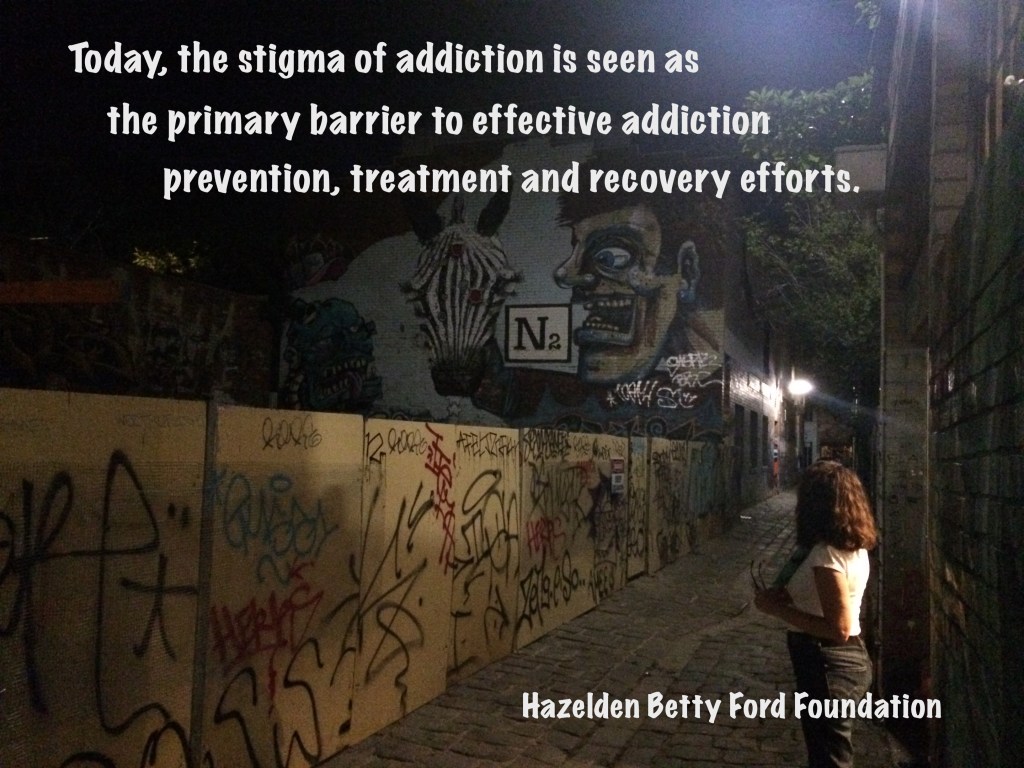
In an article on The Stigma of Addiction from Hazelden Recovery we learn: “The stigma of addiction stems from behavioral symptoms of substance use disorder…which can result in negative consequences including legal, occupational and relationship problems. Understandably, these consequences cause embarrassment and shame among those affected. They also create stigmatized attitudes and perceptions among the wider public, a response that perpetuates and exacerbates the private shame associated with drug addiction. For generations, this combination of personal shame and public stigma has produced tremendous obstacles to addressing the problem of alcoholism and addiction. Today, the stigma of addiction is seen as a primary barrier to effective addiction prevention, treatment and recovery efforts at the individual, family, societal levels. Addiction stigma prevents too many people from getting the help they need.” Yes, only one in 10 people struggling with addiction receive treatment. The article goes on to discuss the irony that many of these stigmatizing behaviors diminish and/or disappear when a person is appropriately treated in recovery.

When talking recently with some of our son’s friends, they have been unwilling to let their past drug use become public knowledge because of the potential negative repercussions they justifiably fear in their careers and relationships. How much worse would it be if they were still living with addiction? What does this say about us as individuals, communities, employers, and society in general? When an individual is seen as having a moral failure instead of a chronic health condition, stigma is the logical result. But no one makes the decision about how their brain will react to a substance and whether they will become addicted after minimal use or hate how it makes them feel and never use it again.

Negative labels stick like glue to our hearts and soul and, for those struggling with addiction and alcoholism, the personal shame becomes how they define themselves. The public stigma that follows is the tattoo they never asked to have. If we can reject stigmatizing and instead provide a safe and listening ear to those struggling with addiction, inviting them to share their stories and encourage them to consider recovery options, they may be willing to join the many people who do learn to manage their disease and successfully recover. Let’s remember that they are just as valuable and able and worthy of love – and as human – as you and me.

https://www.hazeldenbettyford.org/recovery-advocacy/stigma-of-addiction
2021 International Overdose Awareness Day August 31

Translation into most languages at tab to the right.

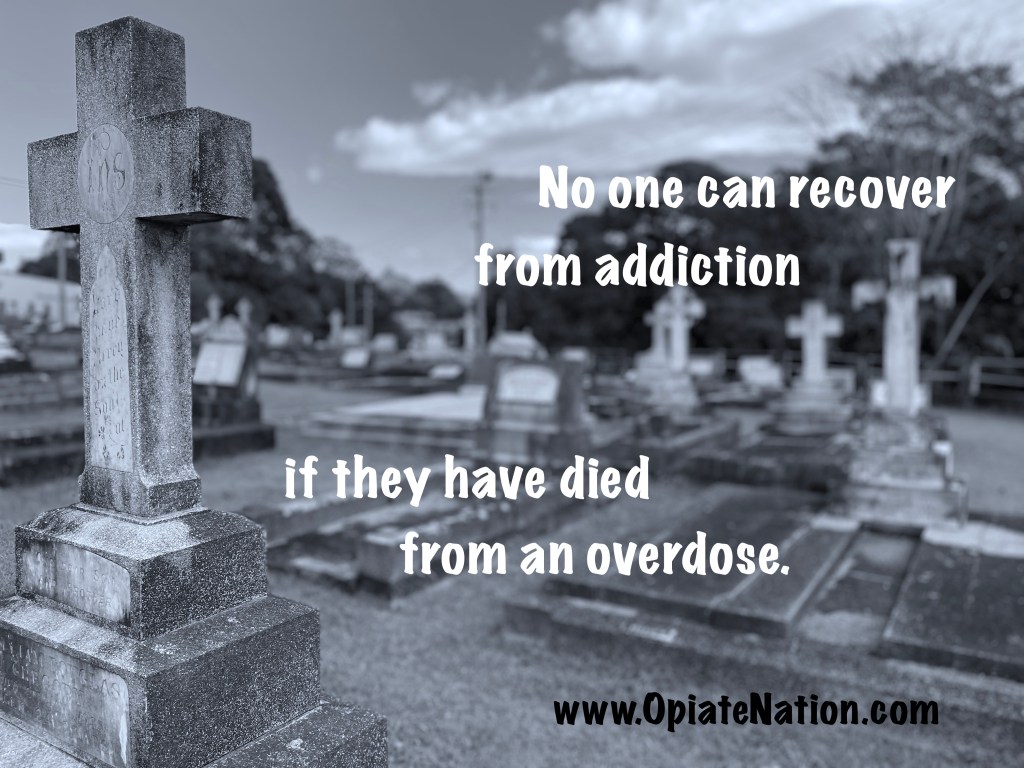
The need has never been more urgent to alert us all to the risk of overdose facing millions of people worldwide. During the 18 months of the Covid-19 pandemic, overdose deaths have risen approximately 30% in many parts of the world due to isolation, unstable drug sources, and lack of reliable medical and recovery help. Even the normal inadequate support services have been seriously disrupted and diverted. And the hope of C19 disappearing sometime soon is now seen as wishful thinking – it is a new deadly virus we will have to learn how to live with.

So, what can we do to help prevent further loss of lives for those already struggling with addiction?

Continue reading “2021 International Overdose Awareness Day August 31”

Connection is Crucial

(Translation into most languages is available to the right.)

During a recent podcast on Straight from the Source (1), David Higham (founder of The Well, a peer-run alcohol and other drug service in the northwest of England) spoke about his life.

For more than 20 years, David was a habitual heroin user more accustomed to life in prison than the outside world. He joined a 12-step program during his final stint. Upon release, he found that sustained well-being and recovery was rare and he knew he had to help change that. What interested me most from his story was this insight:

“Drug treatment is trying to find a solution for my solution…But what’s the solution for my problem?”

Continue reading “Connection is Crucial”

What Would They Say?

(Short topical blog based on Opiate Nation – translation into most languages in tab on right.)

August 2nd is the seventh anniversary of our son’s death. JL died of a heroin overdose in the early morning hours of that Saturday in 2014. He was 25 years old.

In 2020 alone, 93,000 people died of drug overdoses in the USA – hundreds of thousands more worldwide. Millions in the past few decades. These were beloved daughters, sons, partners, parents, friends, relatives. I think I can confidently say they did not want to be addicted and if they could have turned back the clock to the time before they began using drugs, they would have.

Continue reading “What Would They Say?”

Mirror Mirror

(I am re-posting this from July 4th for those who were on holiday and missed it.)

Topical blogs taken from OPIATE NATION. Translation into most languages at tab on right.

I was listening to a young man who had been heavily addicted to crystal meth. As he told his story, one of his “ah-ha” moments was walking into a bathroom in his parents’ home and seeing himself in the mirror. As he looked at the vestige of his former self – an emaciated, festered, hollow-eyed man – he remembered who he once was: a happy and carefree young person with good friends, a star athlete, a kind and honest person, a loving son. That moment of realization caused him to reach out and ask for help which eventually led to the beginning of his recovery journey.

As I heard his story, a photo flashed before my eyes of my son, JL – one we found on his phone after he died from a heroin overdose. It was a selfie he had taken after he had relapsed, just days before he died, standing in front of a full-length mirror in a public bathroom. He was dressed for work in slacks and a dress shirt. No smile. I have always wondered why he took that photo. Was it to remind himself of who he really was? To be able to be honest with himself when he might look at it later when he was high? Was he attempting to make himself stop using? To ask someone for help?

Continue reading “Mirror Mirror”

Mirror Mirror

Topical blogs taken from OPIATE NATION. Translation into most languages at tab on right.

I was listening to a young man who had been heavily addicted to crystal meth. As he told his story, one of his “ah-ha” moments was walking into a bathroom in his parents’ home and seeing himself in the mirror. As he looked at the vestige of his former self – an emaciated, festered, hollow-eyed man – he remembered who he once was: a happy and carefree young person with good friends, a star athlete, a kind and honest person, a loving son. That moment of realization caused him to reach out and ask for help which eventually led to the beginning of his recovery journey.

As I heard his story, a photo flashed before my eyes of my son, JL – one we found on his phone after he died from a heroin overdose. It was a selfie he had taken after he had relapsed, just days before he died, standing in front of a full-length mirror in a public bathroom. He was dressed for work in slacks and a dress shirt. No smile. I have always wondered why he took that photo. Was it to remind himself of who he really was? To be able to be honest with himself when he might look at it later when he was high? Was he attempting to make himself stop using? To ask someone for help?

I’ll never know.

But after listening to this other young man, I’m guessing my son had similar thoughts going through his mind. Yet, what seems to have happened is that his addicted mind told himself that he could handle it on his own – that he could just cut down his use and not have to go through withdrawal one more time, not have to be embarrassed by telling us he had relapsed after 6 months of sobriety, not have to start all over again.

Perception refers to how we interpret things and it is the motivation behind our actions and reactions. His perception of his ability to use his willpower was skewed, because our self-perception is influenced by many factors including our perceived needs, our experiences, and our expectations.

Beneath self-perception is our self-concept, our view of our self, which influences our decisions, our feelings, and our judgement. It may include genuine self-knowledge or varying degrees of distortion.

Many times, we choose – albeit unconsciously – to be self-deceived because it is too painful to be honest with ourselves, to interpret what we see in the mirror with unbiased and accurate judgement. There is a saying written in the first century AD that sums this up:

“Those who hear (a clear direction) and don’t act are like those who glance in the mirror, walk away, and two minutes later have no idea who they are or what they look like.”

Because of this very human tendency, we all need a few close friends and a safe community who love us enough to honestly reflect back what we saw in the mirror – which we can so conveniently forget.

Stories: Common Threads

(Thirty-second in a series of topical blogs based on chapter by chapter excerpts from Opiate Nation. Translation into most languages is available to the right.)

During the years since our son died, we have been encouraged and supported by his friends –many of whom have awe-inspiring recovery stories. We asked several of them to share their stories in Opiate Nation with the hope that they will give insights for parents and encourage other young adults to know they can be sober and have a meaningful life full of joy, love, and hope.

What we learned from these stories – and from the many stories we have heard in recovery meetings, in the news, and in books – is that there are some common threads that run through the lives of people struggling with addictions. And although there are no formulas for raising kids who will not use drugs or abuse alcohol, becoming aware of the common threads and risk factors in families with addiction and alcoholism is a good place for parents to start. If these commonalities are understood and taken into consideration, they might help avert tragedies such as the one we experienced.

I have written about each of these threads in separate chapters of Opiate Nation, but I will summarize them here:

Continue reading “Stories: Common Threads”

Celebrating Freedom and New Life

April 4, 2021

 (I am taking a break from the chapter by chapter topics from Opiate Nation to focus on the significance of this holy week. Translations into most languages available at tab to the right.)

Spring is the season of regeneration, freedom, new life. The time of year when the whole earth seems excited to be alive after being dormant all winter. For the northern hemisphere, March and April are Spring – for our friends and family in Australia, right now it is Autumn. Regardless of what season it is where you live on this planet, it is Easter Sunday and the end of Passover week. Both the Christian and Jewish traditions celebrate the freedom from bondage and the beginning of a new life, although from differing perspectives and beliefs. Both begin the time with reflection and prayer. (I don’t understand Islamic tradition well enough to comment on it except to say that Ramadan is observed around this same time of year with introspection and fasting in remembrance of Muhammad receiving the Quran.)

For Christians, the freedom is from the bondage to sin in one’s life; for Jews, it is the freedom from bondage that the Israelites suffered under in Egypt. Both faiths look to an historical event in the past. They also remind us that while bondage was dealt with symbolically once – whether personally or communally – it is an ongoing problem in this imperfect world.

Continue reading “Celebrating Freedom and New Life”

Hopes & Dreams

(Twenty-first in a series of topical blogs based on chapter by chapter excerpts from Opiate Nation. Translation into most languages is available to the right.)

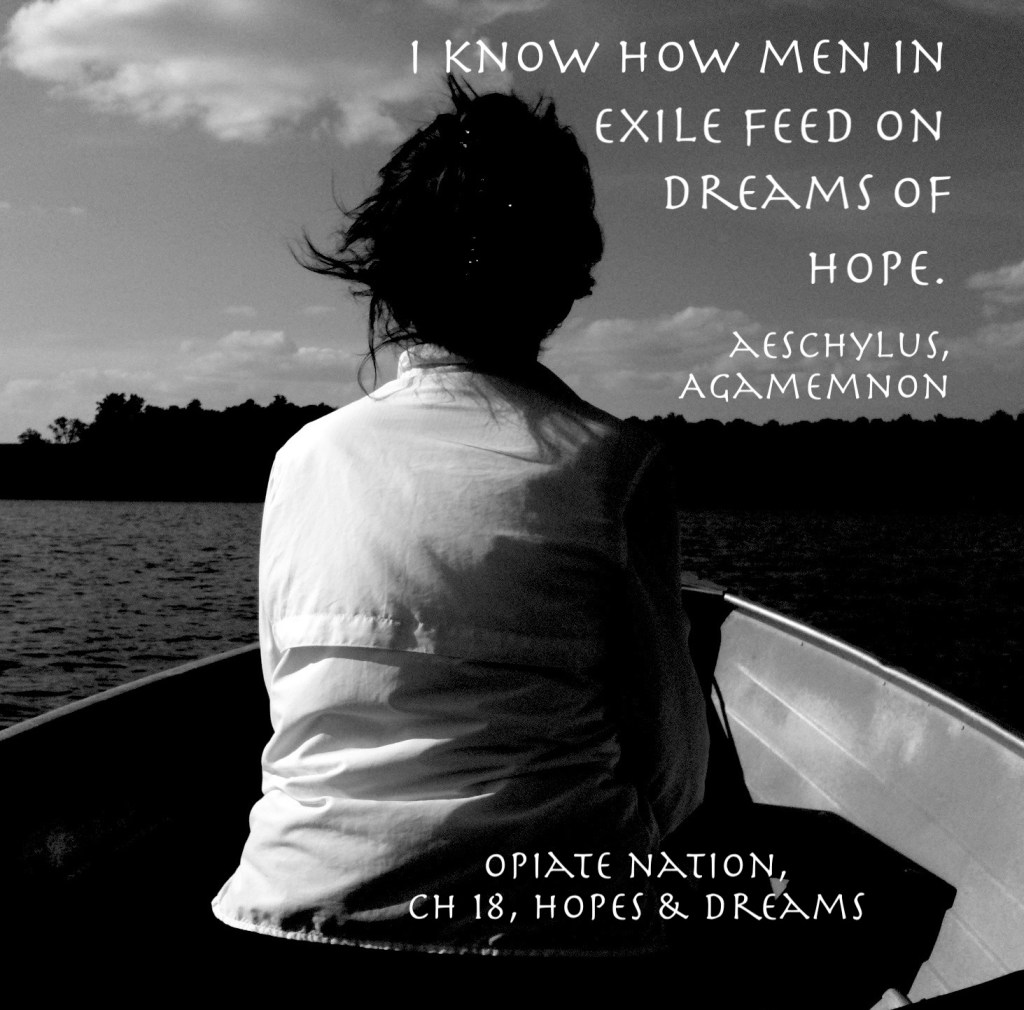
I know how men in exile feed on dreams of hope.

–Aeschylus, Agamemnon

After our son’s death from overdose, John and I truly felt like “men in exile,” forced into separation from our son, banished from each other’s’ lives. We are not just on different continents, but in different worlds, different dimensions. And hope? Any hope would have been just that—a dream, a mirage.

His untimely death took all hope of a sober and content son in this life away. Lost hope is what crushes parents when their child dies a needless death, an ignoble death to many. Had he fought in a war and been killed in action, to society it would have been a noble death. Most people who are separated from the life-and-death battle with addiction can’t see the struggle that this generation of young people are fighting on a moment-by-moment basis against an enemy that is in their brain, in their body—not outside it—one they can’t shoot and kill or put in prison. But we, as parents and friends, see it and wonder how much longer can they fight before they lose?

Continue reading “Hopes & Dreams”

The Secret Keepers

(Twentieth in a series of topical blogs based on chapter by chapter excerpts from Opiate Nation. Translation into most languages is available to the right.)

National secrecy. Communal secrecy. Familial secrecy. Cloaked as “Discretion” it perpetuates problems. What it did for us when we found out that our son was addicted to heroin was to create a puzzle that we were forced to try to put together in the dark with many missing pieces. No one was talking – not friends, parents, school leaders. When the drug bust happened at his high school in the spring of 2005, and the administration didn’t call a meeting of all parents to alert us to what was going on, one wonders what motivation was behind that decision? Clearly, it wasn’t what was best for the rest of the students, families, or our community.

Years ago, while working through our angst with the systemic problems in organized Christianity, and continuing to run into absolute resistance, secrets, and denial, we came upon a quote that finally explained why we were not, and never would be, making headway: “If you speak about the problem, you become the problem.” This wisdom came from an important and insightful book, The Subtle Power of Spiritual Abuse. But the subtle power of abuse is not limited to churches: governments, schools, communities, families—no one wants to be seen as part of the problem, especially with drug addiction and alcoholism. So, if we just keep troublesome or messy things secret, if we don’t speak about them, we can all just get along.

Continue reading “The Secret Keepers”
Malcolm Guite

Blog for poet and singer-songwriter Malcolm Guite

The Gift of Need

How Need Can Strengthen Individuals and Communities

Memoirs and Musings

David Bradley Such

Dave Barnhart

Church planter, pastor, author, coach

RecoveryLife101

Just another WordPress.com site

Abbie In Wondrland

life...on Gods' terms.

Living In Graceland

"..learn the unforced rhythms of grace" matt 11:28

Janaburson's Blog

All about opioid addiction and its treatment with medication

Breaking In News Network

Seeking the truth and bypassing the MSM

Junkbox Diaries

Trauma, PTSD, Mental Health, Addiction, and Recovery

Ohio Society of Addiction Medicine

The Ohio Society of Addiction Medicine is a chapter of ASAM - A professional society actively seeking to define and expand the field of addiction medicine.

traceyh415

Addiction, Recovery, Loss, Grief

WordPress.com News

The latest news on WordPress.com and the WordPress community.