HEALTHCARE – Privilege or Basic Need?

(Translation into most languages at tab to right)

If access to health care is considered a human right, who is considered human enough to have that right?

I critique market-based medicine not because I haven’t seen its heights but because I’ve seen its depths.

~Paul Farmer, M.D., Ph.D. (1)

In sorting through bins of old notes and letters, I knew one bin in particular would bring up painful memories. It was our son, JL’s. It was difficult, as I had imagined. And one of the – no, THE – most painful reminder related to his death from an overdose. It was the fact that we played a role in his preventable death. And so does the American capitalistic healthcare debacle.

The previous New Year’s eve, he was with two of his friends who overdosed and one died. It shook him to his core and he came to us and asked for help. We went together to his addiction doctor and after separate sessions, we then talked together. His doctor said: “This young man cannot start using again because if he does, he will die.” This came from his years of experience working with young people who had been inadverntently caught up in the opioid epidemic of the 2000’s. He felt JL would need to be on Suboxone for a long period of time and maybe for the rest of his life.

JL was hesitant because he had been on Suboxone years ago when it was very expensive and being prescribed at 32 mg a day – a huge amount that left patients feeling like they were drugged. And the worse part was trying to get off it. Tapering off was extremely difficult and took forever – like extended withdrawals.

Aside from the physical hurdles was the cost. It was very expensive and, guess what? It was, of course, not covered by our private health insurance (which cost us almost $1000/mo as self-employed workers) because addiction was not considered a healthcare issue. As a matter of fact, if a person said they had an illegal drug addiction, they would likely be dropped from health insurance coverage and be reported to the police.

What is so painful for us now is that we made the decision that January to drop JL from our costly policy and to not cover his getting Suboxone due to the expenses (it would have been hundreds of dollars a month for the Rx). And in the mistaken belief that he just needed to try harder. We thought this would force him to stay clean – good old fashioned will power and hard work. He did go into a detox program for a month and then into a great sober living program where he did so well we thought we had turned the corner in his 10-year struggle with opioid addiction (which had started when he was 14 and experimenting with Oxy’s).

What we didn’t understand at that time was that opioid addiction is not overcome by willpower. The result was after 6 months, he finally had impacted wisdom teeth surgery and weeks of opioid pain meds – because we thought there was no other option and we thought he could handle it. Within 3 weeks he began using heroin again and after a few days, overdosed and died. August 2, 2014.

What our family did not have as an option was what was finally put into law in 2014: The Affordable Care Act (ACA). This law mandates that all new individual and small-group plans cover substance use disorder (SUD) treatment as one of the ten essential health benefits. It also prevents insurers from denying coverage or charging more because of a pre-existing condition, including addiction.

Sadly, there are politicians who want to revoke the ACA or limit much of its coverage. As the supposed leading nation in the developed world, we are the only one without universal health care for every person from cradle to grave. All of our peer nations have it. Some systems work better than others. Regardless, health care is not seen as an option or a privilege for those who can afford it. It is considered part of a healthy and egalitarian society.

But in order for our government to save money (since our elected officials don’t want to tax millionaires and billionaires equitably), there have been significant cuts to Medicaid and SNAP and changes to the Affordable Care Act (ACA), that are projected to increase costs and reduce coverage for millions. There are too many details to go into here, but the bottom line to me is this:

Why are we even debating how much coverage these programs and health insurance companies offer when we should be pressing for complete health care coverage for all Americans – especially for the least of us who can barely afford food?

If we consider ourselves a nation built on Judeo-Christian principles, how can we not believe that as a society it is our responsibility to care for the sick – as people of faith have always done?

 If how we viewed health care changed – as a basic need instead of a privilege –  then the necessary changes to our taxing structure and health insurance would change. Where there is a will, there is a way.

  1. Dr. Paul Farmer. https://www.pih.org/paul
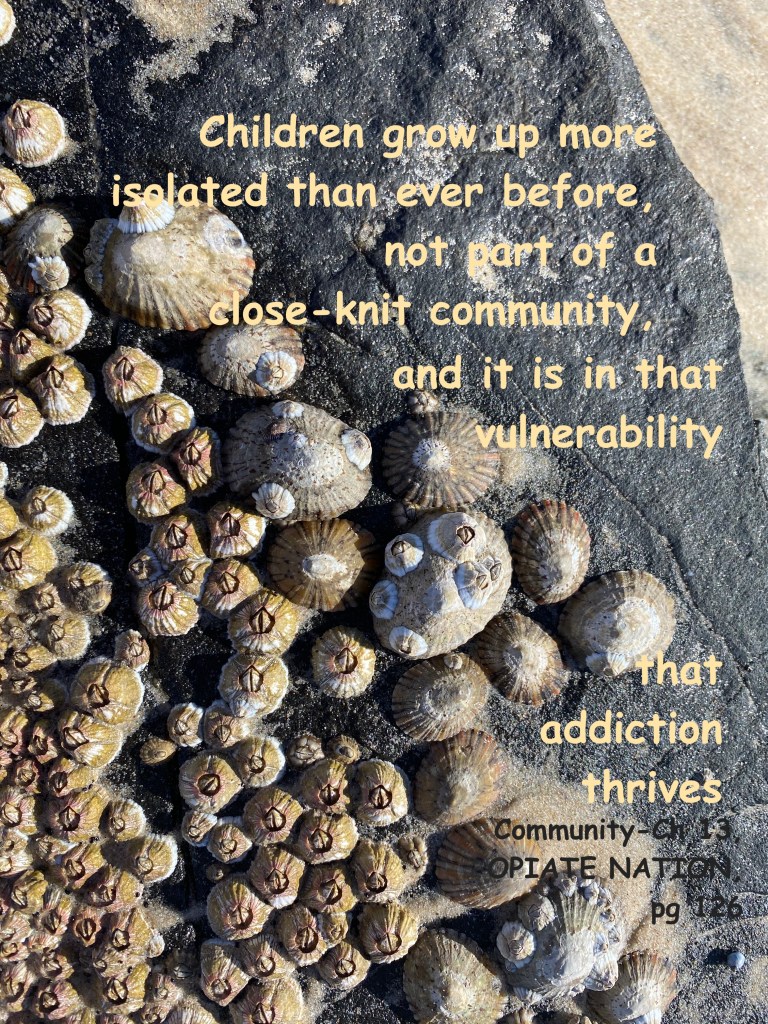
Missing Community

(Fifteenth in a series of topical blogs based on chapter by chapter excerpts from Opiate Nation. Translation into most languages is available to the right.)

(This blog was posted on December 27, 2020, but due to technical glitches, it was not shared on some platforms – here it is again for those who missed it.)

For much of the world, Christmas and the holiday season this year has been nothing like our normal times of celebrating with family and friends. Togetherness is dangerous in most countries due to Covid-19. Yet, despite all the health and safety warnings, many have travelled and gathered with their loved ones. Why would people risk the well-being of themselves and their beloveds just to spend a few hours or days together?

Community. We all need it and ultimately cannot live without it. Communities may seem optional when all is well, but they become indispensable during hard times, whether personally or corporately. They can be small or large and most of us have several different sizes and types that we are part of: our family, school, sports, church, work, etc. What communities have in common are shared interests, beliefs, and needs, even while the individuals may have diverse characteristics. They are united and working towards a common goal and understand that they can achieve it because of, and with, the support and encouragement of others.

Continue reading “Missing Community”

If my son were alive today during the Covid-19 pandemic…..

I would fear for his life more than ever.

“Drug Overdoses Soaring: Suspected overdoses nationally jumped 18% in March, 29% in April, 42% in May, data from ambulance teams, hospitals, and police shows.”

As a young man in America who wanted more than anything to be free of his deadly heroin addiction, how would he be weathering the Covid-19 pandemic?

“The drug-overdose-and-death epidemic already was hurting communities before COVID-19, but during the pandemic there have been reports from every region of the country on spikes in opioid-related calls to first responders, visits to emergency rooms, fentanyl and tainted-drug-related overdoses. There also have been challenges to accessing sterile needle and syringe and exchange services.”

Continue reading “If my son were alive today during the Covid-19 pandemic…..”

BLOG: MAT, Part 2

MAT––Medication Assisted Treatment. Dr. Hillary Kunins, a clinical addiction expert, dispels the notion that treating an addiction patient with medication is simply exchanging one drug with another. Here is a link for a 2 min video where Dr Kunins offers a simple explanation of why physical dependence is not the same as addiction.

Here are the drugs that are currently in use for opioid addiction. Methadone has historically been used for heroin addiction, since the early 1970’s, when it was authorized by the FDA but restricted to daily dispensing clinics. Because it is an opioid-like drug, it has tended to only keep addicts alive, but never really able to be drug-free.

Nearly a half-century ago, buprenorphine was developed in England, where chemists were competing to invent a less addictive painkiller than morphine––it turned out to be far more addictive. It is now sold as Subutex and is an opioid partial agonist. An agonist is a chemical that binds to a receptor and activates it, producing a biological response. Like heroin, buprenorphine attaches to the brain’s opioid receptors creating euphoria, but it does not plug in as completely, so its effects are reduced. It is slower acting and longer lasting, attenuating the rush of sensation and eliminating the plummets afterward. But there is still potential for abuse and it can produce side effects such as respiratory depression.

Naloxone (Narcan, Evzio, injectable or intranasal spray) was patented in 1961, and is an opioid antagonist—meaning that it binds to opioid receptors and can reverse and block the effects of other opioids by displacing them from the opioid receptor sites in the brain.Whereas an agonist causes an action, an antagonist blocks the action of the agonist. It has been used in hospital “code arrest” emergency situations for decades. It was used on me before a surgery when I had been given too much anesthesia and was beginning to go in to respiratory arrest. It is being carried by emergency personnel and families of addicts because it can very quickly restore normal respiration to a person whose breathing has slowed or stopped as a result of overdosing with heroin or prescription opioid pain medications.

Naltrexone (Vivitrol, monthly injection) is an opiate antagonist that is more slowly released than naloxone. It is primarily used to manage opioid dependence or alcohol dependence and abuse by blocking neural pathways to the brain for dopamine neurotransmitters. It requires going through complete withdrawals and detoxification first because it will not work until opioids are out of the system. People who try to take opioids after taking naltrexone are at risk for opioid overdose and death since it takes using large amount of opioids to overcome its effects.

Suboxone––four parts buprenorphine, one part naloxone––was approved by the FDA in late 2002. Generally, although not accurate, when the word “buprenorphine” is used, people are referring to Suboxone. In addition to side effects from the buprenorphine in Suboxone, if a person has been taking it for a long time and they no longer receive it, they will suffer withdrawal symptoms similar to those suffered when stopping other forms of opiates. And, suffering from these withdrawal symptoms can worsen underlying mental disorders like anxiety or depression. At times, withdrawal can become overwhelming, which happened to jL, which sends patients into buprenorphine abuse and dependency. This has created a debate over the use of Suboxone and Subutex for addiction treatment.

A new study in The Lancet (January 27, 2018), sponsored by the National Institute on Drug Abuse (NIDA), compared the effectiveness of extended-release naltrexone with buprenorphine-naloxone in the US. The results were both promising and disappointing. While naltrexone is as effective as buprenorphine-naloxone once treatment begins, it is also significantly more difficult to actually start naltrexone because of the prolonged detox period—which can span more than a week—that buprenorphine-naloxone does not.

The biggest regret we have had since our son’s death in 2014 is that we did not take his doctors advice and have John Leif on Suboxone. There were many reasons that went into this decision, but the main one was that our health insurance did not pay the costs for any “mental health” coverage. Since we had so many years of our son’s relapses and recovery expenses, we decided to let him just “try harder” with the 12-steps and a sober living house. Sadly, it was not enough for a young man who desperately wanted to be clean and free of his enslaving addiction––he need MAT and we believe he would be alive today if he had been given that option.

Medication Assisted Treatment – Part 1

Medication Assisted Treatment, or MAT, is finally gaining acceptance as a response to drug addiction in the US––it is a cultural shift from the view that addiction is a “moral failure.” The Hazelden Betty Ford Foundation, one of the top drug treatment providers in the country, used to subscribe almost exclusively to the abstinence-only model, based on an interpretation of the 12 steps of Alcoholics Anonymous and Narcotics Anonymous popularized in American addiction treatment in the past several decades. But in 2012, they announced they would begin providing MAT. There are four opioid substitutes that are used for MAT in opioid addiction: methadone, buprenorphine, naloxone, and naltrexone. More on these in the next blog.

November 6, 2013, the New York Times did an extensive article discussing the development, use, and risks of opioid substitutes, in particular bupreorphine and the combination drug, Suboxone. The author explaining that “While addiction is considered a chronic, relapsing disease, experts believe that replacing illegal drugs with legal ones, needles with pills, or more dangerous opioids with safer ones reduces the harm to addicts and to society. Addicts develop a tolerance to its euphoric effects and describe themselves as normalized by it, their cravings satisfied. It also diminishes the effects of other opioids but, studies have shown, does not entirely block them, even at the highest recommended doses.”

In a Frontline report in 2016, one of the doctors who specializes in addiction medicine related that doctors are limited by the DEA to treat only 100 patients per year with Suboxone. The thought behind this law is that they don’t want it to be abused––and it can be abused, as a commodity sold on the street to ward of withdrawals or for those who cannot afford the cost of a doctor and the medication. Our family faced the dilemma of the high costs for the doctors visits and the Suboxone because they were not covered by our son’s health insurance. We made the decision for him to not use this option, all hoping that a sober living house and meetings would help him succeed in his desire for sobriety. He was dead from a heroin overdose 7 months later.

The physician on Frontline pointed out the contradiction––the contradiction that has frustrated me and my husband for years––that there is still no limit on how many oxycodone or other opioid prescriptions physicians can write—the very abuse of which is documented to be fueling the opiate epidemic and creating the need for Suboxone. I personally experienced this absurd mentality towards opiates when my oral surgeon sent me home with 60 Vicodin after a root canal––60. I used two. He is the same oral surgeon who did JL’s wisdom teeth extraction and gave him multiple prescriptions for Percocet two weeks before and two weeks after the surgery––which fueled his relapse on heroin and ultimately, his death. He should have his license revoked.

As of a 2017 report by SAMHSA (Substance Abuse and Mental Health Services Administration), physicians who have prescribed buprenorphine/Suboxone to 100 patients for at least one year can now apply to increase their patient limits to 275 under new federal regulations. It is good to see movement in the right direction and I hope there will be more progress soon, especially in terms of making medication options a covered public health care benefit available to addicts who want to get their lives back.


Malcolm Guite

Blog for poet and singer-songwriter Malcolm Guite

The Gift of Need

How Need Can Strengthen Individuals and Communities

Memoirs and Musings

David Bradley Such

Dave Barnhart

Church planter, pastor, author, coach

RecoveryLife101

Just another WordPress.com site

Abbie In Wondrland

life...on Gods' terms.

Living In Graceland

"..learn the unforced rhythms of grace" matt 11:28

Janaburson's Blog

All about opioid addiction and its treatment with medication

Breaking In News Network

Seeking the truth and bypassing the MSM

Junkbox Diaries

Trauma, PTSD, Mental Health, Addiction, and Recovery

Ohio Society of Addiction Medicine

The Ohio Society of Addiction Medicine is a chapter of ASAM - A professional society actively seeking to define and expand the field of addiction medicine.

traceyh415

Addiction, Recovery, Loss, Grief

WordPress.com News

The latest news on WordPress.com and the WordPress community.