The Importance of Friends – Pt 2

(Translation into most languages at tab to the right.)

How do clean and sober friends stay involved with a friend who is in active addiction and/or alcoholism? I ended last month’s blog asking this question. In particular, I want to discuss ways that teens and young adults can deal with this difficult and at times very frustrating problem.

What does being a good friend to someone who is addicted look like? 

The first thing is to not pretend you don’t know about their addiction. Talk about it openly but without judgment. Understand that they may deny any problem, so you may have to cite specifics that have made you concerned. Express that you care about them and don’t think less of them as a person because of their struggles. Risk your comfort zone. “Greater love has no one than this: to lay down your life for your friends.” (1)

Be a good listener. A problem with drugs or alcohol may start from just experimenting with drugs at a party or concert. It may then turn into addiction and be fueled by problems at home or with friends or underlying mental health issues. When your friend feels cared for and accepted and not confronted with more guilt or shame, they will be willing to open up. Nobody planned to become addicted and nobody wants to be an addict. Here’s links to good info on how to help someone trapped in addiction. (2,3)

But, if you remain a good friend to someone who is living a self-destructive life, how do you help them without enabling their addiction? For young people who are good friends, enabling might be keeping secrets for them about their problem, especially from adults who may need to know in order to take life-saving action. It may be loaning them money or driving them to get drugs. The pressure would sound something like: “If you’re my real friend, you won’t tell…”  Or “If you really want to help me you would…” Basically, when you support their problematic behavior in the name of ‘helping’ them, you are actually keeping them from living with the consequences of their poor choices. And this will only prolong their problems and delay change. (4) 

Encourage them to get help through programs like SMART Recovery groups or AA for alcohol and NA for narcotics. Very few people overcome addictive behaviors alone. Community is key. Go with them if you can or drive them. And remember, drug and alcohol recovery take lots of time and most people don’t succeed the first time they try to quit. Dr. John F. Kelly, clinical psychologist and addiction medicine expert, says it can take 8 years and 4-5 treatment attempts at recovery to achieve one year of sobriety from opioid and other drug addiction. It can take years to achieve stable recovery and Medication Assisted Treatment (MAT) is an important aspect. Gone are the times when a 30-day detox/treatment was seen as the solution to addiction. It may be an important first step in the process of ongoing recovery. People can and do recover, but it will likely be a lifetime journey. Here’s a YouTube 2025 video of Dr. Kelly giving a session on: The New Science on Addiction Recovery. (5)

You can encourage your friend with each small step and success, even through relapses. In our son’s recovery program, we ended each session by saying together: “Keep coming back ‘cause it works if you work it.” It takes hard work and it can be very discouraging for your friend to relapse because your friend wants to be free. No one wants to live controlled by addiction. No one. Encouragement to stick with it is vital.

If your friend or family member is using opioids, you should get naloxone (a medicine that can temporarily reverse the effects of an opioid overdose) and keep it handy. Available through local community-based programs or pharmacies.  

It’s worth saying again: Friends are SO important for people in active addiction.

Don’t ever give up on your friends trapped in addiction. They need friends more than ever, friends who love them and will invest in their lives and let them know they are a worthwhile human – while you also need to encourage them to seek help in order to become sober and stable. And to remind them by example of what a normal and joy-filled life is like and one that they too can have. 

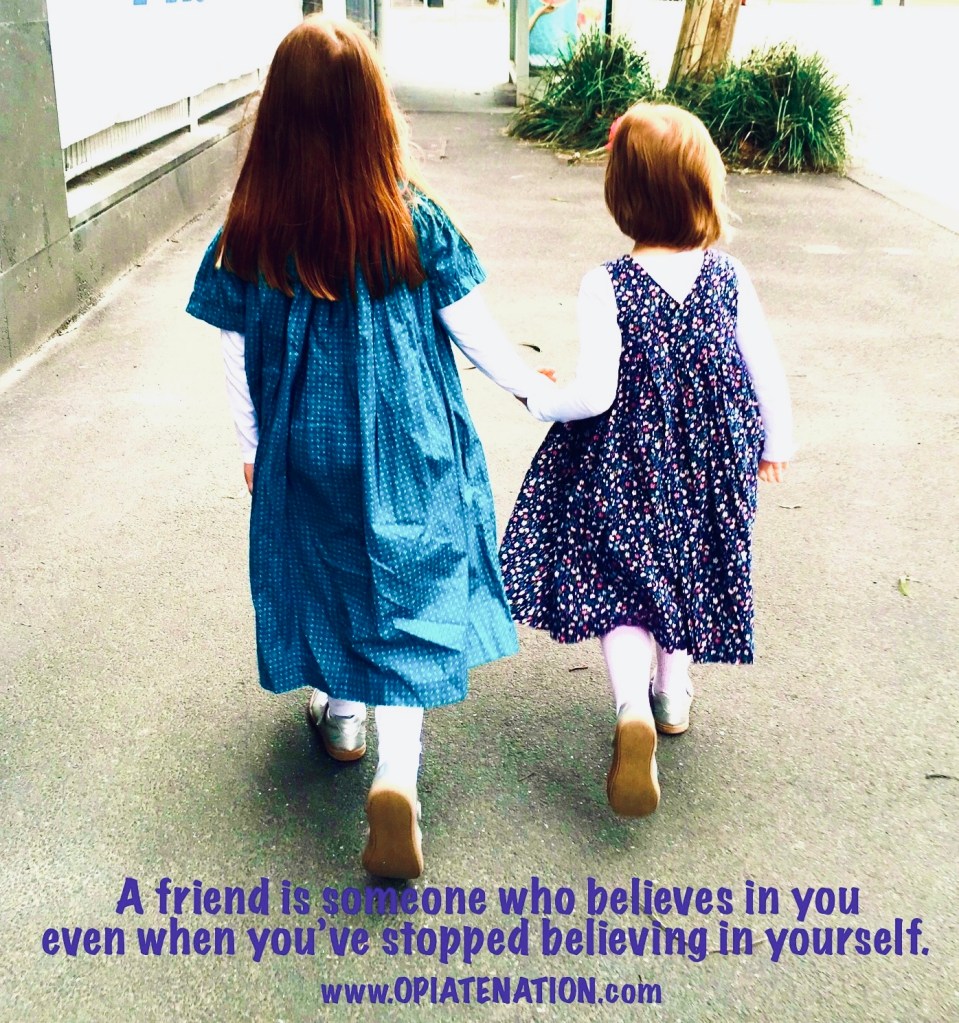
A best friend is someone who believes in you 

even when you’ve stopped believing in yourself.

– Unknown

  1. John 15:13, New Testament 
  2. Helping Someone with a Drug Addiction

https://www.helpguide.org/mental-health/addiction/helping-someone-with-drug-addiction

  • How to help someone who is misusing drugs or alcohol:

https://www.healthdirect.gov.au/help-someone-who-is-misusing-drugs-or-alcohol#:~:text=Celebrate%20small%20successes%20and%20try,Narcotics%20Anonymous%20and%20SMART%20Recovery.

  • Four Signs of Enabling and How to Stop

https://health.clevelandclinic.org/enabling

  • Dr. John F. Kelly, Ph.D. The New Science on Addiction Recovery (lecture)

The Importance of Friends – Part 1

(Translation into most language at tab to the right.)

Approaching what would be my son’s 36th birthday, I thought about the last year of his life. I don’t think about it often because it is painful – so many wishes that things had gone differently for him.

One sadness is that when in active addiction, he was very alone. It’s not that JL didn’t have lots of friends – he did. He was friendly and likeable and the large group of friends who came to his memorial is a testament to that. But most of his high school and university-era friends were not involved in his life during the last few years of his life, and the last year in particular. After his accidental fall and relapse to opiates in 2008 and the next seven years in and out of recovery programs, his life became narrower and something he was ashamed of.

An event that stands out was during a time of heroin use that we were not fully aware of as he lived in our rental house, and we thought he was attending his classes at university. We received an urgent call from two of his friends telling us that they knew he was back to spending all his time with his friend that used heroin with him and they were not getting an answer to their calls. They were at his house and he wasn’t responding to their knocks on his door – did they have our permission to break his door down? Our frightened response was “Yes!” They found him deep in drugged sleep and alive but very startled when they burst in. They confronted him with what they knew and their concern about his drug use. He of course was defensive and pretended that nothing was wrong.

Gradually, these friends, along with others, were no longer part of his life. JL did make a good friend or two in his recovery programs, but he always kept his addicted friends and dealers separate from his sober friends who were mostly not aware of his use and relapses – he had a pretty good poker face. Most of them were shocked to hear of his overdose death because he had been in a sober living house for six months and doing well.

Many of the friends who had such good times together when JL was clean (although not necessarily sober, as they enjoyed drinking with him not realizing how that always led back to drugs for JL) felt guilt after his death. Guilt because he called several of them the week before his death when he had just relapsed. It seems he wanted a friend to talk to and perhaps perceive that he was struggling. And guilt because they wished they had stayed in touch with JL and not distanced themselves from him when he continued to struggle with addiction. 

But there’s the rub: How do sober friends stay involved with a friend who is in active addiction? I think it is especially difficult for young people, who don’t know what they can do, who may be more concerned with their own lives and issues, and who are not yet mature. This is not to suggest that any human is ever totally selfless regardless of how old we are – I know myself too well to hold this delusion. But the passing of years does bring relational experience and can help us focus more on those around us.

Next month I will try to share some insights and ideas for teens and young adults for how to truly be a friend to someone who is struggling with addiction and sobriety. Just remember: 

Don’t ever give up on your friends or family who are trapped in addiction. They need good friends more than ever. King Solomon gave this wise insight 3,000 years ago: Two are better than one, because they have a good return for their labor: If either of them falls down, one can help the other up. But pity anyone who falls and has no one to help them up. (1)

Many people will walk in and out of your life,

 but only true friends will leave footprints in your heart.

—Eleanor Roosevelt

  1. Ecclesiastes 4:9-10

TEMPTATION: Fight it or Heed the warning signs?

(Translation into most languages at tab to the right)

I have been thinking about temptation recently and how differently we each respond when we face something that is hard for us to resist. How do we resist something that is alluring and that we have repeatedly succumbed to in the past? Something that we are addicted to like lying or shoplifting, alcohol or drugs, gossip or gambling, social media or overeating? The list of behaviors that can derail our lives in one way or the other is endless. It’s not just how an addiction can cause us harm, but also how it can debilitate or destroy our relationships, that makes learning how to beat temptation important.

So, when we are tempted to indulge in our pet addiction, what do we do? 

I read an article on Medium about temptation and willpower that supports the thoughts I’ve held throughout my life. Riikka Iivanainen (1) confesses that she has high self-control and discusses her research into why some people succeed at resisting temptation while others don’t. 

She says, High self-control does predict many positive life outcomes: People who’re good at self-control do better in school, have fewer mental health problems, have better relationships with friends and family, and generally exhibit fewer impulsive behaviors like binge eating and alcohol abuseThey’re even happier.

From the many scientific studies she researched, she goes on to say, Having good self-control doesn’t mean a constant battle against temptations. The kind of self-control that gets you all those good outcomes is more effortless than what’s commonly suggested by the term’s “willpower” and “self-discipline.”

Psychologists tell us that constantly resisting temptation is exhausting and will soon leave us with ego-depletion. Relying on self-control in the face of temptation is destined to fail. So what kind of self-control is “more effortless”? Riikka says, The people who reported fewer problematic desires and less conflict related to those desires were good at avoiding temptation, not resisting it.

Isn’t this insight what the basis of what most recovery programs are built upon? The acronym HALT is a tool to remind us to take a moment and avoid temptation by being aware of the primary things that can lead us to it: Hungry, Angry, Lonely, Tired. We are susceptible to self-destructive behaviors, temptations, and relapse when these basic human needs are unmet. HALT is a reminder, an early warning system. Being self-aware helps us recognize our needs and address them in a positive way before turning to harmful habits or destructive people.

Hungry – being hungry can be physical or emotional hunger

Angry – being angry at someone else or at yourself

Lonely – being lonely can be while in a crowd or from self-isolation

Tired – being tired affects our body, mind, and spirit

Some ways to deal with these needs is the subject of my Opiate Nation blog post April 14, 2018, H.A.L.T. https://opiatenation.com/2018/04/14/h-a-l-t/

We need to know ourselves and be honest about what our problematic desires are and avoid them rather than flirt with them. Desires are matters of the heart and we need to do all we can to support the healthy, life-affirming desires we have. I’ll end with pertinent insights from some of my favorite sources: 

There are several good protections against temptation, but the surest is cowardice.(2)

Strength comes prior to temptation, not during it. Overcoming is a prior act. It involves making a decision to remain pure before the temptation comes. (3)

Rather than waiting for temptation to raise its inevitable head and struggling to resist it, researchers at the University of Wyoming say it’s more effective to plan in advance to manage those temptations with well-thought-out self-control strategies. (4)

It is easier to prevent bad habits than to break them. (5)

Paul repeatedly told the early Christians in their very pagan cultures to “flee” temptation. (6)

Learning takes us through many states of life, but it fails utterly in the hour of danger and temptation. Then faith alone saves. (7)

But for persons needlessly to expose themselves to temptation, and to do those things that tend to sin, is unwarrantable, and contrary to that excellent example set before us. (8)

Jesus showed us by example when we are confronted with unavoidable temptation to speak the truth in order to help us resist until we are able to escape. (9)

Temptations, of course, cannot be avoided, but because we cannot prevent the birds from flying over our heads, there is no need that we should let them nest in our hair. (10)

  1. https://riikkaiivanainen.medium.com/the-secret-life-of-people-with-high-self-control-its-easier-than-you-think-7dd26fb5282c
  2. Mark Twain
  3. The Mind of Christ by T.W. Hunt & Claude V. King, 1990
  4. https://www.psychologytoday.com/au/blog/cravings/201911/4-ways-avoid-temptation-and-reach-your-goals
  5. Benjamin Franklin
  6. I Corinthians 10:14; I Timothy 6:11; II Timothy 2:22
  7. Mahatma Gandhi, Mohandas Gandhi, Homer A. Jack (2005). “The Wit and Wisdom of Gandhi”, p.40, Courier Corporation
  8. Jonathan Edwards, https://www.biblebb.com/files/edwards/temptation.htm
  9. Matthew 4:1-11
  10. Martin Luther

Remembering The Least of Us on Int’l Overdose Awareness Day August 31st, 2022

(Translation into most languages at tab to the right)

I wish everyone could read the penultimate chapter of The Least of Us by Sam Quinones. Its title is the same as that of the book. I have almost every line underlined and starred. In it, he describes the dire state we in Western society are in with addiction, the well-thought out reasons many of our public policies are still getting it wrong, and the slivers of hope that encourage us that the world could look differently for the next generation of young people. Some poignant quotes:

“Underground chemists seem to be searching the chemistry literature for drugs that might be molecularly modified to be more potent…The world Gary Henderson predicted when he coined the term ‘designer drugs’ in 1988 is now with us. Counterfeit pills laced with fentanyl (and new synthetics every day) and made in Mexico now dominate the market…There seems now no way to stop all the bizarre drugs devised by those whose own brain chemistry has been twisted by the profits of the underworld’s free market…recovering addicts face scary odds as long as the drugs that torment them are widely available, potent, and almost free. The now-cliché is ‘We can’t arrest our way out of this.’ We can’t treat our way out of it either, as long as supply is so potent and cheap.”

Continue reading “Remembering The Least of Us on Int’l Overdose Awareness Day August 31st, 2022”

Addiction Constriction

John Leif Trang – March 10, 1989 – August 2, 2014

(Translation into most languages at tab on right)

On March 10th, our son would have been celebrating his 33rd birthday. That day is now a painful reminder of all the potentials and possibilities that a young person should be experiencing in the 4th decade of their life.

After JL died of a heroin overdose in 2014, I began the dreaded process of sorting through his belongings – which included his computer and phone. Many of the photos on his phone I had never seen and some have now become permanently seared into my visual memory. One is of JL with a Boa wrapped around his shoulders and neck.

Boas are constrictors. Constrictors don’t chase their prey. They are ambush hunters. A boa grabs its prey with its teeth, then quickly coils its body around the prey and squeezes. It doesn’t break the bones – it constricts so tightly that its prey can’t breathe. With each exhale, it tightens its coils until its prey dies slowly from an overwhelmed circulatory system due to blood not getting to the brain. Once dead, the snake swallows its prey whole.

Continue reading “Addiction Constriction”

Peter’s Story: Alcohol The Gateway Drug

(Thirty-fifth in a series of topical blogs based on chapter by chapter excerpts from Opiate Nation. Translation into most languages is available to the right.)

This week’s Story of Hope is from a friend of JL’s, Peter (not his real name). Here are some excerpts from his story in Opiate Nation (5 min read):

My name is Peter and I’m an alcoholic and addict. This is how I introduce myself at the AA meetings I attend several times every week, as I have done for over 10 years. I am from a fairly affluent family, raised with high moral standards, and attended the best schools. So how is it that I became an alcoholic by the time I was a senior in high school and an opioid addict and dealer by the time I was 20?

The first time I used alcohol was in my junior year in high school. I was new to the school and I felt like I didn’t get the playbook for how to be a part of the group. I had been raised with strong values against using drugs and alcohol – but I wanted to fit in with the popular kids.

I tried a capful of vodka—that was it. I hated the way it tasted. The next day I was sick—not so much from the alcohol, but with guilt. This would be a consistent theme in my drinking and using: I always felt guilt and the consequences of doing something soul-crushing and bending the moral line I had deep within me. Once that barrier had been crossed, then anything was permissible. Initially I only drank on weekends at parties so that I wouldn’t be the outsider.

Continue reading “Peter’s Story: Alcohol The Gateway Drug”

Hank’s Story: Drinking Loneliness

(Thirty-third in a series of topical blogs based on chapter by chapter excerpts from Opiate Nation. Translation into most languages is available to the right.)

This week’s Story of Hope is from our son’s friend, Hank (not his real name). Here are some excerpts from his story in Opiate Nation (5 min read):

I grew up in a loving home – the youngest of seven kids in a Catholic family. Although there are no alcoholics in my immediate family, my mother’s side of the family consists of proud Irish New Yorkers where alcoholism runs rampant. I experienced my first drunk at the age of 13.

Continue reading “Hank’s Story: Drinking Loneliness”

The Rescuers: Enabling, Caretaking, and Drama

(Twenty-fourth in a series of topical blogs based on chapter by chapter excerpts from Opiate Nation. Translation into most languages is available to the right.)

Historically, “enabling” referred to facilitating or empowering someone in order to help them accomplish something. By teaching children to read, we enable them to develop their intellect and further their learning. Or, as in 1933 Germany, “The Enabling Act” gave Adolf Hitler the power to enact laws without the involvement of the legislative bodies: he was enabled to become a legal dictator. In modern psychology, enabling can be positive, but it is also used in a negative sense when it encourages dysfunctional, unhealthy behavior and habits, as it is used in addiction and recovery vocabulary. Rescuing and caretaking are terms that mean what they say. They are closely connected to enabling: we rescue people from their responsibilities and we take care of people’s responsibilities for them.

Melody Beattie (Codependent No More) refers to the “Drama Triangle” roles of victim, persecutor, rescuer, and says “Rescuing/caretaking looks like a much friendlier act than it is. It requires a victim who is actually capable of taking care of themselves even though we and they don’t admit it…After we rescue, we will inevitably move to the next corner of the triangle, persecutor. We become resentful and angry at the person we have so generously helped…Then we move to the victim corner of the triangle, at the bottom, the predictable and unavoidable result of a rescue.”

Continue reading “The Rescuers: Enabling, Caretaking, and Drama”

The Vortex of Shame

(Twenty-third in a series of topical blogs based on chapter by chapter excerpts from Opiate Nation. Translation into most languages is available to the right.)

For generations, the combination of personal shame and public stigma has produced tremendous obstacles to addressing the problem of alcoholism and drug addiction in America. Addiction stigma prevents too many people from getting the help they need. –Hazelden-Betty Ford Institute for Recovery

Historically, the word shame was used interchangeably with guilt – the appropriate pang of conscience that followed doing something wrong. In reality, there is an important distinction between shame and guilt. Shame is about who you think you are; guilt is about what you have done.

Stigmas are linked to shame. In the Greek and Latin worlds, a stigma was a mark or brand, especially for a slave, identifying them as “inferior.” Later, it became known as a mark or stain we can’t see with our eyes: social stigmas that are based on perceivable characteristics, associated with certain behaviors that distinguish a person from other members of society. They convey disapproval and disgrace.

Continue reading “The Vortex of Shame”

Hopes & Dreams

(Twenty-first in a series of topical blogs based on chapter by chapter excerpts from Opiate Nation. Translation into most languages is available to the right.)

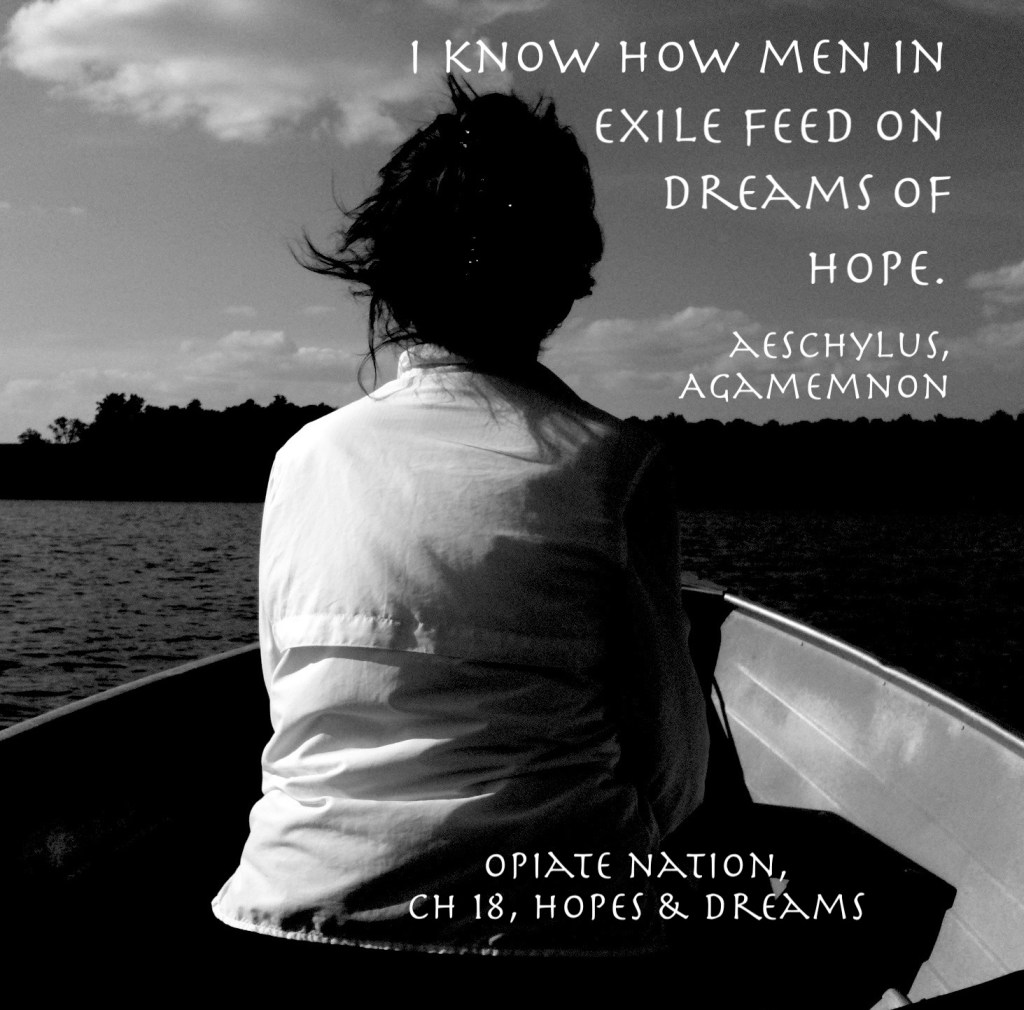
I know how men in exile feed on dreams of hope.

–Aeschylus, Agamemnon

After our son’s death from overdose, John and I truly felt like “men in exile,” forced into separation from our son, banished from each other’s’ lives. We are not just on different continents, but in different worlds, different dimensions. And hope? Any hope would have been just that—a dream, a mirage.

His untimely death took all hope of a sober and content son in this life away. Lost hope is what crushes parents when their child dies a needless death, an ignoble death to many. Had he fought in a war and been killed in action, to society it would have been a noble death. Most people who are separated from the life-and-death battle with addiction can’t see the struggle that this generation of young people are fighting on a moment-by-moment basis against an enemy that is in their brain, in their body—not outside it—one they can’t shoot and kill or put in prison. But we, as parents and friends, see it and wonder how much longer can they fight before they lose?

Continue reading “Hopes & Dreams”
Malcolm Guite

Blog for poet and singer-songwriter Malcolm Guite

The Gift of Need

How Need Can Strengthen Individuals and Communities

Memoirs and Musings

David Bradley Such

Dave Barnhart

Church planter, pastor, author, coach

RecoveryLife101

Just another WordPress.com site

Abbie In Wondrland

life...on Gods' terms.

Living In Graceland

"..learn the unforced rhythms of grace" matt 11:28

Janaburson's Blog

All about opioid addiction and its treatment with medication

Breaking In News Network

Seeking the truth and bypassing the MSM

Junkbox Diaries

Trauma, PTSD, Mental Health, Addiction, and Recovery

Ohio Society of Addiction Medicine

The Ohio Society of Addiction Medicine is a chapter of ASAM - A professional society actively seeking to define and expand the field of addiction medicine.

traceyh415

Addiction, Recovery, Loss, Grief

WordPress.com News

The latest news on WordPress.com and the WordPress community.