All Souls, All Saints, All of Us

(Translation into most languages at tab to the right.)

This year, the All-Souls’ Procession in Tucson, where I live, is today. The traditional date for celebrating All Souls’ Day (the Day of the Dead) is November 2nd. It was delayed this year because Halloween was on the same weekend. Tucson has one of the largest processions in the country with several hundred thousand people participating. Preceding this is All Saints Day on November 1st.

All Saints Day had its beginnings in Roman Church tradition dating back to the early centuries when Christians were martyred for their faith or who had publicly confessed and somehow survived the Roman persecution. The belief was that they were saints and immediately taken up into heaven. By the mid 800’s, Pope Gregory IV assigned Nov. 1st as the holy feast of All Saints.

All Souls’ Day evolved sometime around 1000 as a time to pray for the souls of all who had died. This is tied in directly with the Catholic Church belief in purgatory and those who are awaiting the joys of heaven. In pleading for them, we are reminded of our own offenses and so inspired to lead purer lives.

My husband, John, and I have walked many times in the procession here in Tucson although we are not Catholics and we believe that all those who have faith in and follow Jesus are saints, as the New Testament teaches.(1) Many Evangelical Christians think it is wrong to participate in All Souls’ events because it is not biblical to pray for the dead and they reject the concept of purgatory because nothing we do can alter ones destination in the afterlife. (2)

While we hold to basic New Testament beliefs, we do not find it contradictory to be part of the All-Souls’ procession in remembrance of our son, John Leif. The procession is a public ceremony to honor the dead and celebrate their lives, allowing participants to release and integrate their grief. Our son’s death from a heroin overdose – a reason many others are there – continues to be a source of sadness and regret. To remember and celebrate him as a person worthy of love is important for us. We do not want to shame him and do not want him to be forgotten. 

What is sad to us is the way in which this holiday is treated with similar vitriol that partisan politics infiltrates so many areas of American life these days. There are “Christians” who stand along the procession route shouting out ugly and sinful – yes, sinful – rebukes to those walking in remembrance of their loved ones. Sadly, many people feel it necessary to take a side on almost every issue – and supposed Christians are some of the leading voices. The unholy mixture of politics and “faith” in our country is deeply disturbing to us and absolutely un-Biblical. 

While we hold that our beliefs are true and worthy of sharing with others, we also feel it imperative that we respect others’ beliefs and faith traditions without mocking or denigrating them as all New Testament writing demonstrates. This is especially important when it comes to how people choose to remember and honor their loved ones who have died. 

In the past several decades, opioid addiction has taken the lives of hundreds of thousands of beautiful young people. We believe they are worthy of being remembered without shame and with love in whatever way their loved ones choose. And in so doing, we hope their lives stand as a warning for other young people tempted into experimenting with increasingly deadly drugs.

  1. I Corinthians 1:2, Romans 1:7, Philippians 1:1, Ephesians 2:19
  2. Hebrews 9:27
  3. History behind All Saints and All Souls:
Born Imperfect, Complex, & Unique

(Translation into most languages at tab to the right.)

I think we would all agree that each and every one of us is born imperfect. There are so many complex and unique aspects to the human body which generations of genes have contributed. The things that make up our physical and mental attributes. One example is our face. It is estimated that only 2% of the world’s population has a truly symmetrical face. The right side usually appears larger than the left and eyes, nose and ears are not perfectly aligned. When you see a photo of a face with both sides exactly the same, its actually creepy. They lack character and look like AI.

Some of us are born with deficiencies that make life difficult and challenging, like being born blind, or deaf, or with a physical deformity. Because of amazing advances in science and medicine in the last century, many of these problems can be corrected. I had crowded teeth when I was young and am so thankful I was able to get braces and have a normal smile. We would not understand if someone had the opportunity to receive this kind of help and didn’t access it because they or others in their community thought they should just live as they are. We all want to feel comfortable and that we belong, are ‘normal’ in this world.

What about when someone is born with an internal deficiency such as a heart condition or kidney problem or blood disorder? We never think twice about having medical help or drugs and lifestyle changes to remediate the problem if it is possible. So why is there any discussion on whether someone who is born with an imbalance of normal brain chemicals or hormones should live in constant struggle and not access medication?

This thought came up as I considered the reasons behind why some people seem to need something like drugs to make them feel ‘normal’ to themselves and to the people around them. When everyone else seems to easily roll with the ups and downs of life while they get stuck on the downs. When how they think and process input and information is not the same as others. When their ability to be at peace or sleep is chronically unobtainable.

I’m not at all suggesting that individuals who seek drugs all have legitimate genetic or biochemical voids. As we know, many young people start drug use because of peer pressure and the environment that surrounds them. But underlying mental struggles or health conditions may be the determining factor that pushes them into, rather than away from, repeated use. I found it interesting that among my son’s high school and college friends, many tried all the drugs – uppers, downers, hallucinogenic – and some went on to addiction to uppers like cocaine and meth while others to downers like opioids and benzos and some walked away from all of them.

But once repeated and continual use happens, the chemicals and receptors in the brain are changed and more than ever, medication and therapy are going to be a big part of recovery from use and restoration of normalized brain signals. The need for medication may be short term or lifelong. Regardless, we all need to remember that just like shaming someone because they have a physical deformity is totally unacceptable, shaming someone who is struggling with mental health and/or addiction problems is also unacceptable. 

This does not mean we enable destructive behavior or stop supporting someone to get professional medical and psychological help along with a supportive community. Never. If we want to see someone who is struggling become as healthy as possible, our love and support are crucial. And we know that in a country where public health care is a privilege rather than part of a foundation of society, finding the right care can be daunting. Let us be there to help our family, friends, and community receive the care they need by being encouraging and supportive.

Stigma of Addiction: The Effects, The Reasons, and How to Reduce Stigma

by Chris Elkins, MA

https://www.drugrehab.com/addiction/stigma/

Cognitive Behavioral Therapy Info Hazelden Betty Ford:

https://www.hazeldenbettyford.org/mental-health-services/cognitive-behavioral-therapy#:~:text=Learn%20more%20about%20this%20popular,techniques%20in%20working%20with%20patients.

The Importance of Friends – Pt 2

(Translation into most languages at tab to the right.)

How do clean and sober friends stay involved with a friend who is in active addiction and/or alcoholism? I ended last month’s blog asking this question. In particular, I want to discuss ways that teens and young adults can deal with this difficult and at times very frustrating problem.

What does being a good friend to someone who is addicted look like? 

The first thing is to not pretend you don’t know about their addiction. Talk about it openly but without judgment. Understand that they may deny any problem, so you may have to cite specifics that have made you concerned. Express that you care about them and don’t think less of them as a person because of their struggles. Risk your comfort zone. “Greater love has no one than this: to lay down your life for your friends.” (1)

Be a good listener. A problem with drugs or alcohol may start from just experimenting with drugs at a party or concert. It may then turn into addiction and be fueled by problems at home or with friends or underlying mental health issues. When your friend feels cared for and accepted and not confronted with more guilt or shame, they will be willing to open up. Nobody planned to become addicted and nobody wants to be an addict. Here’s links to good info on how to help someone trapped in addiction. (2,3)

But, if you remain a good friend to someone who is living a self-destructive life, how do you help them without enabling their addiction? For young people who are good friends, enabling might be keeping secrets for them about their problem, especially from adults who may need to know in order to take life-saving action. It may be loaning them money or driving them to get drugs. The pressure would sound something like: “If you’re my real friend, you won’t tell…”  Or “If you really want to help me you would…” Basically, when you support their problematic behavior in the name of ‘helping’ them, you are actually keeping them from living with the consequences of their poor choices. And this will only prolong their problems and delay change. (4) 

Encourage them to get help through programs like SMART Recovery groups or AA for alcohol and NA for narcotics. Very few people overcome addictive behaviors alone. Community is key. Go with them if you can or drive them. And remember, drug and alcohol recovery take lots of time and most people don’t succeed the first time they try to quit. Dr. John F. Kelly, clinical psychologist and addiction medicine expert, says it can take 8 years and 4-5 treatment attempts at recovery to achieve one year of sobriety from opioid and other drug addiction. It can take years to achieve stable recovery and Medication Assisted Treatment (MAT) is an important aspect. Gone are the times when a 30-day detox/treatment was seen as the solution to addiction. It may be an important first step in the process of ongoing recovery. People can and do recover, but it will likely be a lifetime journey. Here’s a YouTube 2025 video of Dr. Kelly giving a session on: The New Science on Addiction Recovery. (5)

You can encourage your friend with each small step and success, even through relapses. In our son’s recovery program, we ended each session by saying together: “Keep coming back ‘cause it works if you work it.” It takes hard work and it can be very discouraging for your friend to relapse because your friend wants to be free. No one wants to live controlled by addiction. No one. Encouragement to stick with it is vital.

If your friend or family member is using opioids, you should get naloxone (a medicine that can temporarily reverse the effects of an opioid overdose) and keep it handy. Available through local community-based programs or pharmacies.  

It’s worth saying again: Friends are SO important for people in active addiction.

Don’t ever give up on your friends trapped in addiction. They need friends more than ever, friends who love them and will invest in their lives and let them know they are a worthwhile human – while you also need to encourage them to seek help in order to become sober and stable. And to remind them by example of what a normal and joy-filled life is like and one that they too can have. 

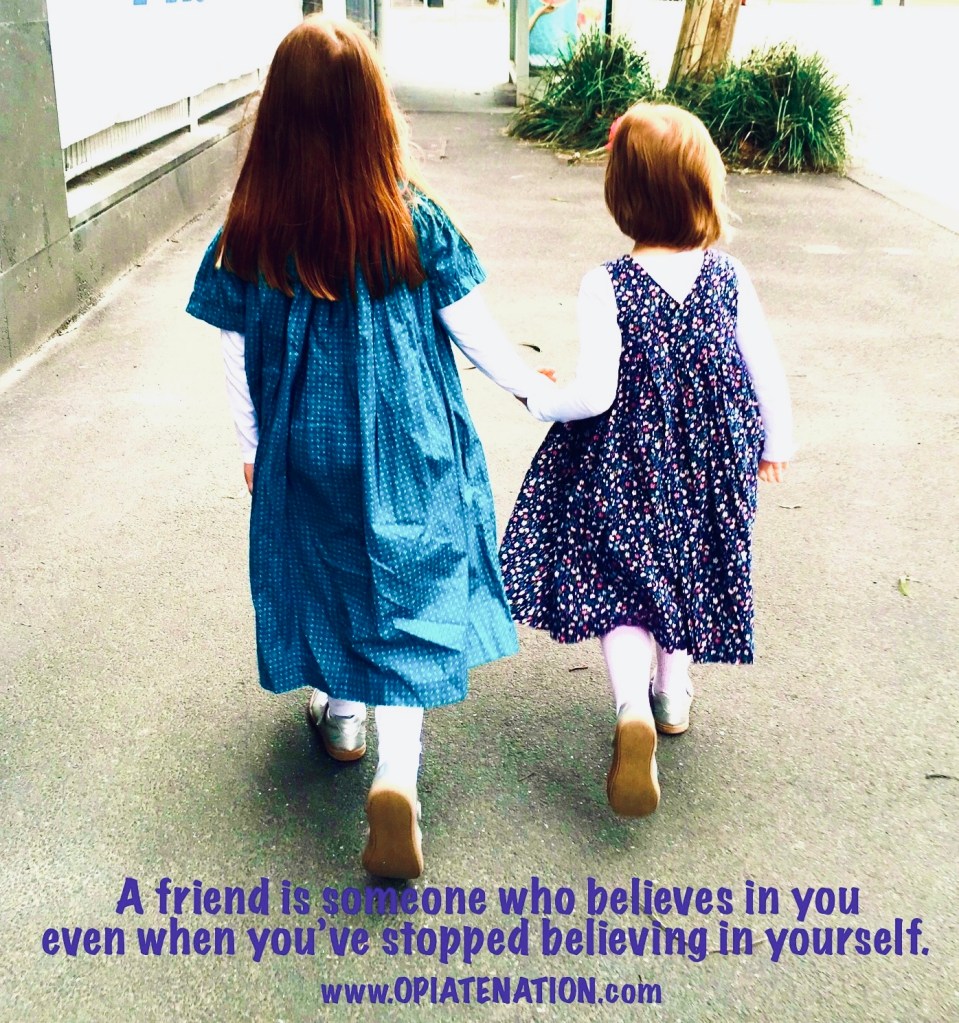
A best friend is someone who believes in you 

even when you’ve stopped believing in yourself.

– Unknown

  1. John 15:13, New Testament 
  2. Helping Someone with a Drug Addiction

https://www.helpguide.org/mental-health/addiction/helping-someone-with-drug-addiction

  • How to help someone who is misusing drugs or alcohol:

https://www.healthdirect.gov.au/help-someone-who-is-misusing-drugs-or-alcohol#:~:text=Celebrate%20small%20successes%20and%20try,Narcotics%20Anonymous%20and%20SMART%20Recovery.

  • Four Signs of Enabling and How to Stop

https://health.clevelandclinic.org/enabling

  • Dr. John F. Kelly, Ph.D. The New Science on Addiction Recovery (lecture)

Learning Compassion

(Translation into most languages at tab to the right.)

The other day, I was thinking back over the tragic deaths of many of my family members. And I thought about how I felt towards people a few decades ago when they suffered various illnesses or struggled with disease or addiction. I didn’t have much compassion because I hadn’t ever experienced those types of painful and heart-wrenching needs myself or in anyone I loved.

But in 2000, when my younger brother was in intensive care for two months on a ventilator and in a coma, I began to learn about the sorrow and desperation that hover around situations like this – for the one who is ill and for those who love them and who cannot do a thing to help or change the outcome. His diagnosis of HIV/AIDS and slow but impending death broke my heart – maybe for the first time in my life.

Continue reading “Learning Compassion”

Gilded Grief

(Short topical blogs based on Opiate Nation – translation into most languages in tab on right.)

While reading Rising Strong by Brené Brown, I was struck by a thought she shared about our American culture and the absence of honest conversation and the hard work it takes for us to rise strong after a fall on our face – a failure. She worries that “this lack of honesty about overcoming adversity has created a Gilded Age of Failure.”

Gilding is a perfect word-picture for this characteristically human behavior: applying a very thin coating of gold to a plain, inexpensive object that gives it the appearance of gold. This is what we do when we are dishonest about our feelings. We are choosing to make our real, plain, and common story appear better than it is.

“We’ve all fallen…but scars are easier to talk about than they are to show with all the remembered feelings laid bare…We much prefer stories about falling and rising to be inspirational and sanitized…We like recovery stories to move quickly through the dark so we can get to the sweeping redemptive ending.”  (Rising Strong, Introduction)

Continue reading “Gilded Grief”

Hank’s Story: Drinking Loneliness

(Thirty-third in a series of topical blogs based on chapter by chapter excerpts from Opiate Nation. Translation into most languages is available to the right.)

This week’s Story of Hope is from our son’s friend, Hank (not his real name). Here are some excerpts from his story in Opiate Nation (5 min read):

I grew up in a loving home – the youngest of seven kids in a Catholic family. Although there are no alcoholics in my immediate family, my mother’s side of the family consists of proud Irish New Yorkers where alcoholism runs rampant. I experienced my first drunk at the age of 13.

Continue reading “Hank’s Story: Drinking Loneliness”

Regrets: Endless Stairways

(Twenty-ninth in a series of topical blogs based on chapter by chapter excerpts from Opiate Nation. Translation into most languages is available to the right.)

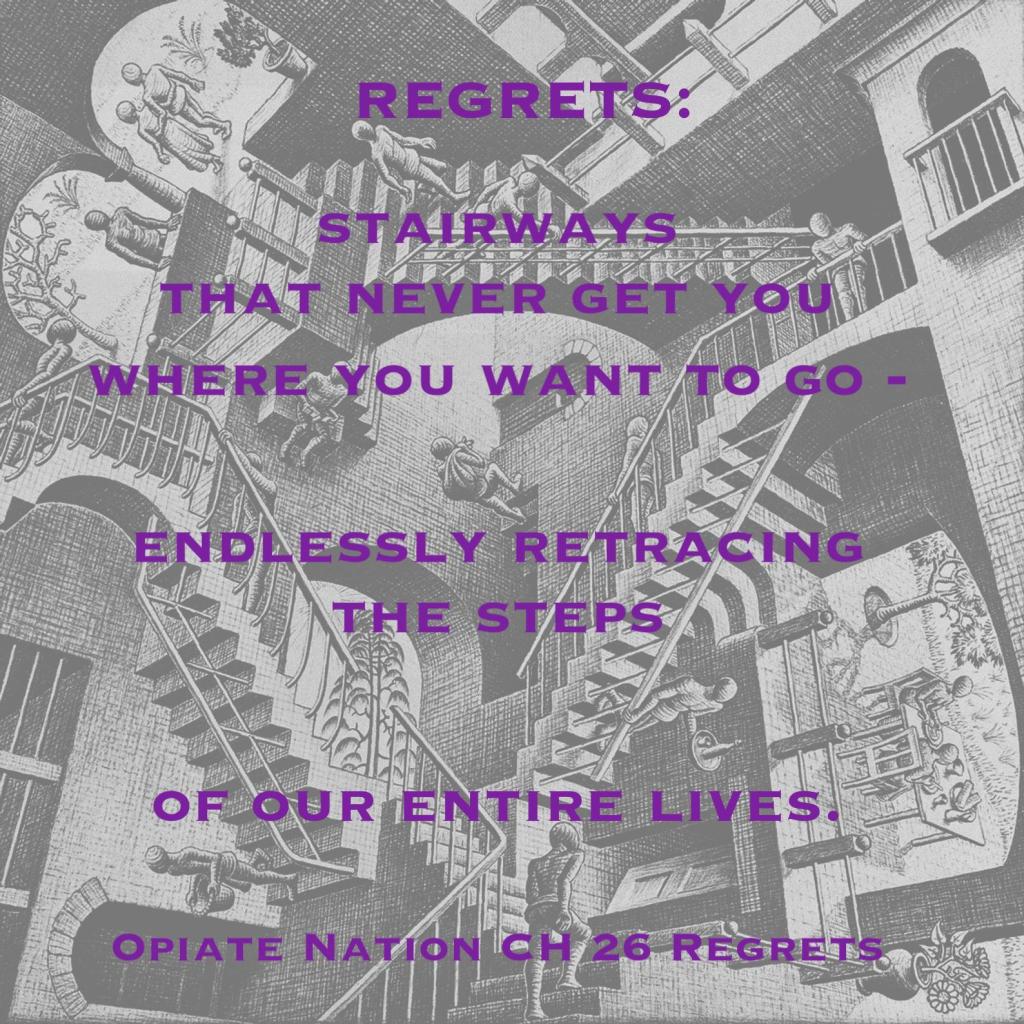
Our family loves the art of Dutch mathematician and artist M. C. Escher: the buildings that open into themselves, the school of fish that become a flock of birds, the circuitous stairways that go up and down throughout multiple buildings without an end point. Yes, stairways that never get you where you want to go, but keep you endlessly retracing your steps. They are no longer interesting art to wonder at. They now mirror how John and I have felt many times since August 2nd—regrets—retracing the steps of our entire lives.

Continue reading “Regrets: Endless Stairways”

Hopes & Dreams

(Twenty-first in a series of topical blogs based on chapter by chapter excerpts from Opiate Nation. Translation into most languages is available to the right.)

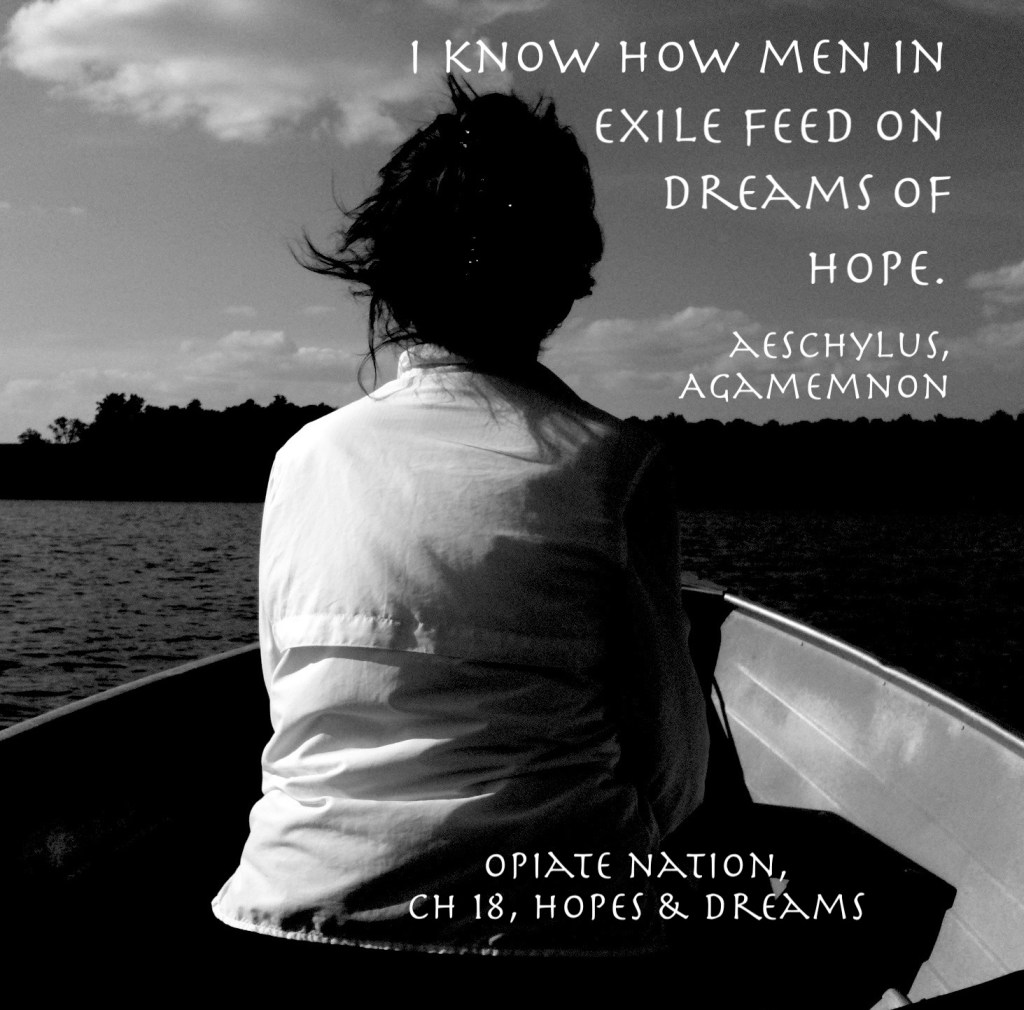
I know how men in exile feed on dreams of hope.

–Aeschylus, Agamemnon

After our son’s death from overdose, John and I truly felt like “men in exile,” forced into separation from our son, banished from each other’s’ lives. We are not just on different continents, but in different worlds, different dimensions. And hope? Any hope would have been just that—a dream, a mirage.

His untimely death took all hope of a sober and content son in this life away. Lost hope is what crushes parents when their child dies a needless death, an ignoble death to many. Had he fought in a war and been killed in action, to society it would have been a noble death. Most people who are separated from the life-and-death battle with addiction can’t see the struggle that this generation of young people are fighting on a moment-by-moment basis against an enemy that is in their brain, in their body—not outside it—one they can’t shoot and kill or put in prison. But we, as parents and friends, see it and wonder how much longer can they fight before they lose?

Continue reading “Hopes & Dreams”

What’s Inside the Shell?

(Ninth in a series of topical blogs based on chapter by chapter excerpts from Opiate Nation. Translation into most languages is available to the right.)

Shells are beautiful and fascinating to me. Each and every one is unique, differing from others just like our fingerprints. John and I just spent time at the central eastern coast of Australia and on our daily walks on the beach I just couldn’t stop picking up shells – especially the Nautilus shells with their logarithmic spirals of every size, shape, and color. These are empty shells that were once the home of a sea creature.

The exoskeleton of mollusks is the hard, outer layer that protects the tender creature inside. As the creature grows, layers are added to accommodate it. One day, as I was picking up shells in the surf, the inhabitant was still inside. It immediately retreated as far back into its shell as possible.

Continue reading “What’s Inside the Shell?”

Handwriting on the Wall

The other day I was thinking about our son and his struggles with drugs and alcohol and all that we know and understand now compared to what we knew and understood in the early 2000’s right up until his death in 2014. I saw myself, as if I were standing out in an open field, turning, looking back over my shoulder. That’s what I do when something unexpected or disturbing happens. I look back and try to figure out what I missed, what I could have done differently.

My next thought was: Why couldn’t my husband and I see the handwriting on the wall? Why didn’t we realize how dire the situation was at every new juncture with our son as the years went by? But, I realized that it wasn’t that we couldn’t see the handwriting on the wall. It was that we didn’t understand what it meant.

Continue reading “Handwriting on the Wall”
Malcolm Guite

Blog for poet and singer-songwriter Malcolm Guite

The Gift of Need

How Need Can Strengthen Individuals and Communities

Memoirs and Musings

David Bradley Such

Dave Barnhart

Church planter, pastor, author, coach

RecoveryLife101

Just another WordPress.com site

Abbie In Wondrland

life...on Gods' terms.

Living In Graceland

"..learn the unforced rhythms of grace" matt 11:28

Janaburson's Blog

All about opioid addiction and its treatment with medication

Breaking In News Network

Seeking the truth and bypassing the MSM

Junkbox Diaries

Trauma, PTSD, Mental Health, Addiction, and Recovery

Ohio Society of Addiction Medicine

The Ohio Society of Addiction Medicine is a chapter of ASAM - A professional society actively seeking to define and expand the field of addiction medicine.

traceyh415

Addiction, Recovery, Loss, Grief

WordPress.com News

The latest news on WordPress.com and the WordPress community.