The Importance of Friends – Pt 2

(Translation into most languages at tab to the right.)

How do clean and sober friends stay involved with a friend who is in active addiction and/or alcoholism? I ended last month’s blog asking this question. In particular, I want to discuss ways that teens and young adults can deal with this difficult and at times very frustrating problem.

What does being a good friend to someone who is addicted look like? 

The first thing is to not pretend you don’t know about their addiction. Talk about it openly but without judgment. Understand that they may deny any problem, so you may have to cite specifics that have made you concerned. Express that you care about them and don’t think less of them as a person because of their struggles. Risk your comfort zone. “Greater love has no one than this: to lay down your life for your friends.” (1)

Be a good listener. A problem with drugs or alcohol may start from just experimenting with drugs at a party or concert. It may then turn into addiction and be fueled by problems at home or with friends or underlying mental health issues. When your friend feels cared for and accepted and not confronted with more guilt or shame, they will be willing to open up. Nobody planned to become addicted and nobody wants to be an addict. Here’s links to good info on how to help someone trapped in addiction. (2,3)

But, if you remain a good friend to someone who is living a self-destructive life, how do you help them without enabling their addiction? For young people who are good friends, enabling might be keeping secrets for them about their problem, especially from adults who may need to know in order to take life-saving action. It may be loaning them money or driving them to get drugs. The pressure would sound something like: “If you’re my real friend, you won’t tell…”  Or “If you really want to help me you would…” Basically, when you support their problematic behavior in the name of ‘helping’ them, you are actually keeping them from living with the consequences of their poor choices. And this will only prolong their problems and delay change. (4) 

Encourage them to get help through programs like SMART Recovery groups or AA for alcohol and NA for narcotics. Very few people overcome addictive behaviors alone. Community is key. Go with them if you can or drive them. And remember, drug and alcohol recovery take lots of time and most people don’t succeed the first time they try to quit. Dr. John F. Kelly, clinical psychologist and addiction medicine expert, says it can take 8 years and 4-5 treatment attempts at recovery to achieve one year of sobriety from opioid and other drug addiction. It can take years to achieve stable recovery and Medication Assisted Treatment (MAT) is an important aspect. Gone are the times when a 30-day detox/treatment was seen as the solution to addiction. It may be an important first step in the process of ongoing recovery. People can and do recover, but it will likely be a lifetime journey. Here’s a YouTube 2025 video of Dr. Kelly giving a session on: The New Science on Addiction Recovery. (5)

You can encourage your friend with each small step and success, even through relapses. In our son’s recovery program, we ended each session by saying together: “Keep coming back ‘cause it works if you work it.” It takes hard work and it can be very discouraging for your friend to relapse because your friend wants to be free. No one wants to live controlled by addiction. No one. Encouragement to stick with it is vital.

If your friend or family member is using opioids, you should get naloxone (a medicine that can temporarily reverse the effects of an opioid overdose) and keep it handy. Available through local community-based programs or pharmacies.  

It’s worth saying again: Friends are SO important for people in active addiction.

Don’t ever give up on your friends trapped in addiction. They need friends more than ever, friends who love them and will invest in their lives and let them know they are a worthwhile human – while you also need to encourage them to seek help in order to become sober and stable. And to remind them by example of what a normal and joy-filled life is like and one that they too can have. 

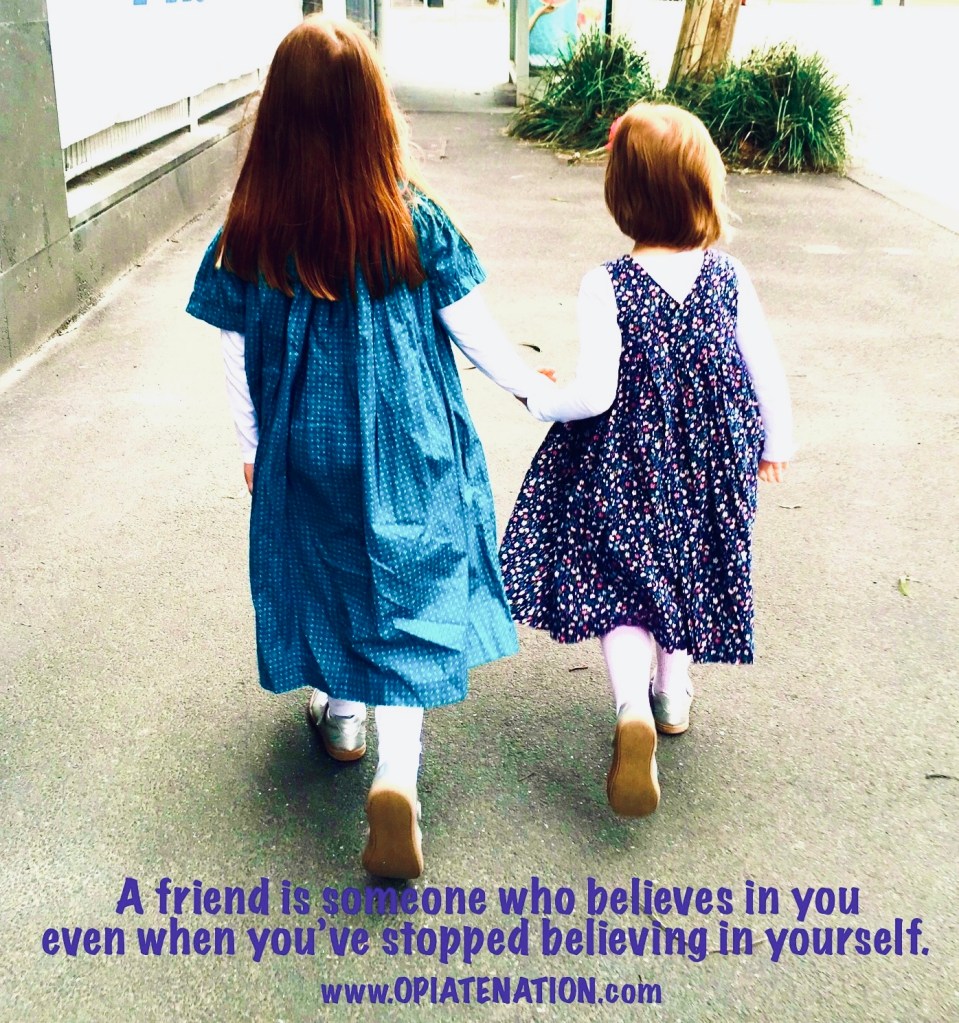
A best friend is someone who believes in you 

even when you’ve stopped believing in yourself.

– Unknown

  1. John 15:13, New Testament 
  2. Helping Someone with a Drug Addiction

https://www.helpguide.org/mental-health/addiction/helping-someone-with-drug-addiction

  • How to help someone who is misusing drugs or alcohol:

https://www.healthdirect.gov.au/help-someone-who-is-misusing-drugs-or-alcohol#:~:text=Celebrate%20small%20successes%20and%20try,Narcotics%20Anonymous%20and%20SMART%20Recovery.

  • Four Signs of Enabling and How to Stop

https://health.clevelandclinic.org/enabling

  • Dr. John F. Kelly, Ph.D. The New Science on Addiction Recovery (lecture)

Recovery Options for Teens

 Statue by Gustav Vigeland, Vigeland Park in Oslo, Norway.

(Translation into most languages at tab to the right.)

Understanding the teenage brain was the topic of my last post: Is Teenage Turmoil Inevitable? It is important to digest before parents consider a recovery program for their teen. Knowing that adolescents and teens feel and process information differently than adults is why they require a different approach to addiction and recovery.

Regardless of the type of program considered, the one absolute necessity is that the family be involved in the process – because family dynamics are an integral part of a young persons’ sober and addicted life. And the best place to start this discussion is to focus on the CRAFT model.

The American Psychological Association has an informative article, below. (1) In it they point to studies discussing how programs like Al-Anon for family members with an addicted loved one “may improve the well-being of friends and family members, they are not effective in getting the addicted person into treatment.”

Intervention programs, designed to help “family and friends work with a counselor to confront a substance user and urge him or her to get treatment” is only used by 30 percent of families due to discomfort with confrontation. And treatment is only the first step on the long road to recovery. After that, the family still needs other tools.

CRAFT (Community Reinforcement Approach to Family Training) originated at the University of New Mexico and was developed by Robert Meyers, Ph.D. and colleagues. Research on CRAFT shows that approximately 70% of families who receive CRAFT are able to help their loved ones start treatment within a year (Miller, Meyers, & Tonigan, 1999). CRAFT also helps family members improve their own lives, whether their loved one ends up seeking treatment or not.

CRAFT teaches real life skills to use connection to encourage positive change, because CRAFT is rooted in the belief that connection is the opposite of addiction. It teaches positive communications skills to foster the connection that is desired by the person who is struggling with addiction and their loved ones.

Helping Families Help is a great non-profit website resource for CRAFT information. (2)

SMART Recovery was established in 1994, here in the USA, to meet the increasing demand of those seeking a secular and evidence-informed alternative to the widespread 12-Step addiction recovery program. It is intended for adults over 18 and those seeking flexibility and independence, while AA offers structure and strong community support. It may be best for young adults in their 20’s, as most 18- to 25-year-olds who struggle with addiction are not yet “adult” in their thinking and coping skills. Smart Recovery is now in 23 countries. See info below. (3) 

Basically, the steps in helping your teen who is addicted are this:

  1. Getting them into treatment
  2. Choose a program – inpatient or outpatient
  3. Detox 
  4. Individual Therapy
  5. Family Therapy 
  6. Contingency Management
  1. Getting your loved one into treatment: sign up for CRAFT 10-week email training course through Helping Families Help or investigate other options.
  2. Choose a program: based on the drugs involved and length of time used.
  3. Detox: Most drugs will still be in your child’s system. Detox flushes them out. Detoxing under the care of professionals ensures that it’s done safely out of reach from harmful substances. Your teen will likely experience withdrawal symptoms as well.
  4. Individual Therapy: To understand a teen’s problem and to address it comprehensively. The first course of action in rehab is one or more types of therapy, both one-on-one and group settings. Motivational Interviewing uses a person-centered, non-confrontational style where the teen is encouraged to examine the pros and cons of their use and to create goals to help them achieve a healthier lifestyle. This helps them gradually realize the consequences of their actions. Cognitive Behavioral Therapy (CBT) is goal-oriented therapy that helps teens express and understand their feelings and cope with difficult emotions. They learn to replace negative behaviors (such as using substances) with positive ones (like sports or art or service endeavors).
  5. Family Therapy: Based on the premise that family carries the most profound and long-lasting influence on development, and in modeling both good and bad behaviors and beliefs. These sessions bring together those closest to an addicted teen and address issues such as poor family communication, cohesiveness and problem solving. Again, CRAFT is crucial here.
  6. Contingency Management: This form of therapy tracks each patient’s progress in rehab, including each day they succeed in staying sober, and rewards them with a prize. The more teens feel satisfied with their rewards, not only will they continue striving to stay sober, but their brain will relearn how to appreciate rewards that aren’t drugs or alcohol. Following rehab, a teenager is thrust back into the world. Temptations lie around every corner and their problem stays with them for years after treatment. After you’ve helped your child kick their habit you must help prepare them with a plan to prevent relapse – or for all of you to know what to do when relapse occurs, which is likely especially for certain drugs like opioids. MAT (Medication Assisted Treatment) is vital for opioid addiction and the long-lasting changes in the brain that will continue to undermine all the best plans and determination to stay clean and sober. Our son and many of the hundreds of thousands of young people who died from opioids are the sad evidence of this truth.

I do not offer these steps and advice as a medical or addiction professional. I can only offer my opinion based on our personal experience and the stories from others, along with the research I’ve done over the past 20 years since my husband and I first discovered that our 15 year old son was using heroin. What we wish we had known I share with you in the hope that your story will end differently than ours.

1. An underappreciated intervention

The CRAFT model is giving family and friends the skills they need to help get loved one’s treatment for substance use problems  By Katherine Lee – December 2017, Vol 48, No. 11

https://www.apa.org/monitor/2017/12/underappreciated-intervention

2. Helping Families Help – CRAFT Information

https://helpingfamilieshelp.com/about-craft

https://www.npr.org/sections/health-shots/2018/08/10/636556573/families-choose-empathy-over-tough-love-to-rescue-loved-ones-from-opioids

3. SMART Recovery

https://smartrecovery.org/what-is-smart-recovery

4. The Different Types of Adolescent Treatment Programs

New Horizons Recovery Centers (USA)

https://www.newhorizonscenters.com/blog/the-different-types-of-adolescent-addiction-treatment-programs

The Freedom of Habits

(Twenty-fifth in a series of topical blogs based on chapter by chapter excerpts from Opiate Nation. Translation into most languages is available to the right.)

I’ve heard a saying: “The chains of habit are too weak to be felt until they are too strong to be broken.” And just like chains, some habits are stronger and deadlier than others. Conversely, healthy habits can be just as strong and powerful – but instead of bondage, they bring freedom to live our lives to the fullest.  

In The Power of Habit, Charles Duhigg says, “Habits are a three-step loop: The cue, the routine, the reward. They become automatic beginning with a cue that triggers a routine and a craving for a clear reward. Craving is an essential part of the formula for creating new habits…You can never truly extinguish bad habits. So in order to change a habit, you must keep the old cue and deliver the old reward (that you are craving), BUT insert a new routine.”

Continue reading “The Freedom of Habits”

The Rescuers: Enabling, Caretaking, and Drama

(Twenty-fourth in a series of topical blogs based on chapter by chapter excerpts from Opiate Nation. Translation into most languages is available to the right.)

Historically, “enabling” referred to facilitating or empowering someone in order to help them accomplish something. By teaching children to read, we enable them to develop their intellect and further their learning. Or, as in 1933 Germany, “The Enabling Act” gave Adolf Hitler the power to enact laws without the involvement of the legislative bodies: he was enabled to become a legal dictator. In modern psychology, enabling can be positive, but it is also used in a negative sense when it encourages dysfunctional, unhealthy behavior and habits, as it is used in addiction and recovery vocabulary. Rescuing and caretaking are terms that mean what they say. They are closely connected to enabling: we rescue people from their responsibilities and we take care of people’s responsibilities for them.

Melody Beattie (Codependent No More) refers to the “Drama Triangle” roles of victim, persecutor, rescuer, and says “Rescuing/caretaking looks like a much friendlier act than it is. It requires a victim who is actually capable of taking care of themselves even though we and they don’t admit it…After we rescue, we will inevitably move to the next corner of the triangle, persecutor. We become resentful and angry at the person we have so generously helped…Then we move to the victim corner of the triangle, at the bottom, the predictable and unavoidable result of a rescue.”

Continue reading “The Rescuers: Enabling, Caretaking, and Drama”

Lifespan of Heroin & Opioid Addicts

(Second in a series of topical blogs based on chapter by chapter excerpts from Opiate Nation. Translation into most languages is available to the right. If you feel this blog is important, please repost to your social media using the buttons below. Thank You!)

When our 25 yr old son died of a heroin overdose in 2014, the statistics for the average life-span of a heroin addict was 5 years. Five years. Not very long if you are 15 or 20 or even 30, the age when most young adults’ nowadays are just getting in gear with their career, a long-term relationship, and planning a family. To have your life swept away before you have a chance to experience some of the most wonderful years of living on this earth is painful to consider.

Continue reading “Lifespan of Heroin & Opioid Addicts”

What people are saying about Opiate Nation

As the months have passed since Opiate Nation was released last October, we have received many very encouraging reviews and comments. I have gathered some of them together and created a new page entitled “Recommendations & Reviews.” (see Menu) If you have wondered whether our story is worth the read, especially if you have no personal experience with addiction or heartbreaking loss, then perhaps these reviews will have some insight that will inspire you to order a copy for yourself or a loved one. If you have already read it, we would love to hear from you and know how you have been supported and reassured through our book. It is the reason we have written and published it.

GLOBAL DRUG SURVEY 2020

The Global Drug Survey (GDS) runs the largest drug – which includes alcohol – survey in the world. The GDS is now it is ninth year and is translated into 16 languages and partners with over 30 countries. Their international team is committed to helping make drug use safer regardless of the legal status of the drug and promoting honest conversations about drug use across the world.

How we wish we had been able to have more open conversations with our son while he was struggling during a relapse or actively using. Had he not feared some punitive measure we could impose on him in an attempt to force him to be squeaky clean, he would have felt less shame and the feeling of being a failure. He could have felt that we were partners with him in his battle against the overwhelming enemy that was within. Continue reading “GLOBAL DRUG SURVEY 2020”

POWER-less or POWER-ful?

Last week I wrote about regrets that John and I deal with – wishing that we had known about some type of long-lasting recovery option for our son, JL – and the SMART recovery approach and how it differs from traditional 12-Step programs such as AA. Continuing on with the concepts about individuals who struggle with life-threatening addictions of any variety, I have a few more thoughts.

With the genetic / disease model of addiction that scientific research has brought to the table, there are many in the recovery world who feel this mindset gives those living with addiction a green light to excuse their responsibility, their power of choice. But I disagree. It is clear that we had nothing to do with our family tree, our genetic inheritance (1). We were “powerless” as far as choosing to be born into our family. Yet, this doesn’t mean we are powerless to overcome the negative Continue reading “POWER-less or POWER-ful?”

Offering Recovery Options

One of the most recurring regrets John and I deal with is wishing that we had known about some type of long-lasting recovery option for our son, JL. He was becoming recovery resistant after so many cycles of detox and recovery programs and relapse. As the opioid epidemic sped up with mounting deaths by overdose, we now have statistics that make it clear that it usually takes many recovery/relapse cycles before a person can maintain long-term sobriety – especially for the main victims of this epidemic – those who started using opioids at a young age. Like our son. It’s not that he didn’t want to be clean and sober. He did, with all his heart. But opioids don’t let go easily or quickly. Continue reading “Offering Recovery Options”

Malcolm Guite

Blog for poet and singer-songwriter Malcolm Guite

The Gift of Need

How Need Can Strengthen Individuals and Communities

Memoirs and Musings

David Bradley Such

Dave Barnhart

Church planter, pastor, author, coach

RecoveryLife101

Just another WordPress.com site

Abbie In Wondrland

life...on Gods' terms.

Living In Graceland

"..learn the unforced rhythms of grace" matt 11:28

Janaburson's Blog

All about opioid addiction and its treatment with medication

Breaking In News Network

Seeking the truth and bypassing the MSM

Junkbox Diaries

Trauma, PTSD, Mental Health, Addiction, and Recovery

Ohio Society of Addiction Medicine

The Ohio Society of Addiction Medicine is a chapter of ASAM - A professional society actively seeking to define and expand the field of addiction medicine.

traceyh415

Addiction, Recovery, Loss, Grief

WordPress.com News

The latest news on WordPress.com and the WordPress community.