Why We Need to Learn to Grieve

Why Grieve? First, those who grieve well, live well. Second, and most important, grief is the healing process of the heart, soul, and mind. It is the path that returns us to wholeness. Until we do, we suffer from the effect of unfinished business.  

~Elisabeth Kübler-Ross, On Grief and Grievingpg. 229

(Translation into most languages at tab to the right)

Like most people in Western societies, I was never taught how to grieve the loss of someone I loved. My family had not suffered the untimely loss of anyone close to us. Elderly grandparents passed and we would miss them, but quiet tears and sad faces was all I ever saw at those rare funerals. And grief is not something one normally thinks about when we are young. Unless it is a very close relative or friend, the empty space left by a person doesn’t drag us down to the depths of our soul when we are young and resilient. 

 When my younger brother died of AIDS at 40, it was the first death of someone I loved dearly and it was the first time I felt my heart break. I couldn’t seem to function because life had suddenly become dark and unknowable. If this could happen, anything could happen. I was afraid. How could I survive this? I had very few tools to help navigate the grief and didn’t know anyone who could empathize with this tragedy other than my husband John. My parents were devastated but mostly unable to talk about it. There were other deaths that followed: When my sister died of breast cancer that metastasized to her brain at 56. And when my youngest brother died a death of despair from suicide at 52. The feelings were much the same but by then I had one thing that helped. I knew from experience that I would survive. 

 Then in 2014, John and I experienced the most painful event of our lives. Our 25-year-old son died of an accidental heroin overdose. Today, he would have been 37. For this, we needed survival skills that went beyond the love and care of family and friends. Thankfully, we were introduced to On Grief and Grieving: Finding the Meaning of Grief Through the Five Stages of Loss by Elisabeth Kübler-Ross and David Kessler.(1,2) Knowing that everything we were feeling was normal was a comfort in and of itself. It is a guide for the process of grieving that has helped millions of people understand that grieving well takes time and cannot be rushed. These five stages follow a predictable pattern but are not necessarily linear or progressive because each response to loss is as unique as each loss. I wrote in detail about how we navigated the grief from our son’s death in Opiate Nation: A Memoir of Love, Loss and Acceptance. (3)  

The Five Stages of Loss are: denial, anger, bargaining, depression, and acceptance. Disbelief was perhaps a better way to describe our denial – feeling paralyzed by this sudden shock, and an inability and unwillingness to face what happened. Our bodies and our souls were in so much pain. We didn’t want to believe that our son was really gone from our lives, from this earth. But this stage is where many people get stuck. Moving out of denial and facing the facts will not happen until we feel safe and know that we are ready to handle what really is. 

Once we are ready to face reality, anger surfaces. It is part of the process of loss because anger brings a sense of temporary control we once thought we had and that is now gone. Kübler-Ross stresses that to not allow anger may slow down the grieving process. Many people, especially people of faith, avoid anger because isn’t “acceptable” and it is unthinkable to be angry at God. And there is an added sense of unfairness that complicates grief when the young die.

Bargaining is negotiating with reality while we vacillate between thinking there is something we can do and realizing there isn’t. The overwhelming pain involved with accepting reality causes us to alternate between hope and despair. John and my journal entries are full of “if only’s” and regrets, evidence that we tried to negotiate and somehow change the past. 

Truly feeling the overwhelming feelings of the reality of the loss leads to depression. This was the most difficult aspect of grief and the longest for us. We had to face the fact that the place our son occupied was now empty. Learning to sit with our feelings of deep sadness was not easy. It was a slow slog through each day and night.

The final stage of grieving is acceptance. It makes change possible and makes our present circumstances bearable and even good. For people of faith, we surrender to God’s ultimate plan and it can bring peace, forgiveness, healing, and a newfound freedom. That allowed us to move forward to a better, although different, future. This is where we begin to see some of the gifts that have accompanied the loss. 

Death is part of living as humans on this earth and death brings grief. It is one of life’s equalizers. Our learning to grieve well becomes a gift to others suffering through the death of a loved one as we also model how we mourn, which is the external part of loss. Learning to accept our humanness and our limitations helps us learn about grace and forgiveness, towards ourselves and others. When we experience grief, we have experienced the full cycle of being human. Greif transforms our broken and wounded souls and has the power to heal. Leo Tolstoy said, Only people who are capable of loving strongly can also suffer great sorrow, but this same necessity of loving serves to counteract their grief and heals themAnd when we heal and continue to live after the loss of our loved one, this is the gift that grief gives us and that we can share with others.  

  1. The Elizabeth Kübler-Ross Foundation. https://www.ekrfoundation.org/elisabeth-kubler-ross/
  2. David Kessler https://grief.com/the-five-stages-of-grief/
  3. www.OpiateNation.com

Grieving The Living

(Translation into most languages at tab to the right)

In a world where ‘nothing is certain except death and taxes’ and loss is unavoidable, grief is guaranteed to be an emotion each of us will experience in our lives sooner or later. If we have lost a loved one and grieved well, we can understand grief in others and empathize more fully.

But what about those who are living with a loved one with mental health problems, or in active addiction, or in a recovery program for the umpteenth time, or whose whereabouts are unknown? How do they live with the constant flux between hoping against hope, waiting, and praying for a miraculous change, and discouragement and depression as they watch their loved one struggle against an unrelenting enemy no one can see? My husband and I lived in this twilight zone for years – as do millions of others. While he was still living, we were grieving the loss of the son we loved and raised and had hoped to see move successfully into adulthood.

In an excellent article, Grieving the Living, Dr. Susan D. Writer shared insights that are an invaluable help and source of comfort for this all too common situation:

Continue reading “Grieving The Living”

Grief: Anticipation Anxiety

(Thirty-first in a series of topical blogs based on chapter by chapter excerpts from Opiate Nation. Translation into most languages is available to the right.)

There is something about the rise of a full moon that I just love. I’m not sure why it holds such fascination for me, but it always has. I’m greedy about it – I wish we had a full moon every night, like we have the sun every day. When I was growing up in Tucson, Arizona, I loved anticipating the moon’s first peek as it came up over the mountains on the eastern edge of our valley, creating a silhouette of Thimble Peak. Then, it was as if the moon just popped up and suddenly the entire valley was bathed in moonlight. I loved walking in the desert under its light. The movie, Under the Same Moon, captures the beautiful thought that regardless of where we are in the world, we can look up and know we are under the same moon as those we love.

Anticipation can bring pleasure or anxiety as we are waiting for or pondering a future event. Expectation – like a child waiting for their birthday. But during the Covid Pandemic, there is a sense of anxiety from there being no known end in sight. The anticipation is open-ended and we are unable to plan ahead, which has caused instability in many areas: our health, jobs, housing, food supply. We may anticipate a not-so-good outcome and the future is not predictable or knowable. Not that any of our futures are predictable or knowable, but there are fairly reasonable assumptions we can make when life is close to “normal”.

Continue reading “Grief: Anticipation Anxiety”

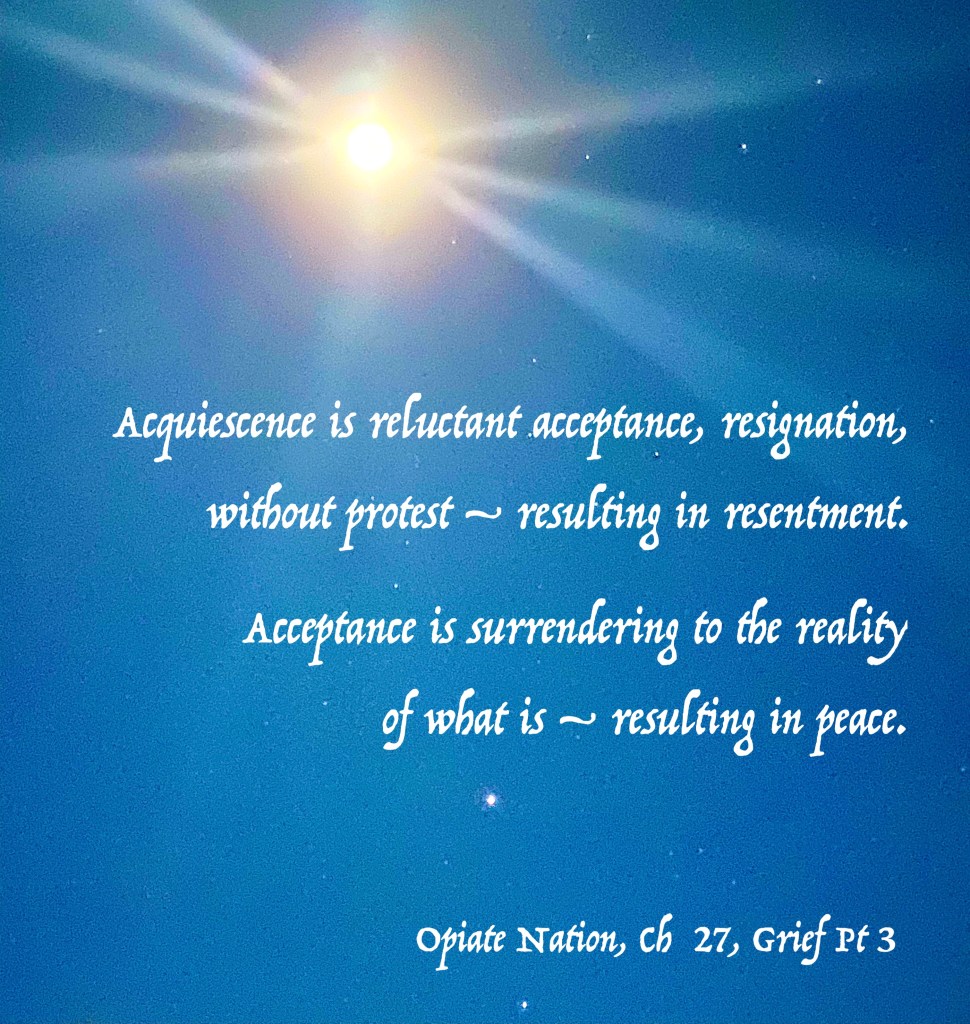
Grief: Acceptance or Acquiescence?

(Twenty-ninth in a series of topical blogs based on chapter by chapter excerpts from Opiate Nation. Translation into most languages is available to the right.)

I have never been one to accept something without question – anyone who knows me well, knows this – and they live with the frustration my incessant questions create. But it’s the way I need to process what is happening to or in or around me in order for me to honestly make the decision to accept or reject whatever the issue is at hand. I don’t think I could live with myself if I pretended I agreed or accepted something when I didn’t – the dishonesty would keep me in turmoil. And many times, it is ultimately for self-preservation that I accept something distasteful or painful when I finally understand there is no other option.

Death leaves us no other option – it is not negotiable. For most of us, our survival instinct brings us to the realization that in order to retain our sanity, we must eventually accept death – even of those we love the most in this world – whether we like it or not.

Continue reading “Grief: Acceptance or Acquiescence?”

The Paradox of Memories

(Twenty-eighth in a series of topical blogs based on chapter by chapter excerpts from Opiate Nation. Translation into most languages is available to the right.)

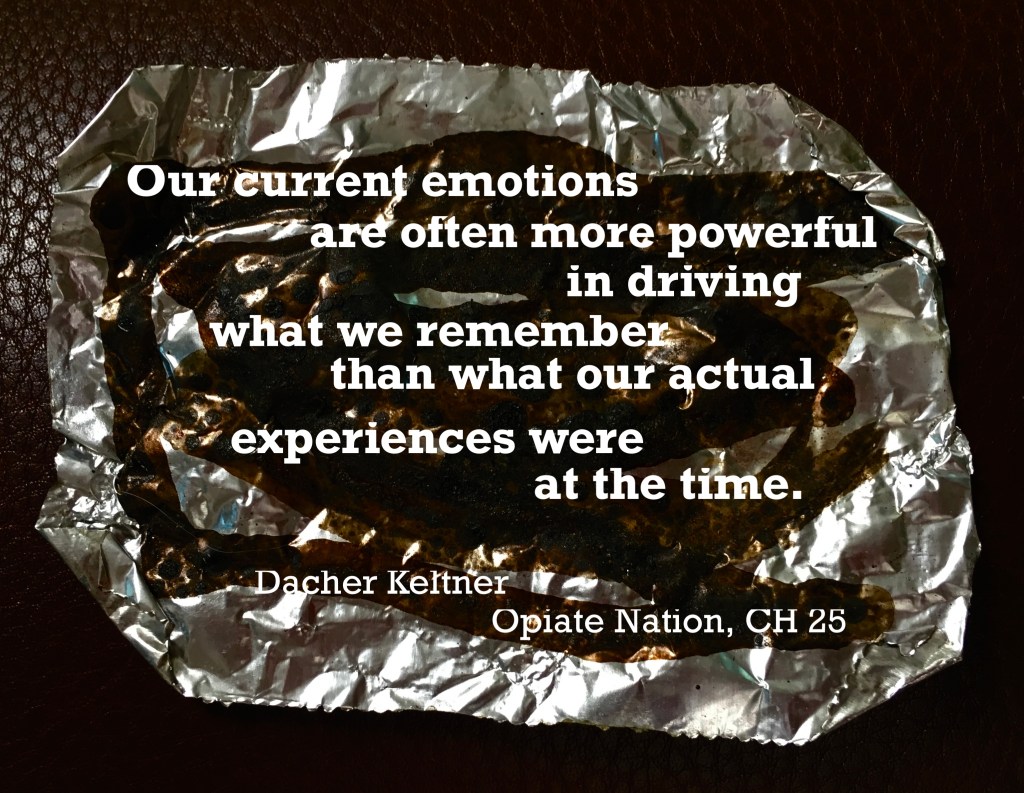
Memories are strange things. How much control do we have over them? What triggers bring up which memories? How do triggers differ with each individual personality? Does grief affect memory? I know it does mine because I continue to experience new associations and memories being formed from what were once familiar items with no particular memory attached before—which now, after my son’s battle with addiction and death, have a specific memory related to him.

Like aluminum foil.

Continue reading “The Paradox of Memories”

Singing The Blues

(Eleventh in a series of topical blogs based on chapter by chapter excerpts from Opiate Nation. Translation into most languages is available to the right.)

Honesty is one of the main themes that ripple under the surface of “The Blues.” Expressions of honest feelings, whatever they may be at the moment – themes of lost love, painful relationships, dashed hopes, and heartache. The majority of us have or will experience heartache in our lives. Although it seems counterintuitive, most of us feel consoled by songs that express what we are feeling deep inside but may have a hard time putting into words. In order for me to be honest, I have to acknowledge that I am singing The Blues.

Continue reading “Singing The Blues”

The In’s and Out’s of Grieving & Mourning

(Eighth in a series of topical blogs based on chapter by chapter excerpts from Opiate Nation. Translation into most languages is available to the right.)

When I was young, I only went to one funeral. I can’t remember who it was for or where it was, but it must have been for a close relative or I wouldn’t have been there. I do remember seeing everyone dressed in black. It was a very somber setting, people talking in hushed voices, and I didn’t comprehend what was happening. I just knew everyone was sad. After that day, I never thought about that person again – and even if my parents thought about him or her, their acts of mourning seemed to stop with the funeral. And I had no knowledge of any grieving on their part because at that time and in their cultural setting, people kept feelings regarding their grief to themselves.

It wasn’t until 20 years ago when my younger brother died from AIDS that I was faced with a death that was so close I felt a personal loss that tore at my heart. There was no way to just quickly plan a funeral and burial and then move on. My life as I had known it, now had a gaping chasm where my brother had once been and it was not going to close up anytime in the near future. I needed someone who had travelled this path before me to guide me through the overwhelmingly disturbing and depressing feelings. None of my friends had experienced a close loss like this. So, I looked to the books that were most recommended: On Grief and Grieving by Elisabeth Kübler-Ross and A Grief Observed by C. S. Lewis.

Continue reading “The In’s and Out’s of Grieving & Mourning”

Separation Anxiety

(Fifth in a series of topical blogs based on chapter by chapter excerpts from Opiate Nation. Translation into most languages is available to the right.)

After many years of not having a dog, we decided to adopt one from our local shelter. We found a beautiful German-shepherd/wolf mix who was 18 months old. Bella was docile, sweet and quiet. The next day, as I headed out to the grocery store, I gave her a hug and saw her watch me through the window as I got into the car.

            When I returned an hour later, I was met with a shock. I found her, panting rapidly and pacing nervously in our bedroom where our wooden shutters were open and had bite marks. She had tried to escape while I was gone. I had no idea why. I immediately called the shelter. “She is having separation anxiety: she needed to escape being left alone.” We found out that she had been with two families previously when she was dumped at the shelter because she continued to try to escape when she was left alone for hours on end. They gave us the name of a dog behaviorist and we started down the long road of helping Bella manage her fear when we had to leave her at home.

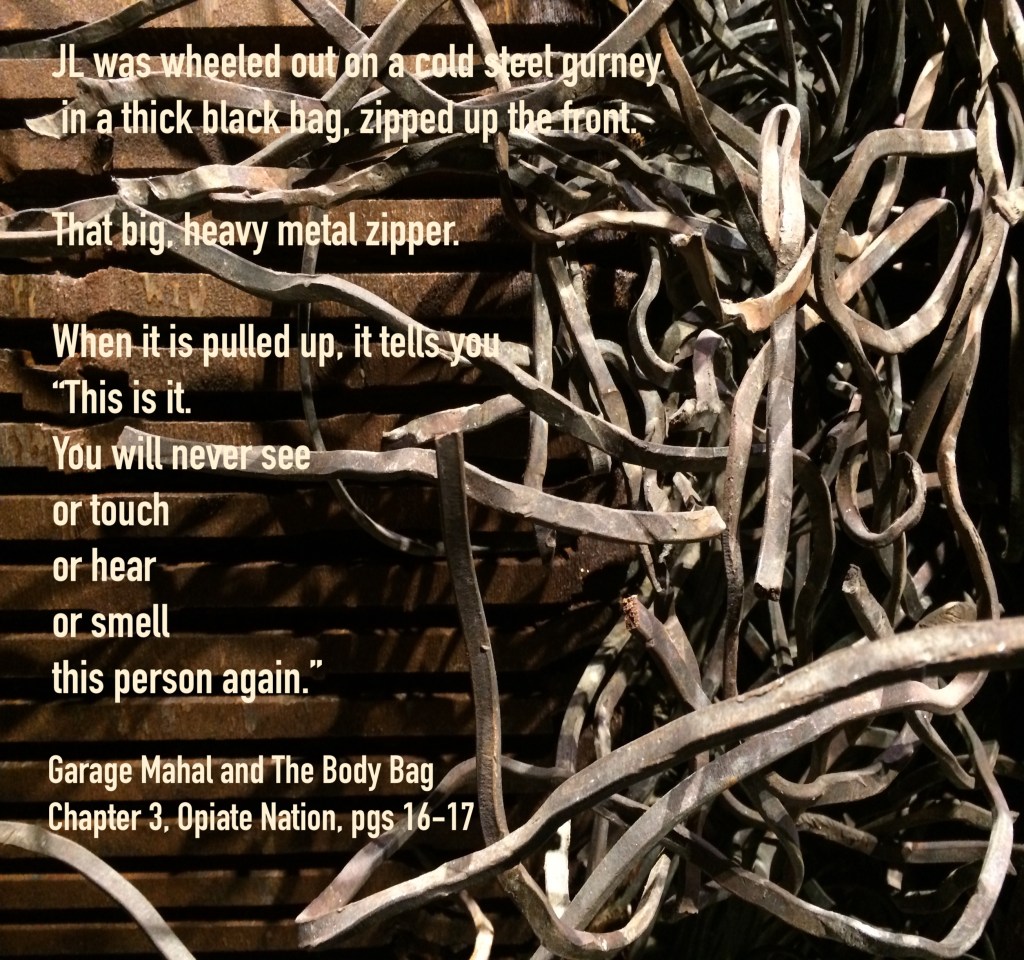
            Children and adults can experience separation anxiety when someone they are attached to leaves them. They can have recurrent and excessive distress just anticipating being separated from loved ones and the anxiety can be so intense that it is hard to function in everyday life. Panic attacks and physical symptoms such as nausea and headaches can occur. For me and my husband, on the morning of our son’s death from overdose, standing over our son in that body bag we experienced the ultimate separation anxiety. The overriding emotion we felt was fear: fear of the unknown future we were facing. We couldn’t visualize how we would survive without our son as part of our lives and the future we thought we all had together. He had not only been an integral part of our lives for 25 years but he was literally a part of us–the combination of our DNA that formed him as a particular and unique human being. To say that it was like having part of you taken away doesn’t describe it. This was having our hearts torn out.

            We would never embrace or kiss or stroke the cheek of our son again. We were facing an existential crisis, shaken to the core, questioning our reason for living. Regardless of our strong faith that had seen us through many other deaths in our families, this separation seemed incomprehensible and cruel. It was only by falling down on our faces and waiting for Mercy to gradually pick us up that we were able to survive this traumatic separation from our son and move forward again in life.

Woefully Unprepared

(Today begins a series of topical blogs based on excerpts from Opiate Nation, chapter by chapter, that will run for 28 weeks. Translation into most languages is available to the right.)

It’s a bit ironic that as I begin blogging through Opiate Nation we are in the midst of a pandemic. Ironic in several significant ways.

Opiate Nation was written because of the opioid epidemic – which, in reality, is a pandemic. Every industrialized nation, and many emerging and third-world nations too, are dealing with the results from the ease of availability of opioids, whether natural and home-grown, or synthetic and imported. Or both, as is the case in America.

And like the Coronavirus pandemic that crept up on us so gradually that it’s deadliness caught us by surprise and mostly unprepared as nations, the opioid epidemic crept up on us too. In both cases, certain international players were unscrupulous for various reasons, causing delays in awareness when there might have been a chance for all of us to not be caught off balance.

The “inoculation” that should have happened, especially in the United States, by way of accurate scientific information disseminated by responsible leaders, didn’t happen. Instead, false information fueled by political agendas and financial motivation created a scenario that so crippled a timely public health response that, for many nations, it became too little too late.

Continue reading “Woefully Unprepared”

Loneliness Pt. 2: Unemployment Anxiety & Isolation

We are a global community – like it or not. We are connected down to the minutia of life, from what we breathe, to what we eat, to what we think, to what infects us. And right now, the world, our world is in a life-or-death struggle with a microscopic enemy that seems to keep gaining the upper hand. The result in just one area is massive unemployment and the subsequent loss of access and funding for public and private support services.

I don’t want to get in to the politics of whether economies should be opened up regardless of Covid-19 and suffer the consequences in lives lost, verses lives ruined by no work and massive personal and societal debt. What I am concerned about are the consequences of what so many millions of people are facing from having lost their means of livelihood, and in particular, those whose lives were already balanced on a knife edge on a daily basis.

Continue reading “Loneliness Pt. 2: Unemployment Anxiety & Isolation”
Malcolm Guite

Blog for poet and singer-songwriter Malcolm Guite

The Gift of Need

How Need Can Strengthen Individuals and Communities

Memoirs and Musings

David Bradley Such

Dave Barnhart

Church planter, pastor, author, coach

RecoveryLife101

Just another WordPress.com site

Abbie In Wondrland

life...on Gods' terms.

Living In Graceland

"..learn the unforced rhythms of grace" matt 11:28

Janaburson's Blog

All about opioid addiction and its treatment with medication

Breaking In News Network

Seeking the truth and bypassing the MSM

Junkbox Diaries

Trauma, PTSD, Mental Health, Addiction, and Recovery

Ohio Society of Addiction Medicine

The Ohio Society of Addiction Medicine is a chapter of ASAM - A professional society actively seeking to define and expand the field of addiction medicine.

traceyh415

Addiction, Recovery, Loss, Grief

WordPress.com News

The latest news on WordPress.com and the WordPress community.