Just Normal

(Translation into most languages at tab to the right.)

Eleven years ago today my husband John and I woke up thinking it would be just another normal, hot August Saturday morning. But when the sheriff knocked on the door, the day – and our lives – were no longer normal. It is surprising how quickly our lives can go from normal to abnormal.

         I was sorting through some files and found a drawing that our son, John Leif (JL) had done when he was around nine. It was obviously of Van Gogh’s “Starry Night” but it was also obviously done by a normal nine-year-old – not an artistic prodigy. And it made me think about how JL was just like any other normal kid growing up in middle-class America in the 1990’s-2000’s. He learned to ride a 2-wheel bike at around five, he played with Lego’s, he took swimming lessons, he loved monster trucks and lasagna and macaroni & cheese with ketchup. But something so abnormal for normal young teenagers ended up ruining some of what should have been the best years of his life and ultimately taking his life – and the lives of many of his friends and hundreds of thousand other normal kids.

         What was abnormal was the criminal promotion and availability of highly addictive medicine to young kids by Purdue Pharmaceuticals and the Sackler family. Never before had American kids been exposed to legal drugs (that were promoted as “non-addictive”) that they experimented with as if they were simply trying a joint. And the results were the devastation of the Opioid Epidemic. Which is not over, especially for the once normal kids who are still alive and living with the cancer of addictions. We see many of them on the street corners and under bridges, living from hand to mouth, barely surviving, living anything but a normal life.

         Sadly, seeing these shells of once normal kids has become a “new normal” as our society doesn’t seem to agree on how to best provide lasting recovery options with a continuum of care – or whether we even should. In my last Substack podcast and article with special guest Sam Quinones we discuss some ideas from his book “The Least of Us” for how to help get these once normal kids from normal families the help they need to try to return to something like a normal life. (1) Let’s not forget that those addicted people were once normal kids.

  1. JudeDiMeglioTrang1.substack.com

Isolation Loneliness

It has been said thatthe opposite of addiction is not sobriety, it is connection – to others, to a community.The Coronavirus pandemic has brought disconnection and magnified loneliness and stress for people the world over due to social isolation, economic instability, reduced access to spiritual communities, and overall national anxiety and fear of the future. “We certainly have data from years of multiple studies showing that social isolation and social stress plays a significant role in relapse…relapsing to drug use can play a role in overdose.” Dr. Wilson Compton, deputy director NIDA.

The acronym HALT: Hungry, Angry, Lonely, Tired, is used in Alcoholics Anonymous and most recovery programs. It is a simple reminder that when our basic human needs are not met, one is susceptible to toxic thoughts and self-destructive behaviors including relapse and suicide.

Regardless of where you live, there have likely been restrictions imposed to limit the number of people who can gather together – from dozens in some countries to only the members of your immediate household in others – in order to slow down the high-speed train that is Covid-19. For many of us, we have been able to maintain our emotional equilibrium because we know this is for a limited time and we can look forward with hope to the future.

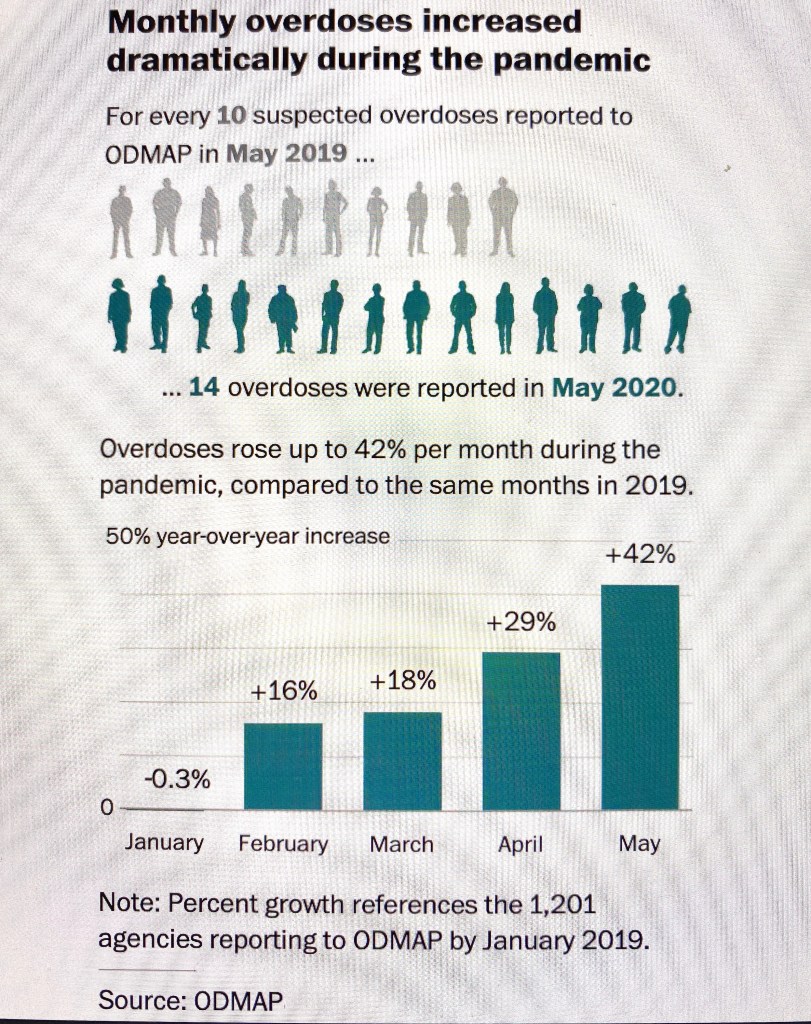
But what about those vulnerable members of society who already struggle on a daily basis with insecure housing and food supplies and to maintain their mental health, sobriety, or recovery? In the midst of one of the most isolating crises the modern world has known, it is no surprise then that cities across America, and around the world, are reporting dramatic increases in drug overdoses, alcohol relapses, and suicides.

In-person community meetings are at the foundation of recovery programs. And no wonder. It is in community where individuals become part of something greater than themselves. And I believe it is in the breakdown of communal life in individualistic American ideology that has, to a great degree, contributed to the anxiety, insecurity, and depression that so characterizes our national psyche and has led to the pursuit of finding relief in so many unhealthy ways.

A friend of our son who is an alcoholic who has been working his recovery for the past 8 years, put it this way: 

“Self-isolation breeds relapse for people in recovery. With quarantine, people are losing the accountability they have relied on from in-person meetings and it’s a lot easier for people to further isolate and close off their emotions. Attending virtual meetings keeps me grounded and gets the message across as much as regular in-person meetings but lacks the fellowship aspect. This will no doubt expose many in recovery to loneliness.”

Even though increasing numbers of people around the world are vaccinated, it will not stop some of the isolation and loneliness. Is there anything those of us who are not isolated emotionally can do to help? The one thing my husband and I have made as a priority in our weekly schedule is to check in with friends around the world via texts, emails, letters, phone or video calls – including our young friends who are in recovery and elderly friends who just need to know they are not forgotten. With our social networks and finances, we can support organizations that are working the front lines to serve the addiction/mental health population. We can make or purchase masks, buy food and basic supplies, to give to those in need and support recovery programs in our area.

Loneliness Pt. 2: Unemployment Anxiety & Isolation

We are a global community – like it or not. We are connected down to the minutia of life, from what we breathe, to what we eat, to what we think, to what infects us. And right now, the world, our world is in a life-or-death struggle with a microscopic enemy that seems to keep gaining the upper hand. The result in just one area is massive unemployment and the subsequent loss of access and funding for public and private support services.

I don’t want to get in to the politics of whether economies should be opened up regardless of Covid-19 and suffer the consequences in lives lost, verses lives ruined by no work and massive personal and societal debt. What I am concerned about are the consequences of what so many millions of people are facing from having lost their means of livelihood, and in particular, those whose lives were already balanced on a knife edge on a daily basis.

Continue reading “Loneliness Pt. 2: Unemployment Anxiety & Isolation”

Loneliness in a Lonely Time

It has been said that the opposite of addiction is not sobriety, it is connection – to others, to a community. The Coronavirus pandemic has brought disconnection and magnified loneliness and stress for people the world over due to social isolation, economic instability, reduced access to spiritual communities, and overall national anxiety and fear of the future. “We certainly have data from years of multiple studies showing that social isolation and social stress plays a significant role in relapse…and relapsing to drug use can play a role in overdose.” Dr. Wilson Compton, deputy director NIDA.

The acronym HALT: Hungry, Angry, Lonely, Tired, is used in Alcoholics Anonymous and most recovery programs. It is a simple reminder that when our basic human needs are not met, one is susceptible to toxic thoughts and self-destructive behaviors including relapse and suicide.

Continue reading “Loneliness in a Lonely Time”

OPIATE NATION WINS NATIONAL INDIE EXCELLENCE® AWARD

With so much distress in the world with the Covid-19 Pandemic, especially the effects it is having on the weakest and vulnerable members of our societies, I have hesitated to announce a personal accomplishment. Yet, my hope is that as Opiate Nation gains more visibility, it will get into the hands of people who could be most encouraged and benefit from our story.

I am a member of a group of 35,000 women called “The Addict’s Mom” on Facebook. I confess, I rarely read the posts because it is so depressing: Story after story of mom’s who have been holding out for years to see their daughter or son released from the hell-hold of addiction to drugs, only to then post that “…today I lost my daughter/son…can someone tell me how I will survive this?”  It is for these mom’s and dad’s and siblings and friends that we wrote Opiate Nation, but one of the stipulations of being a member of the group is no self-promotion. So I hope that, with more visibility and more reviews and re-posts on social media, our book will get to these most desperate of people.

Continue reading “OPIATE NATION WINS NATIONAL INDIE EXCELLENCE® AWARD”

Advocacy Makes a Difference

A few months ago, John was on a phone call with a physician who was asking his input about a new drug to help with opioid addiction. At the end of the call, as I walked into the room, John told him about our son’s addiction and death and how we hoped that by speaking openly about him and through our book and blog we could help in some small way. His response was something I will never forget. He said “Don’t underestimate advocacy because it is the surest way to change things. Science and medicine take a long time and have limited effectiveness.”

His comment came to mind in the recent weeks as I watched millions of people around the world protesting against racial prejudice that lay at the heart of police brutality to People of Color (POC). They are advocates of racial equality as a basic human right. I thought: how I wish I could be helpful in a practical way to a problem I have watched change very little over the decades of my life. I felt anger and also frustration, wondering if all the sacrifice and effort would actually bring about real, lasting change.

It is the same feeling I have when I see a young person on the streets, homeless and struggling, enslaved to a substance that is stealing their life. Or anyone living with addiction of any sort. And if I feel discouraged and hopeless, how must they feel? What will help bring real, substantive change and hope in all these circumstances?

Continue reading “Advocacy Makes a Difference”
Malcolm Guite

Blog for poet and singer-songwriter Malcolm Guite

The Gift of Need

How Need Can Strengthen Individuals and Communities

Memoirs and Musings

David Bradley Such

Dave Barnhart

Church planter, pastor, author, coach

RecoveryLife101

Just another WordPress.com site

Abbie In Wondrland

life...on Gods' terms.

Living In Graceland

"..learn the unforced rhythms of grace" matt 11:28

Janaburson's Blog

All about opioid addiction and its treatment with medication

Breaking In News Network

Seeking the truth and bypassing the MSM

Junkbox Diaries

Trauma, PTSD, Mental Health, Addiction, and Recovery

Ohio Society of Addiction Medicine

The Ohio Society of Addiction Medicine is a chapter of ASAM - A professional society actively seeking to define and expand the field of addiction medicine.

traceyh415

Addiction, Recovery, Loss, Grief

WordPress.com News

The latest news on WordPress.com and the WordPress community.