HEALTHCARE – Privilege or Basic Need?

(Translation into most languages at tab to right)

If access to health care is considered a human right, who is considered human enough to have that right?

I critique market-based medicine not because I haven’t seen its heights but because I’ve seen its depths.

~Paul Farmer, M.D., Ph.D. (1)

In sorting through bins of old notes and letters, I knew one bin in particular would bring up painful memories. It was our son, JL’s. It was difficult, as I had imagined. And one of the – no, THE – most painful reminder related to his death from an overdose. It was the fact that we played a role in his preventable death. And so does the American capitalistic healthcare debacle.

The previous New Year’s eve, he was with two of his friends who overdosed and one died. It shook him to his core and he came to us and asked for help. We went together to his addiction doctor and after separate sessions, we then talked together. His doctor said: “This young man cannot start using again because if he does, he will die.” This came from his years of experience working with young people who had been inadverntently caught up in the opioid epidemic of the 2000’s. He felt JL would need to be on Suboxone for a long period of time and maybe for the rest of his life.

JL was hesitant because he had been on Suboxone years ago when it was very expensive and being prescribed at 32 mg a day – a huge amount that left patients feeling like they were drugged. And the worse part was trying to get off it. Tapering off was extremely difficult and took forever – like extended withdrawals.

Aside from the physical hurdles was the cost. It was very expensive and, guess what? It was, of course, not covered by our private health insurance (which cost us almost $1000/mo as self-employed workers) because addiction was not considered a healthcare issue. As a matter of fact, if a person said they had an illegal drug addiction, they would likely be dropped from health insurance coverage and be reported to the police.

What is so painful for us now is that we made the decision that January to drop JL from our costly policy and to not cover his getting Suboxone due to the expenses (it would have been hundreds of dollars a month for the Rx). And in the mistaken belief that he just needed to try harder. We thought this would force him to stay clean – good old fashioned will power and hard work. He did go into a detox program for a month and then into a great sober living program where he did so well we thought we had turned the corner in his 10-year struggle with opioid addiction (which had started when he was 14 and experimenting with Oxy’s).

What we didn’t understand at that time was that opioid addiction is not overcome by willpower. The result was after 6 months, he finally had impacted wisdom teeth surgery and weeks of opioid pain meds – because we thought there was no other option and we thought he could handle it. Within 3 weeks he began using heroin again and after a few days, overdosed and died. August 2, 2014.

What our family did not have as an option was what was finally put into law in 2014: The Affordable Care Act (ACA). This law mandates that all new individual and small-group plans cover substance use disorder (SUD) treatment as one of the ten essential health benefits. It also prevents insurers from denying coverage or charging more because of a pre-existing condition, including addiction.

Sadly, there are politicians who want to revoke the ACA or limit much of its coverage. As the supposed leading nation in the developed world, we are the only one without universal health care for every person from cradle to grave. All of our peer nations have it. Some systems work better than others. Regardless, health care is not seen as an option or a privilege for those who can afford it. It is considered part of a healthy and egalitarian society.

But in order for our government to save money (since our elected officials don’t want to tax millionaires and billionaires equitably), there have been significant cuts to Medicaid and SNAP and changes to the Affordable Care Act (ACA), that are projected to increase costs and reduce coverage for millions. There are too many details to go into here, but the bottom line to me is this:

Why are we even debating how much coverage these programs and health insurance companies offer when we should be pressing for complete health care coverage for all Americans – especially for the least of us who can barely afford food?

If we consider ourselves a nation built on Judeo-Christian principles, how can we not believe that as a society it is our responsibility to care for the sick – as people of faith have always done?

 If how we viewed health care changed – as a basic need instead of a privilege –  then the necessary changes to our taxing structure and health insurance would change. Where there is a will, there is a way.

  1. Dr. Paul Farmer. https://www.pih.org/paul
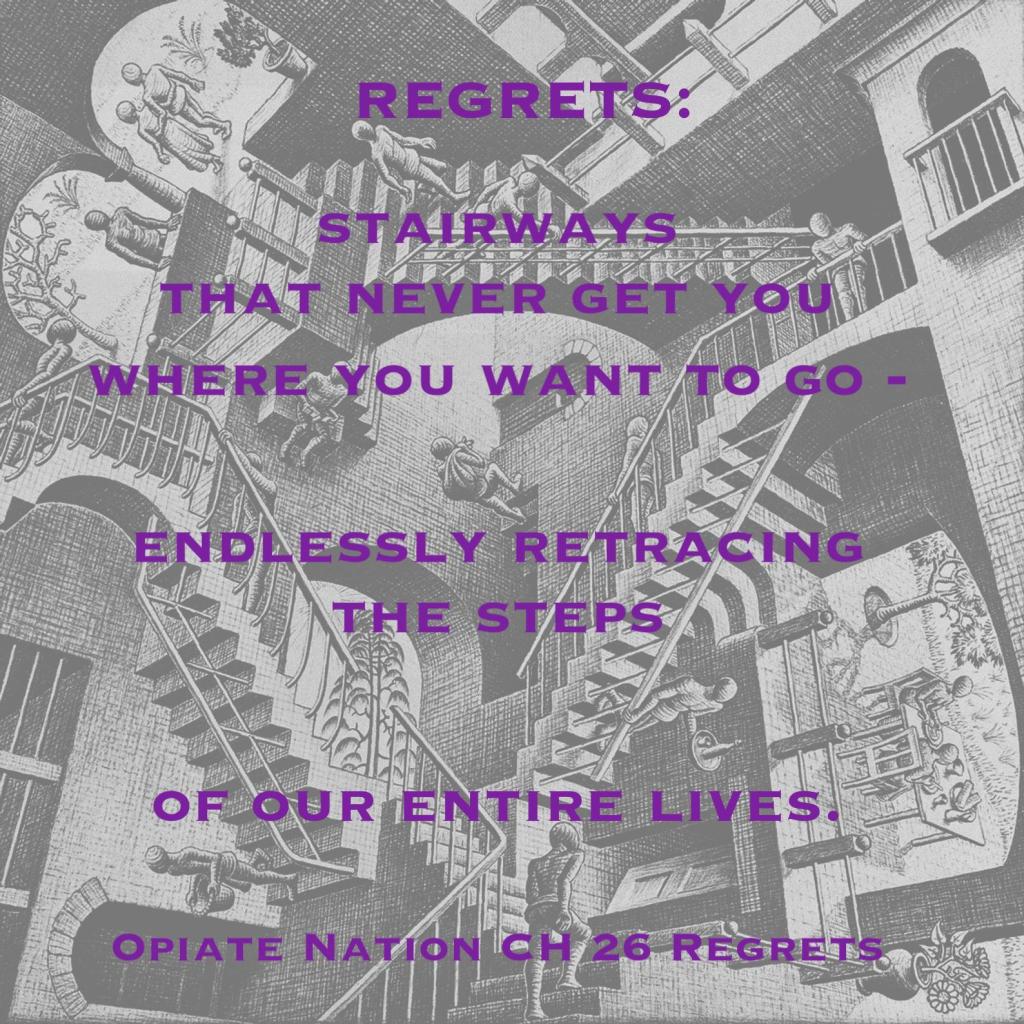
Regrets: Endless Stairways

(Twenty-ninth in a series of topical blogs based on chapter by chapter excerpts from Opiate Nation. Translation into most languages is available to the right.)

Our family loves the art of Dutch mathematician and artist M. C. Escher: the buildings that open into themselves, the school of fish that become a flock of birds, the circuitous stairways that go up and down throughout multiple buildings without an end point. Yes, stairways that never get you where you want to go, but keep you endlessly retracing your steps. They are no longer interesting art to wonder at. They now mirror how John and I have felt many times since August 2nd—regrets—retracing the steps of our entire lives.

Continue reading “Regrets: Endless Stairways”

The Vortex of Shame

(Twenty-third in a series of topical blogs based on chapter by chapter excerpts from Opiate Nation. Translation into most languages is available to the right.)

For generations, the combination of personal shame and public stigma has produced tremendous obstacles to addressing the problem of alcoholism and drug addiction in America. Addiction stigma prevents too many people from getting the help they need. –Hazelden-Betty Ford Institute for Recovery

Historically, the word shame was used interchangeably with guilt – the appropriate pang of conscience that followed doing something wrong. In reality, there is an important distinction between shame and guilt. Shame is about who you think you are; guilt is about what you have done.

Stigmas are linked to shame. In the Greek and Latin worlds, a stigma was a mark or brand, especially for a slave, identifying them as “inferior.” Later, it became known as a mark or stain we can’t see with our eyes: social stigmas that are based on perceivable characteristics, associated with certain behaviors that distinguish a person from other members of society. They convey disapproval and disgrace.

Continue reading “The Vortex of Shame”

The Cost of Secrets

 (Fourteenth in a series of topical blogs based on chapter by chapter excerpts from Opiate Nation. Translation into most languages is available to the right.)

When Breaking Bad was released in 2008, our son, and most of his generation of young people, watched it. He told us about it and encouraged us to watch it while also warning us that there would be some parts we wouldn’t like – but to keep watching. We did and he was right. But JL knew that we wanted to be connected to his life through the media he viewed and so we became fully engaged and finished the series.

When I think back about it now I realize that we didn’t fully ‘get’ why JL wanted us to watch this series. I believe now that he wanted us to understand the complications and conflicts that drug use brings into a life, perhaps knowing it would reveal secrets that he just couldn’t talk about with us directly. His life was complicated and so he lived with many inner conflicts. It is the inescapable nature of any addiction.

Continue reading “The Cost of Secrets”

What people are saying about Opiate Nation

As the months have passed since Opiate Nation was released last October, we have received many very encouraging reviews and comments. I have gathered some of them together and created a new page entitled “Recommendations & Reviews.” (see Menu) If you have wondered whether our story is worth the read, especially if you have no personal experience with addiction or heartbreaking loss, then perhaps these reviews will have some insight that will inspire you to order a copy for yourself or a loved one. If you have already read it, we would love to hear from you and know how you have been supported and reassured through our book. It is the reason we have written and published it.

Darkness & Light

Last week, our son would have turned 31. My husband and I still wonder what that would have been like? Would we have enjoyed celebrating as he got married like most of his friends have? Would he be living nearby or in a distant state for a new job? Would he and his wife be planning to start a family and give us grandchildren? These are questions we can only visit in our imaginations, and yes, they bring pain.

On our son’s FB memorial page and our Instagram this week, I posted a photo of the desert after a storm when a rainbow appeared, with this quote: “As in nature, so in life: it takes both clouds and sunshine to make a rainbow.” I have been pondering these apparent paradoxes in nature and in life, especially the concept of darkness & light. While reading A Grace Disguised by Jerry Sittser, I was reminded again of how we felt from the moment we heard the words from the sheriff’s mouth: “I’m sorry to have to tell you, but your son is dead.” Sittser lost his mother, his wife, and his daughter together in a head-on collision by a drunk driver and says, “Sudden and tragic loss leads to terrible darkness.” Yes. Existential darkness.

He describes a dream of seeing the sun setting and running frantically west toward it in order to remain in some vestige of light – but the sun was outpacing him to sink below the horizon. As he looked back over his shoulder, utter darkness and despair was closing in behind him. He later realized that “the quickest way to reach the light of day is to head east, plunging into the darkness, until one comes to the sunrise.”

Continue reading “Darkness & Light”

Handwriting on the Wall

The other day I was thinking about our son and his struggles with drugs and alcohol and all that we know and understand now compared to what we knew and understood in the early 2000’s right up until his death in 2014. I saw myself, as if I were standing out in an open field, turning, looking back over my shoulder. That’s what I do when something unexpected or disturbing happens. I look back and try to figure out what I missed, what I could have done differently.

My next thought was: Why couldn’t my husband and I see the handwriting on the wall? Why didn’t we realize how dire the situation was at every new juncture with our son as the years went by? But, I realized that it wasn’t that we couldn’t see the handwriting on the wall. It was that we didn’t understand what it meant.

Continue reading “Handwriting on the Wall”
Malcolm Guite

Blog for poet and singer-songwriter Malcolm Guite

The Gift of Need

How Need Can Strengthen Individuals and Communities

Memoirs and Musings

David Bradley Such

Dave Barnhart

Church planter, pastor, author, coach

RecoveryLife101

Just another WordPress.com site

Abbie In Wondrland

life...on Gods' terms.

Living In Graceland

"..learn the unforced rhythms of grace" matt 11:28

Janaburson's Blog

All about opioid addiction and its treatment with medication

Breaking In News Network

Seeking the truth and bypassing the MSM

Junkbox Diaries

Trauma, PTSD, Mental Health, Addiction, and Recovery

Ohio Society of Addiction Medicine

The Ohio Society of Addiction Medicine is a chapter of ASAM - A professional society actively seeking to define and expand the field of addiction medicine.

traceyh415

Addiction, Recovery, Loss, Grief

WordPress.com News

The latest news on WordPress.com and the WordPress community.