The Importance of Friends – Pt 2

(Translation into most languages at tab to the right.)

How do clean and sober friends stay involved with a friend who is in active addiction and/or alcoholism? I ended last month’s blog asking this question. In particular, I want to discuss ways that teens and young adults can deal with this difficult and at times very frustrating problem.

What does being a good friend to someone who is addicted look like? 

The first thing is to not pretend you don’t know about their addiction. Talk about it openly but without judgment. Understand that they may deny any problem, so you may have to cite specifics that have made you concerned. Express that you care about them and don’t think less of them as a person because of their struggles. Risk your comfort zone. “Greater love has no one than this: to lay down your life for your friends.” (1)

Be a good listener. A problem with drugs or alcohol may start from just experimenting with drugs at a party or concert. It may then turn into addiction and be fueled by problems at home or with friends or underlying mental health issues. When your friend feels cared for and accepted and not confronted with more guilt or shame, they will be willing to open up. Nobody planned to become addicted and nobody wants to be an addict. Here’s links to good info on how to help someone trapped in addiction. (2,3)

But, if you remain a good friend to someone who is living a self-destructive life, how do you help them without enabling their addiction? For young people who are good friends, enabling might be keeping secrets for them about their problem, especially from adults who may need to know in order to take life-saving action. It may be loaning them money or driving them to get drugs. The pressure would sound something like: “If you’re my real friend, you won’t tell…”  Or “If you really want to help me you would…” Basically, when you support their problematic behavior in the name of ‘helping’ them, you are actually keeping them from living with the consequences of their poor choices. And this will only prolong their problems and delay change. (4) 

Encourage them to get help through programs like SMART Recovery groups or AA for alcohol and NA for narcotics. Very few people overcome addictive behaviors alone. Community is key. Go with them if you can or drive them. And remember, drug and alcohol recovery take lots of time and most people don’t succeed the first time they try to quit. Dr. John F. Kelly, clinical psychologist and addiction medicine expert, says it can take 8 years and 4-5 treatment attempts at recovery to achieve one year of sobriety from opioid and other drug addiction. It can take years to achieve stable recovery and Medication Assisted Treatment (MAT) is an important aspect. Gone are the times when a 30-day detox/treatment was seen as the solution to addiction. It may be an important first step in the process of ongoing recovery. People can and do recover, but it will likely be a lifetime journey. Here’s a YouTube 2025 video of Dr. Kelly giving a session on: The New Science on Addiction Recovery. (5)

You can encourage your friend with each small step and success, even through relapses. In our son’s recovery program, we ended each session by saying together: “Keep coming back ‘cause it works if you work it.” It takes hard work and it can be very discouraging for your friend to relapse because your friend wants to be free. No one wants to live controlled by addiction. No one. Encouragement to stick with it is vital.

If your friend or family member is using opioids, you should get naloxone (a medicine that can temporarily reverse the effects of an opioid overdose) and keep it handy. Available through local community-based programs or pharmacies.  

It’s worth saying again: Friends are SO important for people in active addiction.

Don’t ever give up on your friends trapped in addiction. They need friends more than ever, friends who love them and will invest in their lives and let them know they are a worthwhile human – while you also need to encourage them to seek help in order to become sober and stable. And to remind them by example of what a normal and joy-filled life is like and one that they too can have. 

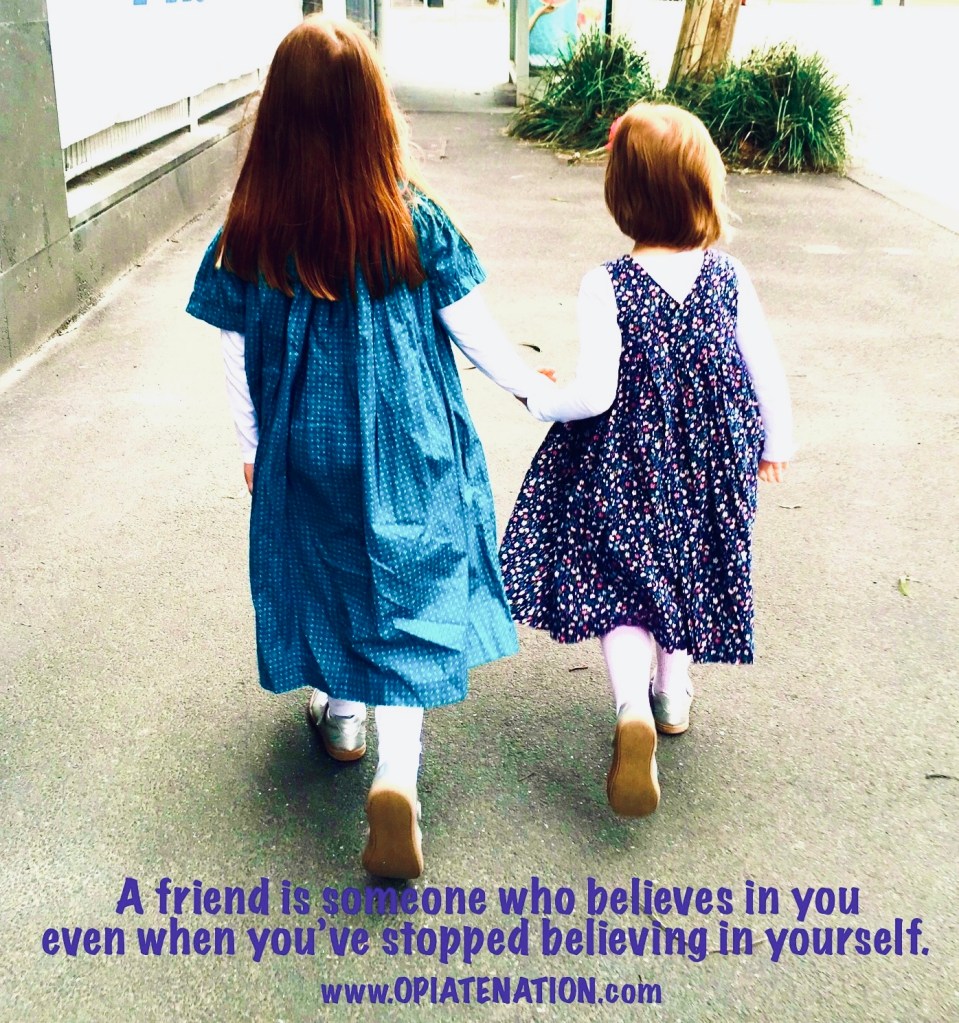
A best friend is someone who believes in you 

even when you’ve stopped believing in yourself.

– Unknown

  1. John 15:13, New Testament 
  2. Helping Someone with a Drug Addiction

https://www.helpguide.org/mental-health/addiction/helping-someone-with-drug-addiction

  • How to help someone who is misusing drugs or alcohol:

https://www.healthdirect.gov.au/help-someone-who-is-misusing-drugs-or-alcohol#:~:text=Celebrate%20small%20successes%20and%20try,Narcotics%20Anonymous%20and%20SMART%20Recovery.

  • Four Signs of Enabling and How to Stop

https://health.clevelandclinic.org/enabling

  • Dr. John F. Kelly, Ph.D. The New Science on Addiction Recovery (lecture)

Dis-Couraged or En-Couraged?

Discouragement is the opposite of having the heart, the courage to face something. It’s when the heart has been sucked out of you. But the en in encouragement means “into”, the process of putting courage into someone. Giving them the heart and hope to go on. 

(Translation into most languages at tab to the right.)

It’s time for a confession. I have not been writing many blogs for Opiate Nation in the past two years – not because I haven’t had time but because I have felt discouraged. Decades into the Opioid Epidemic and all the information and media coverage, the hope that addiction and deaths from drug overdoses would decrease has proven unfounded. It seems that people in general are just tired of hearing about it, especially if it doesn’t particularly concern them. And I have felt that I didn’t have anything helpful to add to the conversation and wondered: what more needs to be said?

But I felt reprimanded in my heart and soul for being one more person who is fatigued by the persistence of a problem that seems to never get better, let alone go away. What about all the people living in active addiction? And what about their friends and family who spend sleepless nights and anxious days worried about them? And what of those who have lost loved ones to addiction and are living in debilitating grief?

I started thinking about discouragement and how to “snap out of it”? For me, there is no snapping out of it on my own. Once I’m dis-couraged, I have found that only being en-couraged changes things. And encouragement usually comes to me through two avenues: a few intimate friends and God, both of whom know me well. The words spoken out loud by friends and the ones directly into my soul by God are what lift my troubled and discouraged heart and bring hope and courage.

Courage comes from Latin cor meaning “heart”. The dis in discouragement means “opposite of”. Discouragement is the opposite of having the heart, the courage to face something. It’s when the heart has been sucked out of you. But the en in encouragement means “into”, the process of putting courage into someone. Giving them the heart and hope to go on. 

Although my life has not been characterized by addiction personally, encouragement has been important in my life, especially after my son died from addiction. How much more important would encouragement be to those struggling with addiction? And for the families and loved ones of those struggling or already lost? And how can we encourage without enabling?

So, I have been reminded of the importance of an encouraging word. Knowing this, how can I offer encouragement in the arena of addiction and Harm Reduction? Although people do recover from addiction and live full lives, there will always be people struggling with addiction and using drugs. When we acknowledge and accept this, we must try our best to help minimize the harm from that use in the ways we can. For me, that has been through writing to offer information, comfort, and encouragement. 

Anne’s Story: Cultural Influences

(Thirty-fourth in a series of topical blogs based on chapter by chapter excerpts from Opiate Nation. Translation into most languages is available to the right.)

This week’s Story of Hope is from a young friend of ours, Anne (not her real name). Here are some excerpts from her story in Opiate Nation (5 min read):

I was eleven years old when I first experienced shooting heroin. Looking back, I can hardly believe it and I am so thankful to be alive, and to be sharing my story.

My boyfriend and I watched the movies Trainspotting and Requiem for a Dream and they really piqued our interest in drugs. The way it was portrayed in those movies made me think using heroin would be an amazing dream sequence, when in actuality, it made me violently ill. My boyfriend insisted we keep trying. He became obsessed with all drugs: ecstasy, LSD, cocaine, and various pills and so I tried them all.

Continue reading “Anne’s Story: Cultural Influences”

Hank’s Story: Drinking Loneliness

(Thirty-third in a series of topical blogs based on chapter by chapter excerpts from Opiate Nation. Translation into most languages is available to the right.)

This week’s Story of Hope is from our son’s friend, Hank (not his real name). Here are some excerpts from his story in Opiate Nation (5 min read):

I grew up in a loving home – the youngest of seven kids in a Catholic family. Although there are no alcoholics in my immediate family, my mother’s side of the family consists of proud Irish New Yorkers where alcoholism runs rampant. I experienced my first drunk at the age of 13.

Continue reading “Hank’s Story: Drinking Loneliness”

The Vortex of Shame

(Twenty-third in a series of topical blogs based on chapter by chapter excerpts from Opiate Nation. Translation into most languages is available to the right.)

For generations, the combination of personal shame and public stigma has produced tremendous obstacles to addressing the problem of alcoholism and drug addiction in America. Addiction stigma prevents too many people from getting the help they need. –Hazelden-Betty Ford Institute for Recovery

Historically, the word shame was used interchangeably with guilt – the appropriate pang of conscience that followed doing something wrong. In reality, there is an important distinction between shame and guilt. Shame is about who you think you are; guilt is about what you have done.

Stigmas are linked to shame. In the Greek and Latin worlds, a stigma was a mark or brand, especially for a slave, identifying them as “inferior.” Later, it became known as a mark or stain we can’t see with our eyes: social stigmas that are based on perceivable characteristics, associated with certain behaviors that distinguish a person from other members of society. They convey disapproval and disgrace.

Continue reading “The Vortex of Shame”

Hopes & Dreams

(Twenty-first in a series of topical blogs based on chapter by chapter excerpts from Opiate Nation. Translation into most languages is available to the right.)

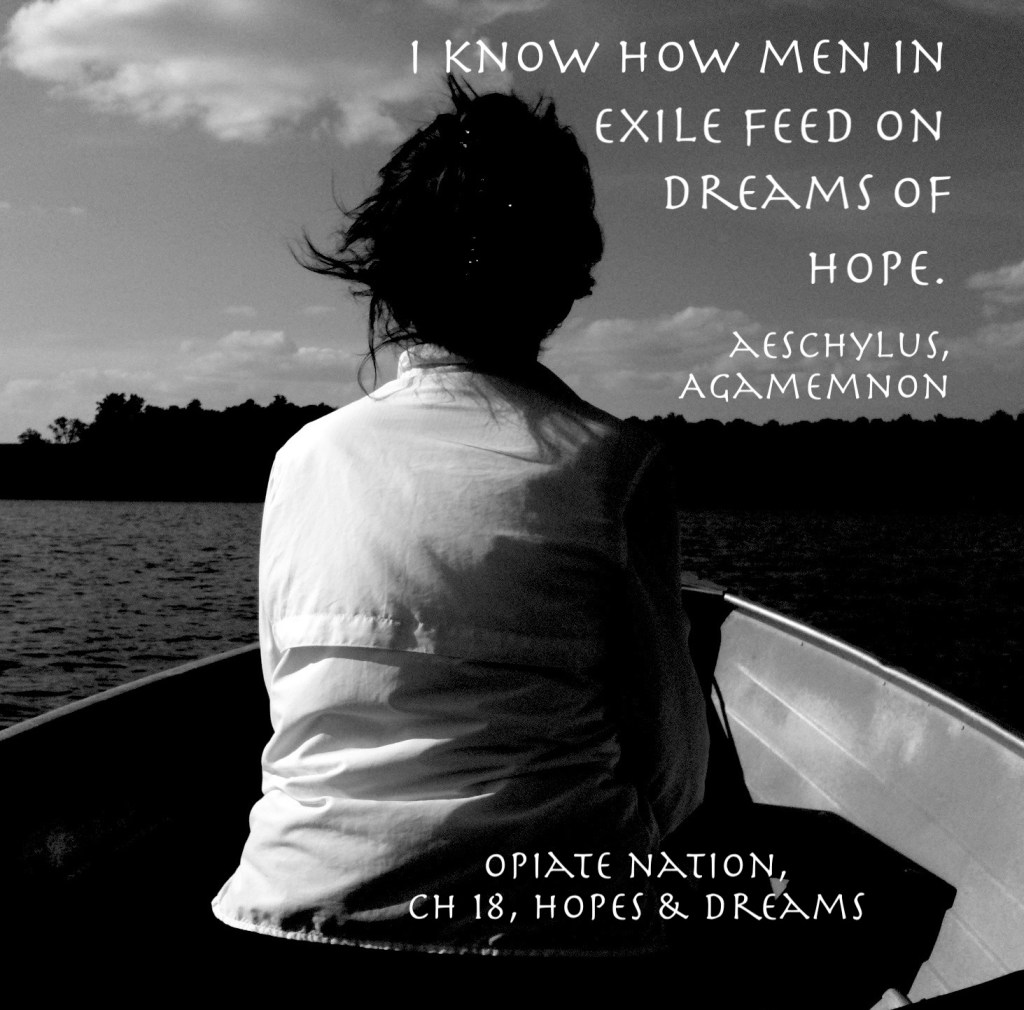
I know how men in exile feed on dreams of hope.

–Aeschylus, Agamemnon

After our son’s death from overdose, John and I truly felt like “men in exile,” forced into separation from our son, banished from each other’s’ lives. We are not just on different continents, but in different worlds, different dimensions. And hope? Any hope would have been just that—a dream, a mirage.

His untimely death took all hope of a sober and content son in this life away. Lost hope is what crushes parents when their child dies a needless death, an ignoble death to many. Had he fought in a war and been killed in action, to society it would have been a noble death. Most people who are separated from the life-and-death battle with addiction can’t see the struggle that this generation of young people are fighting on a moment-by-moment basis against an enemy that is in their brain, in their body—not outside it—one they can’t shoot and kill or put in prison. But we, as parents and friends, see it and wonder how much longer can they fight before they lose?

Continue reading “Hopes & Dreams”

Darkness & Light

Last week, our son would have turned 31. My husband and I still wonder what that would have been like? Would we have enjoyed celebrating as he got married like most of his friends have? Would he be living nearby or in a distant state for a new job? Would he and his wife be planning to start a family and give us grandchildren? These are questions we can only visit in our imaginations, and yes, they bring pain.

On our son’s FB memorial page and our Instagram this week, I posted a photo of the desert after a storm when a rainbow appeared, with this quote: “As in nature, so in life: it takes both clouds and sunshine to make a rainbow.” I have been pondering these apparent paradoxes in nature and in life, especially the concept of darkness & light. While reading A Grace Disguised by Jerry Sittser, I was reminded again of how we felt from the moment we heard the words from the sheriff’s mouth: “I’m sorry to have to tell you, but your son is dead.” Sittser lost his mother, his wife, and his daughter together in a head-on collision by a drunk driver and says, “Sudden and tragic loss leads to terrible darkness.” Yes. Existential darkness.

He describes a dream of seeing the sun setting and running frantically west toward it in order to remain in some vestige of light – but the sun was outpacing him to sink below the horizon. As he looked back over his shoulder, utter darkness and despair was closing in behind him. He later realized that “the quickest way to reach the light of day is to head east, plunging into the darkness, until one comes to the sunrise.”

Continue reading “Darkness & Light”

Celebrating our Dead & Death to Stigma

2019 11 All Souls Procession 5Last weekend, my husband and I were part of the 30th annual All Souls Procession here in Tucson. It is part of the Mexican & Latin American celebration of El Diá de los Muertos (The Day of the Dead – see link below for an article about it). November 1st & 2nd are set aside to gather as a community to show our love and respect for our loved ones who have died. I have heard that Tucson’s celebration is one of the largest in America with about 100,000 people.

While John and & were walking, carrying a large photo poster of our son decorated with marigold-colored trim & lights, a woman in the procession came up to us and asked John, “Who is that?” John responded, “This is our son who died of a heroin overdose at 25.” The woman’s face froze for a few moments as we continued walking, then she looked down and turned to walk away as she said in a low voice with a pained look on her face, “My daughter is an addict.”

We don’t know why this woman was drawn to come up to us and ask that question, Continue reading “Celebrating our Dead & Death to Stigma”

Poetry – for all our needs

In March, I wrote a blog about fentanyl that featured a poem by Carol Bialock: Breathing Under Water. I knew almost nothing about the author other than that she was clearly a deep thinker and an excellent poet. After that post, I was contacted by Fernwood Press, to let me know that for Carol’s upcoming 90th birthday, they were publishing a collection of her poems.

I have since learned more about this remarkable woman who was a sister of the Society of the Sacred Heart in Chile and a lifelong activist for human rights. (To learn more about her, please go to www.CarolBialock.com.) I want to share some highlights from Coral Castles, her newly published book.

I am no poet and I confess, I struggle when reading most poetry – I do better hearing a Continue reading “Poetry – for all our needs”

MYSTERIOUS WAYS

I love mysteries. From the time I began reading on my own, I gravitated toward mysteries: first Nancy Drew, then Agatha Christie, Edgar Allan Poe, Arthur Conan Doyle. My husband and I continue to read and watch mysteries covering topics from historical to crime to espionage. Maybe my penchant for asking “Why?” is at the root of this affinity. The challenge of figuring out a conundrum and the satisfaction when the mystery is finally solved. Continue reading “MYSTERIOUS WAYS”

Malcolm Guite

Blog for poet and singer-songwriter Malcolm Guite

The Gift of Need

How Need Can Strengthen Individuals and Communities

Memoirs and Musings

David Bradley Such

Dave Barnhart

Church planter, pastor, author, coach

RecoveryLife101

Just another WordPress.com site

Abbie In Wondrland

life...on Gods' terms.

Living In Graceland

"..learn the unforced rhythms of grace" matt 11:28

Janaburson's Blog

All about opioid addiction and its treatment with medication

Breaking In News Network

Seeking the truth and bypassing the MSM

Junkbox Diaries

Trauma, PTSD, Mental Health, Addiction, and Recovery

Ohio Society of Addiction Medicine

The Ohio Society of Addiction Medicine is a chapter of ASAM - A professional society actively seeking to define and expand the field of addiction medicine.

traceyh415

Addiction, Recovery, Loss, Grief

WordPress.com News

The latest news on WordPress.com and the WordPress community.